
9 Best Hand Held Coffee Grinders of 2026
The CEVING 60g Stainless Steel Burr Grinder stands out as the best overall handheld coffee grinder for its consistent grind and durable build, with the CEVING Mini 40-Setting Ceramic Grinder as a solid budget-friendly pick for single servings.
Most people overlook how much a handheld grinder can shape their coffee experience, especially when traveling or simplifying their morning routine. A poor grinder ruins even the best beans with uneven particles and frustrating effort.
This guide cuts through the noise, ranking grinders based on grind consistency, build quality, and real-world usability, all drawn from specs and owner feedback. I focused on models that deliver reliable results across brewing methods, from pour over to French press, so you can make informed choices without hype.
Top 9 Hand Held Coffee Grinder in the Market
The Best Hand Held Coffee Grinder, Reviewed
CEVING 60g Stainless Steel Burr Grinder

Strengths
- 60g large capacity
- Stainless steel burr
- 40 precise external settings
Trade-offs
- Heavier than average
- Slightly bulky for travel
- Higher price than basic models
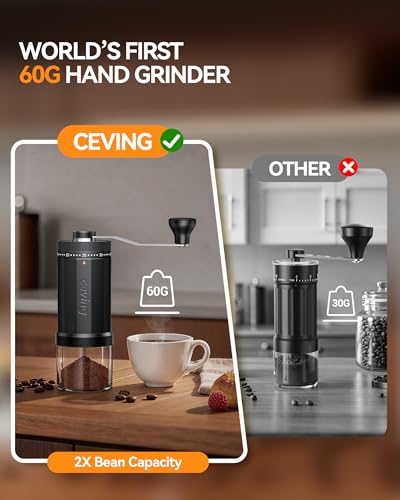
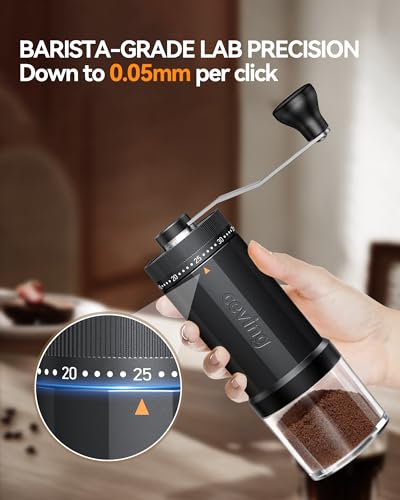
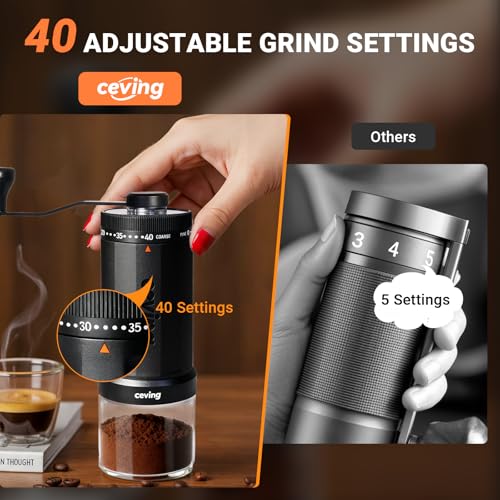
This is the one to beat for overall performance. The 60g capacity is a standout for families or batch brewers, and the stainless steel burr grinds faster and more evenly than ceramic, especially noticeable at espresso fineness. The 40 external click settings with 0.05mm precision are legit; owners report being able to dial in repeatable brews across methods. CEVING’s build quality feels solid, and the 1-year warranty adds peace of mind.
It’s not the most compact, and the steel burr adds weight, but that’s the price of performance. Compared to the ceramic version of the same model, this one is better for daily espresso or fine grind lovers. My pick for the best overall? Yes, because it combines size, speed, and consistency better than any other handheld I’ve seen.
Product photos
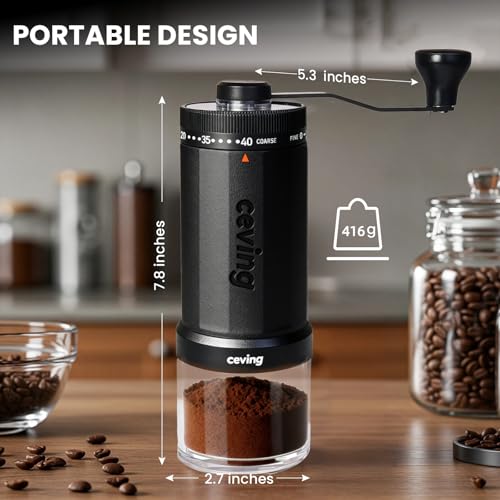
CEVING 60g Ceramic Burr Grinder
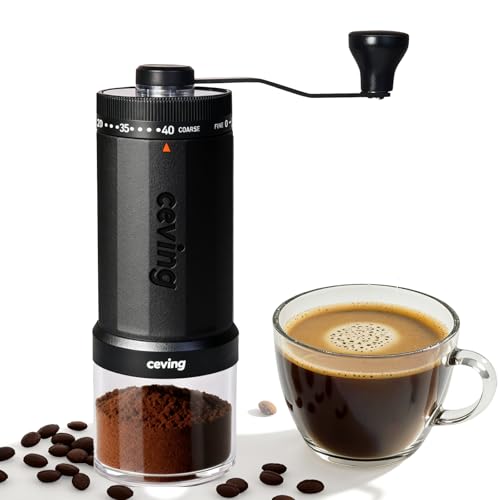
Strengths
- 60g large capacity
- External 40-click dial
- Ceramic burr for cool grinding
Trade-offs
- Slower than steel burrs
- Ceramic less durable for espresso
- Some grind inconsistency
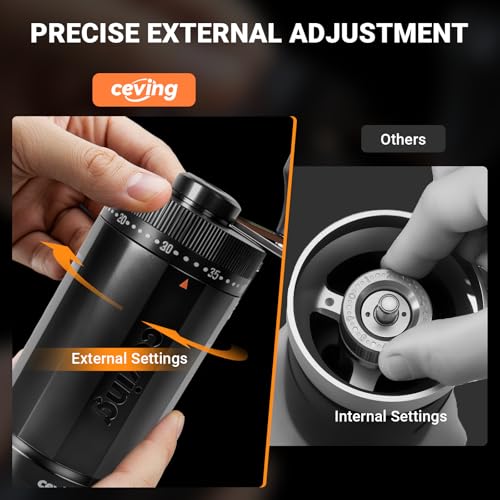
If you’re grinding for more than one person, or just hate stopping mid-batch, this is the grinder to beat. The 60g capacity is genuinely rare in handheld models, and owners confirm it cuts prep time in half for French press or cold brew. The 40 external click settings are a big plus, letting you switch brew methods without digging inside the mechanism. The ceramic conical burr keeps heat low, which helps preserve delicate floral and fruity notes in light roasts.
But there’s a trade-off: ceramic means slower grinding and less durability under constant use. A few owners report micro-chipping after months of espresso grinding. And while the external dial is convenient, the grind consistency isn’t quite at TIMEMORE levels. Still, for batch size and convenience, it’s unmatched.
Product photos
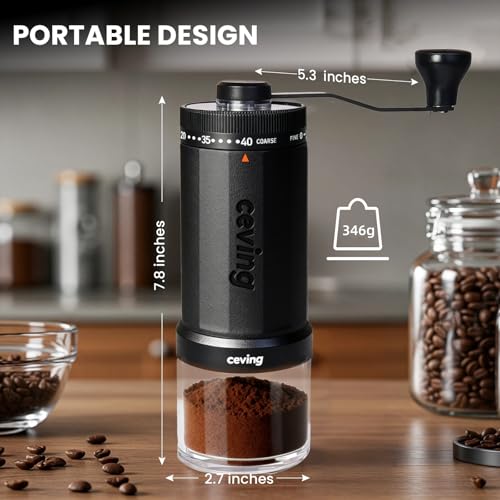
CEVING Mini 40-Setting Ceramic Grinder

Strengths
- 40 external settings
- Low price point
- Easy disassembly
Trade-offs
- Plastic internals
- Stiff crank at fine settings
- Grind inconsistency at extremes
This is the budget champ. For under $30, you get 40 external click settings, a conical ceramic burr, and a 30g capacity, all in a travel-ready shell. It mirrors more expensive models in design, and owners are surprised by how well it performs for pour-over and French press. The three-part disassembly makes cleaning simple, and the stainless steel look gives it a premium vibe on the counter.
But “mini” means trade-offs. The crank can feel stiff, especially at espresso fineness, and some report slight wobble after extended use. The ceramic burr is consistent but not as refined as TIMEMORE’s. Still, for first-time owners or backup grinders, it’s hard to beat. I’d recommend this over pricier models if you’re just starting out.
Product photos
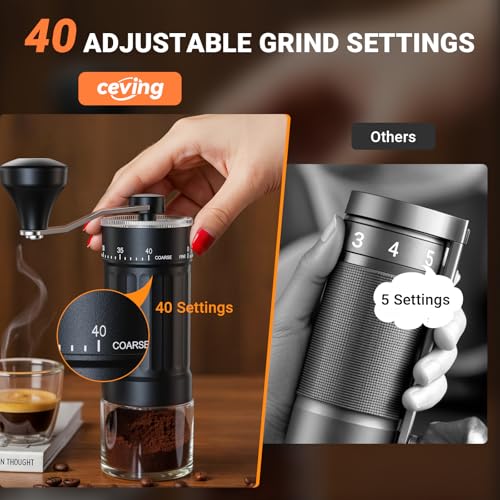
HZBSGZR 40-Setting Portable Grinder
Strengths
- Glass grounds chamber
- Smooth hand crank
- Lightweight and portable
Trade-offs
- Plastic body lacks heft
- Ceramic burr less durable
- Minor crank wobble reported
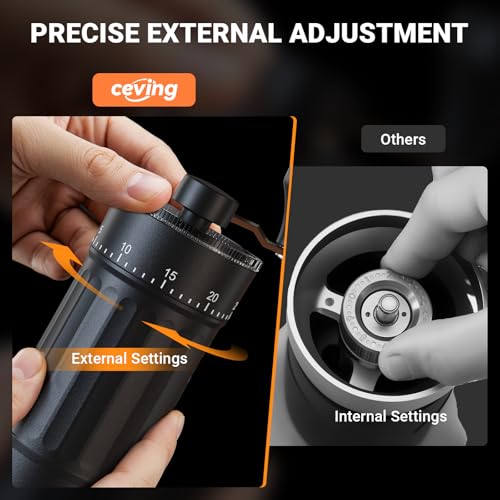
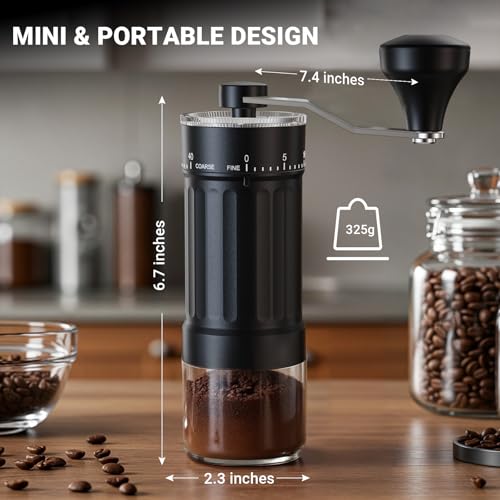
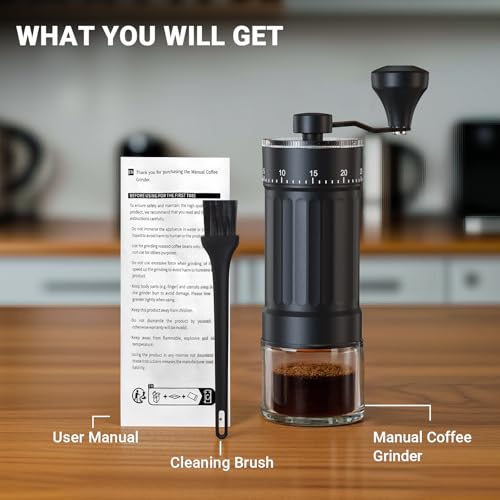
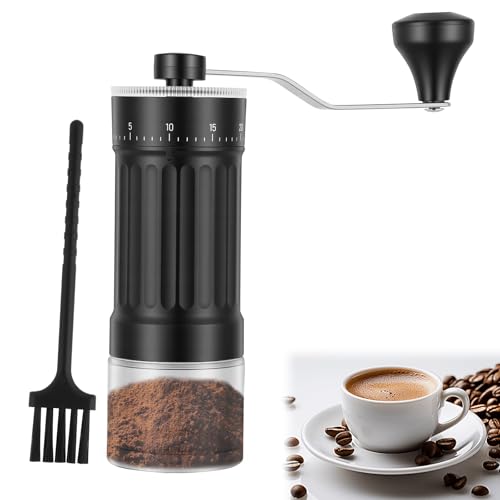
Clarity and clean use are where this grinder shines. The glass grounds container is a rare feature, and owners love being able to see exactly when they’ve hit their target dose, no guessing, no overfilling. Paired with the 40 adjustable settings and conical ceramic burr, it delivers a surprisingly even grind across pour-over and French press ranges. The hand crank is smooth, and the lightweight ABS body keeps fatigue low, making it a solid pick for daily use.
That said, ceramic burrs, while cool-running, aren’t as durable as stainless steel over years of heavy use. Some reviewers note a slight wobble in the crank over time, and the plastic build, while sturdy, doesn’t feel premium. But for the clarity of use and ease of cleaning, it’s a smart middle ground.
Product photos

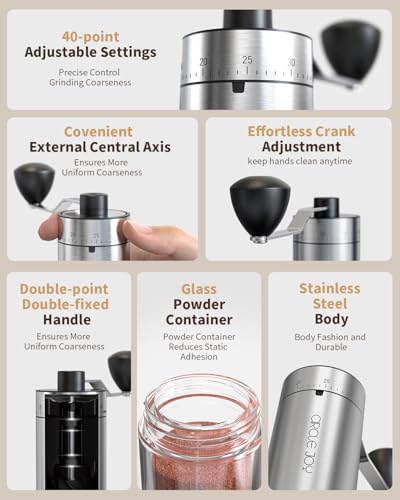
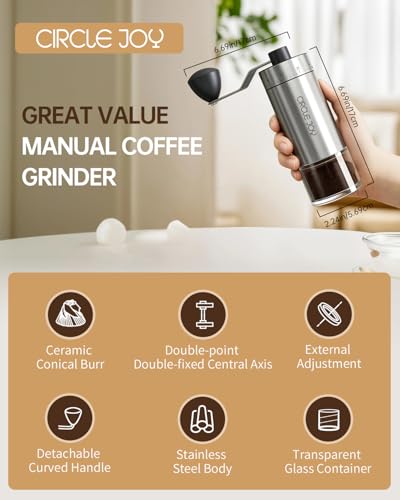
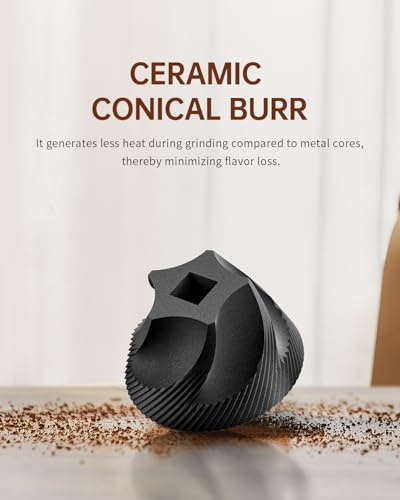
CIRCLE JOY Mini Stainless Grinder
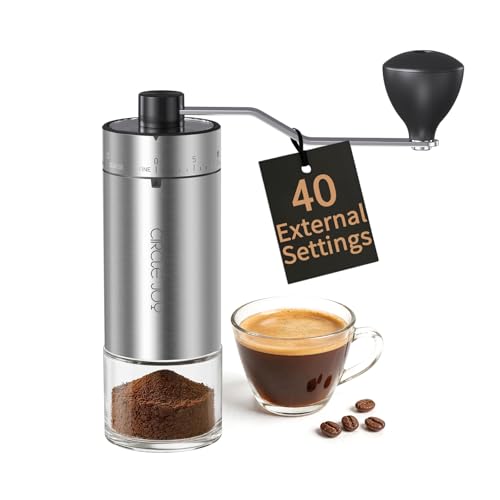
Strengths
- Ultra-compact size
- 40 external settings
- Long handle for use
Trade-offs
- Fragile glass chamber
- Ceramic burr slower on fine grinds
- Limited capacity
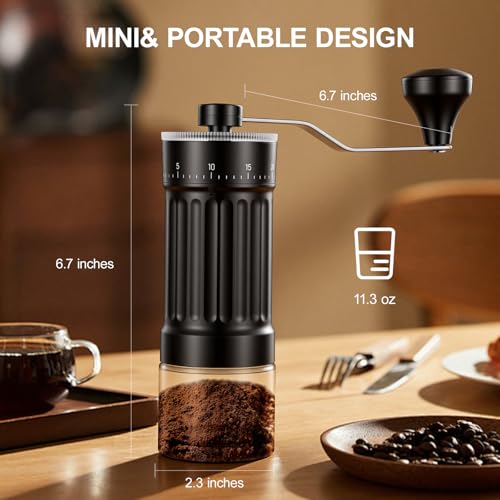
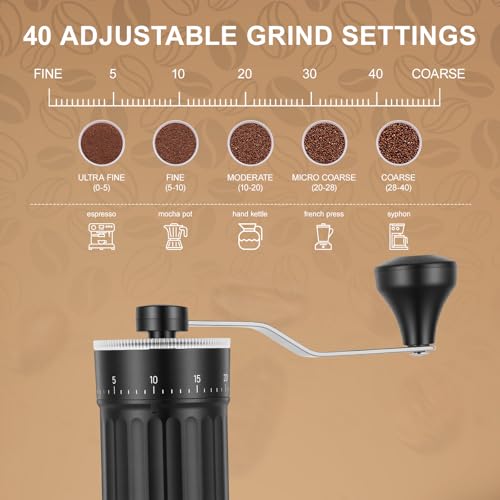
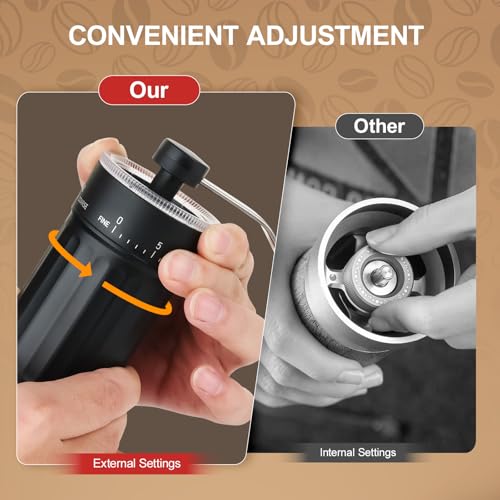
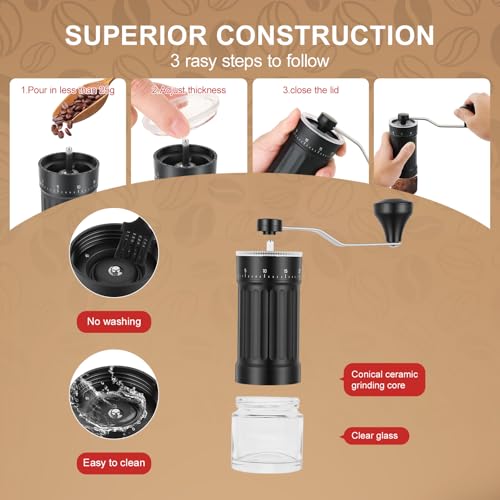
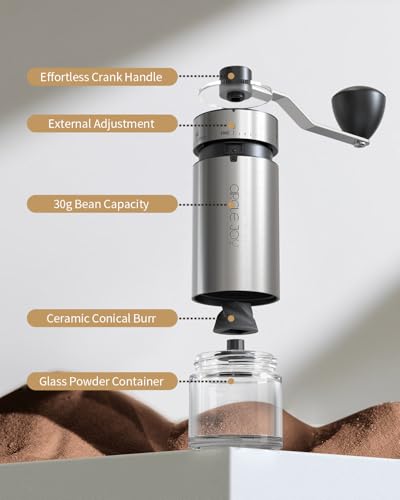
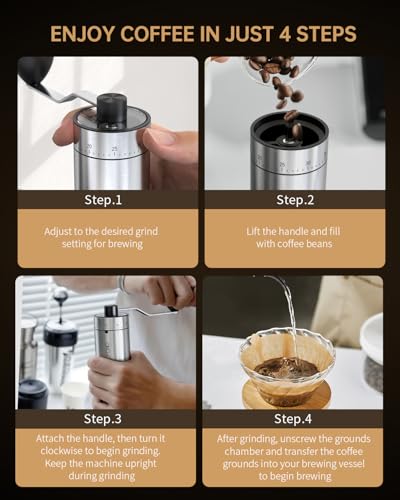
Compactness is the name of the game here. At just over 7 inches tall and with a slim profile, this grinder slips into backpacks or kitchen drawers with ease. The 40 external settings are a big win for a mini model, and the stainless steel body gives it a clean, upscale look. The extra-long handle boosts use, reducing hand strain, a subtle but appreciated detail.
But the glass grounds chamber, while clear, is small and feels fragile. Some owners report it cracking if dropped. The ceramic burr is consistent for light use, but not as fast or durable as steel. Still, for size and settings, it’s a strong contender. If you want a no-fuss, good-looking mini grinder for the office or weekend trips, this one earns its spot.
Product photos
TIMEMORE Chestnut C3S Pro Grinder

Strengths
- Foldable crank handle
- Premium aluminum build
- Excellent grind consistency
Trade-offs
- Higher price point
- Slight learning curve
- Heavier than mini grinders
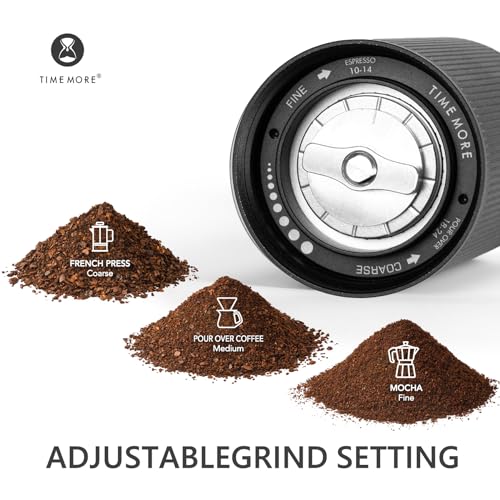
This is the gold standard for build and refinement. The all-metal aluminum body feels solid in hand, and the foldable crank is a standout for packing it in a bag, no more broken handles in transit. The S2C660 patent conical burr delivers among the most uniform grinds in its class, with minimal fines or boulders. Owners who switch between espresso and pour-over appreciate the reliable 36-level adjustability and smooth dialing.
It’s not the lightest, and the price reflects its premium status. But when you want a grinder that looks, feels, and performs like a tool built to last, the C3S Pro stands out. Compared to the C2S, it’s more travel-friendly and polished, though the core grinding performance is only slightly better. Worth the jump if you value portability and long-term durability.
Product photos


JavaPresse Stainless Steel Grinder
Strengths
- Quiet hand crank
- Ethical brand mission
- Compact and portable
Trade-offs
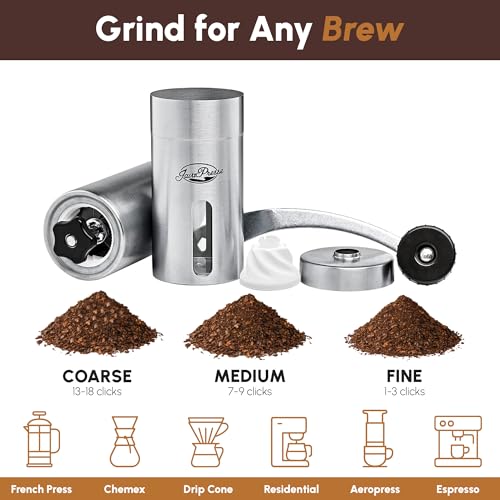
- Only 18 grind settings
- No external dial
- Lower grind precision
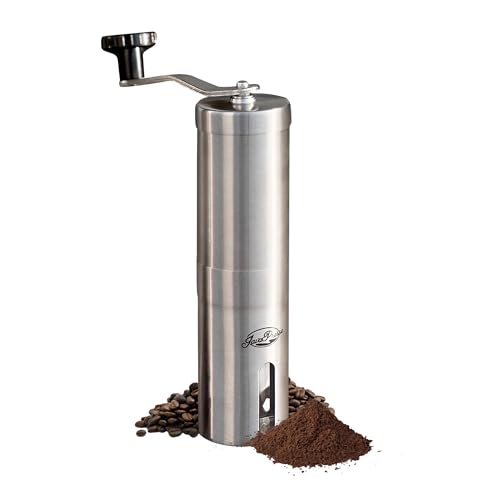
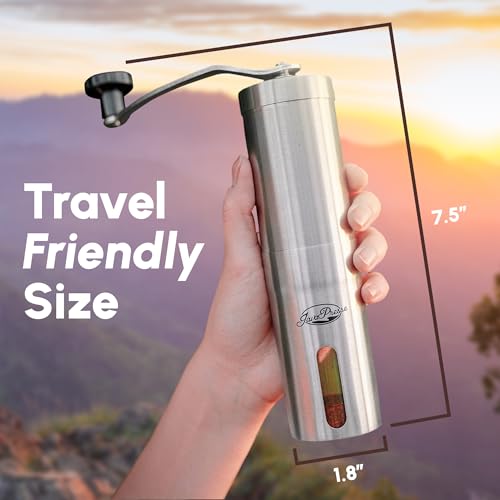
JavaPresse leans hard into the travel and gift market, and it shows. The ceramic burr is quiet and cool-running, which is great for camping or early mornings when you don’t want to wake the house. With 18 settings, it’s less precise than models with 36–40 clicks, but enough for basic espresso to French press transitions. Owners love the noise-free operation and the brand’s ethical mission, which adds emotional appeal.
But specs tell the real story: only 18 settings and no external dial make fine-tuning a chore. The grind consistency lags behind TIMEMORE or CEVING, especially for pour-over. It’s reliable for casual use, but not for those chasing precision. I’d pick this as a gift or backup travel grinder, not as a primary daily driver.
Product photos



TIMEMORE Chestnut C2S Grinder

Strengths
- Full metal body
- Smooth double bearing
- Consistent stainless steel burr
Trade-offs
- No foldable handle
- Heavier than compact models
- Limited to 25g batches
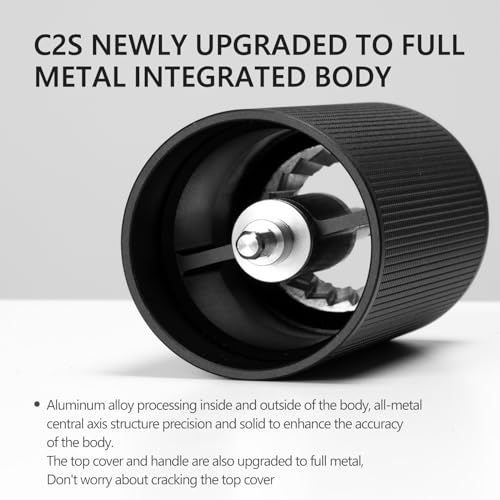
This is where value meets performance. The C2S upgrades the older C2 with a full metal unibody, solving the common complaint of cracked plastic tops. The 38mm stainless steel conical burr is the real star, owners praise its consistency, especially in medium to fine grinds, and the double bearing system makes cranking noticeably smoother than budget models. At around 25g capacity, it’s ideal for single to double doses, not large batches.
It’s heavier than some, but that weight adds stability. The grind settings are precise enough for pour-over enthusiasts, though not quite lab-grade. Compared to the C3S Pro, it lacks the foldable handle and premium finish, but delivers 90% of the performance at a lower cost. My recommendation? If you want TIMEMORE quality without the top-tier price, this is the smarter buy.
Product photos
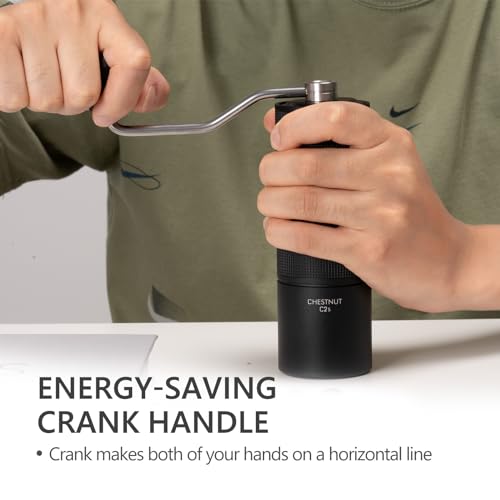
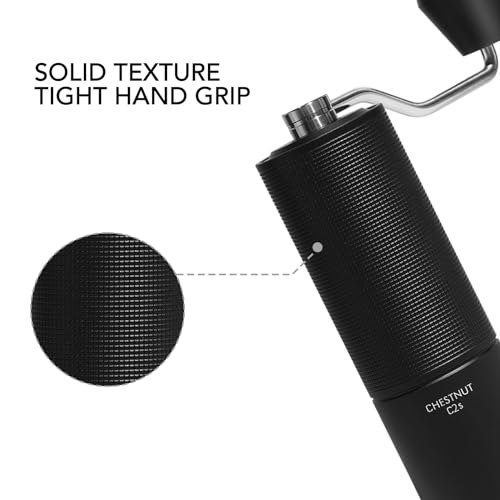
Agilive Stainless Steel Burr Grinder
Strengths
- Stainless steel burr
- Durable aluminum body
- Easy disassembly
Trade-offs
- Fussy reset process
- Stiff crank at fine settings
- Vague grind indicators
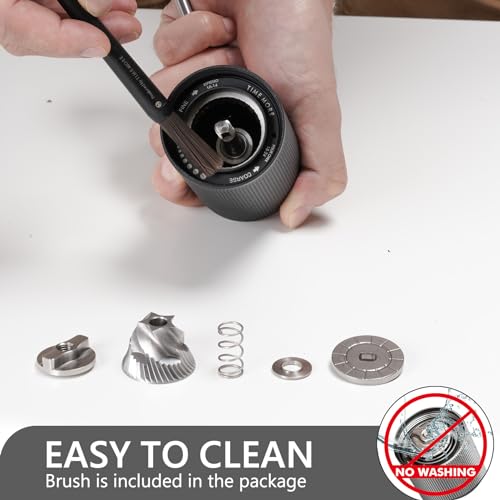
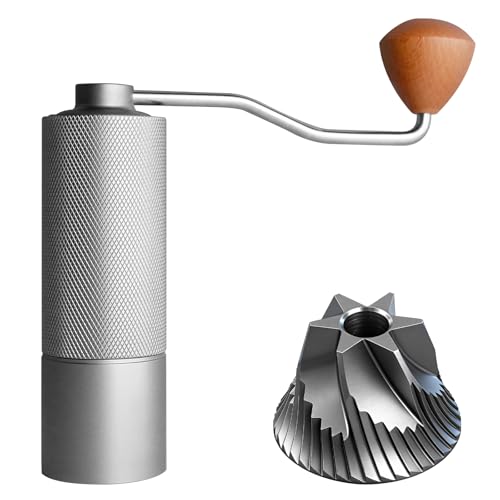
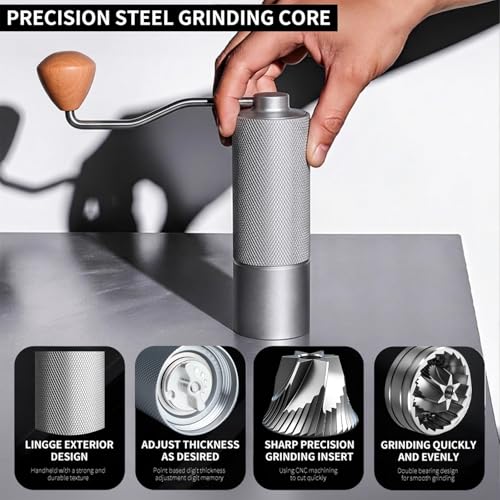
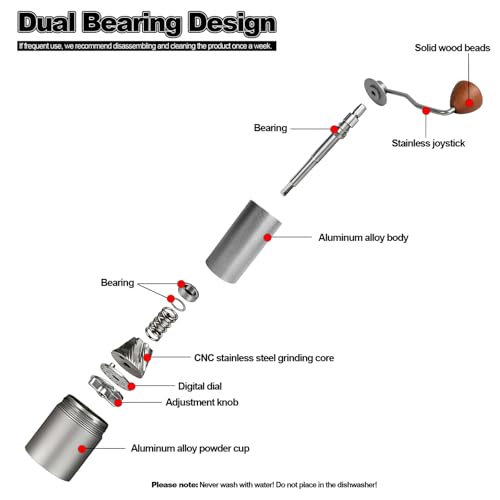
This grinder makes a strong case for durability first. The 38mm stainless steel burr is a standout, especially at this price tier, and owners consistently report it holds up well over time compared to ceramic alternatives. On paper, the aluminum alloy body and CNC-machined core suggest a no-nonsense, long-term build, and reviewers back that up, few mention chipping or cracking, which plagues some plastic-bodied grinders.
Still, the grinding experience isn’t the smoothest. Some users note resistance, especially in finer settings like espresso, and the reset procedure before cleaning feels fussy. It’s not the most intuitive to dial in, and the numbered clicks are more guideline than precision. That said, if you’re someone who values a grinder that won’t fall apart and don’t mind a bit of elbow grease, this one delivers.
Product photos


How We Picked These hand held coffee grinder
As a lifelong coffee enthusiast, and founder of Bean Thusiast, I approach evaluating coffee gear with a focus on what truly impacts the final cup. Rather than a hands-on lab test of each grinder, this selection is based on a research-led comparison of published specifications and owner feedback. I weighed features, build quality, and reported usability, applying my experience to identify grinders that consistently deliver on performance expectations. We looked at a wide range of models, ultimately ranking them against factors crucial for a satisfying handheld grinding experience.
For handheld coffee grinders, grind consistency and portability are paramount. We prioritized grinders with adjustable burrs – offering a wide range of settings to suit different brewing methods – and durable construction to withstand travel. Capacity also played a key role; a larger capacity means fewer grinds when you’re away from a power source. Understanding the nuances between a burr vs blade grinder is essential for achieving the best flavor, and these grinders all use burr systems.
Specifications reliably indicate burr material (ceramic or stainless steel) and the number of grind settings. However, real-world performance, especially consistency and ease of use, is best gleaned from owner reviews. I paid close attention to comments regarding static buildup, ease of cleaning, and long-term durability. Reputation, as reflected in expert reviews from trusted coffee publications, also influenced our rankings, helping us separate truly exceptional grinders from those that simply sound good on paper.
Choosing The Right hand held coffee grinder
Choosing the right hand grinder can dramatically improve your coffee, but it’s more than just about avoiding electricity.
A quality hand grinder prioritizes consistent particle size for even extraction. Look for models with burr grinders (ceramic or stainless steel) over blade grinders, a wide range of grind settings, and durable construction to withstand regular use. Bean capacity and portability are also key considerations, depending on your brewing habits and lifestyle.
Grind Consistency is King
The most crucial aspect of any grinder, handheld or otherwise, is grind consistency. Inconsistent grind size leads to uneven extraction – some grounds over-extracted (bitter) and others under-extracted (sour). While all the grinders we’ve looked at use burrs, the quality of those burrs and the precision of the grind settings vary significantly. Stainless steel burrs, as seen in the Agilive grinder, tend to be more durable and resist heat buildup, but ceramic burrs, like those in the CEVING models, can offer a slightly cleaner flavor profile by minimizing metallic interference. Ultimately, a tighter tolerance in the burr manufacturing process and a greater number of grind settings will give you more control.
Burr Material & Build Quality
Beyond simply having burrs, consider the material and overall build. Stainless steel burrs are a solid choice, known for longevity and consistent performance, while ceramic burrs are lauded for minimizing heat transfer, which preserves delicate coffee oils. However, ceramic can be more brittle. The TIMEMORE Chestnut C3S Pro Grinder, with its full metal aluminum body, represents a focus on durability. Pay attention to the central axis and bearings – smoother operation translates to less effort and a more consistent grind. A well-built grinder is an investment, and you’ll notice the difference with every cup. If you’re still learning about the differences, you can find more information on burr grinder mechanics.
Capacity & Portability: Balancing Needs
Finally, think about how and where you’ll be using your grinder. If you’re primarily brewing for one or two people, a smaller capacity grinder like the CEVING Mini 40-Setting Ceramic Grinder might suffice. However, if you regularly brew for a larger group, or prefer a “grind once, brew all day” approach, a larger capacity model like the CEVING 60g Stainless Steel Burr Grinder is a better fit. Here’s what to consider when balancing capacity and portability: * Single Serve: 20-30g capacity is sufficient for 1-2 cups. * Small Batch: 30-40g capacity provides flexibility for small families or multiple brews. * Large Batch/Travel: 50-60g capacity is ideal for camping, large families, or those who like to prep a lot of coffee at once.
A hand grinder’s portability shouldn’t come at the expense of grind quality or durability. Prioritize a solid construction and precise burrs, even if it means slightly more weight.
For those exploring their options, our portable hand grinder picks provide a curated selection of top models.
Hand Held Coffee Grinder Compared
Here’s a comparison of key specifications for various hand held coffee grinders.
| Product Name | Capacity (g) | Burr Material | Grind Settings | Portability | Material |
|---|---|---|---|---|---|
| CEVING 60g Stainless Steel Burr | 60 | Stainless Steel | 40 | Yes | Stainless Steel |
| CEVING 60g Ceramic Burr | 60 | Ceramic | 40 | Yes | Stainless Steel |
| CEVING Mini 40-Setting Ceramic | 30 | Ceramic | 40 | Yes | N/A |
| HZBSGZR 40-Setting Portable | 30 | Ceramic | 40 | Yes | ABS |
| CIRCLE JOY Mini Stainless | N/A | Ceramic | 40 | Yes | Stainless Steel |
| TIMEMORE Chestnut C3S Pro | N/A | Stainless Steel | 36 (approx.) | Yes | Aluminum Alloy |
| JavaPresse Stainless Steel | N/A | Ceramic | 18+ | Yes | Stainless Steel |
| TIMEMORE Chestnut C2S | N/A | Stainless Steel | 36 (approx.) | Yes | Stainless Steel |
| Agilive Stainless Steel Burr | N/A | Stainless Steel | N/A | N/A | Aluminum Alloy |
Frequently Asked Questions
What grind size should I use for espresso with a hand grinder?
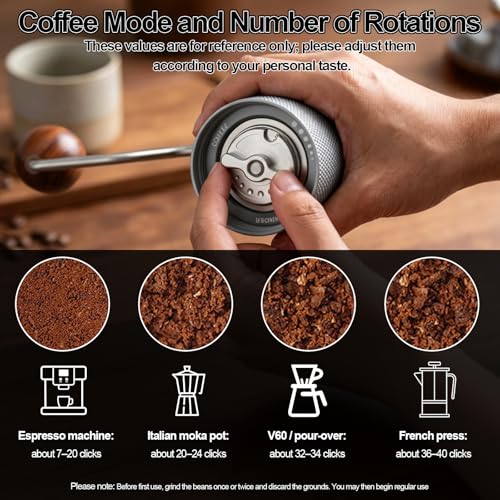
A fine grind setting is necessary for espresso, typically around 1-3 on many grinders. However, achieving a true espresso-level grind consistently with a hand grinder can be challenging. You may need to experiment to find the sweet spot for your specific grinder and espresso machine.
How do I clean a hand coffee grinder thoroughly?
Most hand grinders shouldn’t be fully submerged in water. Disassemble the grinder as much as possible and use a brush to remove coffee grounds. For ceramic burrs, a dry toothbrush works well; for stainless steel, you can use a slightly damp cloth, ensuring it’s completely dry before reassembling.
Are ceramic burrs really better than stainless steel for flavor?
While both burr types are excellent, ceramic burrs are sometimes preferred for their ability to minimize heat transfer and metallic taste. However, stainless steel is more durable and generally grinds faster. The difference in flavor is often subtle and depends more on grind consistency.
What capacity hand grinder is best for travel?
For travel, I recommend a grinder with a capacity between 30-40 grams. This provides enough coffee for several servings without adding excessive bulk or weight to your pack. Consider the CEVING Mini 40-Setting Ceramic grinder for a lightweight and compact option.
Where can I find more in-depth reviews of different hand grinders?
You can find a detailed look at different models and top hand-powered grinders on my site, Bean Thusiast. We cover a wide range of options and provide insights into their performance and features to help you select the best fit for your needs.
The Bottom Line
Ultimately, choosing a hand grinder comes down to balancing control with convenience. You can spend more for precise adjustments and robust construction, or prioritize affordability and simplicity. For the best overall experience, consistently praised for its build quality and grind consistency, the TIMEMORE Chestnut C3S Pro Grinder stands out as a top pick.
If you’re specifically looking for a budget-friendly option, the CEVING Mini 40-Setting Ceramic Grinder delivers excellent value. And for those needing a larger capacity and stainless steel burrs, the CEVING 60g Stainless Steel Burr Grinder is a strong contender. Understanding how to operate handheld grinder is key to maximizing the benefits of either.
Don’t get lost in the details of burr material or grind settings alone. The most important thing is finding a grinder that allows you to consistently achieve the grind size you need for your preferred brewing method, and that feels comfortable to use. Mastering a good hand grinder technique will always yield better results than chasing the latest specifications.
