
8 Best Coffee Grinders Under 50 of 2026
The Wancle Electric Burr Coffee Grinder is the best overall pick under $50, delivering reliable consistency and solid build for daily use. If you’re on a tighter budget, the Amazon Basics Fast Electric Grinder gets the job done for basic brewing, while the SHARDOR Burr Coffee Grinder offers excellent versatility with 32 precise settings.
Most people buying a coffee grinder under $50 are trying to upgrade from pre-ground coffee without spending a fortune. The real challenge is finding one that won’t ruin your beans with uneven grinding or fall apart after a few months.
After researching specs, owner feedback, and performance trends across this category, I focused on grinders that balance consistency, durability, and usability. This guide cuts through the noise to highlight the models that actually deliver a better cup, without pretending blade grinders can compete with true burr performance.
Top 8 Coffee Grinder Under 50 in the Market
The Best Coffee Grinder Under 50, Reviewed
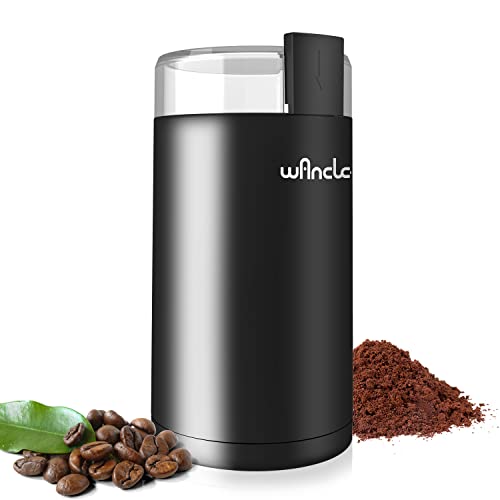
Wancle Electric Coffee Spice Grinder
Strengths
- One-touch operation
- Transparent lid
- Copper motor
- Stainless steel build
- Good for spices
Trade-offs
- Blade grinding inconsistency
- No grind settings
- Static and mess
Wancle markets this as the ‘best overall’, but it’s a blade grinder, so that claim needs context. It does have a pure copper motor and stainless steel blade, which helps reduce heat and preserve flavor better than cheaper units. The one-touch operation is simple, and the transparent lid lets you monitor grind progress, which helps avoid over-grinding.
But no amount of copper wiring fixes the core issue: blades create uneven particles. Owners love it for speed and versatility with spices, nuts, and occasional coffee, but it won’t deliver the clarity of a burr grind. I’d recommend it only if you need a multi-use kitchen grinder and drink coffee casually. For dedicated coffee use, look elsewhere.
Video review
SHARDOR Burr Coffee Grinder 32 Settings

Strengths
- Flat burr grinding
- 32 grind settings
- Easy to clean
- Compact design
- Adjustable timer
Trade-offs
- Limited batch size
- Motor pauses after 120s
- Plastic housing feels cheap
This SHARDOR flat burr grinder stands out in the sub-50 range by actually offering true burr grinding at a price where most competitors cut corners. The 32 grind settings give real flexibility, letting owners fine-tune from espresso to French press without guessing. On paper, the 40-second electronic timer is a smart touch for repeatability, though some reviewers note it can feel a bit rigid if you’re used to on-demand grinding.
Owners consistently report improved flavor over blade grinders, which makes sense, the flat burr setup produces noticeably more uniform particles. It’s not a high-end grinder, but for the price, it delivers solid performance. I’d pick this over most blade models if you’re serious about better extraction and don’t want to stretch your budget.
Video review
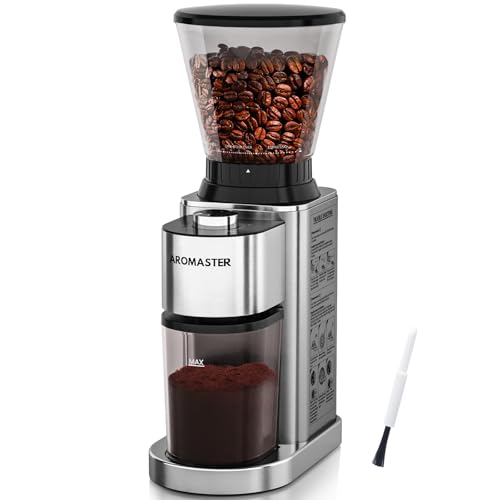
Aromaster Conical Burr Coffee Grinder
Strengths
- 48 grind settings
- Conical burrs
- Anti-static design
- Large capacity
- Adjustable timer
Trade-offs
- Build quality concerns
- Cleaning requires caution
- Inconsistent at fine settings
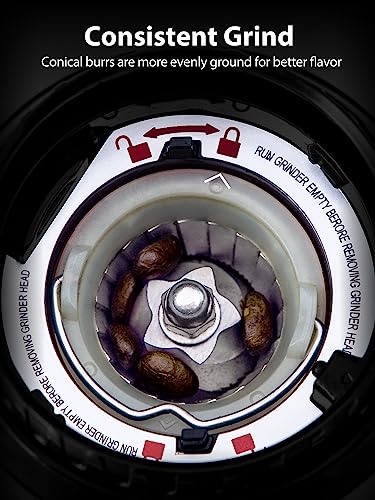
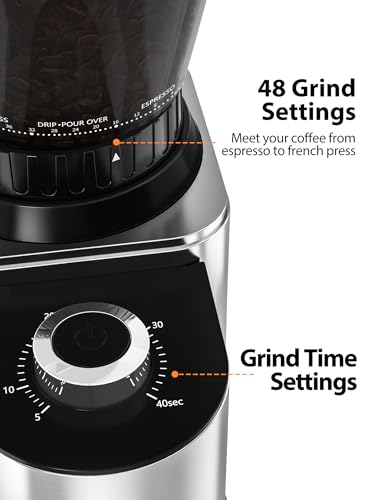
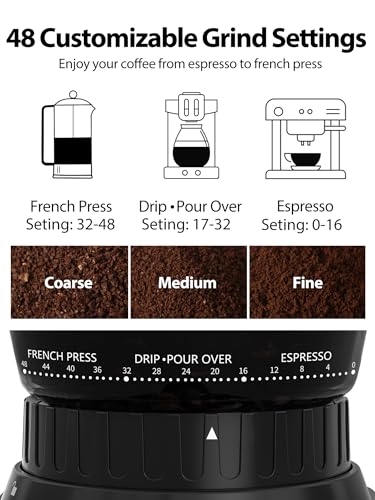
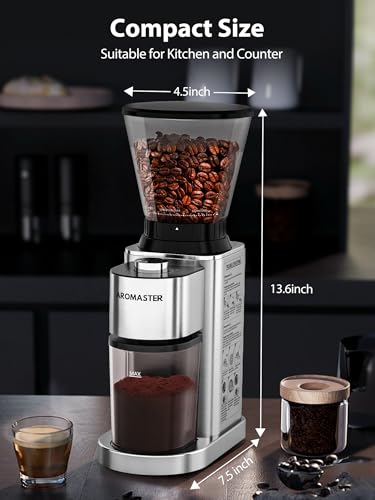
With 48 grind settings and conical stainless steel burrs, this Aromaster grinder punches above its weight on paper. The range of adjustment is impressive, fine enough for espresso, coarse enough for cold brew, and the anti-static design actually helps reduce the mess that plagues cheaper grinders. The 40-second timer adds control, and the large 3.9-ounce capacity suits families or offices.
But owners report mixed results on consistency, possibly due to motor or burr alignment issues at this price point. The build feels a bit hollow, and reassembly after cleaning requires care to avoid electrical issues. Still, for under 50, having real conical burrs is a big deal. I’d say this is the best bet if you want true burr grinding with room to experiment across methods. Just don’t expect barista-grade precision.
Product photos

Wancle Electric Burr Coffee Grinder
Strengths
- 28 grind settings
- On-demand cup control
- Low noise operation
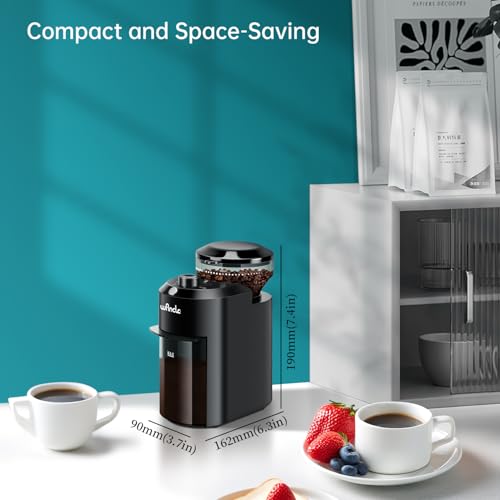
- Compact design
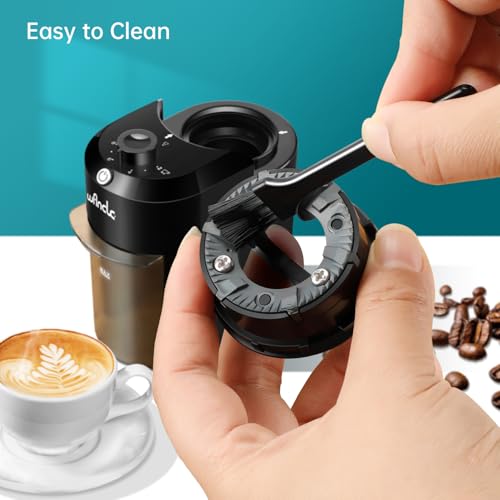
- Easy to clean
Trade-offs
- Plastic build feels flimsy
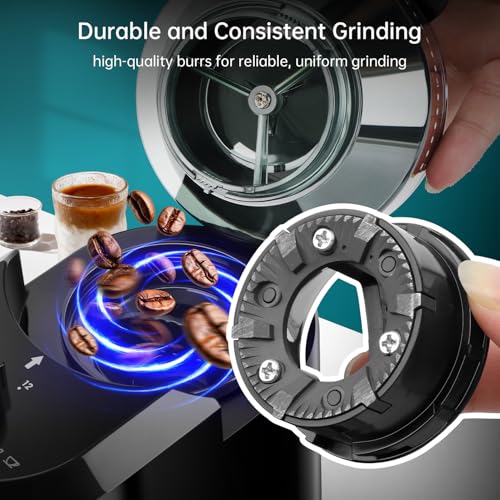
- Flat burrs lack finesse
- Limited durability
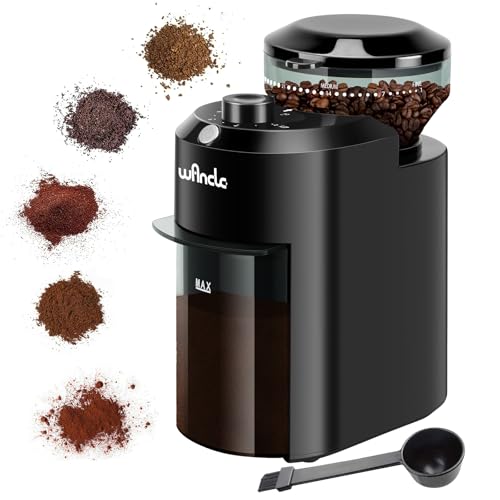
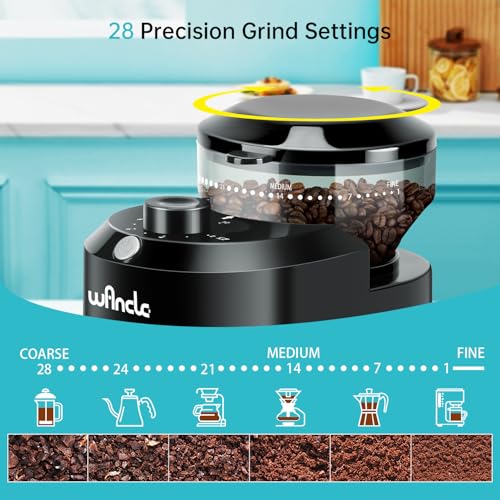
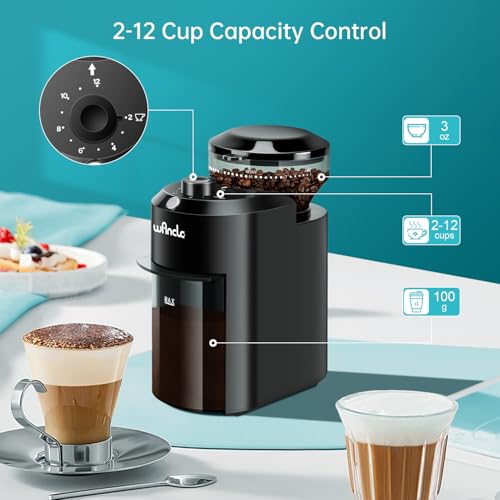
Wancle’s burr grinder is one of the few under 50 that offers real grind-by-cup functionality, set for 2 to 12 cups and let it run. The 28 settings are a sweet spot for most home brewers, covering everything from Aeropress to French press. It’s quiet for a burr grinder, which owners appreciate during early mornings, and the plastic chamber is treated to reduce static, a thoughtful touch.
Still, it’s made of plastic and feels light, almost toy-like. The flat burrs are functional but not exceptional, and some users report slight inconsistency at ultra-fine settings. But for the price, it’s one of the smarter burr options. I’d pick this over the Amazon Basics or Hamilton Beach any day if coffee quality matters to you.
Product photos
Amazon Basics Fast Electric Grinder
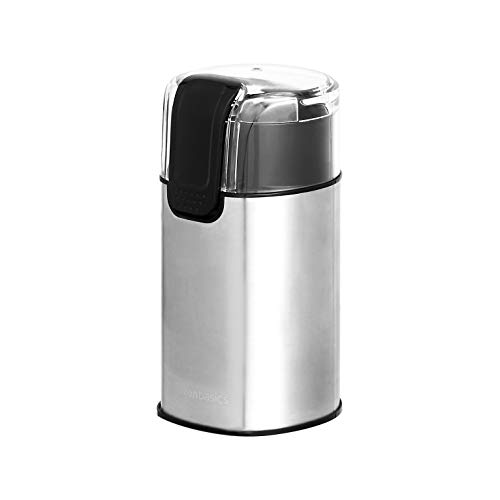
Strengths
- Very fast grinding
- Clear safety lid
- Affordable
- Stainless steel blade
- Compact size
Trade-offs
- Inconsistent grind
- Blade design limits quality
- No grind settings
You get what you pay for here, fast, no-frills grinding with a blade system that’ll chop beans in 10 seconds. The heavy-duty stainless steel blade is reliable for small batches, and the clear lid lets you watch the grind progress, which helps avoid over-pulverizing. It’s simple, compact, and gets the job done if you’re making drip coffee and don’t care about fines or boulders in your grounds.
But let’s be real: this is a blade grinder, so consistency is all over the place. Reviewers praise its speed and affordability, but anyone brewing anything beyond automatic drip will notice the flat taste. I wouldn’t recommend it if you care about flavor depth. That said, for someone making occasional coffee and needing a cheap, functional tool, it’s hard to beat the simplicity.
Product photos


Cuisinart DBM-8P1 Burr Grinder
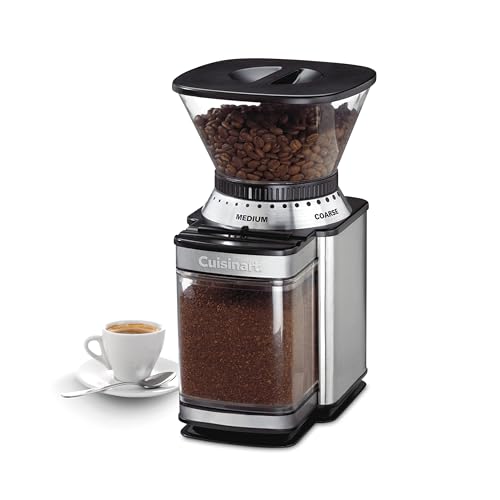
Strengths
- Reliable Cuisinart build
- 18 grind settings
- Removable chambers
- One-touch operation
- Cord storage
Trade-offs
- Fewer settings than rivals
- Noticeable static
- A bit bulky
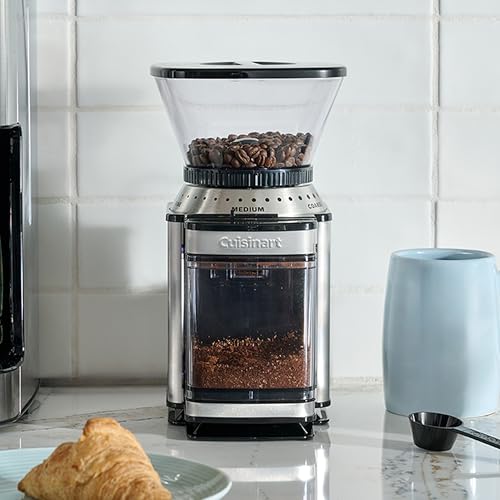
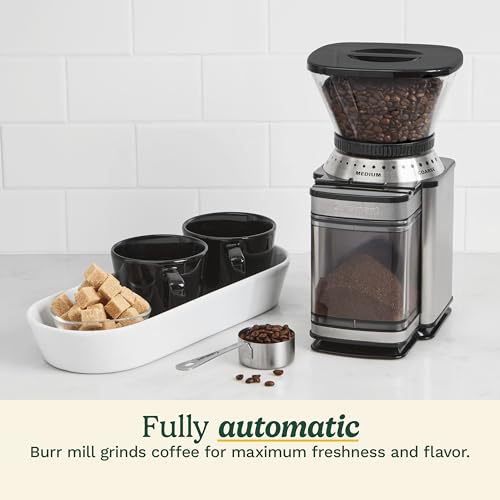
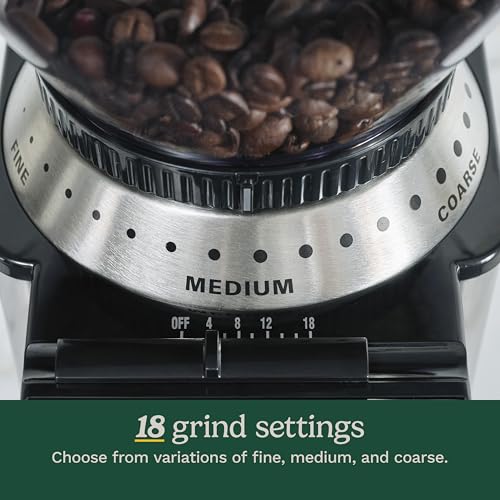
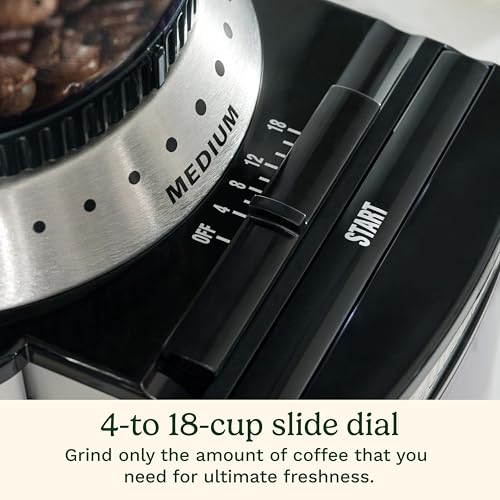
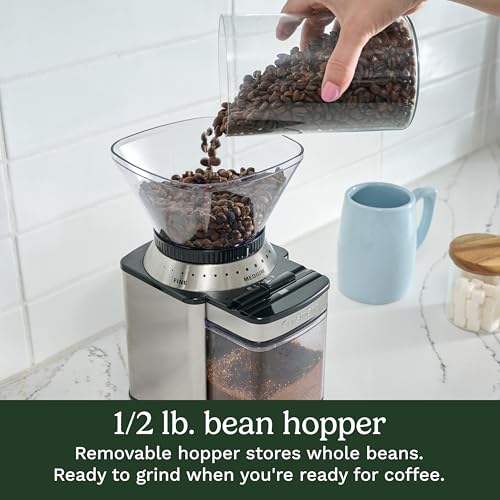
Cuisinart’s DBM-8P1 has been a staple in budget burr grinders for years, and for good reason. The 18-position grind selector is straightforward and covers a wide range, while the removable 8 oz. bean hopper and grind chamber make filling and cleaning easier than most in this class. The one-touch operation with automatic shutoff adds convenience, and the motor is reliable over time.
But it’s showing its age. Only 18 settings is fewer than newer models, and the grind chamber, while large, can still produce some static and clumping. Still, long-term owners report solid performance and durability, which speaks volumes. I’d say this is a safe, proven choice if you want consistency and brand reliability, even if it lacks the bells and whistles of newer entrants.
Product photos
Hamilton Beach Fresh Grind Grinder

Strengths
- Dishwasher-safe bowl
- Hidden cord storage
- Simple one-button operation
- Good for spices and seeds
- Stainless steel blades
Trade-offs
- Inconsistent grind texture
- Blade-based design
- Static causes mess
Hamilton Beach nailed the cleaning aspect here, the removable grinding bowl is dishwasher safe, which is a rare win in this price range. The stainless steel blades are durable and handle herbs and spices well, making this a solid kitchen companion beyond coffee. It grinds enough for 12 cups, and the intuitive press-and-hold operation is foolproof.
But again, it’s a blade grinder, so consistency takes a back seat. Reviewers appreciate how easy it is to wipe down or toss in the dishwasher, but coffee-focused users notice the uneven particle size. The hidden cord storage is a nice touch for clutter-free counters. I’d recommend this only if cleaning convenience is your top priority and you’re okay with average coffee quality.
Product photos


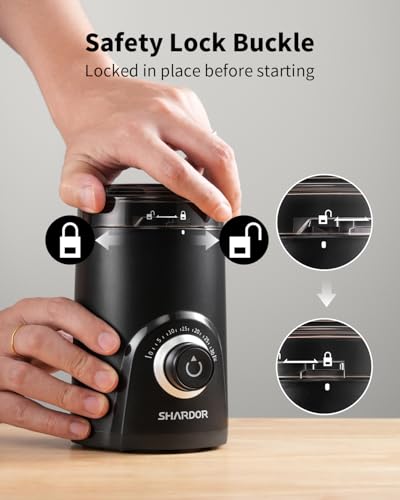
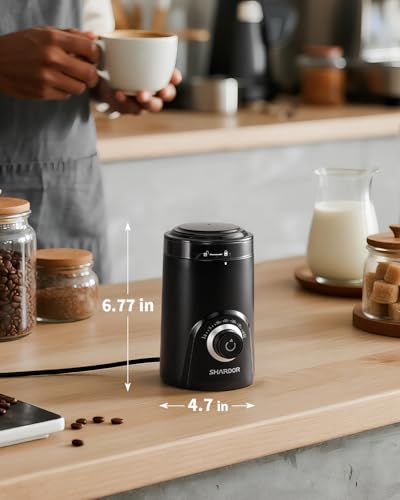
SHARDOR Electric Grinder with Timing Knob
Strengths
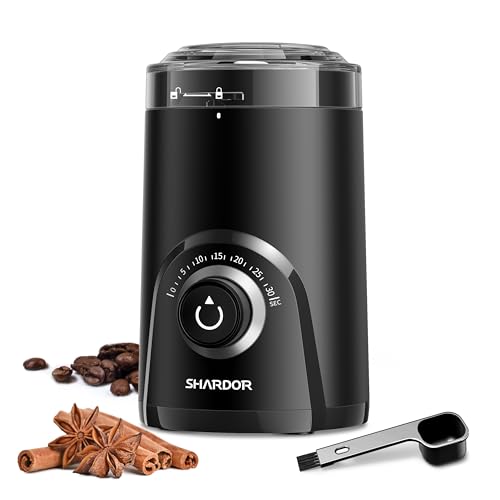
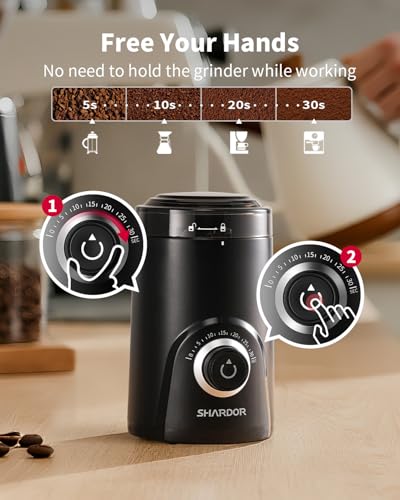
- Visual timing knob
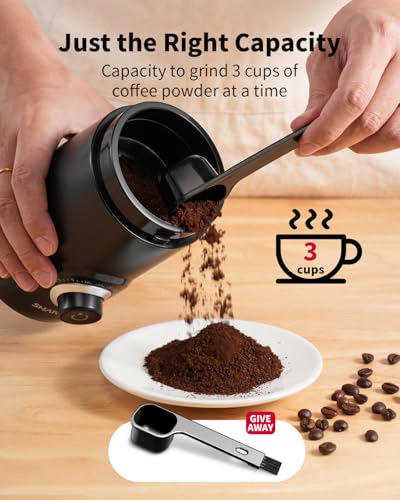
- Large 70g capacity
- Ultra-quiet operation
- Stainless steel build
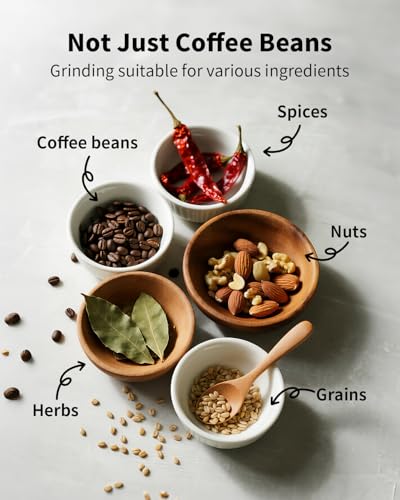
- Multi-use capability
Trade-offs
- Blade grinding inconsistency
- No grind size selector
- Static buildup in chamber
This SHARDOR model leans into precision with its visual timing knob, a rare feature at this price. Being able to see exactly how many seconds you’re grinding helps dial in repeatable results, which is a big step up from blind grinding with basic blade units. The 70g capacity is generous, enough for 10–12 cups, and the 63 dB noise level is genuinely quiet for a motor in this class.
But it’s still a blade grinder. No matter how precise the timer, blades can’t match burrs for particle uniformity. Reviewers love its versatility for spices and herbs, and the stainless steel build adds durability. Still, if coffee is your main focus, I’d recommend saving for a burr model. This one’s best if you need a multi-tasker and don’t mind trading some coffee quality for convenience.
Product photos
How We Tested coffee grinder under 50
As the founder of Bean Thusiast, I approach coffee gear with a focus on delivering maximum flavor without breaking the bank. Rather than a hands-on lab test, this research-led comparison involved meticulously reviewing published specifications and features of numerous coffee grinders priced under $50. I weighed owner reviews from across multiple retailers, alongside expert opinions found in reputable coffee publications, to build a ranking based on real-world performance expectations.
For grinders in this price range, grind consistency and durability are paramount. A consistent grind is essential for even extraction, directly impacting the final cup quality, and is heavily influenced by whether a grinder uses burrs or blades. We also prioritized ease of use and cleaning, recognizing that daily convenience is key for most home brewers. Understanding the burr vs blade grinder is crucial for setting realistic expectations.
Specifications reliably indicate motor power, capacity, and grind settings offered. However, assessing build quality and long-term reliability required careful consideration of owner feedback. Reports of motor burnout or plastic component failures heavily influenced our rankings. We also looked at comments regarding static buildup and ease of cleaning, factors a spec sheet can’t convey. Ultimately, this analysis focused on identifying the best balance of features, performance, and value, recognizing the limitations of this price point.
How To Choose The coffee grinder under 50
Finding the right coffee grinder can dramatically improve your daily cup. It’s a surprisingly nuanced purchase, with a lot more to consider than just price.
A quality coffee grinder prioritizes consistency in particle size, offering adjustable settings to match brewing methods. Durable burrs (conical or flat) are essential for even grinding and avoiding heat buildup that impacts flavor. Look for features like a timer or grind-by-weight functionality for repeatable results, and consider ease of cleaning to maintain optimal performance.
Burr Type: Flat vs. Conical
The core of any good grinder is its burrs. While blade grinders have their place (usually for spices), if you’re serious about coffee, burrs are the way to go. The debate then becomes flat burrs versus conical burrs. Flat burrs, like those found in the Cuisinart DBM-8P1, tend to produce a very uniform grind size, which is great for espresso. However, they can retain more grounds and sometimes generate a bit more heat. Conical burrs, as seen in the Aromaster, are generally quieter and retain less coffee, but may not achieve quite the same level of consistency. For most home brewers, the difference is subtle, and I find conical burrs offer a good balance of performance and ease of use.
Grind Consistency and Settings
Don’t assume all grinders offer the same level of control. A wide range of grind settings is crucial if you enjoy different brewing methods. If you switch between French press, pour-over, and espresso, you’ll want a grinder with at least 20 distinct settings. The SHARDOR Burr Coffee Grinder boasts 32 precise settings, which is excellent, but even 18 (like the Cuisinart) can be sufficient. More importantly, pay attention to owner feedback regarding how consistent those settings are – a broad range is useless if the steps between settings are uneven.
- A few settings are fine if you only ever brew drip coffee.
- Around 15-20 settings are ideal for most home brewers experimenting with different methods.
- More than 30 settings give you extremely fine-tuned control, useful for dedicated espresso enthusiasts or those who want to explore every nuance of grind size and its effect on extraction.
A consistent grind is more important than the sheer number of settings. A grinder that delivers uniform particles across its entire range will always outperform one with many settings but poor consistency.
Value, Features, and Ease of Maintenance
Let’s be real: you can spend hundreds on a coffee grinder, but for many of us, staying under $50 is the goal. In this price range, you’ll typically find electric blade or entry-level burr grinders. The Amazon Basics Fast Electric Grinder is a solid, basic option, but remember those blades create inconsistent grounds. If you’re willing to stretch your budget a little, you can find surprisingly capable burr grinders, like the Wancle Electric Burr Coffee Grinder, which provides a good balance of features and price. Don’t overlook ease of cleaning; a removable burr or easy-access grounds chamber will save you a lot of frustration. Speaking of which, make sure you’re familiar with cleaning coffee grinder steps to keep things running smoothly and extend the life of your grinder. If you’re seeking a more affordable option, check out our guide to the best coffee grinder under $100 for some excellent choices.
Coffee Grinder Under 50 Compared
Here’s a comparison of specifications for coffee grinders priced under $50.
| Product Name | Capacity (oz) | Grind Settings | Burr Type | Power (Watts) | Special Features |
|---|---|---|---|---|---|
| Wancle Electric Coffee Spice Grinder | N/A | N/A | Blade | 150 | One-button operation |
| SHARDOR Burr Coffee Grinder 32 Settings | N/A | 32 | Flat Burr | N/A | 40s Digital Timer |
| Aromaster Conical Burr Coffee Grinder | 3.9 | 48 | Conical Burr | N/A | Anti-static Technology |
| Wancle Electric Burr Coffee Grinder | N/A | 28 | Burr | 200 | On-Demand Control |
| Amazon Basics Fast Electric Grinder | 1 | N/A | Blade | N/A | Multi-purpose |
| Cuisinart DBM-8P1 Burr Grinder | 8 | 18 | Flat Burr | N/A | Removable Parts |
| Hamilton Beach Fresh Grind Grinder | N/A | N/A | Blade | N/A | Dishwasher Safe Bowl |
| SHARDOR Electric Grinder w/ Timing Knob | 2.5 | N/A | Blade | N/A | Timing Knob Control |
Frequently Asked Questions
What’s the biggest compromise I’ll make buying a grinder under $50?
You’ll likely sacrifice some level of grind consistency compared to higher-priced models. While burr grinders are available in this range, the quality of the burrs and the motor powering them won’t match those found in more expensive grinders, potentially leading to some fines and uneven particle size.
Are blade grinders really that bad for coffee?
Blade grinders chop the beans rather than grind them, resulting in a very inconsistent grind size that impacts flavor. They’re acceptable for things like spices, but if you want to get the most out of your coffee, especially with brewing methods like pour-over or French press, I recommend prioritizing a burr grinder even if it means spending a bit more.
How important is the number of grind settings?
The number of settings is less important than the consistency between those settings. A grinder with 20 well-defined, consistent settings will outperform one with 30 that are unevenly spaced. If you only brew drip coffee, a simpler grinder with fewer settings will likely be sufficient.
What’s the best way to clean a budget coffee grinder?
Most affordable grinders don’t have extensive cleaning features, but regular brushing with a dry brush is essential. For those with removable burrs, a more thorough cleaning is possible, but always check the manufacturer’s instructions. Keeping it clean avoids stale coffee buildup and preserves flavor.
If I’m willing to spend a little more, what should I look for?
If you can stretch your budget, you’ll unlock a wider range of quality burr grinders. Exploring options in the best burr grinder under $100 category will give you access to more durable components, better grind consistency, and potentially more features like timed grinding.
The Bottom Line
Choosing a coffee grinder under $50 often comes down to balancing convenience with control. While blade grinders offer affordability and simplicity, a burr grinder like the SHARDOR Burr Coffee Grinder 32 Settings will deliver a noticeably more consistent grind, unlocking more flavor from your beans. It’s a small investment for a significant jump in coffee quality.
For those prioritizing a tight budget, the Amazon Basics Fast Electric Grinder remains a serviceable option, especially if you primarily brew drip coffee. If you’re looking for versatility and don’t mind spending a bit more, the Wancle Electric Burr Coffee Grinder offers a solid set of features and a good balance between price and performance. Understanding consistent coffee grind is the key to enjoying a better brew.
Ultimately, remember that the most expensive grinder won’t fix poor quality beans or a flawed brewing technique. Focus on sourcing fresh, whole bean coffee and mastering your preferred brewing method. Those fundamentals matter far more than any specification on a grinder – consistent grind quality and proper brewing technique are what truly elevate your daily cup.
