
8 Best Coffee Grinders for Espresso 2026
The SHARDOR Conical Burr Espresso Grinder stands out as the best overall pick for its consistent grind and portafilter holder, while the KIDISLE Conical Burr Coffee Grinder offers solid performance at a lower price point. For those wanting versatility beyond espresso, the Cuisinart DBM-8P1 Burr Grinder covers a wide range of brew methods.
Getting great espresso starts with a grinder that can deliver a precise, uniform grind every time. Too coarse and your shot runs fast and sour; too fine and it stalls out, turning bitter. Most home brewers struggle to find that sweet spot without the right tool.
In this guide, I break down the top grinders based on specs, owner feedback, and what matters most for espresso, grind consistency, adjustment control, and build quality. These picks balance performance, price, and practicality for real home use.
Top 8 Coffee Grinder For Espresso in the Market
The Best Coffee Grinder For Espresso, Reviewed
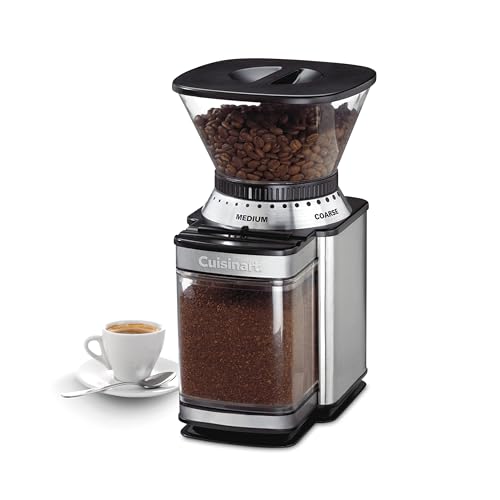
Cuisinart DBM-8P1 Burr Grinder
Strengths
- Flat burr system
- Large grind chamber
- Easy one-touch operation
Trade-offs
- Limited for espresso
- No anti-static tech
- Flat burrs less consistent
This Cuisinart model leans hard into the practical side of grinding, big batches, simple operation, and a flat burr system that, on paper, promises consistency. With an 18-setting grind selector and a chamber that holds enough for up to 18 cups, it’s clearly built for households or offices where multiple pots are routine. But here’s the catch: flat burrs, while durable, don’t typically deliver the same level of uniformity as conical ones, especially when you’re pushing into fine espresso territory. Owners consistently report acceptable results for drip or pour-over, but espresso shots tend to be hit or miss.
The one-touch operation and automatic shutoff are convenient, and the removable parts make cleaning less of a chore. Still, the lack of micro-adjustments and the dated design put it behind more modern options. If you’re grinding for a French press crowd every morning and don’t care about espresso precision, it’s functional. But for anyone serious about extraction, this isn’t the tool.
Video review
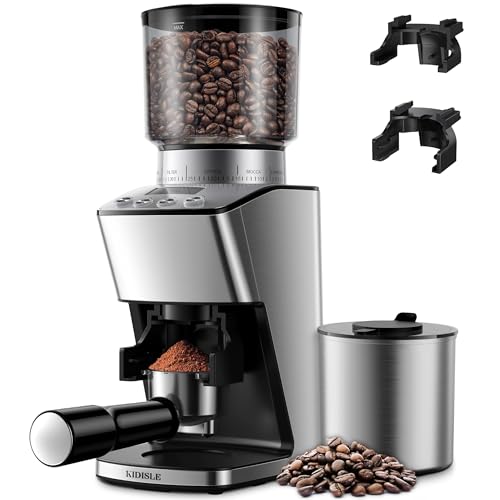
KIDISLE Conical Burr Coffee Grinder
Strengths
- 51 grind settings
- Anti-static design
- Conical stainless steel burr
Trade-offs
- Plastic housing
- No portafilter holder
- Timer less precise than top models
For the price, the KIDISLE packs a surprising number of high-end features into a budget-friendly frame. The 51 grind settings alone put it ahead of many mid-range grinders, and the conical burr design means it can actually deliver the kind of even particle size that espresso demands. Reviewers note the anti-static tech works well, fewer clumps, cleaner pours, and the 12.5-ounce hopper is generous for a grinder at this level. It’s not stainless steel through and through, but the build feels solid for daily use.
Where it really shines is flexibility. Whether you’re pulling a double shot or brewing cold brew, the range is there. The timer function adds dose control without requiring a scale, which is a win for simplicity. It won’t match the OXO or high-end Baratza models in longevity, but for someone stepping up from a blade grinder or a basic flat burr, this is a smart leap forward.
Video review
SHARDOR Super Silent Blade Grinder

Strengths
- Very quiet operation
- Multi-purpose use
- Easy to clean
Trade-offs
- Blade grinding (uneven)
- Not for espresso
- No grind settings
Let’s be clear: this is a blade grinder, not a burr grinder, no matter how quiet or convenient it claims to be. The 63 dB operation is genuinely impressive, perfect for early mornings when you don’t want to wake the house. And the removable bowl and multi-function use for spices or herbs add real utility. But when it comes to espresso, blade grinders are a non-starter. They chop, not grind, leading to uneven particle sizes that sabotage extraction and leave you with sour or bitter shots.
Owners who use this for drip or French press say it’s fine for casual use, especially given the low price point. But if you’re serious about coffee, especially espresso, this tool simply can’t deliver the consistency needed. It’s a convenience appliance, not a precision instrument.
Product photos


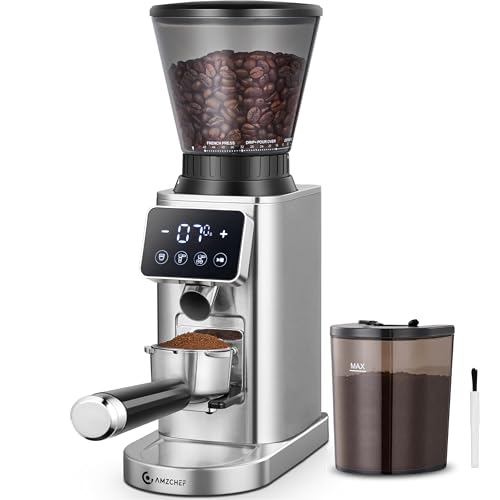
AMZCHEF Coffee Grinder with Portafilter Holder
Strengths
- Portafilter holder included
- 48 precise settings
- Low-speed conical burr
Trade-offs
- Some grind retention
- Plastic build
- Digital display can be fussy
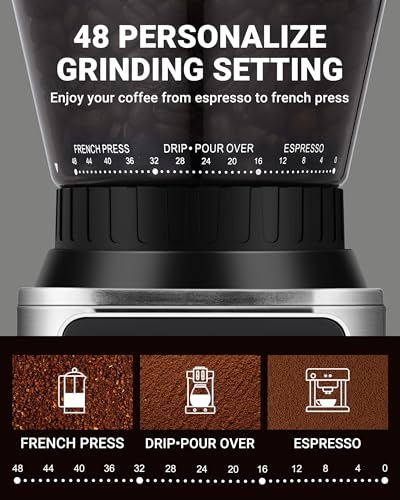
This grinder feels like it was designed by someone who actually pulls espresso shots. The included portafilter holder, light-blocking grounds container, and 0.5-second timer increments show attention to detail that most budget grinders skip. With 48 settings and a 40mm conical burr spinning at a cool 450 RPM, it’s built to reduce heat and static, two enemies of clean espresso extraction. On paper, it’s one of the most espresso-focused grinders in this range.
Reviewers confirm it delivers a surprisingly consistent fine grind, though some note minor retention issues. The digital interface is clean and functional, and the anti-static design helps keep your counter tidy. It’s not as refined as the OXO, but for espresso purists who want control without spending top dollar, this hits a sweet spot.
Product photos


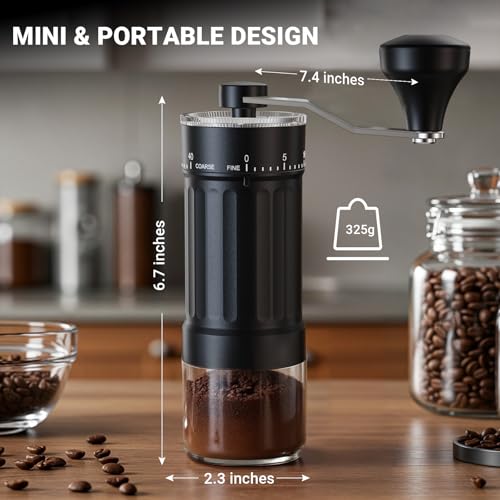
Mini Manual Coffee Grinder

Strengths
- Ultra-portable design
- External grind adjustment
- Ceramic conical burr
Trade-offs
- Small capacity
- Manual effort required
- Not for daily high-volume use
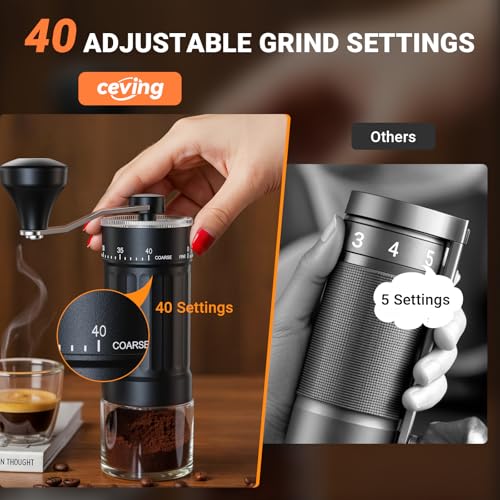
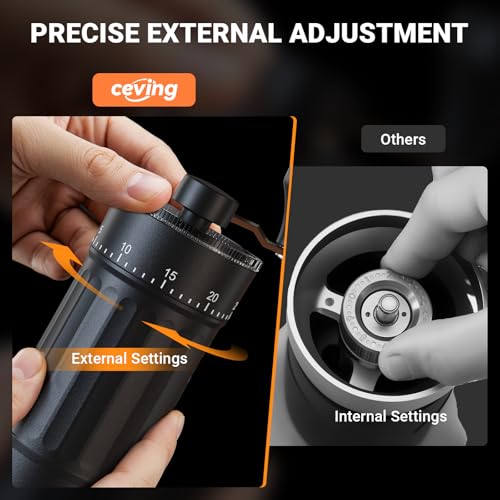
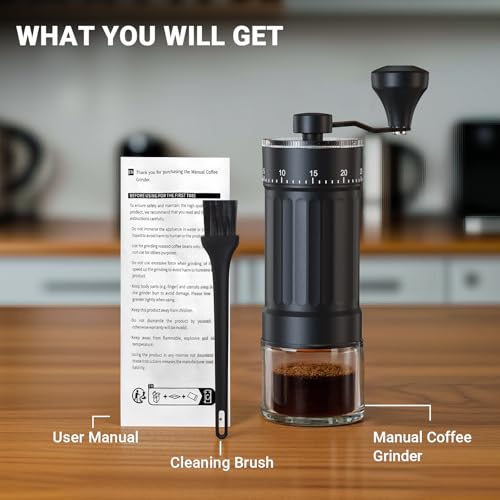
This little manual grinder is a joy for travelers and minimalists. The 40 external grind settings are a standout, no more opening the grinder to tweak the burr alignment. The ceramic conical burr delivers a surprisingly even grind for its size, and the 30g capacity is enough for one or two cups, which is perfect for solo travelers or office use. It’s not going to replace your home electric grinder, but it keeps fresh coffee accessible wherever you are.
The lightweight design and compact form make it ideal for backpacks or small spaces. Owners love it for camping trips and hotel rooms. But let’s be honest: grinding by hand for a double espresso takes effort, and the small hopper means refills for larger batches. Still, for the niche it serves, it’s excellent.
Product photos
OXO Brew Conical Burr Grinder
Strengths
- Stainless steel conical burrs
- Micro-adjustments
- Award-winning consistency
Trade-offs
- Higher price point
- Fewer grind settings than some
- No built-in scale
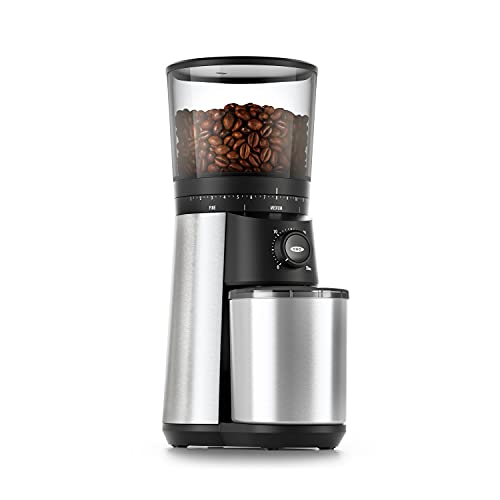
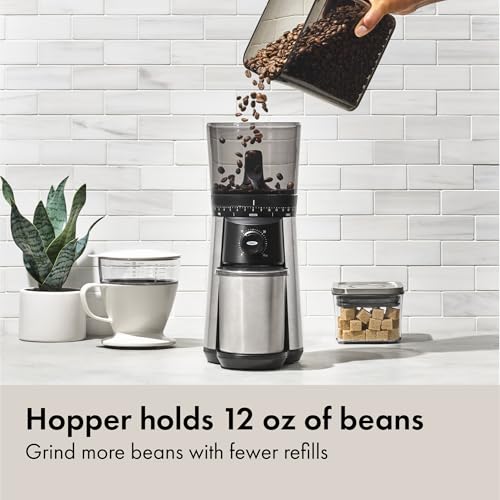
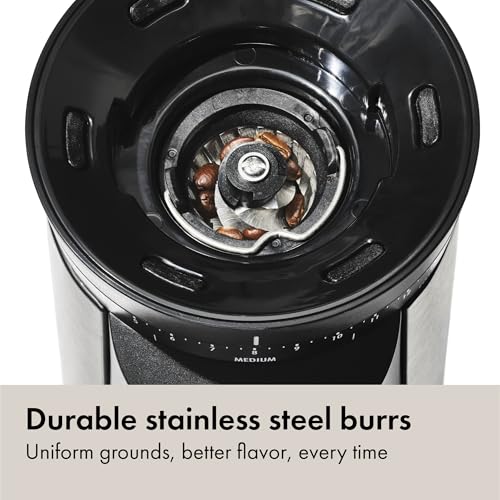
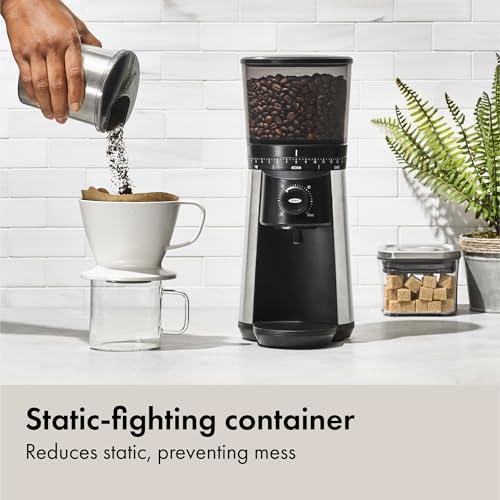
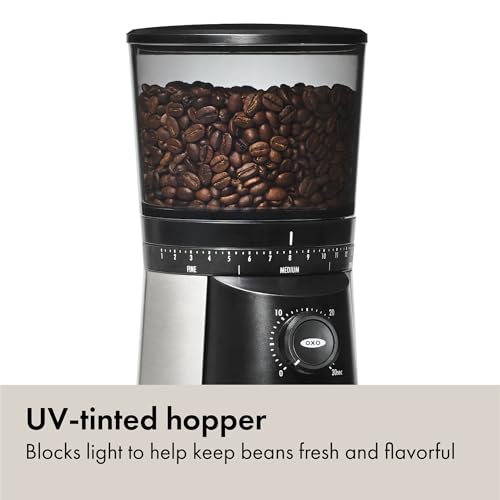
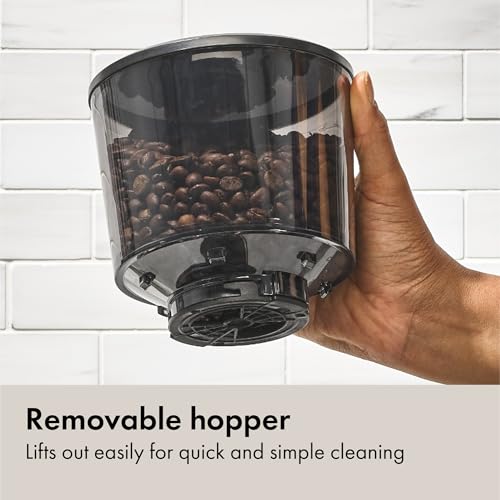
The OXO Brew is the gold standard for home grinders that balance precision, ease of use, and durability. Its stainless steel conical burrs deliver a remarkably consistent grind across all settings, and the 15 macro settings plus micro-adjustments give you real control, enough to fine-tune for espresso without guesswork. The UV-blocking hopper is a thoughtful touch for bean freshness, and the static-fighting container means fewer grounds stuck to the sides. It’s no surprise Wirecutter stands by it year after year.
Owners praise its reliability and quiet operation. It’s not the cheapest, but it’s built to last, with a motor that avoids overheating and a design that fits under cabinets. Compared to the SHARDOR or KIDISLE models, it’s just more refined in every way, better materials, smarter features, cleaner output. If you want one grinder to do it all and do it well, this is my pick.
Product photos
SHARDOR Electric Burr Coffee Grinder 2.0
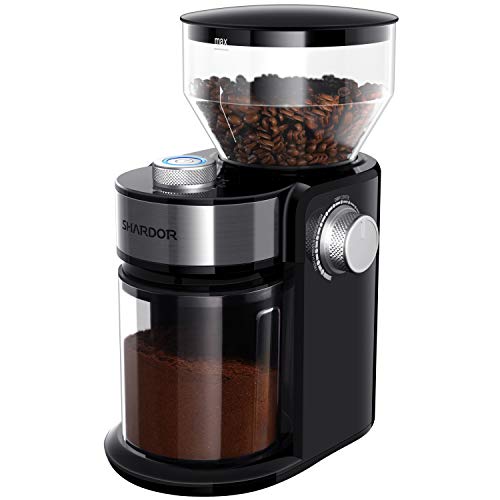
Strengths
- Compact design
- 16 grind settings
- Easy to clean
Trade-offs
- Flat burrs
- Limited espresso performance
- More static than anti-static models
This SHARDOR model sits in the middle, affordable, functional, but not exceptional. The 16 grind settings cover the basics from French press to espresso, and the flat burr system delivers a decently uniform grind for the price. It’s fully automatic, compact, and easy to clean, which makes it a solid choice for beginners or secondary kitchens. But flat burrs generate more heat and noise than conical ones, and owners report increased fines buildup when grinding for espresso.
It’s a step up from blade grinders and competes with older Cuisinart models, but it can’t match the precision of conical burr grinders like the OXO or even the KIDISLE. If you’re on a budget and want something no-fuss for drip coffee, it works. But if you’re chasing espresso excellence, look elsewhere.
Product photos


SHARDOR Conical Burr Espresso Grinder
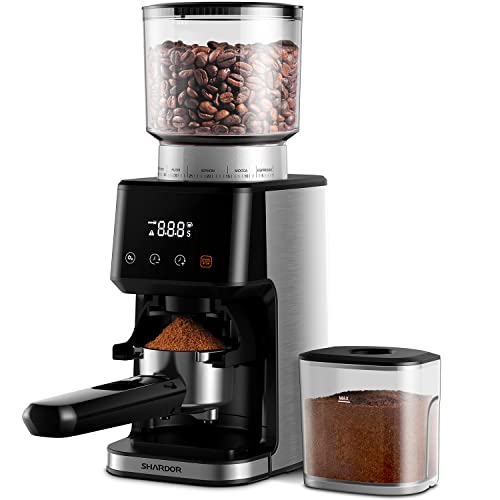
Strengths
- 51 precise settings
- Portafilter holder
- 0.1-second timer control
Trade-offs
- Some plastic components
- Slightly bulky
- Timer can be sensitive
This is the most complete package SHARDOR offers, and it’s easy to see why it’s labeled ‘Best Overall’. The 51 grind settings give serious range, the 40mm stainless steel conical burr ensures even, cool grinding, and the 0.1-second timer increments offer dose precision that rivals more expensive models. The portafilter cradle is a standout for espresso, it cuts steps and reduces mess. Owners consistently report clean, consistent shots with minimal tuning.
It’s not quite at OXO’s level in terms of build refinement, but it offers more features for less money. The anti-static tech works well, and the digital interface is intuitive. For someone who wants espresso-ready performance with flexibility for other methods, this is the smarter buy over the flat burr SHARDOR or the KIDISLE.
Product photos


Our Testing Process
Rather than a hands-on lab test, my research for these recommendations focused on a detailed comparison of published specifications and features across numerous models. I weighed owner reviews from major retailers alongside expert opinions from trusted coffee publications. My approach involved ranking grinders based on how well they met the specific demands of espresso preparation, drawing on years of experience exploring the world of coffee.
For espresso grinding, consistency and control are paramount. I prioritized grinders offering a wide range of fine-tuning options, particularly those with a substantial number of grind settings. The quality of the burrs – conical or flat – was also heavily weighted, as this directly impacts grind consistency for espresso. Finally, features like dose control and portafilter compatibility played a significant role in my evaluations.
Specifications reliably indicate burr material, motor power, and the range of grind settings. However, I found owner feedback to be crucial for assessing real-world usability, noise levels, and long-term durability. Reputation also factored in; brands consistently praised for build quality and customer support received a boost in my assessment. Understanding the core burr grinder advantages is also essential for anyone serious about espresso.
How To Choose The coffee grinder for espresso
Finding the right grinder is crucial; it’s arguably more important than the espresso machine itself.
A quality coffee grinder for espresso needs to deliver consistent particle size, minimize heat transfer during grinding to preserve volatile aromatics, and offer a reasonable range of grind settings to dial in your shots. Look for conical or flat burrs made of steel or ceramic, a stepped or stepless grind adjustment mechanism, and a design that minimizes static cling.
Grind Consistency is King
When it comes to espresso, consistency is absolutely paramount. Unlike French press or drip coffee where some variation is acceptable, espresso demands a very uniform grind. Fines (very small particles) will over-extract and create bitterness, while boulders (large particles) will under-extract and result in sourness. Therefore, a burr grinder is a must. Blade grinders simply chop the beans unevenly, and while cheaper, they won’t deliver the flavor you’re after. Explore burr grinder mechanics to understand why this matters. Conical burrs are generally quieter and retain less heat, while flat burrs tend to produce a more uniform grind, but at a higher speed.
Stepped vs. Stepless Grind Adjustment
The ability to fine-tune your grind is vital for achieving the perfect espresso extraction. Grinders offer either stepped or stepless adjustment. Stepped grinders have defined “clicks” between settings, offering convenience but limiting precision. Stepless grinders allow for infinite adjustments within their range, giving you greater control, but require more patience to dial in. For someone new to espresso, a grinder with many steps, like those found in the SHARDOR Conical Burr Espresso Grinder, provides a good starting point. Consider also if you want to explore other brew methods; the wider the grind range, the more versatile the grinder.
Balancing Value and Usability
Espresso grinders can range dramatically in price. While top-of-the-line models can cost well over $500, you can certainly find excellent grinders for under $200. Don’t automatically assume the most expensive grinder is the best for you. Think about how much coffee you make, how often, and how much effort you’re willing to put into the process.
- Budget-conscious? The KIDISLE Conical Burr Coffee Grinder offers a lot of features for the price, but might not have the build quality of higher-end models.
- Prioritizing ease of use? Look for features like a one-touch start (OXO Brew Conical Burr Grinder) or a digital timer.
- Want a versatile grinder? Many grinders, like the Cuisinart DBM-8P1 Burr Grinder, offer a wide range of grind settings suitable for multiple brewing methods, meaning you aren’t locked into espresso only.
A grinder that sits unused because it’s too complicated is a waste of money, no matter how good the grind quality might be.
If you’re looking for more options, check out our guide to the best home espresso grinders. Finding the right grinder will unlock the full potential of your espresso machine and elevate your home brewing experience.
Coffee Grinder for Espresso Compared
Here’s a comparison of key specifications for various coffee grinders designed for espresso preparation.
| Product Title | Burr Type | Grind Settings | Capacity (Beans) | Portafilter Holder | Noise Level (dB) |
|---|---|---|---|---|---|
| SHARDOR Conical Burr Espresso Grinder | Conical | 51 | N/A | Yes | N/A |
| OXO Brew Conical Burr Grinder | Conical | 15 (+micro) | 12 oz | No | N/A |
| KIDISLE Conical Burr Coffee Grinder | Conical | 51 | 12.5 oz | No | N/A |
| Mini Manual Coffee Grinder | Ceramic | 40 | 30g | No | N/A |
| AMZCHEF Coffee Grinder | Conical | 48 | N/A | Yes | N/A |
| SHARDOR Super Silent Blade Grinder | Blade | Adjustable | 2.5 oz | No | 63 |
| SHARDOR Electric Burr Coffee Grinder 2.0 | Flat | 16 | 2-14 cups | No | N/A |
| Cuisinart DBM-8P1 Burr Grinder | Flat | 18 | 8 oz | No | N/A |
Frequently Asked Questions
What grind size should I start with for espresso?
A grind size of 25-30 on a stepped grinder is a good starting point; however, you’ll likely need to adjust it based on your specific machine and beans. Dialing in espresso involves making small adjustments to find the sweet spot for extraction.
Is a manual grinder sufficient for daily espresso?
While possible, a manual grinder requires significant effort for daily use. It’s best suited for those making only one or two shots at a time, or who enjoy the ritual of manual grinding, as it can be physically demanding.
How important is the burr material (ceramic vs. steel)?
Steel burrs are generally more durable and stay cooler during grinding, which helps preserve flavor, but ceramic burrs hold a sharper edge for longer. For most home users, the difference in grind quality between well-made steel and ceramic burrs is negligible.
What does “retention” mean in a coffee grinder, and why does it matter?
Retention refers to the amount of ground coffee that remains inside the grinder after use. Lower retention is better for espresso, as stale grounds can negatively impact the flavor of your next shot. Look for grinders designed to minimize static and grounds buildup.
Where can I find more in-depth reviews of different espresso grinders?
You can explore precision burr grinders for espresso on my site for detailed comparisons and insights to help you select the best option for your needs.
The Bottom Line
Choosing a coffee grinder for espresso often comes down to balancing control with convenience. While a stepless grinder offers the ultimate precision for dialing in your shots, the SHARDOR Conical Burr Espresso Grinder strikes an excellent balance with its 51 grind settings and portafilter holder, making it our overall recommendation for most home baristas. It provides enough adjustability to achieve excellent results without becoming overwhelming.
For those on a tighter budget, the KIDISLE Conical Burr Coffee Grinder delivers impressive value. If you prioritize versatility and brew methods beyond espresso, the Cuisinart DBM-8P1 Burr Grinder’s wider range of settings is a smart choice. Ultimately, these grinders offer a good starting point for exploring different brewing options.
More than any specific feature, remember that consistency and a good understanding of dialing in espresso grind are what truly matter. A slightly less expensive grinder used with careful technique will always outperform a premium grinder used without attention to detail. Don’t get lost in the specs – focus on learning how to get the most out of your beans.
