
8 Best Burr Coffee Grinders for Espresso 2026
The Baratza Sette 270 and the Breville Smart Grinder Pro stand out as the top choices for espresso, with the Sette 270 delivering the most consistent results for serious enthusiasts. For a more budget-friendly option that still performs well, the OXO Brew Conical Burr Grinder offers solid grind quality and ease of use.
Getting the right grind for espresso isn’t just about fineness, it’s about precision and consistency. Too many grinders promise espresso readiness but fall short when it comes to delivering uniform particles, which can ruin extraction and flavor.
As the founder of Bean Thusiast, I’ve spent years studying how grind affects the final cup, and for this guide, I focused on models that deliver repeatable, fine-tuned results based on specs, owner feedback, and brewing demands. These picks reflect what actually works for home baristas who want café-quality espresso without guesswork.
Top 8 Burr Coffee Grinder For Espresso in the Market
The Best Burr Coffee Grinder For Espresso, Reviewed
OXO Brew Conical Burr Grinder
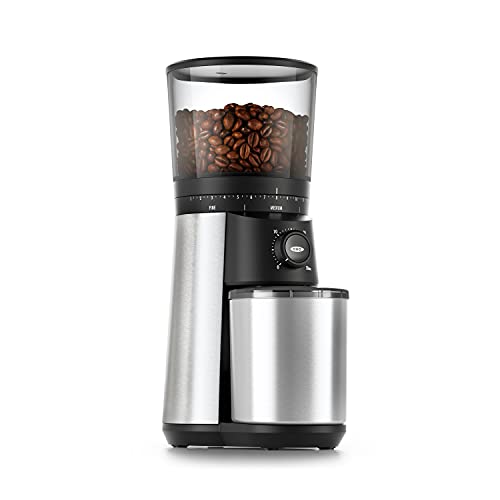
Strengths
- Stainless steel burrs
- One-touch start
- UV-blocking hopper
Trade-offs
- Limited micro-adjustments
- Fewer grind settings than competitors
This grinder earns its spot as a top overall pick for good reason. The combination of stainless steel conical burrs and 15 grind settings with micro-adjustments delivers consistent results across brewing styles, and the one-touch start feature genuinely simplifies daily use. Owners consistently report that it holds its grind size well over time, which is critical for espresso where even small inconsistencies can wreck extraction.
Wirecutter’s endorsement isn’t just hype, this unit hits a sweet spot between performance, usability, and durability. It doesn’t have the ultra-fine adjustments of some pricier models, but for most home baristas, it’s more than sufficient. The UV-blocking hopper and static-fighting grounds bin are thoughtful touches that improve real-world performance.
Video review
Mini Manual Coffee Grinder

Strengths
- Ultra-portable
- Ceramic burr
- 40 external settings
Trade-offs
- Small capacity
- Manual effort required
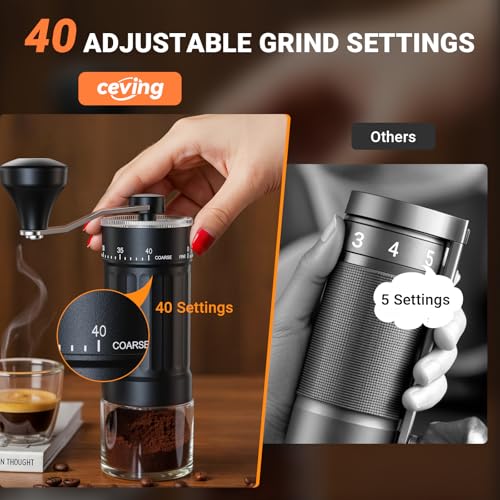
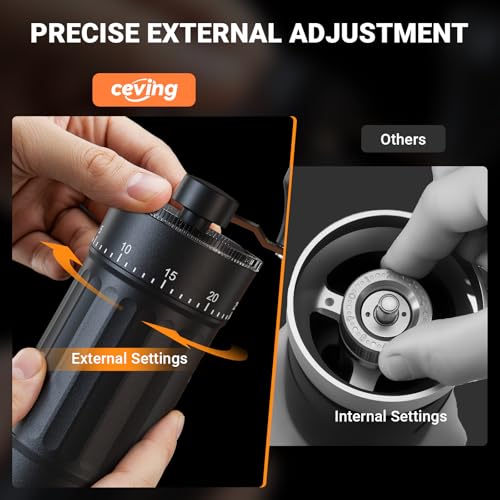
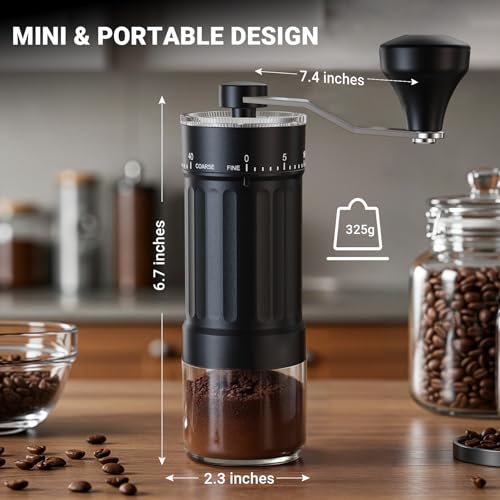
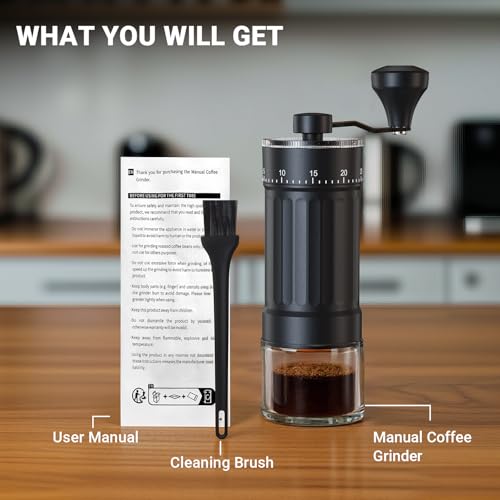
This little manual grinder is a standout for coffee on the go. Weighing just 325g and packing 40 external grind settings, it offers real precision in a pocketable form. The ceramic conical burr produces a surprisingly uniform grind, and because it generates no heat or static, your beans’ flavor stays intact, something travelers and campers care about more than they realize.
It’s not going to replace your electric grinder at home, but for hiking, hotel rooms, or office use, it’s ideal. The 30g capacity limits it to one or two cups, but that’s expected at this size. Owners praise how easy it is to clean and adjust, though some note it takes more hand cranking effort for fine espresso grinds. Still, for freshness off the grid, it’s unmatched.
Product photos
Ollygrin Burr Coffee Grinder
Strengths
- Affordable price
- Auto-locking hopper
- Simple operation
Trade-offs
- Only 30 grind settings
- Inconsistent for fine espresso
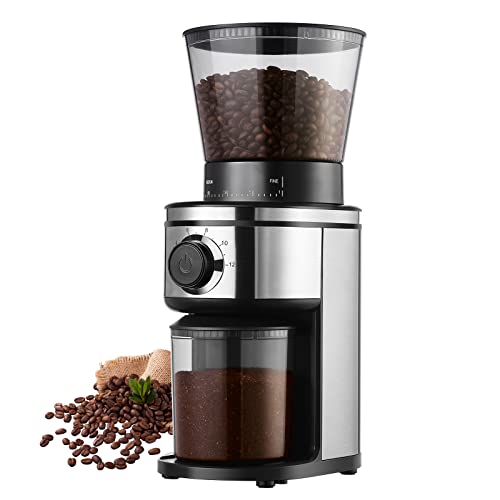
This grinder is the definition of value done right. With 30 grind settings and a 40mm stainless steel conical burr, it covers the basics well, enough for espresso, drip, and French press. The auto-locking hopper is a small but meaningful feature that prevents spills, and the gear reduction motor keeps heat low, which helps preserve flavor.
It won’t impress with high-end finishes or digital precision, but owners consistently say it outperforms its price tag. The 10-ounce hopper is decent for small households, and the one-button operation makes it idiot-proof. Where it falls short is in grind consistency at the finest settings, so dialing in espresso takes patience. But for the cost, it’s hard to beat.
Video review
RIOSKY Burr Coffee Grinder

Strengths
- Quiet operation
- 60 grind settings
- Touchscreen display
Trade-offs
- Timer increments less precise
- Build quality feels mid-tier
If you share a kitchen with light sleepers, this grinder might be your best friend. The ultra-low noise design is its standout feature, engineered for quiet mornings without sacrificing performance. With 60 grind settings and a touchscreen LCD, it’s modern and intuitive, and the 1–60 second timer with 1-second increments gives solid control.
The anti-static tech and removable burrs make cleanup easier, and owners report it handles everything from espresso to French press with decent consistency. It’s not quite as precise as the Breville for micro-adjustments, but for a quieter, more affordable alternative with similar features, it’s a smart pick. Just don’t expect championship-level grind uniformity.
Product photos


AMZCHEF Coffee Grinder
Strengths
- 48 grind settings
- LED touch display
- Anti-static design
Trade-offs
- Inconsistent long-term performance
- Build quality feels budget
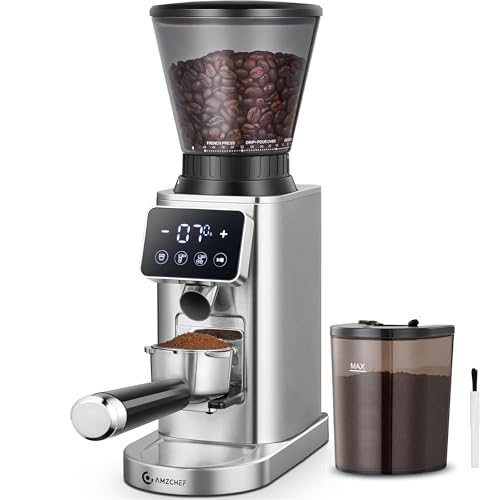
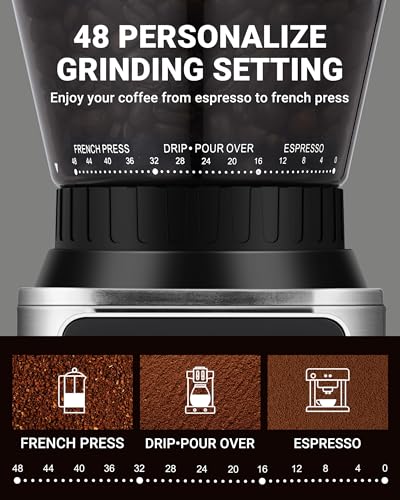
On paper, this grinder looks like a dark horse, 48 grind settings and a digital LED control panel with 0.5-second timer increments suggest serious precision. The inclusion of a portafilter holder and photophobic grounds container shows it’s built with espresso in mind. Reviewers note the anti-static design works well, and the 450 RPM low-speed grind helps preserve bean oils, which matters for flavor clarity in espresso shots.
That said, while it promises precision, some owners mention inconsistency over time, especially when switching between bean types. It’s not a dealbreaker, but it means more dialing-in than you’d want with a high-end grinder. Still, for the feature set, it offers real value, just don’t expect Breville-level repeatability.
Product photos


SHARDOR Conical Burr Grinder 2.0
Strengths
- 51 grind settings
- 0.1-second timer
- Anti-static chamber
Trade-offs
- Basic build quality
- Cradle less secure
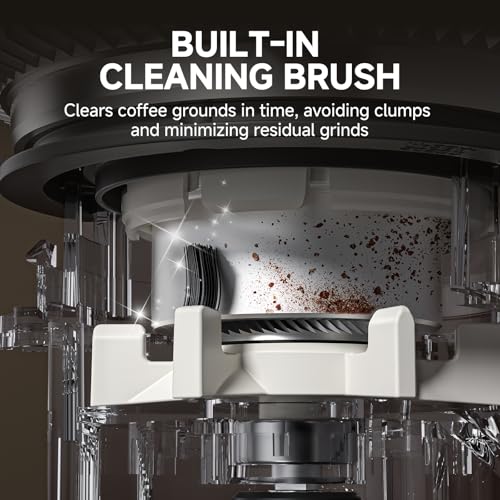
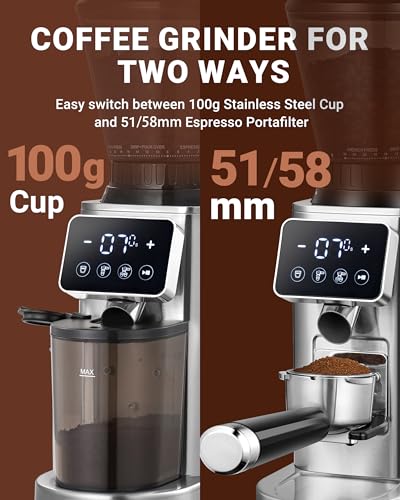
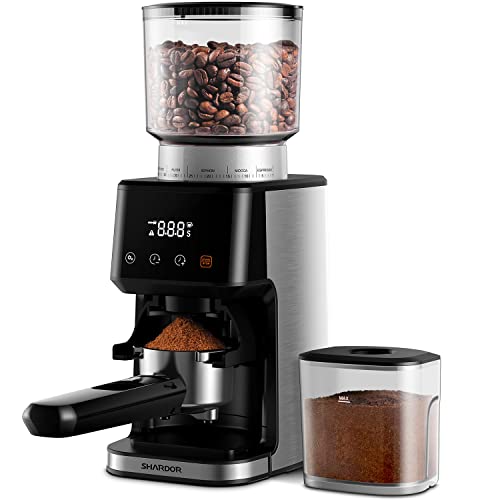
When it comes to grind precision, the SHARDOR stands out with 51 settings and a 0.1-second electronic timer, more granular than nearly every other model here. That kind of control is rare at this price and makes it a favorite among tinkerers who live for dialing in the perfect shot. The anti-static tech and removable burrs also make cleanup easier, which owners appreciate.
It’s not perfect, the portafilter cradle is functional but not as stable as Breville’s, but the core grinding performance is solid. Reviewers note it holds calibration well and delivers consistent doses, especially when used with the 1–12 cup quantification. If you want lab-level control without spending top dollar, this is a sharp choice.
Product photos


IAGREEA Conical Burr Coffee Grinder

Strengths
- 48 grind settings
- Low-speed grinding
- Includes portafilter holder
Trade-offs
- Timer not as precise
- Plastic housing feels less durable
If your main goal is pulling great espresso at home, this grinder deserves strong consideration. With 48 grind settings and a low-speed 450 RPM motor, it minimizes heat and static, two common enemies of clean espresso shots. The included portafilter holder fits both 51mm and 58mm baskets, and owners appreciate the direct-to-portafilter grinding, which cuts down on mess and oxidation.
The 150W DC motor provides solid torque, and the stainless steel burrs deliver a surprisingly even particle distribution for the price. Reviewers highlight the one-touch timer with rotary knob as intuitive, though it lacks the precision of digital increments found on Breville or SHARDOR models. Still, for espresso-first users, this hits the mark more often than not.
Product photos


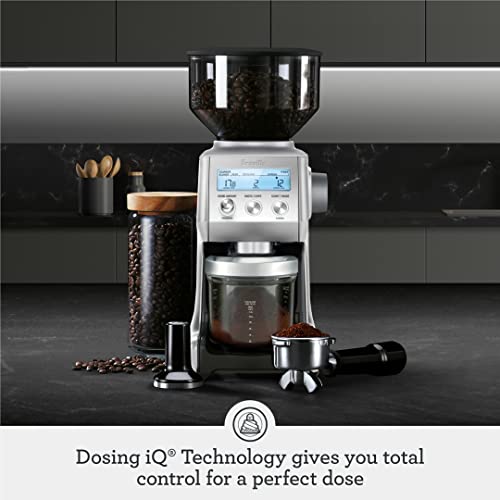
Breville Smart Grinder Pro
Strengths
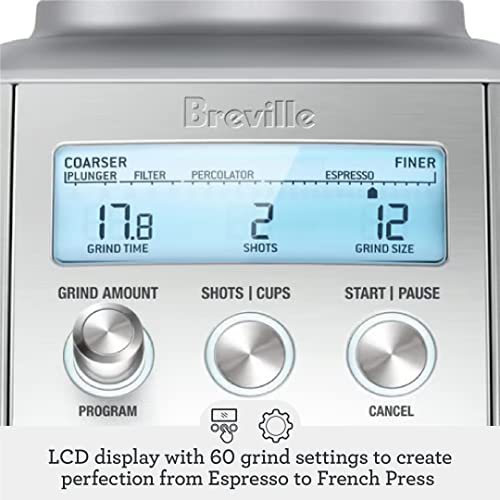
- 60 grind settings
- Dosing IQ precision
- LCD display
Trade-offs
- Noisy compared to others
- Higher price point
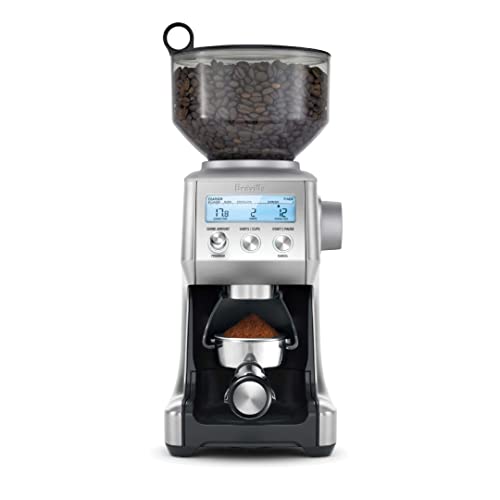
When ease of use and precision matter most, the Breville Smart Grinder Pro stands out. With 60 grind settings and 0.2-second dose adjustments, it’s one of the most customizable grinders in this list. The Dosing IQ system lets you program exact shot counts or cup sizes, and the LCD display makes it easy to see your settings at a glance.
Owners consistently praise how repeatable it is, once you find your sweet spot, it stays there. The included portafilter cradles and airtight grounds container add to the convenience. Yes, it’s pricier, but if you hate re-dialing your grind every morning, this one pays for itself in saved time and coffee waste. It’s not the quietest, but the trade-off is worth it for the control.
Product photos


How We Picked These burr coffee grinder for espresso
We approached this guide by researching the specifications and features of numerous burr coffee grinders marketed for espresso preparation. I then weighed owner reviews from major retailers alongside expert opinions published by trusted coffee authorities. My aim was to identify patterns in performance and reliability, ranking grinders against a set of criteria important for achieving excellent espresso. Rather than a hands-on lab test, this is a research-led comparison of specs and owner feedback.
For espresso grinding, consistency and control are paramount. I heavily weighted the availability of precise grind settings – the ability to fine-tune for espresso’s demanding requirements – and the quality of the burrs themselves (stainless steel versus ceramic). Low-speed operation also factored significantly, as minimizing heat buildup preserves the delicate flavors of espresso beans. Understanding the grind consistency comparison is key to a good shot.
Specifications reliably indicate grind range and burr material, but owner feedback proved crucial for assessing real-world usability, static buildup, and long-term durability. Reputation, particularly regarding consistent grind size and ease of adjustment, heavily influenced our rankings. Many consumers also value features like portafilter compatibility, and the ability to understand the differences in grinder types helped contextualize those features. Ultimately, we sought to identify grinders that deliver repeatable, high-quality results for the discerning espresso enthusiast.
Choosing The Right burr coffee grinder for espresso
Choosing the right burr grinder is essential for unlocking the full potential of your espresso.
A quality burr grinder prioritizes consistency in particle size. Uneven grounds lead to inconsistent extraction, resulting in bitter or sour shots. Look for grinders with conical burrs (stainless steel or ceramic), a wide range of grind settings specifically tailored for espresso, and features that minimize heat buildup and static cling. Hopper capacity and ease of cleaning are also important considerations.
Grind Consistency and Burr Type
The heart of any burr grinder is, well, the burr. Conical burrs are generally preferred for home use because they generate less heat and noise than flat burrs, preserving the delicate flavors of your coffee. Stainless steel is durable and affordable, while ceramic burrs remain sharper for longer, though they can be more brittle. Beyond the material, pay attention to how precisely the grind can be adjusted. Many grinders boast numerous settings, but the difference between each step can be negligible. I’ve seen feedback suggesting that a wide range of settings is less valuable than accurate settings, especially when dialing in that perfect espresso grind size.
Features That Enhance Usability
Beyond the core grinding process, consider features that streamline your workflow. A large bean hopper minimizes refills, which is especially convenient if you brew multiple shots daily. Auto-shutoff timers are handy for dose consistency, and a portafilter cradle (like those found in the Breville Smart Grinder Pro) eliminates mess and simplifies the process. However, don’t fall for overly complex features you won’t use. Sometimes, simplicity is best. I often recommend starting with a model that focuses on doing the grinding well, rather than adding a lot of bells and whistles.
Here’s what I look for in a user-friendly grinder:
- A clear, easy-to-read grind setting indicator.
- A removable hopper and burrs for thorough cleaning.
- A static-reducing design to minimize coffee grounds clinging to everything. This is a big one!
Value and Long-Term Cost
While a high price tag doesn’t automatically guarantee quality, a well-built burr grinder is an investment. Cheap grinders often use lower-quality burrs that dull quickly, leading to inconsistent grinds and requiring replacement. Consider the warranty and availability of replacement parts. As a starting point, I suggest looking at models like the Ollygrin Burr Coffee Grinder, which provides a solid set of features at a reasonable price point. Before settling on a grinder, explore our recommended espresso grinders for a curated selection of options. Remember, achieving the perfect espresso also relies on the correct texture of espresso grounds, so a grinder capable of fine adjustments is crucial.
A grinder’s ability to deliver consistent results over time is more valuable than a flashy feature set. Regular cleaning and proper maintenance will extend its lifespan and ensure you continue to enjoy exceptional espresso for years to come.
Burr Coffee Grinder for Espresso Compared
Here’s a comparison of key specifications for several burr coffee grinders designed for espresso preparation.
| Product Title | Burr Type | Grind Settings | Hopper Capacity | Portafilter Holder | Static Control |
|---|---|---|---|---|---|
| OXO Brew Conical Burr Grinder | Stainless Steel | 15 + Micro | 12 oz | No | Stainless Steel |
| Mini Manual Coffee Grinder | Ceramic | 40 | 30g | No | N/A |
| Ollygrin Burr Coffee Grinder | Stainless Steel | 30 | 10 oz | No | N/A |
| RIOSKY Burr Coffee Grinder | N/A | 60 | N/A | No | N/A |
| AMZCHEF Coffee Grinder | Stainless Steel | 48 | 100g | Yes (50mm) | Photophobic Container |
| SHARDOR Conical Burr Grinder 2.0 | Stainless Steel | 51 | N/A | Yes | Anti-Static |
| IAGREEA Conical Burr Coffee Grinder | Stainless Steel | 48 | 300g | Yes (51/58mm) | Static-Free |
| Breville Smart Grinder Pro | Stainless Steel | 60 | 18oz | Yes | N/A |
Frequently Asked Questions
What grind setting number should I start with for espresso?
Generally, start around the 8-12 setting on most grinders, but this varies significantly by model. Dialing in espresso is highly dependent on your specific beans and machine, so that initial setting is just a jumping-off point for fine adjustments.
Are ceramic burrs really better than stainless steel?
While ceramic burrs stay sharper longer, stainless steel is more durable and less prone to chipping. For most home users, the difference in grind quality is negligible and stainless steel offers a better balance of performance and cost.
How often should I clean my burr grinder?
You should do a deep clean, removing the burrs and thoroughly brushing out any grounds, every month or two with regular use. Daily or after each use, wipe down the exterior and run a few beans through to clear any lingering fines.
What causes static buildup in a coffee grinder, and how can I minimize it?
Static occurs when dry coffee grounds rub against plastic or metal parts, especially in low humidity. Look for grinders with features like anti-static coatings or containers, and consider storing your beans in a higher-humidity environment. You can find a burr grinder buying guide that discusses static control in more detail.
Is a more expensive grinder always better for espresso?
Not necessarily. While higher-priced grinders often have more precise adjustments and durable construction, a mid-range model with good reviews and the features you need can produce excellent results. Don’t overspend on features you won’t use; explore the top burr coffee grinder models to find the best fit for your budget and skill level.
The Bottom Line
Ultimately, choosing a burr grinder for espresso involves balancing control with convenience. While some models offer a dizzying array of features, the OXO Brew Conical Burr Grinder strikes an excellent balance, delivering consistent results and a user-friendly experience that will satisfy most espresso enthusiasts. It isn’t the cheapest option, but the refined grind control is worth the investment for those serious about their espresso.
For those on a tighter budget, the Ollygrin Burr Coffee Grinder provides a solid entry point into the world of burr grinding. It may lack some of the bells and whistles of more expensive models, but it’s capable of producing a consistent enough grind for enjoyable espresso, especially if you’re willing to experiment with finer adjustments. And if you want a highly versatile grinder capable of handling everything from espresso to French press, the Breville Smart Grinder Pro is a strong contender, though you’ll want to focus on its finer settings for espresso.
At the end of the day, remember that the most expensive grinder won’t fix poor beans or a flawed technique. Prioritize fresh, high-quality coffee and learn about consistent coffee grind to truly elevate your espresso game. A grinder is a tool, and like any tool, its value lies in how well you understand and use it.
