
Iced Coffee Invention: The Complete Historical Timeline
This post contains affiliate links. As an Amazon Associate, we earn from qualifying purchases.
Iced coffee was invented in 1840 by French soldiers in Algeria, who created Mazagran by mixing coffee syrup with cold water and ice. This battlefield drink, born from the need for a cool caffeine ration, sparked a global evolution through accidents, wars, and marketing.
Iced coffee was invented in 1840 by French colonial soldiers stationed in Algeria, who created a drink called Mazagran by mixing coffee syrup with cold water and ice. This battlefield innovation was a direct response to the sweltering North African heat, designed to deliver caffeine without the heat. The story doesn’t end there, it’s a chain of accidents, wars, and marketing campaigns that turned a soldier’s ration into a global phenomenon.
Most people think iced coffee is a modern, corporate invention from Starbucks or Dunkin’. That’s wrong. The real history is older, messier, and rooted in colonial military campaigns. You miss the cultural evolution if you start the clock in the 1990s.
This guide walks through the specific year, place, and people behind the first iced coffee. We’ll trace its path from Algeria to your local cafe, through post-war Vietnam and a Greek trade fair, straight into the hands of Gen Z.
Key Takeaways
- The first documented iced coffee, Mazagran, was made in 1840 Algeria by French soldiers combining coffee syrup and cold water.
- The popular Greek Frappé was invented entirely by accident in 1957 by a Nestlé representative using instant coffee.
- Modern iced coffee’s popularity is a generational shift: Gen Z and Millennials treat it as a year-round drink, breaking the old summer-only habit.
- Major chains like Starbucks didn’t invent it, but they scaled it, cold beverages grew from under 40% to 75% of their U.S. sales from 2013 to 2021.
- Global variations like Japanese flash-chilled coffee and Vietnamese coffee with condensed milk are distinct methods, not just “coffee over ice.”
The Original Iced Coffee: Mazagran (1840)
Forget trendy cafes. The first iced coffee was a field ration. French soldiers fighting in colonial Algeria around 1840 faced a tactical problem: the Sahara climate. They needed the alertness from caffeine but couldn’t stomach hot coffee in the heat.
Their solution was pragmatic. They had a sweet, concentrated coffee syrup on hand. By diluting it with cold water and whatever ice they could procure, they created a portable, refreshing stimulant. They named it after the nearby Algerian port town of Mazagran.
The Mazagran was a functional military invention. French troops in North Africa mixed pre-made coffee syrup with cold water and ice around 1840, creating the first documented iced coffee as a tactical response to extreme heat and the need for mobile caffeine.
This wasn’t about craft or flavor notes. It was about utility. The drink provided a caffeine fix without raising body temperature, a crucial advantage. The formula, concentrated coffee + sweetener + cold water, became the prototype for almost every ready-to-drink iced coffee since.
TL;DR: The Mazagran, invented by French soldiers in 1840 Algeria, is the original iced coffee, a sweet, cold coffee syrup drink born from military necessity.
Post-1840: Accidents and Global Spread
After Mazagran, iced coffee didn’t follow a planned rollout. Its spread was chaotic, driven by accident, war, and globalization. Each region developed its own version, often independently.
The Greek Frappé is the classic accident story. In 1957, at the Thessaloniki International Fair, a Nestlé representative named Dimitris Vakondios needed a coffee break. He couldn’t find hot water. Using instant coffee, cold water, and a shaker, he created the frothy, iced drink that defines Greek cafes to this day. It was a happy accident that became a national icon.
Common mistake: Assuming all iced coffee history flows from Mazagran, the Greek Frappé was an independent 1957 invention with instant coffee, showing how simple needs create enduring traditions.
Vietnamese iced coffee, or Cà phê sữa đá, took a different path. Its global spread accelerated during the Vietnam War in the 1960s. American troops encountered the strong, dark roast coffee brewed through a metal phin filter, then poured over ice and sweetened with condensed milk. The condensed milk was a practical choice in a region with limited fresh milk. The soldiers brought a taste for it home, planting the seeds for its global popularity. The method highlights how a brewed coffee method can be radically transformed by local ingredients.
Meanwhile, in Japan, two distinct philosophies emerged. Japanese iced coffee, or flash-chilling, involves brewing hot coffee directly onto ice. This method, ideal for preserving the bright, acidic notes of light roast coffee, locks in aromatics that would otherwise steam away. Kyoto-style cold brew represents the opposite extreme. Using a slow-drip tower, cold water takes hours to pass through coffee grounds. This 17th-century preservation technique, adapted for coffee, produces a smooth, concentrated extract with almost no acidity. The contrast between these methods shows a deep cultural engagement with coffee concentration methods.
The Modern Boom: Cold Coffee Takes Over
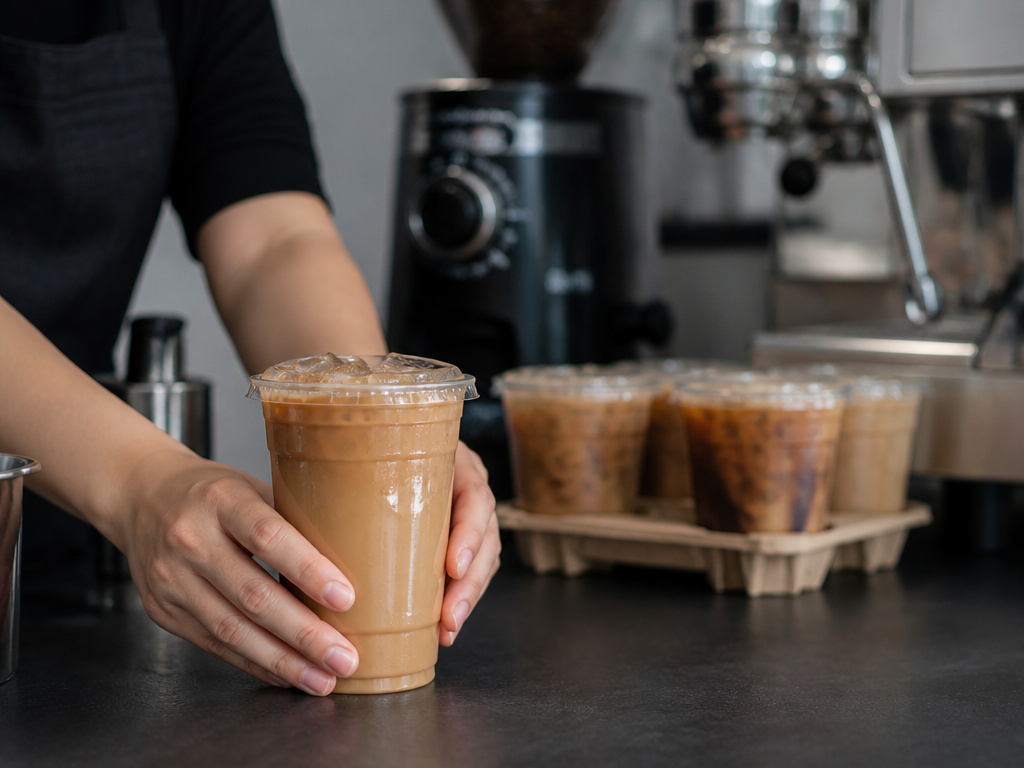
The shift from occasional treat to daily staple is a recent, data-driven story. Between 2016 and 2023, consumer spending on cold coffee in the U.S. more than doubled. Hot coffee spending grew only about 20% in the same period. This isn’t just a summer trend anymore.
The engine of this change is generational. For Gen Z and Millennials, iced coffee is a year-round, all-occasion drink. A 2023 survey found about half of 18–24 year olds had consumed cold coffee within the past day. For Boomers and Gen X, it’s still largely a hot-weather option. The younger cohorts broke the seasonality.
I switched to iced coffee as my daily driver about five years ago. A hot cup goes lukewarm and bitter on my desk in 20 minutes. An iced Americano stays crisp for two hours. The practicality won me over, not the marketing.
Coffee chains didn’t create the demand, but they scaled it massively. Starbucks is the clearest case. From 2013 to 2021, the share of cold beverages in their total U.S. drink sales climbed from less than 40% to 75%. Dunkin’ reported that iced drinks grew 50% since 2019 and now represent two-thirds of beverage sales. This seismic shift in menu engineering forced a change in coffee grinding equipment across the industry, as grinders needed to produce consistent coarse grinds for cold brew at scale.
The rise of ready-to-drink (RTD) cans and bottles mirrors the soft drink playbook. U.S. RTD coffee consumption grew over 40% between 2019 and 2023. Companies like Nespresso and Keurig now market machines specifically designed to flash-chill coffee. This turn toward cold, portable, and often sweeter coffee-based beverages reflects a fundamental rebranding of coffee itself for a new audience.
Global Iced Coffee Variations & Timeline
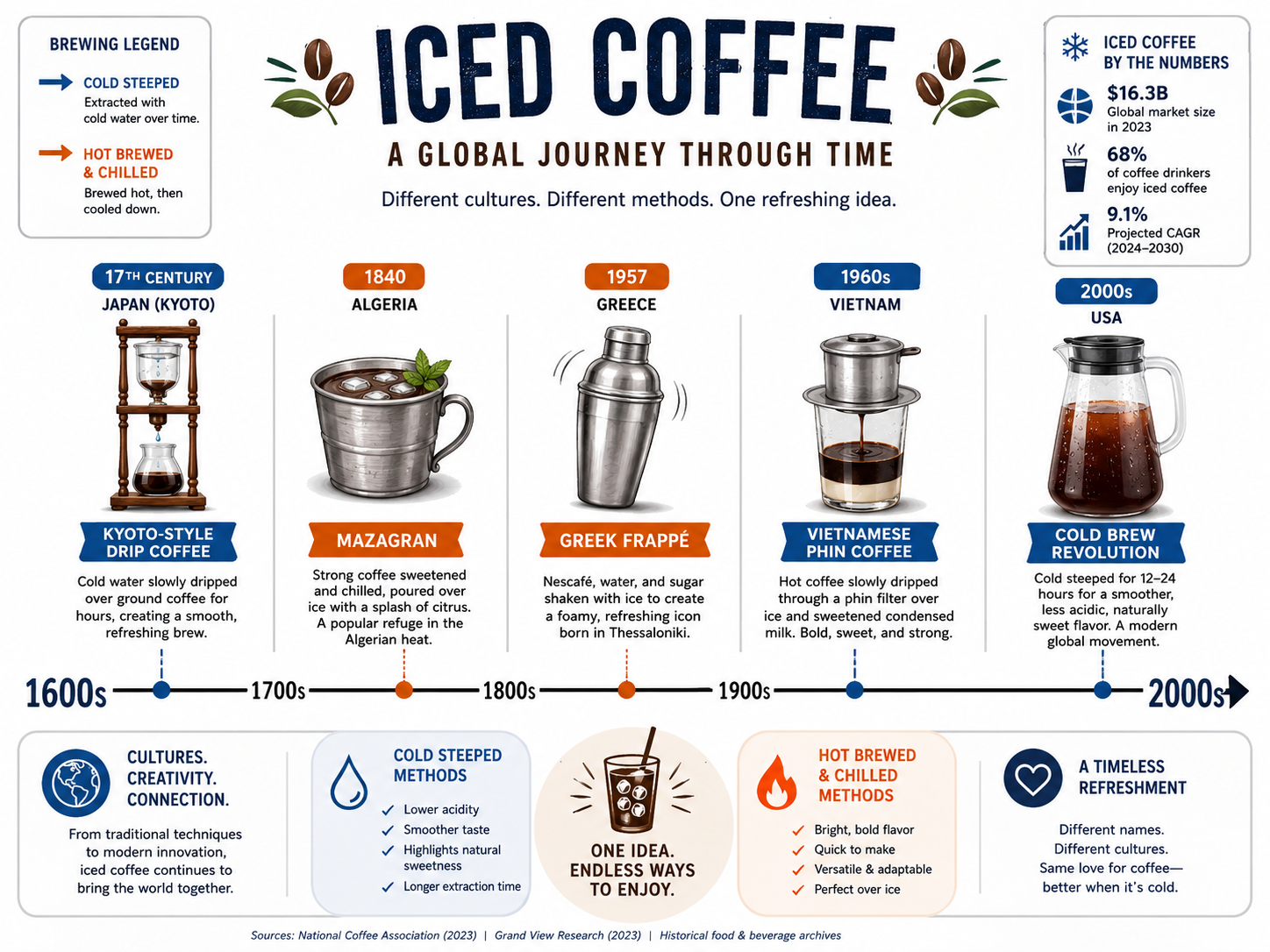
Iced coffee is a single phrase for a dozen different drinks. The method, ingredients, and equipment separate a brisk Japanese pour-over from a creamy Vietnamese brew. The choice of bean matters, too, a chocolatey coffee blend stands up to milk and ice differently than a fruity single-origin bean.
| Variation | Origin & Date | Core Method | Key Characteristic |
|---|---|---|---|
| Mazagran | Algeria, c. 1840 | Coffee syrup + cold water/ice | The original military ration; sweet, concentrated, portable. |
| Greek Frappé | Greece, 1957 | Shaken instant coffee + water + ice | Accidentally invented; frothy, creamy head from shaking. |
| Vietnamese (Cà phê sữa đá) | Vietnam, popularized 1960s | Strong phin-brewed coffee + condensed milk + ice | Intensely sweet and strong; defined by the metal phin filter. |
| Japanese Iced Coffee | Japan, 20th century | Hot coffee brewed directly onto ice | “Flash-chilled”; preserves bright acidity and aroma of the hot brew. |
| Kyoto-Style Cold Brew | Japan, 17th century (adapted) | Slow cold-water drip over hours (often in a tower) | Silky, concentrated, low-acid; a preservation method turned craft. |
| Italian Caffè Ghiacciato | Italy | Hot espresso poured over ice, sometimes with lemon zest | Fast, simple, and strong; highlights the espresso caffeine content in a diluted form. |
| American Cold Brew | United States, 2000s boom | Coarse grounds steeped in cold water 12-24 hours, then filtered | Smooth, less acidic; the base for most modern chain offerings. |
The table shows a clear divide between hot-brew-then-chill methods and true cold-steeped ones. The hot-brew methods (Japanese, Italian) capture more of the coffee’s volatile aromatics and brighter notes. The cold-steeped methods (Kyoto, American cold brew) yield a mellower, often sweeter-tasting cup by avoiding heat-based extraction of certain acidic compounds. Your choice of paper coffee filters also changes the outcome, with thicker filters producing a cleaner cold brew.
TL;DR: From the shaken Greek Frappé to the slow-drip Kyoto tower, global iced coffee methods split between fast, aromatic hot brews and smooth, steeped cold extracts.
Why Iced Coffee Took So Long to Dominate
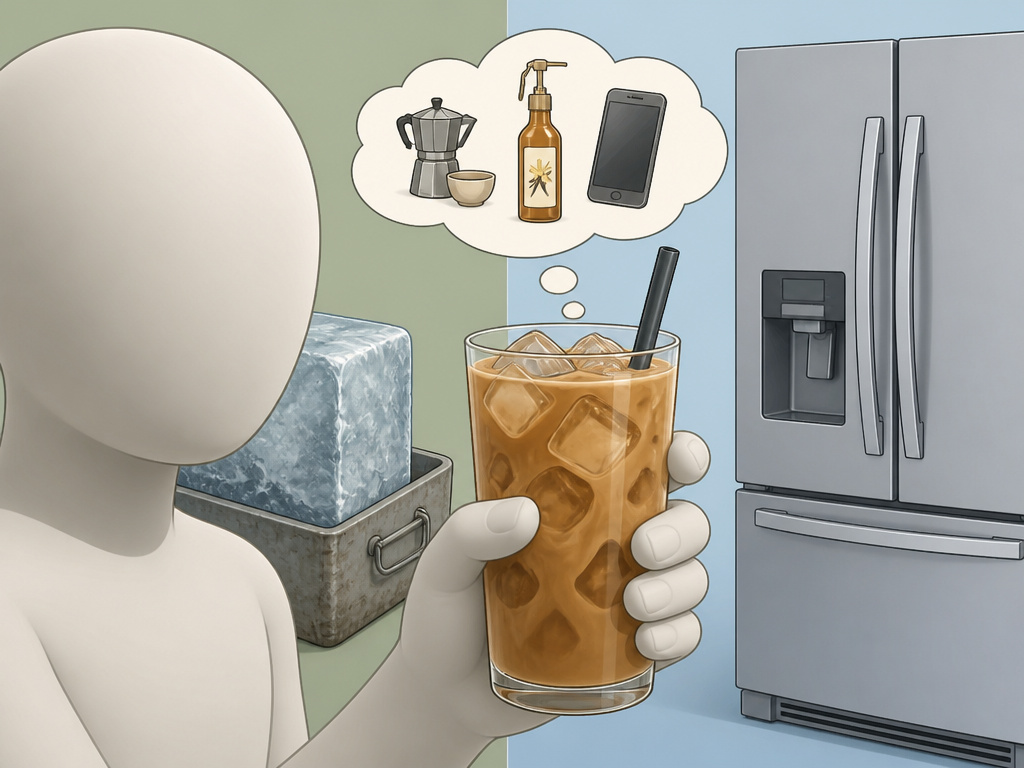
If the idea is so simple, coffee, ice, why did it take 180 years to become a dominant form? The answer is a mix of technology, culture, and pure habit.
For most of coffee’s history, ice was a luxury. Reliable mechanical refrigeration only became widespread in homes and businesses in the early 20th century. Before that, ice was harvested from lakes and stored in insulated icehouses, making it expensive and seasonal for much of the world. You can’t have an iced coffee revolution without accessible ice.
Cultural tradition is a powerful anchor. In countries with deep, ceremonial coffee traditions like Italy, Turkey, or Ethiopia, serving coffee hot is non-negotiable. It’s intertwined with social ritual. The American coffee scene was historically more utilitarian, which ironically made it more flexible and experimental later on. The U.S. lacked a rigid traditional coffee preparation dogma to break.
The final catalyst was a change in what people wanted from coffee. The younger generation doesn’t just want caffeine. They want a customizable, photogenic, sip-able experience that lasts. A hot black coffee doesn’t check those boxes. An iced latte with oat milk, vanilla syrup, and a drizzle of caramel does. The drink became a platform for personalization. This shift also changed ancillary choices, making biodegradable filters and eco-friendly brewing more relevant to a sustainability-conscious audience.
The Wikipedia entry on iced coffee documents this evolution from a single point of origin to a global array of methods, confirming that its rise was never inevitable but always contingent on these intersecting factors.
Frequently Asked Questions
Is cold brew the same as iced coffee?
No. Iced coffee is a broad category for any coffee served cold, often made by brewing hot coffee and then cooling it. Cold brew is a specific subset where coffee grounds are steeped in cold water for 12-24 hours, resulting in a less acidic, smoother concentrate. Japanese iced coffee is another distinct method where hot water is brewed directly onto ice.
Did Starbucks invent iced coffee?
Absolutely not. Starbucks and other major chains commercialized and scaled it in the late 20th and early 21st centuries, but the drink dates back to at least 1840 Algeria. Their innovation was in marketing, distribution, and creating a consistent, craveable product for a mass market.
What is the difference between iced coffee and iced tea in terms of caffeine?
It depends entirely on the brew. A typical 8-oz iced coffee from a drip brew has about 95-165 mg of caffeine. A similar serving of black iced tea has about 25-48 mg. However, a strong cold brew concentrate or a robust caffeine in iced tea made from long-steeping high-quality leaves can narrow that gap significantly.
Why is Vietnamese iced coffee so strong and sweet?
It uses a dark roast, often robusta or a robusta blend, brewed in a small metal phin filter, which produces a very concentrated, potent coffee. Sweetened condensed milk is used both for creaminess and sweetness, a tradition born from the limited availability of fresh refrigeration in Vietnam historically. The combination is intense and designed to stand up to melting ice.
What’s the best coffee bean for iced coffee?
It depends on the method. For flash-chilled Japanese style or simple iced pour-over, a bright, fruity Arabica bean from Ethiopia or Kenya shines. For cold brew or milk-heavy drinks, a darker roast or a chocolatey Colombian coffee blend holds up better. A medium or blonde roast can get lost when poured over ice.
The Bottom Line
Iced coffee wasn’t invented in a corporate lab. It was forged in the Algerian desert in 1840, a soldier’s hack for staying alert in the heat. Its journey to your cup passed through a Greek trade fair, Vietnamese coffee shops, and Japanese kissaten, collecting stories and techniques at every stop.
The modern explosion is a tale of generational preference meeting industrial scale. Younger drinkers wanted a cold, customizable, all-day drink. Big chains provided the system, and the brewed coffee evolution adapted to meet it. Next time you pick up a cold brew, remember you’re holding a direct descendant of a French colonial soldier’s field ration, adapted, improved, and globalized across two centuries.
