
Defining the Strongest Coffee: Science of Caffeine & Brewing
This post contains affiliate links. As an Amazon Associate, we earn from qualifying purchases.
The strongest coffee is defined by two distinct metrics: caffeine content per serving and total dissolved solids (TDS) concentration. Caffeine strength comes from bean type (Robusta over Arabica) and brewing method (espresso or French press over drip). Perceived strength, or TDS, is driven by grind size (355 µm fine), coffee-to-water ratio (60g/L), and using filtered water.
Most people confuse a bitter, dark roast with high caffeine. The real kick comes from a specific bean and a fine grind, not just a longer roast time.
This guide breaks down the science, the methods, and the warnings. We’ll cover the standards, the studies, and the practical steps to get the most intense cup possible, or to understand why your current brew falls short.
Key Takeaways
- Robusta beans contain nearly double the caffeine of Arabica beans. A blend’s strength is determined by its Robusta percentage.
- A fine 355 µm grind, not a dark roast, maximizes extraction for both caffeine and flavor compounds.
- The Specialty Coffee Association defines “strength” as Total Dissolved Solids between 1.15% and 1.45% for filter coffee.
- Ultra-high-pressure cold brew extraction is less sensitive to roast degree than conventional cold brew, making medium roasts suitable.
- Drinking high-caffeine coffee like Death Wish requires extreme caution; the 720mg per serving can cause severe symptoms within 10 minutes.
Caffeine vs. Extraction Yield: The Real Definition
Strength is not a single scale. You have caffeine content and you have sensory strength, which the industry calls Total Dissolved Solids (TDS). Caffeine is a specific molecule; TDS is the total weight of everything extracted from the bean into your cup.
The Specialty Coffee Association’s standard for filter coffee strength is a TDS between 1.15% and 1.45%. That’s the weight of coffee solids in the water. Extraction yield (EY), the percentage of the bean’s mass actually dissolved, should be between 18% and 22% for a balanced cup. A 2023 UC Davis study proposed expanding the ideal EY range to 19–24%, noting that TDS had a greater direct effect on consumer preference than extraction yield alone.
Technical Snippet: The Specialty Coffee Association Standard 102-2024 defines coffee strength as Total Dissolved Solids (TDS) concentration. For filter coffee brewing, the SCA recommends a TDS range of 1.15–1.45% and an extraction yield (EY) of 18–22%. Espresso targets a higher TDS, typically between 8% and 13%.
Caffeine content is a different beast. It’s fixed in the bean. A coffee blend strength with high Robusta will pack more caffeine per gram than a pure Arabica single-origin coffee. Your brewing method just pulls it out.
TL;DR: Strength is two things: caffeine (bean-dependent) and TDS (brew-dependent). Aim for 1.15–1.45% TDS for filter coffee, and pick Robusta beans for caffeine.
Bean Type: The Caffeine Engine
Coffea arabica is the flavor king. Coffea canephora, known as Robusta, is the caffeine brute. Robusta beans contain nearly double the caffeine of their Arabica cousins. They also have a different genetic structure. Arabica is an allotetraploid, which contributes to its complex flavor profile, while Robusta is diploid and simpler, but tougher.
Altitude matters. Arabica grown at 1600–2000 meters develops more sugars because cooler temperatures slow growth and promote accumulation. Robusta thrives at lower, hotter elevations. Shade can help, but excessive shading hinders carbon assimilation in both species, affecting final bean density and extractable solids.
Postharvest processing, natural, washed, honey, modulates nonvolatile compounds. This changes how lipids emulsify and aromas are retained during brewing. Controlled fermentation and anaerobic treatments can enhance sensory complexity, but they don’t significantly alter the base caffeine content. That’s locked in by genetics.
If you want the strongest coffee in terms of pure stimulant, you start with Robusta. Many high-caffeine commercial blends lean heavily on it.
| Bean Type | Typical Caffeine Content | Best For | Risk If Skipped |
|---|---|---|---|
| Arabica | ~1.2–1.5% by weight | Flavor complexity, acidity, sweetness | Lower caffeine yield, potentially weaker perceived “kick” |
| Robusta | ~2.2–2.7% by weight | Maximum caffeine, crema in espresso, body | Often more bitter, less nuanced flavor profile |
| Blend (High Robusta) | Varies with percentage | High-caffeine drinks, espresso bases | Unbalanced flavor if Robusta percentage is too high |
The Roast Level Paradox
Dark roast coffee looks strong. It smells strong. It tastes bitter and intense. But it is not necessarily higher in caffeine. Roasting burns off mass. A darker bean is physically lighter, so you get less caffeine per gram if you measure by weight. If you measure by volume, using a scoop, a darker, more porous bean might fill the scoop with less mass, further reducing caffeine.
The roast influences perceived strength through the development of volatile compounds. A study published in Foods in 2021 found that finer grinds (355 µm) produced significantly higher GC/MS intensities for most volatile compounds in both espresso and cold brew. Roast temperature and time (235°C for 13 min, 240°C for 15 min, 245°C for 17 min) change the composition of these compounds, but the total pool of caffeine remains relatively stable.
Common mistake: Assuming dark roast equals high caffeine, using a volume scoop for dark roast beans can result in using less coffee mass, yielding a weaker cup in both caffeine and TDS.
For ultra-high-pressure cold brew, a 2024 study in the PMC found that the impact of roasting degree was less pronounced than in conventional cold brew. Medium-roasting beans may be more suitable for that high-pressure extraction method. The study identified 15 key aroma compounds, including hazelnut pyrazine, linalool, and butane-2,3-dione, with odor activity values greater than 100.
TL;DR: Dark roast tastes strong but can deliver less caffeine per gram. For maximum caffeine extraction, focus on grind size and ratio, not roast color.
Grind Size & Brew Ratio: The Extraction Lever
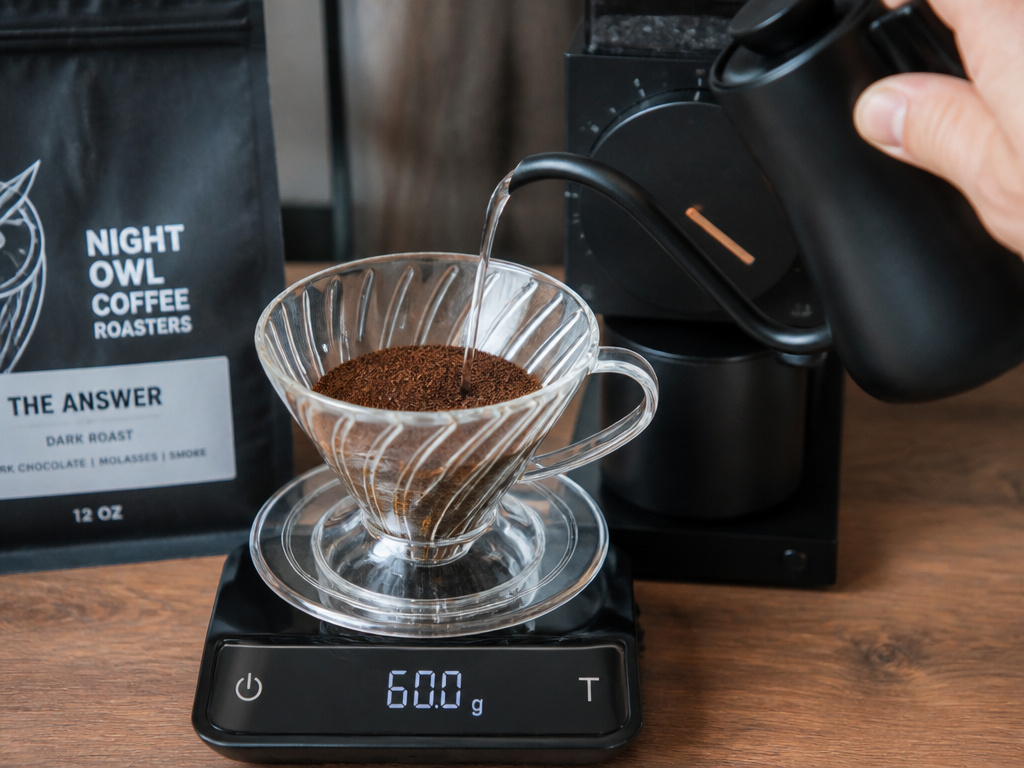
Your grinder is your primary strength control. The 2021 Foods study is clear: a 355 µm fine grind yields significantly higher measured intensities of volatile compounds than a 500 µm medium or 710 µm coarse grind. More surface area means more stuff dissolves.
The European Coffee Brewing Centre (ECBC) Certification Standards for brewers recommend a coffee-to-water ratio of 50–60 grams per liter. That’s the target zone. Go to 60g/L for the upper limit of strength within the standard. For espresso, the TDS target is much higher, 8–13%, because the method extracts a concentrated slug of solids quickly.
I won’t recommend a 60g/L ratio for your daily morning pot. It’s overkill. You’ll hit the SCA’s strength ceiling, but the cup can be harsh and overwhelming. Save that ratio for a single strong serving when you need it.
Water quality is a silent variable. The same 2021 study found that filtered water led to significantly higher GC/MS intensities of volatile compounds in cold brew compared to tap and bottled water. Minerals and chlorine in tap water can interfere with extraction.
Here’s the step-by-step to maximize TDS:
- Weigh your beans. Use a digital scale. Volume scoops are unreliable, especially with dark roasts.
- Grind fine. Target 355 µm if your grinder can measure it. If not, aim for a grind just coarser than espresso powder.
- Use the ECBC ratio. For one liter of water, use 60 grams of coffee. For a standard 300ml cup, use 18 grams.
- Choose filtered water. It’s not just for taste; it’s for extraction efficiency.
- Adjust brew time. A finer grind extracts faster. If using a French press or cold brew, you might shorten the contact time slightly to avoid over-extraction and bitterness.
Skipping step one means you’re guessing your dose. Skipping step three means you’re likely under-dosing. The result is a cup that misses the strength of Americano or a properly made espresso caffeine content benchmark.
Brewing Method Showdown
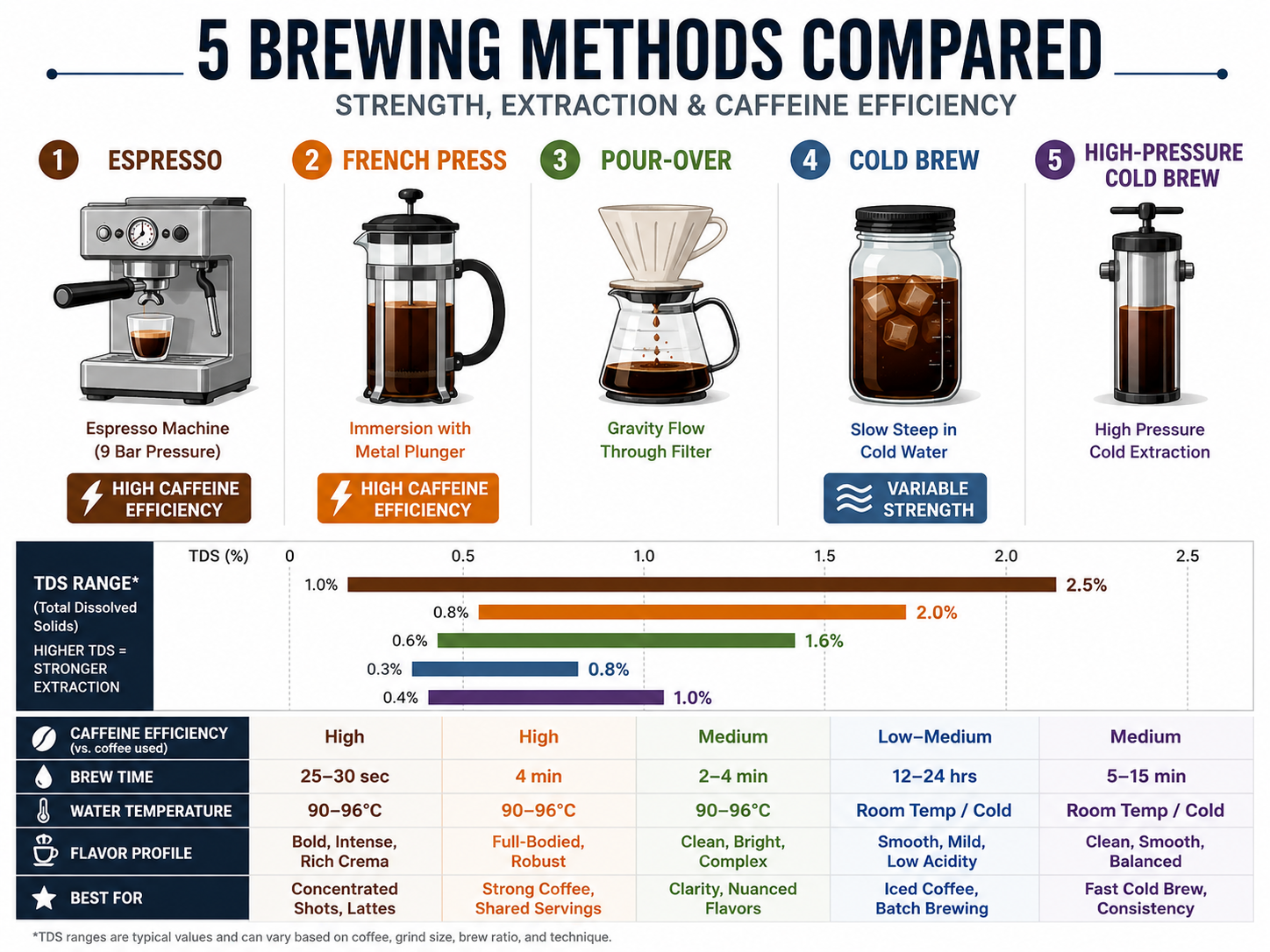
Not all methods pull equal caffeine or solids. Espresso, by design, produces a high TDS (8–13%) in a small volume. A French press, with its full immersion and fine grind potential, can also achieve a high TDS. Drip or pour-over methods generally produce a lower TDS, within the SCA’s 1.15–1.45% range, but they can be pushed with a very fine grind and tight ratio.
Cold brew is interesting. Conventional cold brew strength is heavily influenced by roast degree and time. However, the NIH coffee brewing study on ultra-high-pressure cold brew found its physicochemical characteristics were less sensitive to roast. This makes medium roasts a viable option for that high-pressure technique.
| Brewing Method | Typical TDS Range | Caffeine Efficiency | Best For Maximizing |
|---|---|---|---|
| Espresso | 8–13% | High (fast, concentrated) | Perceived strength & caffeine per volume |
| French Press | 1.5–2.5% (can exceed) | High (full immersion) | Overall TDS & body |
| Drip / Pour-Over | 1.15–1.45% (SCA) | Moderate | Balanced flavor & clarity |
| Cold Brew (Conventional) | Varies widely | Low (slow, cool) | Smoothness, low acidity |
| Cold Brew (Ultra-High-Pressure) | Similar to conventional | Moderate (study data) | Speed & consistency |
The strength of Americano, espresso diluted with water, falls between espresso and drip. It’s a way to get espresso’s caffeine payload in a larger, drinkable volume. A cappuccino caffeine levels drink dilutes that payload with milk, reducing the perceived strength.
TL;DR: Espresso and French press win for concentrated strength. Drip coffee can be strong within the SCA standard. Cold brew’s strength depends heavily on technique and roast.
Commercial “Strongest” Coffees & Safety
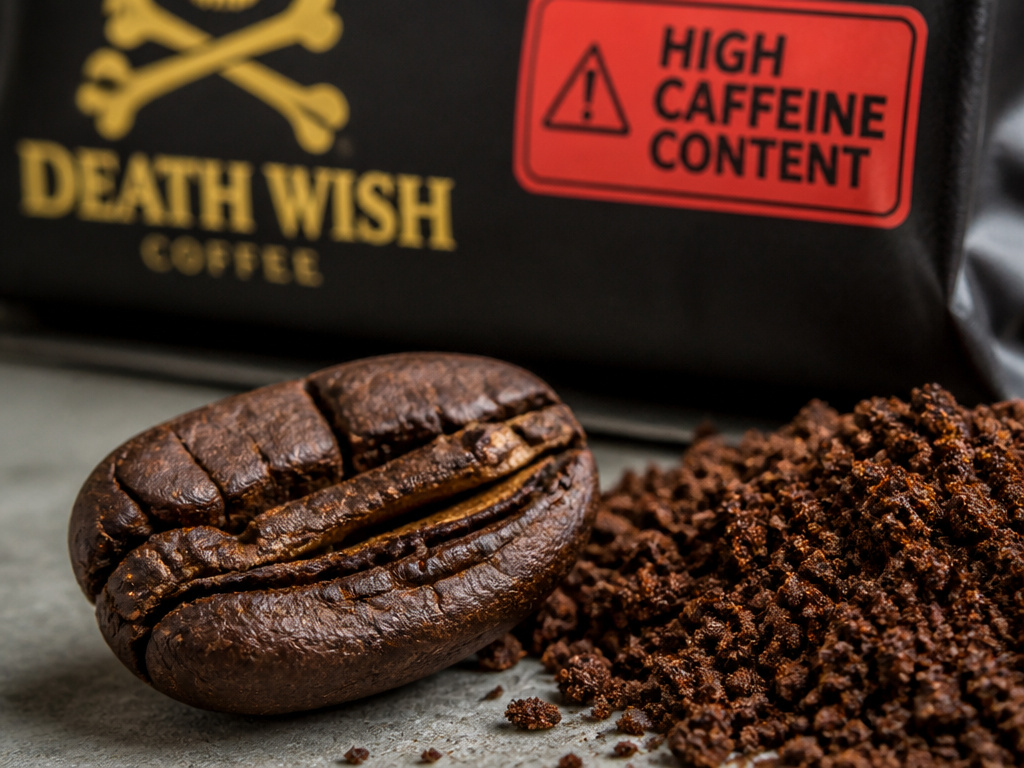
Products like Death Wish Coffee market themselves as the world’s strongest. They achieve this primarily through high Robusta content in their blend. The packaging warns of potential heart palpitations and severe symptoms because a 12oz cup can contain around 720mg of caffeine, six times a typical cup’s 120mg.
YouTube reviewers who tried it reported a significant energy boost within 10-20 minutes after just a few sips. One reviewer noted a “chocolatey cherry” taste but limited consumption to three sips due to the potency. Another, who doesn’t normally drink caffeine, felt completely wired after two sips.
Before you start: High-caffeine coffee can cause tachycardia, anxiety, and insomnia. Know your tolerance. If you have a heart condition or are sensitive to stimulants, avoid these products entirely. Even for regular coffee drinkers, start with a small sample and wait 30 minutes before deciding to finish the cup.
These commercial products are a shortcut. They combine a high-Robusta blend with a dark roast profile for marketing appeal. The caffeine is real. The perceived strength from the dark roast is also real. But as we’ve covered, the dark roast itself isn’t the caffeine source. It’s the bean.
Comparing caffeine sources, a Monster vs coffee energy drink might have similar total caffeine, but the delivery is different. Coffee’s caffeine release is moderated by other compounds. Tea caffeine levels are lower and release even more slowly.
TL;DR: Commercial “strongest” coffees use Robusta blends. They work, but the 720mg caffeine dose is serious. Proceed with extreme caution and know your limits.
Frequently Asked Questions
Does dark roast coffee have more caffeine?
No. Dark roast coffee often has slightly less caffeine per gram because roasting burns off bean mass. The bitter taste creates a perception of strength, but the actual caffeine content can be lower than a light roast of the same bean type.
Is espresso stronger than regular coffee?
Yes, in terms of caffeine concentration per milliliter. A 30ml espresso shot can contain the same caffeine as a 200ml cup of drip coffee. The espresso vs brewed coffee difference is about concentration, not total caffeine per serving.
How can I make my home coffee stronger?
Increase your coffee-to-water ratio towards the ECBC standard’s upper limit of 60 grams per liter. Use a finer grind (target 355 µm). Choose a blend with a higher Robusta percentage. And use filtered water, studies show it improves extraction.
What is the strongest type of coffee bean?
Robusta (Coffea canephora) beans contain approximately 2.2–2.7% caffeine by weight, nearly double the 1.2–1.5% found in Arabica beans. For maximum caffeine, select a blend with a high Robusta content.
Is cold brew stronger than hot coffee?
Not typically. Cold brew usually has a lower caffeine concentration because the cool water extraction is less efficient over time. However, ultra-high-pressure cold brew methods can match conventional hot brew extraction levels, especially with a medium roast.
The Bottom Line
Strength is a split concept. Caffeine strength comes from Robusta beans and concentrated brewing methods like espresso. Perceived strength, or TDS, comes from a fine 355 µm grind, a tight 60g/L coffee-to-water ratio, and filtered water.
Dark roast is a visual and taste cue, not a caffeine guarantee. For the hardest kick, ignore the color and focus on the blend’s Robusta percentage and your grinder setting.
If you venture into commercial ultra-caffeinated coffees, respect the warnings. A 720mg dose is not a typical morning cup. It’s a stimulant event.
Your daily brew can be strong without being dangerous. Measure your beans, grind fine, and use enough coffee. That’s the control you actually have.
