
What Is a Latte Coffee? Learn the Key Components and Recipe
This post contains affiliate links. As an Amazon Associate, we earn from qualifying purchases.
A latte coffee is an espresso drink made with one or two shots of espresso, a larger portion of hot steamed milk, and a thin layer of microfoam. The standard ratio is 1 part espresso to 3-5 parts milk, creating a creamy, balanced beverage where the milk softens but doesn’t mask the coffee’s flavor.
A latte, or caffè latte, is an espresso-based drink composed of one or two shots of espresso, a larger volume of hot steamed milk, and a thin cap (about 1/4 inch) of silky microfoam. The standard ratio is roughly 1 part espresso to 3-5 parts steamed milk, with the foam making up about 10% of the total volume. This structure creates a creamy, balanced beverage where the milk’s sweetness softens the espresso’s intensity without masking its flavor.
Most definitions stop at “espresso and steamed milk,” which is why so many homemade versions taste weak or bland. The mistake is treating the milk as a filler. It’s not. The milk’s temperature, texture, and ratio to espresso are the three variables that separate a milky coffee from a proper latte.
This guide breaks down the latte using primary source manuals from Starbucks and Nespresso, explains the science behind steaming milk, and shows you how to build the drink correctly with any equipment you have at home.
Key Takeaways
- A true caffè latte follows a specific ratio: for a 16oz drink, use 2 shots of espresso, fill to 1/4 inch below the rim with steamed milk, and top with 1/4 inch of foam (per the Starbucks manual).
- Steam milk to 55–65°C (130–149°F). Exceeding 68°C (154°F) denatures the milk proteins, killing the sweetness and creating a scalded, flat flavor.
- The foam for a latte is “microfoam”, tiny, velvety bubbles integrated throughout the milk. This is different from the dry, airy foam of a cappuccino.
- Using drip coffee as a base results in a flat, weak drink because the coffee concentration cannot stand up to the volume of dairy.
- For home brewing without an espresso machine, a Moka pot or a strong Aeropress concentrate is the minimum viable substitute to approximate the required coffee strength.
The Official Latte Recipe (According to the Manuals)
Forget vague descriptions. The procedural specs for a commercial caffè latte are documented in training manuals. The Starbucks Beverage Resource Manual (FS-007-WPS-RC1-1832-PACK) defines it with engineer-level precision.
Caffè Latte: Espresso in steamed milk lightly topped with foam. Fill to ¼” below rim with steamed milk. Top with ¼” foamed milk.
The manual specifies shot counts: a 12-ounce latte gets one shot, while a 16-ounce or 20-ounce gets two. That’s your first non-negotiable. A single shot drowned in 16 ounces of milk is just warm, coffee-flavored milk. The Nespresso Gran Lattissima manual echoes this, defining a caffè latte simply as “a coffee to which a generous amount of hot slightly frothed milk is added.” The word “generous” is key, the milk is the majority component.
TL;DR: The blueprint is 1-2 shots of espresso, steamed milk filled to 1/4 inch from the rim, finished with a 1/4-inch layer of integrated foam.
Espresso: The Non-Negotiable Foundation
The coffee base must be concentrated. This is why the manual says “espresso,” not “strong coffee.” A standard drip coffee brews at about 1:15 coffee-to-water. An espresso shot is roughly 1:2. The difference in dissolved solids is massive. When you try to build a latte with drip coffee, the result tastes watery and thin because the coffee “doesn’t stand a chance under that much dairy,” as one barista guide bluntly puts it.
If you lack an espresso machine, you need a workaround that mimics concentration. A Moka pot brew is the closest widely available substitute. An Aeropress, using a fine grind and a short steep time with minimal water, can also produce a serviceable concentrate. These methods won’t create true crema, but they provide the necessary intensity. The choice of beans matters, too. A balanced espresso blend or a bright single-origin coffee from Ethiopia will behave differently under milk; blends are often crafted for this purpose.
| Brew Method | Coffee-to-Water Ratio | Suitability for Latte | Risk If Used |
|---|---|---|---|
| Espresso | 1:2 | Excellent | None – this is the standard. |
| Moka Pot | 1:5 – 1:7 | Good | Can introduce bitterness if overheated. |
| Aeropress (concentrate) | 1:4 – 1:6 | Fair | May lack body and linger on the palate. |
| Drip / Pour-Over | 1:15 – 1:17 | Poor | Produces a flat, weak, milky drink. |
The Milk Matrix: Volume, Temperature, Texture
The milk does three jobs: it dilutes, sweetens, and textures. Volume is dictated by your cup size minus the espresso and foam. Temperature is a chemical gatekeeper. The consensus range for ideal steamed milk is 55–65°C (130–149°F), cited by experts like James Hoffmann. Scott Rao extends the range to 150–160°F for those who prefer a hotter drink.
Common mistake: Steaming milk until the pitcher is too hot to touch, this usually means you’ve passed 70°C (158°F). The milk proteins denature, the lactose doesn’t fully sweeten, and you’re left with a scalded flavor that no amount of syrup can fix.
Texture is where the craft lives. You are not making whipped cream. You are creating microfoam, a homogenized emulsion of tiny air bubbles suspended in liquid milk. This is what baristas call “wet paint” texture. It pours smoothly and integrates into the espresso, rather than sitting on top like a separate layer.
Steaming Milk: The Science Behind the Silky Texture
Steaming is a physical process, not magic. You are introducing hot water vapor (steam) and air into cold milk. The goal is to stretch the milk proteins (casein and whey) around air bubbles, then heat the liquid to stabilize the foam.
Start with cold milk, preferably whole milk. The fat content stabilizes the foam and carries flavor. Pour into a clean, cold pitcher, filling it only one-third to one-half full. The milk will double in volume. Submerge the steam wand tip just below the surface and open the valve. You’ll hear a distinct paper-tearing sound, this is aeration, or “stretching.”
Aerate for only 2–3 seconds. Any longer and you create large, unstable bubbles typical of a cappuccino. Then, submerge the wand tip deeper to create a whirlpool. This vortex spins the larger bubbles down, breaking them up and folding the foam evenly into the liquid milk. Heat the milk to your target temperature, then shut off the steam and immediately wipe and purge the wand.
TL;DR: Stretch for 2-3 seconds, then whirlpool to heat and integrate. Stop at 65°C (149°F).
Why Milk Alternatives Behave Differently
Not all milks steam the same. This is the biggest hurdle for non-dairy lattes. The protein and fat structures in almond milk, oat milk, and soy milk differ from dairy.
I’ve steamed gallons of various dairy alternatives for coffee. Almond milk, unless specifically formulated for barista use, tends to separate and create thin, large-bubble foam. Oat milk often contains added oils and stabilizers that mimic dairy’s behavior more closely, making it the most reliable non-dairy choice for latte art.
The proteins in these alternatives are less effective at forming the strong, elastic membrane needed for stable microfoam. You can still make a latte, but managing expectations about texture is part of the process. The flavor pairing also changes; the nutty notes of almond milk can complement certain coffees but clash with others.
Latte vs. Cappuccino: It’s About Texture, Not Just Ratios
Many guides say a cappuccino has equal parts espresso, steamed milk, and foam, while a latte has more milk. That’s a simplified rule of thumb, but in modern specialty coffee, the difference is primarily texture.
Watch a barista pour. For a latte, they pour the steamed milk from a height, mixing it thoroughly with the espresso to create a uniform, creamy brown base before finishing with a small layer of foam. For a cappuccino, they pour immediately after steaming, often tilting the cup to let the thicker, drier foam slide on top, resulting in a distinct white layer over a darker base.
The YouTube transcript from a barista tutorial captures it perfectly: “For the cappuccino… we don’t mix in we swirl our espresso we tilt and we want to get that foam all on top so our top should be completely White.” The latte milk is integrated; the cappuccino foam is layered.
| Characteristic | Caffè Latte | Cappuccino |
|---|---|---|
| Milk Texture | Microfoam (integrated, wet) | Dry foam (airy, layered) |
| Foam Proportion | ~10% of volume | ~30% or more of volume |
| Visual Result | Uniform light brown, possible latte art | Distinct white foam dome on top |
| Mouthfeel | Creamy, smooth, liquid | Thick, fluffy, airy |
| Espresso Presence | Mellowed, balanced | More pronounced through the foam |
This texture difference also affects the caffeine in cappuccinos versus lattes. Since the espresso portion is identical for the same size, the caffeine content is the same. The difference in perception comes from the cappuccino’s foam, which delivers a stronger initial coffee hit before the milk mixes in.
How to Make a Latte Without an Espresso Machine
You can approximate a latte without a $2000 machine. The principle remains: strong coffee concentrate + hot, textured milk.
- Make the concentrate. Use a Moka pot. Grind coffee slightly coarser than espresso but finer than drip. Fill the basket without tamping, assemble, and brew on medium heat until you hear a gurgle. Alternatively, use an Aeropress with 18g of fine coffee, add 60g of water just off boil, stir for 30 seconds, press gently, then dilute slightly with 30g of hot water.
- Heat and texture the milk. Pour 6-8 oz of milk into a glass jar with a lid. Seal tightly and shake vigorously for 30-45 seconds until the milk is frothy and has doubled in volume. Remove the lid and microwave for 30-45 seconds. The heat will stabilize the foam. A handheld electric milk frother is a better, low-cost tool that creates finer foam than the jar method.
- Assemble. Pour the coffee concentrate into your cup. Gently pour the hot milk over the coffee, using a spoon to hold back the larger bubbles from the jar method so the liquid milk integrates first. Then spoon the remaining foam on top.
This won’t win a barista competition, but it creates a satisfying, layered drink that respects the latte’s structure. For sweetness, consider brown sugar or vanilla syrup, which integrate better than white sugar.
The Latte Family Tree: Iced, Flavored, and Regional Variations
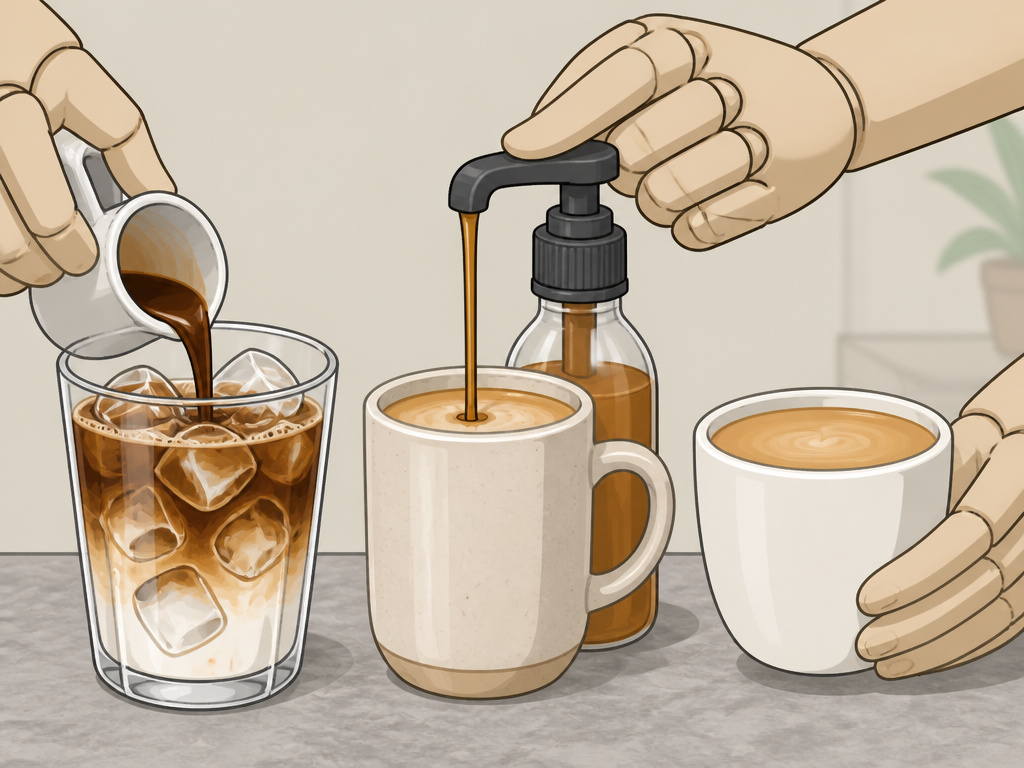
The classic caffè latte is the anchor, but the format is versatile.
- Iced Latte: This is a wildly different drink. It’s simply espresso poured over cold milk and ice. No steaming, no foam. The dilution comes from the ice melt, so a stronger espresso shot or an extra shot is recommended. It’s crisp and refreshing, not creamy.
- Flavored Latte: Add syrup to the espresso before adding milk. The Starbucks manual specifies pump counts: 4 pumps (1 fl. oz.) of syrup for a 16oz latte. Common flavors are vanilla, caramel, and hazelnut.
- Regional Variations: You might see terms like “Kyoto latte” (which often uses cold brew concentrate) or “Turkish latte” (which may use finely ground coffee). These are shop-specific interpretations. The core idea, a coffee concentrate with milk, holds.
When customizing, remember the calories in milk are your primary calorie source. Switching from whole milk to skim or a plant-based milk in coffee like almond milk changes the nutritional profile and the mouthfeel significantly.
Frequently Asked Questions
Is a latte just coffee with milk?
No. It is specifically espresso with steamed milk and a thin layer of microfoam. Using regular brewed coffee results in a much weaker, different drink often called a “café au lait.”
How much caffeine is in a latte?
The caffeine comes from the espresso shots. A single shot has about 63mg of caffeine, and a double has about 126mg. The milk adds no caffeine. So a 16oz latte with two shots has the same caffeine as a double espresso shot or a small cup of drip coffee.
Can I make a latte with a regular coffee maker?
Not a true latte. You can make a similar milk-and-coffee drink, but without the pressure-brewed concentration of espresso or the texture of steamed milk, it will not have the same balance or body. A Moka pot is the minimum viable tool for the coffee base.
What’s the best milk for a latte?
Whole dairy milk is the standard because its fat and protein content create the richest, sweetest, and most stable microfoam. For non-dairy, barista-formula oat milk is the most consistent for steaming and flavor.
Why is my homemade latte foam disappearing?
Your foam is likely made of large, unstable bubbles. This happens from over-aerating (too much of the paper-tearing sound) or using low-protein milk. Ensure you are creating a whirlpool after a brief stretch to integrate the foam into the liquid milk.
What’s the difference between a latte and a flat white?
flat white has less milk and less foam than a latte. It typically uses two shots of espresso in a smaller cup (5-6oz), with steamed milk that has only a velvety microfoam layer, resulting in a stronger coffee flavor.
Before You Go
A latte is a defined formula, not a vague concept. It requires espresso, a majority of steamed milk heated to 55–65°C, and a cap of integrated microfoam. The Starbucks manual gives us the blueprint: fill to 1/4 inch below the rim with steamed milk, top with 1/4 inch of foam. The difference between a latte and a cappuccino lives in the milk’s texture, integrated microfoam versus dry, layered foam.
Your home setup dictates your approach. An espresso machine is ideal. A Moka pot and a frothing wand are a solid plan B. A drip machine and a microwave are a different drink altogether. Choose your coffee grinder wisely; grind consistency from a burr coffee grinder is non-negotiable for good espresso or Moka pot coffee. Start with the right ratio, steam with temperature discipline, and pour with intent. The result is a creamy, balanced cup that celebrates both the coffee and the craft.
{
“@context”: “https://schema.org”,
“@type”: “HowTo”,
“name”: “How to Make a Traditional Caffè Latte”,
“totalTime”: “PT8M”,
“tool”: [
{
“@type”: “HowToTool”,
“name”: “Espresso machine with steam wand”
},
{
“@type”: “HowToTool”,
“name”: “Milk pitcher (12-20 oz)”
},
{
“@type”: “HowToTool”,
“name”: “Digital thermometer”
}
],
“supply”: [
{
“@type”: “HowToSupply”,
“name”: “Freshly ground espresso (18-20g)”
},
{
“@type”: “HowToSupply”,
“name”: “Whole milk (6-8 oz)”
}
],
“step”: [
{
“@type”: “HowToStep”,
“name”: “Pull a double shot of espresso”,
“text”: “Grind 18-20g of coffee and pull a 1:2 ratio shot (36-40g output) into a preheated cup.”
},
{
“@type”: “HowToStep”,
“name”: “Steam the milk to 55-65°C (130-149°F)”,
“text”: “Submerge the steam wand tip, aerate for 2-3 seconds to stretch the milk, then submerge deeper to create a whirlpool and heat to the target temperature.”
},
{
“@type”: “HowToStep”,
“name”: “Tap and swirl the pitcher”,
“text”: “Tap the pitcher on the counter to pop large bubbles, then swirl to integrate the foam and create a glossy, paint-like texture.”
},
{
“@type”: “HowToStep”,
“name”: “Pour and integrate”,
“text”: “Pour the steamed milk into the center of the espresso from a height of 2-3 inches to mix the liquids, then lower the pitcher for the final pour to layer the foam on top.”
}
]
}
{
“@context”: “https://schema.org”,
“@type”: “FAQPage”,
“mainEntity”: [
{
“@type”: “Question”,
“name”: “Is a latte just coffee with milk?”,
“acceptedAnswer”: {
“@type”: “Answer”,
“text”: “No. It is specifically espresso with steamed milk and a thin layer of microfoam. Using regular brewed coffee results in a much weaker, different drink often called a \”café au lait.\””
}
},
{
“@type”: “Question”,
“name”: “How much caffeine is in a latte?”,
“acceptedAnswer”: {
“@type”: “Answer”,
“text”: “The caffeine comes from the espresso shots. A single shot has about 63mg of caffeine, and a double has about 126mg. The milk adds no caffeine. So a 16oz latte with two shots has the same caffeine as a double espresso shot or a small cup of drip coffee.”
}
},
{
“@type”: “Question”,
“name”: “Can I make a latte with a regular coffee maker?”,
“acceptedAnswer”: {
“@type”: “Answer”,
“text”: “Not a true latte. You can make a similar milk-and-coffee drink, but without the pressure-brewed concentration of espresso or the texture of steamed milk, it will not have the same balance or body. A Moka pot is the minimum viable tool for the coffee base.”
}
},
{
“@type”: “Question”,
“name”: “What’s the best milk for a latte?”,
“acceptedAnswer”: {
“@type”: “Answer”,
“text”: “Whole dairy milk is the standard because its fat and protein content create the richest, sweetest, and most stable microfoam. For non-dairy, barista-formula oat milk is the most consistent for steaming and flavor.”
}
},
{
“@type”: “Question”,
“name”: “Why is my homemade latte foam disappearing?”,
“acceptedAnswer”: {
“@type”: “Answer”,
“text”: “Your foam is likely made of large, unstable bubbles. This happens from over-aerating (too much of the paper-tearing sound) or using low-protein milk. Ensure you are creating a whirlpool after a brief stretch to integrate the foam into the liquid milk.”
}
},
{
“@type”: “Question”,
“name”: “What’s the difference between a latte and a flat white?”,
“acceptedAnswer”: {
“@type”: “Answer”,
“text”: “flat white has less milk and less foam than a latte. It typically uses two shots of espresso in a smaller cup (5-6oz), with steamed milk that has only a velvety microfoam layer, resulting in a stronger coffee flavor.”
}
}
]
}
