
Comparing Arabica and Robusta Coffee Beans: Flavor & Uses
Robusta coffee beans vs Arabica beans comes down to three measurable differences: bean shape (round vs oval), caffeine content (2.7% vs 1.5%), and sugar content (3-7% vs 6-9%). Robusta grows below 800 meters, yields more, and fights disease better. Arabica needs cooler, higher altitudes above 1,200 meters and is far more vulnerable to climate change and Coffee Leaf Rust.
Most people think they’re choosing between premium and cheap. The real split is between a workhorse bean that survives climate stress and a delicate one prized for its flavor. That cheap diner cup is usually Robusta. Your single-origin pour-over is Arabica. But a 2023 study on Menoreh Robusta found cupping scores over 80 across wet, semi-wet, and hybrid processing, officially classifying it as Fine Robusta. Processing changes everything.
This guide breaks down the plants, the chemistry, and the real-world trade-offs. You will learn how to spot them, how processing alters their flavor, and which one actually belongs in your grinder.
Key Takeaways
- Robusta beans are round with a straight center cut and pack 2.7% caffeine. Arabica beans are oval with a curved crease and contain 1.5% caffeine.
- Fine Robusta exists. A 2023 study on hybrid-processed Menoreh Robusta recorded cupping scores above 80, with flavor notes of brown sugar, spice, and coconut milk.
- Arabica’s vulnerability is physical. Wild populations could decline by 50-80% by 2088 due to climate change, and Coffee Leaf Rust cost Central America $2 billion in a single year.
- Your brewing method picks the bean. Robusta’s bold, low-acidity body and thick crema make it ideal for espresso blends and Vietnamese phin filters. Arabica’s nuanced sweetness and acidity shine in filter coffee.
- Processing is the wild card. Wet processing boosts Robusta’s antioxidant activity and lowers its caffeine to 2.21%. Hybrid processing increases its fat and protein content, changing the mouthfeel.
What’s the Main Physical Difference?
Look at the beans. Robusta (Coffea canephora) beans are small, round, and uniform. They have a straight cut down the center. Arabica (Coffea arabica) beans are larger, more elongated, and oval-shaped. Their center cut is a distinct, curved crease.
The shape tells you about the plant’s hardiness. Robusta’s compact, round form comes from a tougher, more disease-resistant plant that thrives in hot, low-altitude plains. Arabica’s slender, elongated bean grows on a more delicate bush that needs the cool, misty air of high mountain slopes. You can feel the difference in your hand. Robusta beans are denser. Arabica beans have a slightly softer, more porous structure.
Robusta beans (Coffea canephora) are typically round and uniform with a straight center cut, ranging from small to medium (S13–S18) in size. Arabica beans are elongated and oval-shaped with a curved center crease, measuring 8.5–12.5 mm in length.
TL;DR: Round bean, straight cut, dense feel = Robusta. Oval bean, curved crease, softer feel = Arabica.
Caffeine and Sugar: The Chemical Split
The numbers don’t lie. Robusta contains 2.7% caffeine by dry weight. Arabica contains 1.5%. That’s nearly double the kick in every gram. This isn’t a minor difference. It’s the reason your afternoon espresso blend keeps you awake and your morning pour-over doesn’t.
Sugar content flips the script. Arabica beans hold 6-9% sugar. Robusta beans only carry 3-7%. That sugar is fuel for the Maillard reaction during roasting, creating Arabica’s celebrated caramel and fruity notes. Robusta’s lower sugar means more of its flavor comes from other compounds like chlorogenic acid, which translates directly to bitterness.
This chemical split dictates the drinking experience. Want a potent, bitter, full-bodied cup with a thick crema? You’re describing Robusta. Prefer a sweeter, brighter, more acidic cup with layered aromatics? That’s Arabica’s domain. For a direct look at how these numbers play out in a cup, our comparison of espresso caffeine content versus brewed coffee breaks down the per-volume impact.
| Compound | Robusta (Coffea canephora) | Arabica (Coffea arabica) | Impact on Your Cup |
|---|---|---|---|
| Caffeine | 2.7% (high) | 1.5% (standard) | Robusta delivers a stronger stimulant punch. |
| Sugar | 3–7% (low) | 6–9% (high) | Arabica develops more caramelized sweetness during roast. |
| Chlorogenic Acid | Higher | Lower | Contributes to Robusta’s characteristic bitterness. |
| Lipid (Oil) Content | Lower | Higher | Arabica’s oils carry more volatile aromatics. |
If you’re caffeine-sensitive but love coffee, seek out the low-caffeine Arabica strains AC1, AC2, or AC3, which contain a mere 0.76 mg of caffeine per gram. They’re rare, but they prove the species has genetic flexibility.
How Processing Changes Everything
Bag labels lie. “100% Arabica” is a marketing legend that several major roasters quietly dropped in 2023, blending in cheaper Robusta while keeping the packaging familiar. The truth is on the farm, in the processing method.
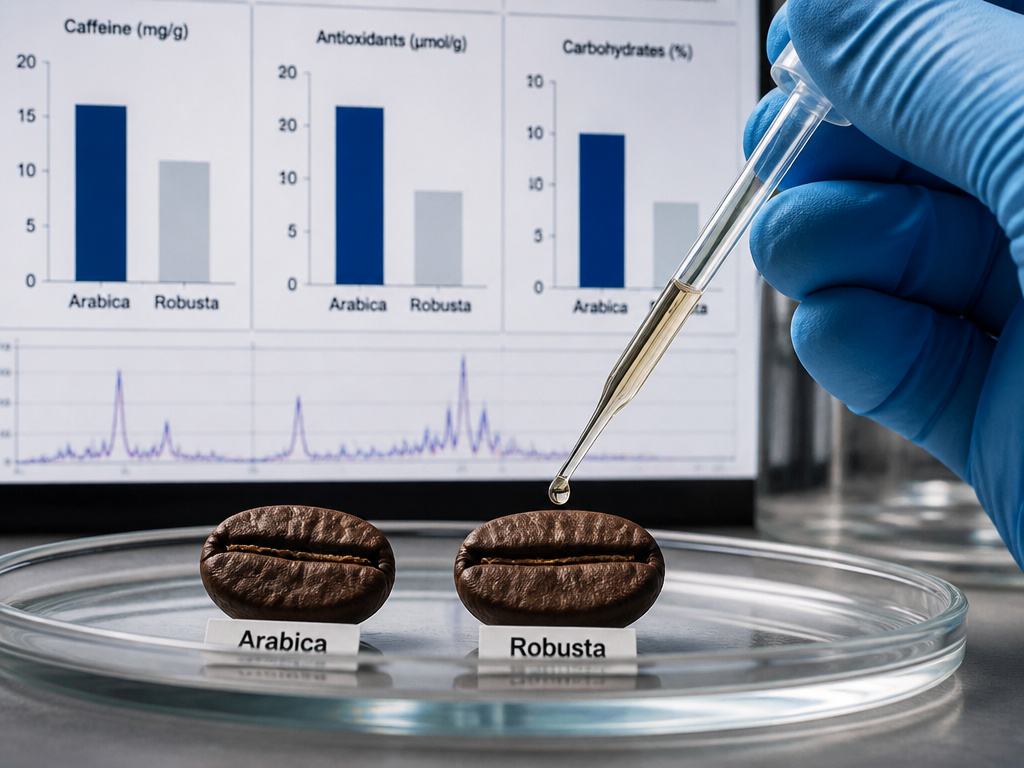
A 2023 peer-reviewed study on Menoreh Robusta from Indonesia tested three processes: wet, semi-wet, and hybrid. Every sample scored above 80 on the cupping scale, qualifying as Fine Robusta. The processing method didn’t just change the score. It rewired the bean’s chemistry.
Wet processing gave the highest antioxidant activity and the lowest caffeine content (2.21%). It also produced the highest levels of total flavonoids and phenolics. Semi-wet processing locked in the highest carbohydrate content at 65.66%. Hybrid processing pushed fat content to 7.76% and protein to 14.72%, while generating a complex volatile profile with notes of brown sugar, spices, coconut milk, chocolate, and rubber.
Hybrid-processed Menoreh Robusta recorded a sensory profile of sweet, clean aftertaste with notes of brown sugar, spice, buttery coconut milk, chocolate, rubber, caramel, and banana leaf, according to a 2023 study published in Pertanika Journal.
The takeaway is simple. You can no longer judge a bean by its species. A well-processed Robusta can out-cup a poorly processed Arabica. This is why some Indian Robusta farmers produce lots that, as one YouTube coffee educator put it, “could beat Arabica cup any day.” When you’re choosing beans, the processing description on the bag, natural, washed, honey, hybrid, matters as much as the species name.
TL;DR: Wet, semi-wet, or hybrid processing can turn commercial Robusta into Fine Robusta with cupping scores above 80. The method changes the caffeine, antioxidant, and flavor compound levels.
The Plants: Climate, Disease, and Survival
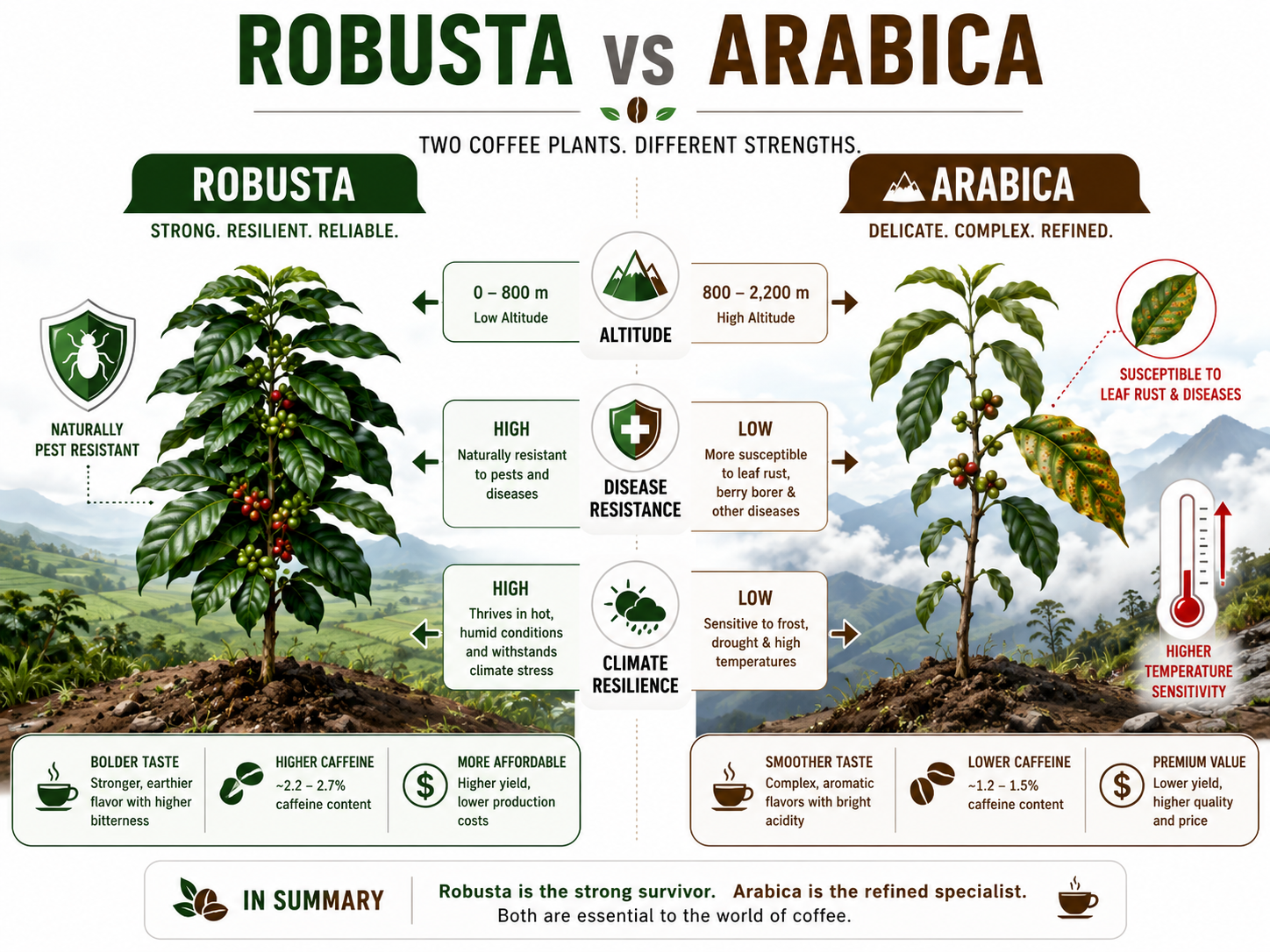
Where they grow decides their fate. Robusta is a survivor. It thrives below 800 meters above sea level, tolerates heat, and resists pests. Its fruit takes up to 10 months to mature, and it yields more beans per plant. You can find the full botanical profile in the Wikipedia entry on Robusta coffee.
Arabica is the diva. It needs altitude, ideally between 1,200 and 1,500 meters, and a steady annual rainfall of 1.2 to 1.8 meters. Its optimum temperature range is a narrow 18–23°C (64–73°F). The Kew Gardens Arabica coffee profile notes it’s an understory plant that requires standing forest, which is disappearing.
Arabica’s weaknesses are catastrophic. Coffee Leaf Rust (Hemileia vastatrix) caused a 16% drop in production across Central America from 2012 to 2013, with losses up to $2 billion annually. The fungus defoliates plants, starving them. Climate change projections estimate wild C. arabica populations could shrink by 50–80% by 2088. The Coffee Berry Borer pest is now climbing into altitudes that were once too cold.
Robusta’s hardiness is why corporations like Nestlé are investing in its genetics for climate-resilient blends. It’s not just about cost. It’s about having a coffee crop in 50 years.
| Trait | Robusta | Arabica | Consequence |
|---|---|---|---|
| Altitude | Below 800 m | 1,200–1,500 m (ideal) | Robusta farms on lowland plains; Arabica needs mountains. |
| Disease Resistance | High | Low | Arabica is vulnerable to Coffee Leaf Rust and Berry Borer. |
| Climate Change Resilience | High | Low (50–80% wild pop. loss projected) | Robusta is the future crop for a warming planet. |
| Yield per Plant | Greater | 0.5–5.0 kg | Robusta produces more beans, justifying its lower price. |
TL;DR: Robusta grows easy and fights off disease. Arabica needs perfect, fragile mountain ecosystems and is losing ground to climate change.
Taste and Use: Which Bean Wins Where?
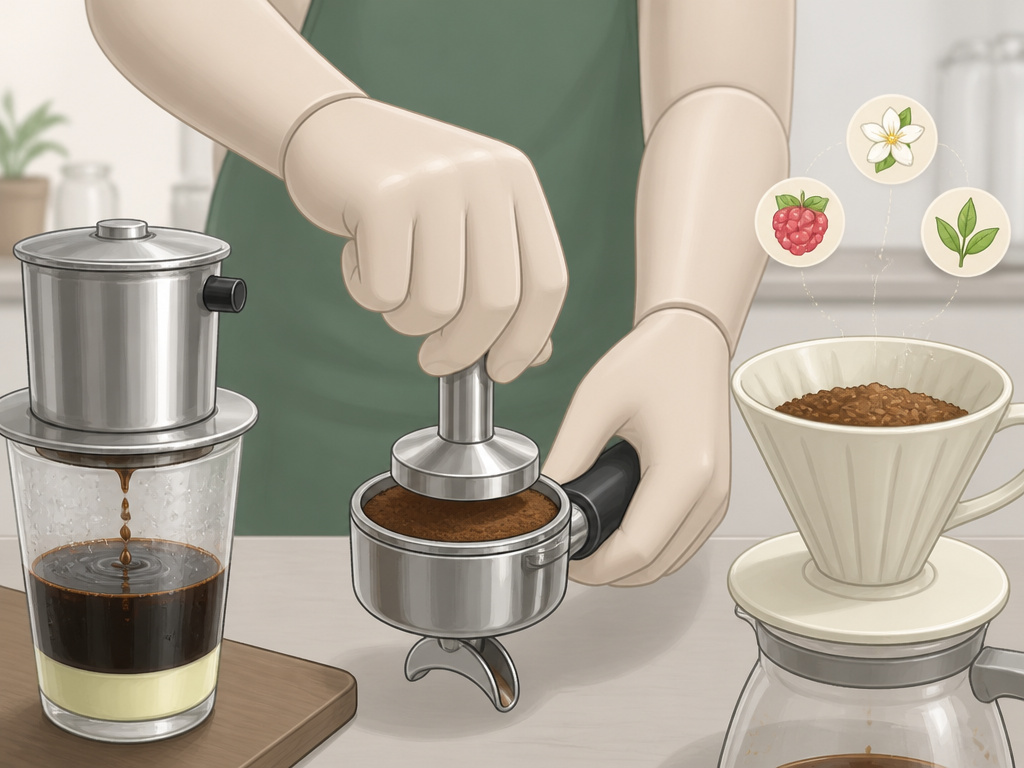
Your brewing method picks the winner. This isn’t about good versus bad. It’s about matching the bean’s inherent qualities to the extraction process.
Espresso and Milk Drinks
Robusta is the secret ingredient in traditional Italian espresso blends, often making up 5-20% of the mix. Its high caffeine and low acidity cut through milk, and its compounds create a thicker, more persistent crema. Arabica alone can taste thin in a latte. A blend gives you body from the Robusta and nuance from the Arabica. For the best results, pair either bean with a consistent burr grinder rather than a blade grinder.
Filter and Pour-Over
Here, Arabica dominates. Its higher sugar content and complex volatile compounds, things like linalool and pyrazines, unfold during a slower brew. You get the floral, fruity, tea-like notes that define specialty third-wave coffee. A high-quality, wet-processed Arabica from Kenya or Ethiopia is the benchmark. Robusta in filter coffee often tastes flat, woody, and harsh unless it’s a meticulously processed Fine Robusta.
Vietnamese Phin Filter and Strong Brews
The traditional Vietnamese phin filter was designed for Robusta. The metal filter, slow drip, and often sweetened condensed milk complement Robusta’s bold, bitter, low-acidity profile. It makes a strong, gritty cup that stands up to milk and sugar. Using a delicate Arabica in a phin can taste weak and sour.
Instant Coffee and Commercial Ground Blends
Robusta is the industry workhorse here. Its bold flavor survives freeze-drying and spray-drying better than subtle Arabica notes. Its lower cost keeps production prices down. That jar of instant in your pantry is almost certainly primarily Robusta.
Common mistake: Using a light-roast Arabica for espresso expecting bright acidity, the high pressure and heat of an espresso machine often turn those delicate acids into sharp, unpleasant sourness. A medium or dark roast, or a blend with some Robusta, balances it.
The debate between coffee blends and single-origin coffees often centers on this bean choice. A blend masterfully marries Robusta’s body with Arabica’s aroma.
Fine Robusta vs. Commercial Arabica: The Quality Flip
The old rule was simple: Arabica good, Robusta bad. The new data breaks that rule. The 2023 Menoreh Robusta study proved that with careful processing, Robusta can score as “Fine” on the cupping scale. Meanwhile, bulk commercial Arabica, grown for yield on massive farms, can taste flat and one-dimensional.
I cupped a hybrid-processed Robusta from India blind last year. It scored an 84. It had a sweetness I’d never associated with the species, a clean aftertaste, and a body that coated the mouth. I’ve had commercial-grade “100% Arabica” that scored lower and tasted like paper.
Quality is now a function of farming and processing, not just species. A shaded, carefully harvested, and precisely processed Robusta can outscore a commodity Arabica. This is why some roasters are quietly blending small percentages of Fine Robusta into their single-origin offerings. It adds body and crema without dragging down the scorecard.
The flip side is also true. A poorly processed, hastily dried Arabica from a stressed plant will taste vegetal and sour, no matter how prestigious its name. The species gives you a range of potential. The craft decides the outcome.
Which One Should You Buy?
Your goal at the counter is to match the bean to the brew. Ignore the marketing and read the details.
Choose Robusta if:
- You brew espresso, especially with milk.
- You use a Vietnamese phin filter.
- You want a high-caffeine, low-acidity kick.
- The bag specifies a processing method (hybrid, wet) and a cupping score.
- You’re on a tighter budget.
Choose Arabica if:
- You primarily brew filter coffee (pour-over, drip, French press).
- You prefer bright, acidic, complex flavor profiles.
- You seek out specific single-origin Arabica from regions like Colombia or Ethiopia.
- You’re exploring lighter blonde roast beans, which highlight Arabica’s delicate notes.
- You are caffeine-sensitive (or seek the low-caffeine AC strains).
Try a Fine Robusta if:
- You want to challenge your own palate.
- You see a bag with a specific processing method and a cupping score above 80.
- You enjoy earthy, chocolatey, full-bodied cups.
Don’t buy based on species alone. A “100% Arabica” label on a generic supermarket bag guarantees nothing about quality. A “Fine Robusta” label with a processing description and a score is a much stronger signal of a thoughtful product.
Frequently Asked Questions
Which has more caffeine, Robusta or Arabica?
Robusta has nearly double the caffeine. It contains 2.7% caffeine by dry weight, compared to Arabica’s 1.5%. A single shot of espresso made with a Robusta blend will have significantly more stimulant power than one made with pure Arabica.
Why is Robusta cheaper than Arabica?
Robusta plants yield more beans per harvest, grow at lower altitudes with fewer climate restrictions, and are naturally resistant to pests and diseases like Coffee Leaf Rust. This makes them cheaper and easier to farm on a large scale.
Can Robusta coffee taste good?
Yes, absolutely. Traditional processing often led to harsh, rubbery flavors. Modern processing methods, like the hybrid process used on Menoreh Robusta in Indonesia, can produce cupping scores above 80 (Fine Robusta) with flavor notes of brown sugar, spice, and coconut milk.
Is Arabica coffee less acidic?
No, Arabica is generally more acidic than Robusta. Its higher sugar and complex acid profile create the bright, wine-like acidity that specialty coffee drinkers seek. Robusta is known for its low acidity, which is why it blends well into espresso.
What’s the health difference between Robusta and Arabica?
Wet-processed Robusta tested highest in antioxidant activity and total flavonoids in a 2023 study. Arabica, particularly shade-grown varieties, can have higher levels of trigonelline, which is associated with aroma and antioxidant activity. The health benefits of tea versus coffee often focus on different compounds, like EGCG and L-theanine.
The Bottom Line
Forget good versus bad. Robusta and Arabica are tools for different jobs. Robusta is the resilient, high-caffeine, full-bodied workhorse built for espresso and a warming climate. Arabica is the delicate, nuanced, acid-forward artist that needs perfect conditions to sing.
The new rule is on the label, not the species. Look for the processing method and the cupping score. A hybrid-processed Fine Robusta with an 84 is a better coffee than a poorly processed commercial Arabica with no score at all. Your brewing method makes the final call. Let your grinder be the judge.
{
“@context”: “https://schema.org”,
“@type”: “HowTo”,
“name”: “How to Choose Between Robusta and Arabica Coffee Beans”,
“tool”: [
{
“@type”: “HowToTool”,
“name”: “Coffee cupping spoon”
},
{
“@type”: “HowToTool”,
“name”: “Burr grinder set to medium-coarse”
},
{
“@type”: “HowToTool”,
“name”: “Digital kitchen scale”
},
{
“@type”: “HowToTool”,
“name”: “Vietnamese phin filter or espresso machine”
}
],
“step”: [
{
“@type”: “HowToStep”,
“name”: “Identify your use case”,
“text”: “Match the bean to your brewing method: Robusta for bold, high-caffeine espresso or phin filter; Arabica for nuanced filter coffee or light roasts.”
},
{
“@type”: “HowToStep”,
“name”: “Check the bean shape and size”,
“text”: “Look for round, uniform beans with a straight center cut for Robusta (S13-S18 size). Look for elongated, oval beans for Arabica.”
},
{
“@type”: “HowToStep”,
“name”: “Evaluate processing method on the bag”,
“text”: “Seek out Robusta labeled ‘hybrid processed’ or ‘wet processed’ for higher cupping scores and complex flavors like brown sugar or coconut.”
},
{
“@type”: “HowToStep”,
“name”: “Taste for the defining characteristics”,
“text”: “Brew and taste: Robusta delivers bold body, bitter chocolate, and low acidity. Arabica offers brighter acidity, floral notes, and sweetness.”
},
{
“@type”: “HowToStep”,
“name”: “Decide based on caffeine need”,
“text”: “Choose Robusta if you want nearly double the caffeine (2.7% vs 1.5% by weight). Choose a low-caffeine Arabica strain (AC1-3) if you’re sensitive.”
}
]
}
{
“@context”: “https://schema.org”,
“@type”: “FAQPage”,
“mainEntity”: [
{
“@type”: “Question”,
“name”: “Which has more caffeine, Robusta or Arabica?”,
“acceptedAnswer”: {
“@type”: “Answer”,
“text”: “Robusta has nearly double the caffeine. It contains 2.7% caffeine by dry weight, compared to Arabica’s 1.5%. A single shot of espresso made with a Robusta blend will have significantly more stimulant power than one made with pure Arabica.”
}
},
{
“@type”: “Question”,
“name”: “Why is Robusta cheaper than Arabica?”,
“acceptedAnswer”: {
“@type”: “Answer”,
“text”: “Robusta plants yield more beans per harvest, grow at lower altitudes with fewer climate restrictions, and are naturally resistant to pests and diseases like Coffee Leaf Rust. This makes them cheaper and easier to farm on a large scale.”
}
},
{
“@type”: “Question”,
“name”: “Can Robusta coffee taste good?”,
“acceptedAnswer”: {
“@type”: “Answer”,
“text”: “Yes, absolutely. Traditional processing often led to harsh, rubbery flavors. Modern processing methods, like the hybrid process used on Menoreh Robusta in Indonesia, can produce cupping scores above 80 (Fine Robusta) with flavor notes of brown sugar, spice, and coconut milk.”
}
},
{
“@type”: “Question”,
“name”: “Is Arabica coffee less acidic?”,
“acceptedAnswer”: {
“@type”: “Answer”,
“text”: “No, Arabica is generally more acidic than Robusta. Its higher sugar and complex acid profile create the bright, wine-like acidity that specialty coffee drinkers seek. Robusta is known for its low acidity, which is why it blends well into espresso.”
}
},
{
“@type”: “Question”,
“name”: “What’s the health difference between Robusta and Arabica?”,
“acceptedAnswer”: {
“@type”: “Answer”,
“text”: “Wet-processed Robusta tested highest in antioxidant activity and total flavonoids in a 2023 study. Arabica, particularly shade-grown varieties, can have higher levels of trigonelline, which is associated with aroma and antioxidant activity. The health benefits of tea versus coffee often focus on different compounds, like EGCG and L-theanine.”
}
}
]
}
