
Is Coffee an Acidic Drink? The Complete Facts on pH & Acidity
Coffee is an acidic drink, with a typical pH range of 4.85 to 5.10, due to a complex mix of organic acids like chlorogenic, citric, and quinic acid. Its perceived sourness or brightness, what coffee professionals call acidity, is a separate measure known as titratable acidity, which peaks during the first crack of roasting and is heavily influenced by bean origin and brew method.
Most people get this wrong because they confuse two different things: the chemical definition of acidity (pH) and the sensory experience of it in the cup. pH tells you the concentration of hydrogen ions, but your tongue perceives a combination of sourness, brightness, and fruitiness that changes wildly with how the bean was grown, roasted, and brewed.
This guide breaks down the peer-reviewed data on coffee acids, shows you how roasting and brewing transform them, and gives you concrete ways to enjoy your coffee without the gut punch.
Key Takeaways
- Coffee’s pH (4.85–5.10) is less acidic than soda or orange juice but can still trigger reflux in sensitive people.
- Titratable Acidity (TA), the measure of all acid molecules present, determines perceived brightness and peaks during the first crack of roasting.
- A 2024 study in Scientific Reports found roast profile changes TA dynamics, a 9-minute “EF” profile produced double the TA of an “SS” profile in the same time.
- Brazilian and Bolivian coffees often have higher total acid concentrations than Kenyan coffees, contradicting the common “Kenyan = more acidic” belief.
- Cold brewing and using a darker roast are the most effective ways to lower both the pH and the perceived acidity in your cup.
What’s the pH of Coffee?
pH measures the concentration of hydrogen ions in a solution on a logarithmic scale from 0 (very acidic) to 14 (very alkaline). A lower pH number means a higher concentration of acidic ions. Brewed coffee consistently lands between 4.85 and 5.10. Place that on the common beverage scale: orange juice sits around 3.5, most sodas are between 2.5 and 3.5, and milk is closer to 6.7. Coffee is less acidic than many popular drinks but firmly on the acidic side of neutral (pH 7.0).
The pH number is a static snapshot of one chemical property. It doesn’t tell you which acids are present, how many acid molecules are in the cup, or how your palate will interpret them. That’s why two coffees with identical pH can taste completely different, one bright and fruity, the other flat and dull.
The average pH of brewed coffee ranges from 4.85 to 5.10, as reported by health and nutrition aggregators citing food chemistry databases. This places it above many fruit juices and soft drinks on the pH scale but below neutral water. The specific value fluctuates based on coffee-to-water ratio, roast degree, and bean origin.
TL;DR: Coffee’s pH of 4.85–5.10 confirms it is chemically acidic, but this number alone is a poor predictor of taste or digestive impact.
The Acid Lineup: What You’re Actually Tasting
When you taste “acidity” in coffee, you’re not tasting pH. You’re tasting a cocktail of specific organic acids, each with its own flavor profile and detection threshold. The major players are chlorogenic, citric, malic, acetic, and quinic acids. A pivotal NIH study on coffee acids quantified these in brewed coffee, giving us hard numbers.
| Acid | Typical Concentration in Brewed Coffee | Flavor Contribution | Sensory Detection Threshold |
|---|---|---|---|
| Chlorogenic Acid (CGA) | 70–350 mg per cup | Astringency, bitterness; precursor to brighter acids | Not a direct flavor; breaks down during roasting |
| Citric Acid | 0.23–0.60 g/L | Bright, citrusy, lemony | <0.16 g/L (or <0.16 mg/mL) |
| Malic Acid | Present (varies) | Apple-like, crisp, tart | 0.20 mg/mL |
| Acetic Acid | Present (varies) | Vinegar, sharp, pungent | >0.31 mg/mL |
| Quinic Acid | Increases with roast | Dry, astringent, sour | Not firmly established |
The “sensory detection threshold” is critical. It’s the minimum concentration at which a trained taster can identify that specific acid. Citric acid has a very low threshold, it’s easy to taste even in small amounts. That’s why coffees with higher citric content, often from Brazilian origins, taste distinctly bright. Acetic acid, on the other hand, requires a higher concentration to be noticed; if you taste vinegar, something went wrong with fermentation or storage.
Why this matters: Your perception of a coffee as “too acidic” often means one specific acid has crossed its detection threshold for you. For some, it’s citric; for others, it’s quinic. Knowing which one helps you choose beans and roasts to avoid it.
Common mistake: Assuming all sourness is from “acidity”, a metallic or sharp sour note is often quinic acid from over-roasting or stale coffee, while a pleasant lemon zing is citric acid from a light roast.
How Roasting Transforms Coffee Acidity
Roasting is where the acid profile gets rewritten. Green coffee beans are loaded with chlorogenic acid (CGA), making up 6–10% of their dry weight. CGA isn’t directly sour, but it’s the parent molecule for several other acids. As the roaster applies heat, CGA decomposes. First, it breaks into caffeic acid and quinic acid. With more heat and time, those break down further.
The relationship between roast degree and acidity isn’t linear. A coffee bean extract pH study found that extract pH decreases (becomes more acidic) up to a medium roast, then increases (becomes less acidic) into dark roast territory. This U-shaped curve happens because early in the roast, CGA breaks down into acids that lower pH. Later, those acids themselves decompose or volatilize, and the pH climbs back up.
The most insightful measure for taste is Titratable Acidity (TA). TA measures all the acid molecules available to react with a base. Research published in Scientific Reports tracked TA in real-time during commercial-scale roasting. They found TA invariably peaks during the first crack, then decays. But the roast profile dictated the peak’s height: a 9-minute roast on one profile yielded a TA of 2.4, while the same time on another profile hit 4.9.
The practical takeaway: A dark roast tastes less acidic because prolonged heat has destroyed more acid molecules, raising the pH and lowering the TA. The trade-off is the loss of the bright, fruity notes those acids provided.
Bean Origin Myths and Acid Reality
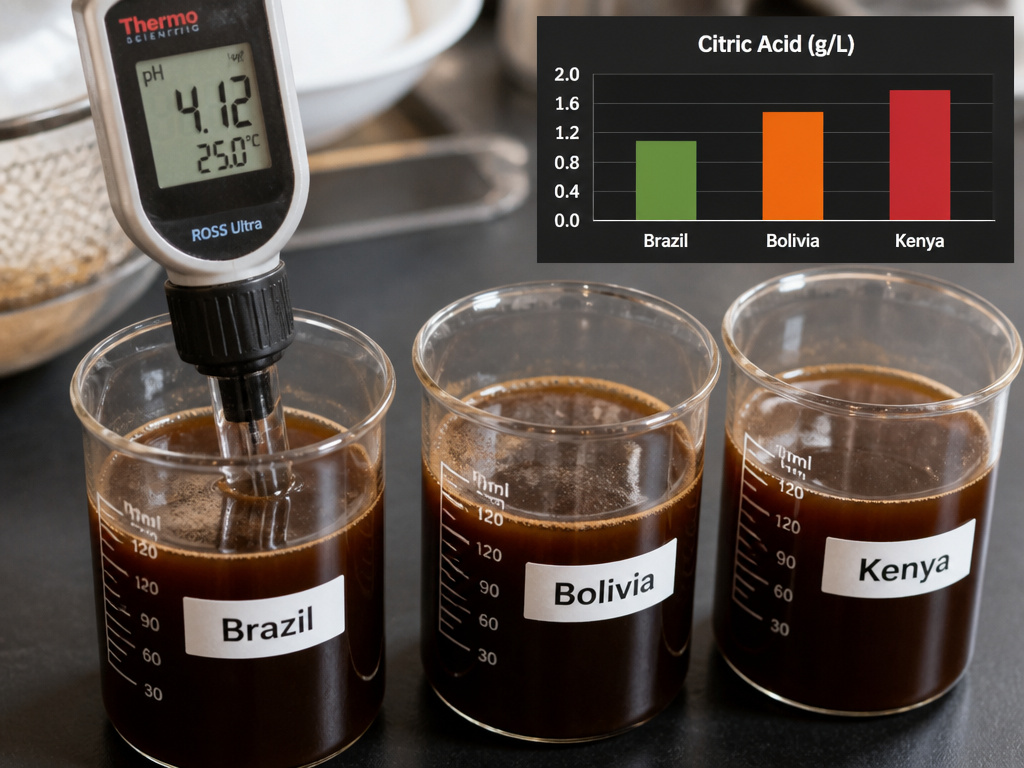
You’ve heard it: “Kenyan coffees are super acidic.” The data says that’s often wrong. The same comprehensive chemical composition of brewed coffee study analyzed coffees from Brazil, Bolivia, and Kenya. On average, the Brazilian and Bolivian coffees had higher total acid concentrations and lower pH than the Kenyan samples.
The difference was mainly due to citric and quinic acid. Brazilian coffees averaged 0.49 g/L of citric acid, Bolivian 0.40 g/L, and Kenyan 0.30 g/L. Since citric acid has a very low detection threshold, those Brazilian coffees presented as much brighter. This flips the common specialty-coffee wisdom on its head. Acidity isn’t an origin trait; it’s a combination of cultivar, soil mineral content, processing method, and altitude.
When comparing the acidity of tea vs coffee, remember that tea’s acidity comes from different compounds like tannins, and its pH is often higher (less acidic). The perceived sharpness in coffee is usually more pronounced because of this specific acid cocktail.
TL;DR: Don’t shop by country stereotypes. A Brazilian natural-process coffee can deliver a bigger acidic punch than a Kenyan washed coffee. Look for processing notes and taste descriptions instead.
Brewing Methods That Lower Perceived Acidity
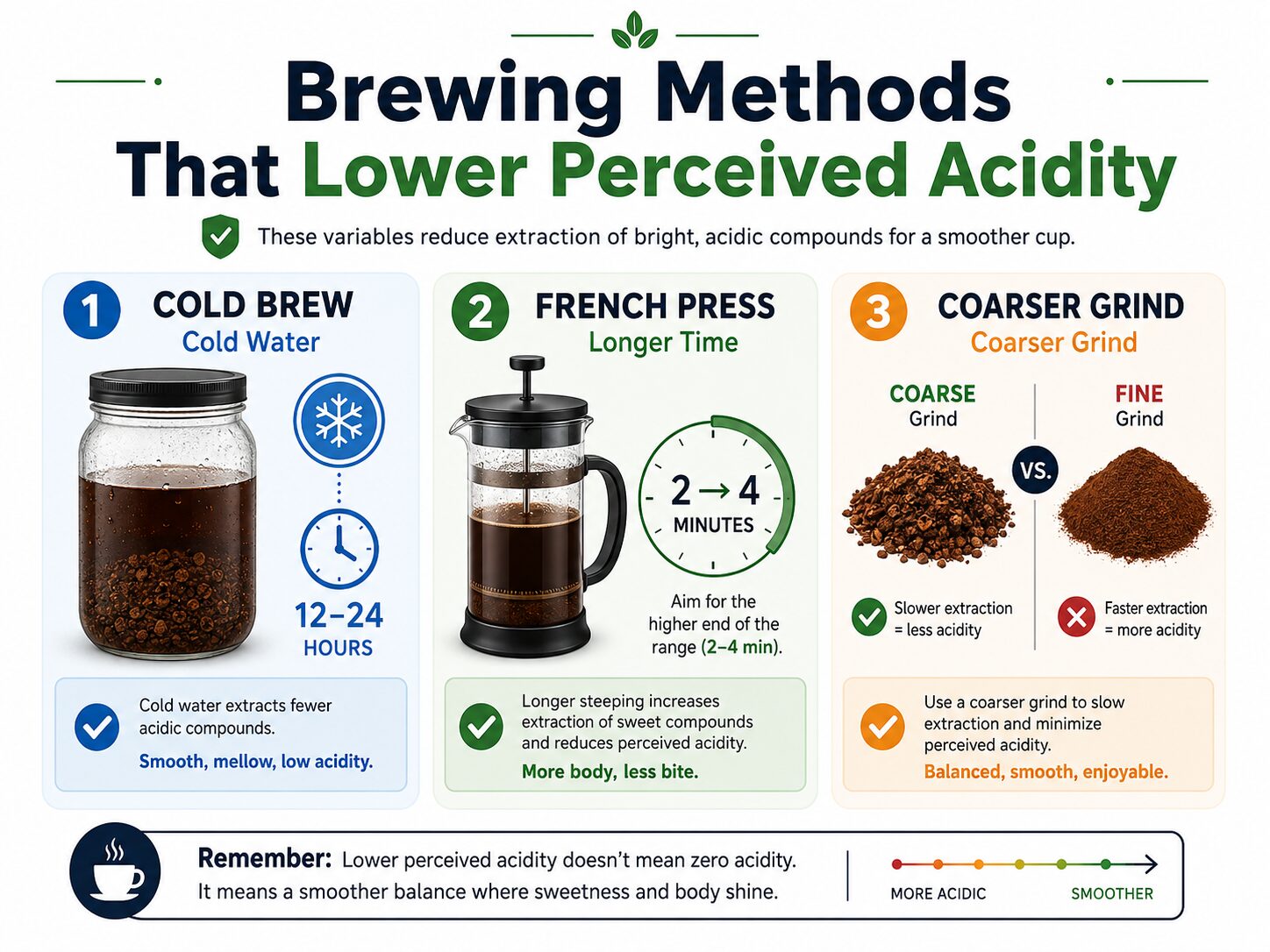
You can manipulate acidity after the roast by how you brew. The goal is to selectively extract fewer acid molecules and more sugars or oils. Water temperature, contact time, and grind size are your levers.
- Cold Brew: This is the most effective method. Steeping coarse grounds in cold water for 12-24 hours results in a brew with significantly lower titratable acidity and pH. Cold water doesn’t efficiently extract the sharper acids like citric and malic, but it slowly pulls out sugars and caffeine. The result is a smooth, sweet cup that many with sensitive stomachs can tolerate.
- Longer Hot Brew Time (French Press): Counterintuitively, extending contact time with hot water can reduce perceived acidity. After the initial extraction of acids, continued steeping pulls out more oils and bitter compounds that balance the sourness. A four-minute French press brew often tastes less sharp than a two-minute pour-over from the same beans.
- Coarser Grind: A coarser grind exposes less surface area, slowing the extraction rate. Acids extract quickly; sugars extract slower. Using a coarser grind can mean you stop the brew (as in pour-over) before all the acids have been pulled out, yielding a sweeter, rounder cup.
Experiment with your coffee brewing tips, like adding a pinch of salt. Sodium ions can block bitterness receptors on your tongue, which are often stimulated by the harsh notes of quinic acid. It doesn’t change the chemistry, but it changes your perception dramatically.
Acidity, Digestion, and Your Body
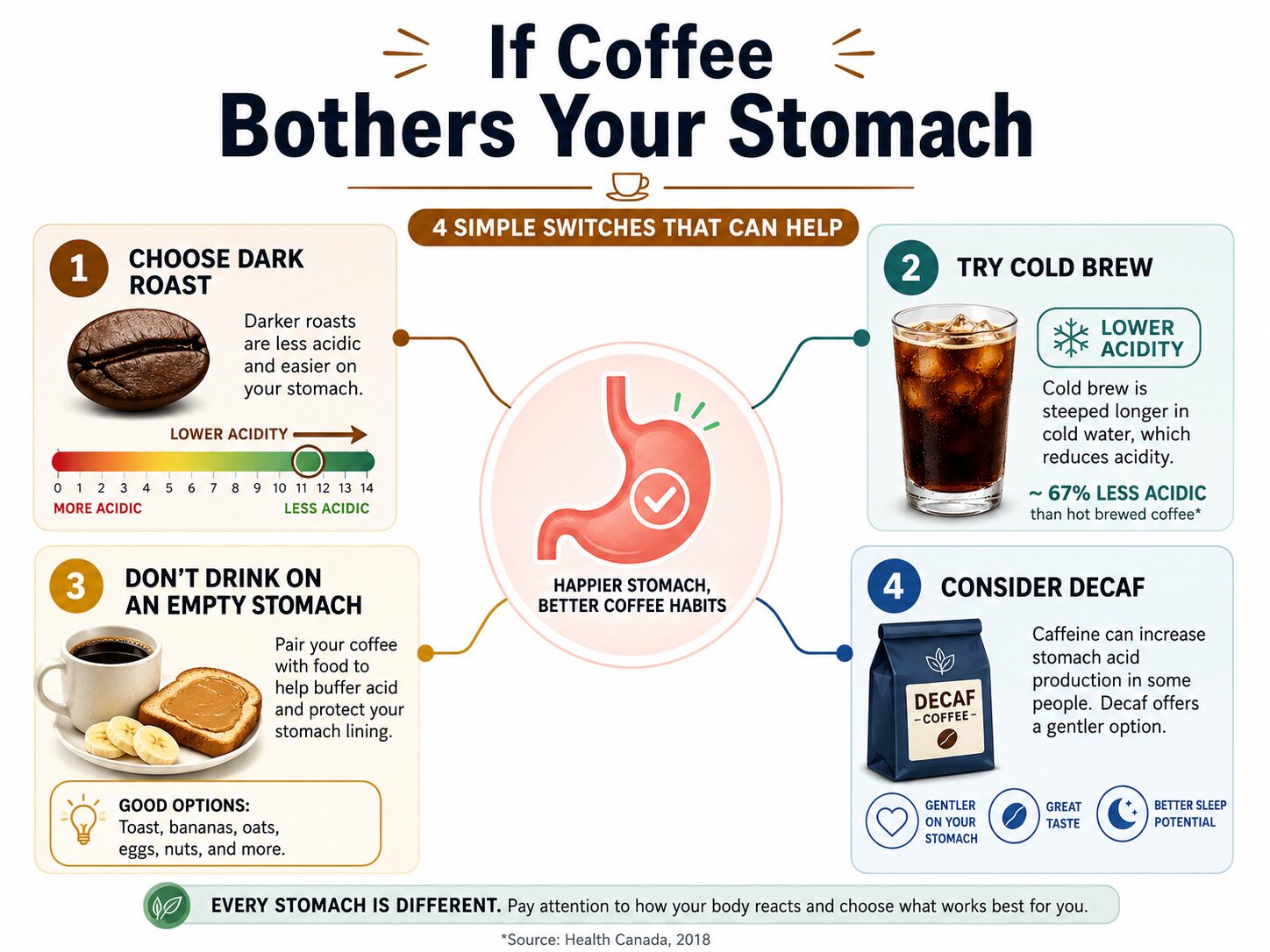
The chemical fact of coffee’s acidity meets the biological reality of your stomach. Coffee stimulates gastrin and gastric acid secretion. For most people, this is fine. For those with conditions like GERD (gastroesophageal reflux disease) or a sensitive gastric lining, that extra acid can cause heartburn, indigestion, or nausea.
The advice to avoid coffee on an empty stomach is prevalent, but the mechanism is debatable. The theory is that without food to absorb and dilute the gastric acid, it’s more likely to irritate the stomach lining or reflux into the esophagus. While not everyone feels this, the anecdotal evidence is strong enough to make it a reasonable personal experiment.
If coffee bothers your stomach, the order of operations is:
1. Switch to dark roast. The higher pH and lower acid content is the first line of defense.
2. Switch to cold brew. The lower acidity is proven and palpable.
3. Have it with food. Even a few bites of toast or a banana can provide a buffer.
4. Consider decaf. Caffeine is a primary driver of gastric acid secretion; removing it can help.
Be aware of the broader digestive side effects of coffee, as caffeine and acids can stimulate the entire gastrointestinal tract. It’s a powerful digestive aid, for better or worse.
Managing Acidity for Taste and Health
Your approach depends on your goal. Are you tweaking for flavor, or mitigating a physical reaction?
For Better Flavor (Reducing Harshness):
- Grind finer and brew hotter to increase extraction. Under-extracted coffee tastes sour (acidic) because the sugars haven’t fully dissolved. The fix is often more extraction, not less.
- Use a paper filter. Metal filters (French press, metal cone) let oils and fine particles through, which can carry acidic compounds. Paper filters trap them, producing a “cleaner,” often less tangy cup.
- Try a pinch of baking soda. A tiny amount (the tip of a knife) neutralizes acids directly. Start microscopically, too much and your coffee tastes like seawater.
For Health & Comfort (Reducing Acid Load):
- Dark roast cold brew is your champion combination.
- Low-acid branded coffees often use a steam treatment before roasting or specific bean blends to reduce chlorogenic acid content.
- Monitor additives. Dairy milk can buffer acidity, but high-fat milk can slow digestion and worsen reflux for some. Experiment.
The link between coffee’s effect on tooth enamel is also tied to acidity. Sipping acidic coffee throughout the day creates a prolonged acid bath for your teeth. Drinking it in a shorter window, followed by a rinse with water, is a smarter dental strategy than constant grazing.
Frequently Asked Questions
Does adding milk make coffee less acidic?
Yes, but not by much. Milk is slightly alkaline (pH ~6.7), so it can neutralize a small amount of acid. The fat and protein also coat your stomach lining, which can reduce irritation. It changes the sensory experience more than it changes the actual pH of the drink.
Is cold brew really less acidic?
Yes, measurably. Studies show cold brew has a higher pH (often above 5.0) and lower titratable acidity than hot brew from the same beans. The cold water fails to extract many of the sharper acidic compounds, yielding a inherently smoother profile.
Which has more acidity: light or dark roast?
Light roast has more acidity, both in terms of higher titratable acidity and often a lower pH. The longer roasting process of a dark roast breaks down acid molecules. A dark roast will taste less bright and sour, and is generally better for sensitive stomachs.
Can I drink coffee if I have acid reflux?
Many people can, with modifications. Start with a single cup of dark roast cold brew, consumed with a meal. Avoid large volumes, light roasts, and drinking on a completely empty stomach. It’s a personal tolerance test.
How does coffee acidity compare to tea?
Coffee is generally more acidic than tea. Black tea typically has a pH between 4.9 and 5.5, which overlaps with coffee’s range, but coffee contains a more complex and potent mix of organic acids. For a deeper dive, our comparison of the health benefits of tea vs coffee covers more than just pH.
The Bottom Line
Coffee is unequivocally an acidic drink by chemical definition. Its pH sits between 4.85 and 5.10, driven by a dynamic set of acids like chlorogenic, citric, and quinic. Your experience of that acidity, whether it’s a pleasant Kenyan blackberry note or a gut-wrenching sourness, depends less on the pH number and more on the concentration and type of acids, which are controlled by origin, roast, and brew method.
The science gives you control. If you love bright, fruity coffees, seek out light roasts from citric-acid-rich origins like Brazil and use a hot, fast brew method. If your stomach rebels, pivot to a dark roast, grind it coarse, and steep it cold overnight. The difference isn’t subtle; it’s the difference between a drink that hurts and one that delights. Your morning ritual shouldn’t be a battle. Use the data to brew your peace.
{
“@context”: “https://schema.org”,
“@type”: “HowTo”,
“name”: “How to Understand and Manage Acidity in Your Coffee”,
“totalTime”: “PT10M”,
“step”: [
{
“@type”: “HowToStep”,
“name”: “Measure the pH”,
“text”: “Recognize that coffee’s acidity is chemical, measured on the pH scale from 0 (acidic) to 14 (alkaline). Brewed coffee typically falls between 4.85 and 5.10, making it less acidic than orange juice but more acidic than milk.”
},
{
“@type”: “HowToStep”,
“name”: “Identify the key acids”,
“text”: “Understand which acids you’re tasting. Chlorogenic acid gives brightness but breaks down when roasted. Citric, malic, and quinic acids are major contributors to flavor; their concentrations shift with roast level and origin.”
},
{
“@type”: “HowToStep”,
“name”: “Adjust your roast”,
“text”: “Choose a darker roast if you experience digestive discomfort. The longer roasting process decomposes more chlorogenic acid into quinic acid, which raises the pH and reduces the sharp, bright notes.”
},
{
“@type”: “HowToStep”,
“name”: “Modify your brew method”,
“text”: “Switch to cold brew. The cold, slow extraction pulls fewer acidic compounds and more sugars from the grounds, resulting in a brew with lower perceived acidity and titratable acidity.”
},
{
“@type”: “HowToStep”,
“name”: “Experiment with additives”,
“text”: “Add a pinch of salt to your cup. The sodium ions can block bitterness receptors on your tongue, which are often confused with harsh acidic sensations, making the coffee taste smoother.”
}
]
}
{
“@context”: “https://schema.org”,
“@type”: “FAQPage”,
“mainEntity”: [
{
“@type”: “Question”,
“name”: “Does adding milk make coffee less acidic?”,
“acceptedAnswer”: {
“@type”: “Answer”,
“text”: “Yes, but not by much. Milk is slightly alkaline (pH ~6.7), so it can neutralize a small amount of acid. The fat and protein also coat your stomach lining, which can reduce irritation. It changes the sensory experience more than it changes the actual pH of the drink.”
}
},
{
“@type”: “Question”,
“name”: “Is cold brew really less acidic?”,
“acceptedAnswer”: {
“@type”: “Answer”,
“text”: “Yes, measurably. Studies show cold brew has a higher pH (often above 5.0) and lower titratable acidity than hot brew from the same beans. The cold water fails to extract many of the sharper acidic compounds, yielding a inherently smoother profile.”
}
},
{
“@type”: “Question”,
“name”: “Which has more acidity: light or dark roast?”,
“acceptedAnswer”: {
“@type”: “Answer”,
“text”: “Light roast has more acidity, both in terms of higher titratable acidity and often a lower pH. The longer roasting process of a dark roast breaks down acid molecules. A dark roast will taste less bright and sour, and is generally better for sensitive stomachs.”
}
},
{
“@type”: “Question”,
“name”: “Can I drink coffee if I have acid reflux?”,
“acceptedAnswer”: {
“@type”: “Answer”,
“text”: “Many people can, with modifications. Start with a single cup of dark roast cold brew, consumed with a meal. Avoid large volumes, light roasts, and drinking on a completely empty stomach. It’s a personal tolerance test.”
}
},
{
“@type”: “Question”,
“name”: “How does coffee acidity compare to tea?”,
“acceptedAnswer”: {
“@type”: “Answer”,
“text”: “Coffee is generally more acidic than tea. Black tea typically has a pH between 4.9 and 5.5, which overlaps with coffee’s range, but coffee contains a more complex and potent mix of organic acids. For a deeper dive, our comparison of the health benefits of tea vs coffee covers more than just pH.”
}
}
]
}
