
How to Make Coffee in a Cuisinart Coffee Maker | Step-by-Step
To make coffee in a Cuisinart coffee maker, use fresh cold water, a medium-coarse grind, and one tablespoon of coffee per 5-6 ounce cup. For Grind & Brew models, you must press the ‘GRIND OFF’ button before brewing if you are using pre-ground coffee, or the machine will try to grind an empty hopper and may overflow.
People assume all drip machines are the same. They fill the reservoir with whatever water is handy, dump in scoops of coffee, and hit brew. The machine makes coffee, but it tastes thin, bitter, or just… off. The difference between a decent cup and a great one from your Cuisinart isn’t magic. It’s matching three specific things to the machine’s design.
This guide walks through the exact sequence, from water choice to the final pour. It covers the critical model-specific steps most online checklists skip, especially for the Grind & Brew series. You will also learn the maintenance habit that keeps the flavor clean for years.
Key Takeaways
- Always use fresh, cold tap or filtered water in the reservoir, never warm or distilled.
- For Grind & Brew models, pressing ‘GRIND OFF’ when using pre-ground coffee is non-negotiable to prevent overflow and grinder damage.
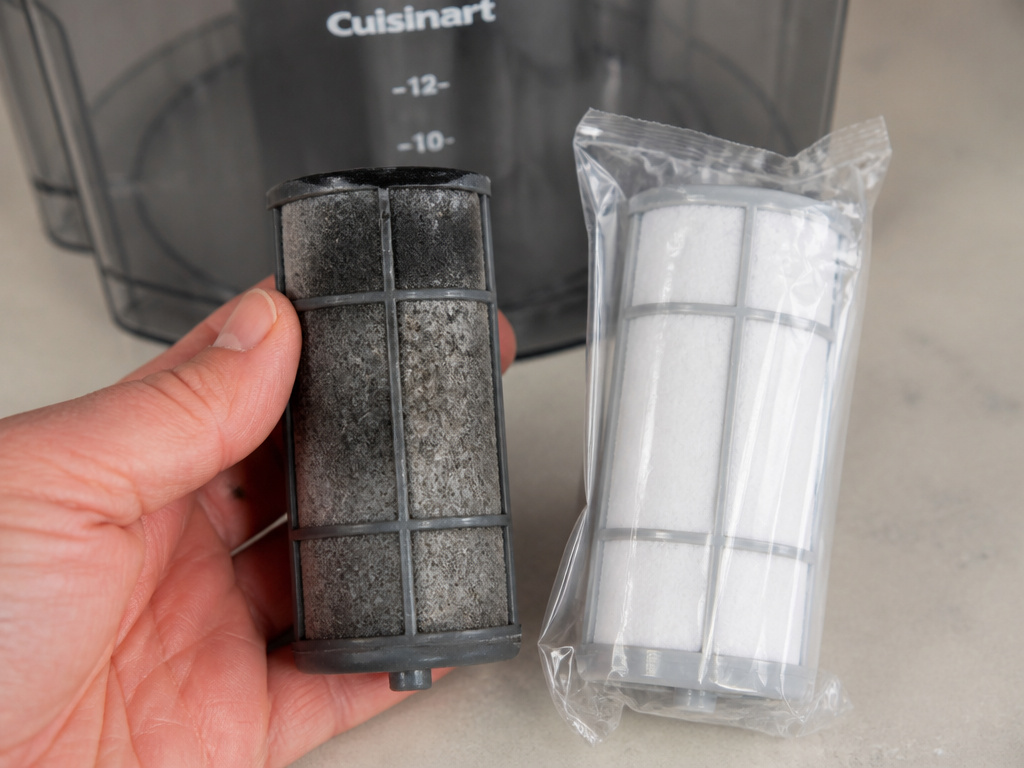
- The charcoal water filter inside the reservoir needs replacement every 60 days, not when you remember it.
- Set the warming plate to ‘Medium’ instead of ‘High’ to keep coffee drinkable without scorching it within 20 minutes.
- Descale with a vinegar solution every 3 months in soft water areas, and every 6–8 weeks if your tap water is hard.
The 5-Step Cuisinart Brewing Sequence (No Matter the Model)
The process is simple when you follow the order. Skipping a step or doing it out of sequence is how coffee ends up on your counter instead of in your cup.
Step 1: Water First, Always. Open the lid at the back of the machine. Pour fresh, cold water into the reservoir up to the cup line you need. Use the carafe’s markings to measure if you are unsure. Cold tap water or filtered water works. Do not use warm water, it can overheat too quickly in the machine. Do not use distilled water, the mineral absence makes extraction taste flat.
Step 2: Prepare the Filter Basket. Lift the brew basket lid. If your model has the permanent gold-tone or mesh filter, make sure it is clicked securely into place. If you prefer paper filter types, place a #4 cone paper filter inside the basket. A critical note: if you use a paper filter, you must remove the permanent filter first. Leaving both in blocks water flow. The basket will overflow, sending hot water and grounds over the sides. It happens fast.
Step 3: Measure the Coffee. This is where people guess. Do not guess. For a standard brew, use one level tablespoon of ground coffee for every 5 to 6 fluid ounces of water in the reservoir. That is the “scoop” that likely came with your machine. For a stronger cup, use the ‘Bold’ setting on the machine itself rather than adding more grounds, overfilling the basket leads to clogging. The ideal grind is medium-coarse, like sea salt. A fine grind like espresso powder will muddle the filter and cause bitter over-extraction.
Common mistake: Overfilling the filter basket with grounds, the water cannot saturate the coffee evenly, leading to a weak, sour center and a bitter, over-extracted ring around the edges. You will taste both in the same cup.
Step 4: Configure the Machine. This step changes by model. For a basic Cuisinart DCC-3200, you might only choose ‘Bold’ or ‘Regular’ strength. For a Grind & Brew model like the DGB-800, you have more buttons. If you added whole beans to the hopper, set the ‘GRIND CONTROL’ dial to match your cup amount (2–12). If you are using pre-ground coffee in a Grind & Brew, you must press the ‘GRIND OFF’ button before brewing. If you forget, the grinder will run dry, and the motor noise changes to a distressed whine after about eight seconds. The ground coffee can also back up into the grinder chamber.
Step 5: Brew and Serve. Place the clean, empty glass carafe on the warming plate. Close the brew basket lid. Press the ‘BREW’ button. The machine will start heating. Coffee will begin dripping into the carafe in about four minutes. When the cycle finishes, the machine will beep. Pour immediately. Do not leave the carafe on the ‘High’ warming plate setting for more than 20 minutes. The coffee at the bottom scorches, and the entire pot takes on a burnt, bitter flavor.
TL;DR: Cold water, measured grounds, the correct filter setup, model-specific button presses, then brew. Serve within 20 minutes of the cycle ending.
What Most People Get Wrong About Their Cuisinart
You followed the steps. The coffee is okay, but not great. The problem is usually one of three subtle misalignments between common practice and how the machine actually works.
First, water quality is not just a snob thing. The charcoal water filter inside the reservoir has a real job. It removes chlorine and mineral precursors that cause scale. Replace it every 60 days, as the manual states. After 90 days, the spent filter can impart a faint cardboard taste to the water, and your coffee. I ran mine to 120 days once out of forgetfulness. The next pot had a distinct stale note that cleaning the carafe could not fix.
Second, the warming plate is a tool, not a keeper. The ‘High’ setting exists, but it is for keeping a full pot hot for a crowd. For one or two people drinking over an hour, ‘Medium’ holds temperature without the aggressive burn. The difference is stark. Coffee left on ‘High’ for 30 minutes develops a sharp, acrid edge. On ‘Medium’, it stays palatable for closer to 45.
Third, the permanent filter requires different care than paper. You cannot just rinse it. Oils from the coffee build up on the mesh. Every few weeks, soak it in a bowl of hot water with a drop of dish soap. Scrub it gently with a soft brush. If you skip this, the trapped oils go rancid. Your morning coffee will start to taste vaguely of old nuts. It is a flavor you will not identify at first, but you will know something is wrong.
Model-Specific Moves: DCC vs. DGB Series
Cuisinart makes several series, but the two main families are the standard drip brewers (like the DCC-3200) and the Grind & Brew models (like the DGB-800). Using one like the other breaks the process.
| Feature | Cuisinart DCC Series (Standard) | Cuisinart DGB Series (Grind & Brew) |
|---|---|---|
| Coffee Input | Ground coffee only | Whole beans OR ground coffee |
| Critical Button | Brew Strength (Bold/Regular) | GRIND OFF (when using pre-ground) |
| Filter Standard | Permanent mesh + paper optional | Permanent gold-tone filter |
| Grind Capacity | N/A | Up to 1/2 lb of whole beans |
| Cleaning Cycle | Self-clean with vinegar solution | Self-clean with vinegar solution |
For the DCC brewer, your only real choice is brew strength. The ‘Bold’ setting simply slows the water flow slightly for a longer contact time. It works. Do not expect a massive transformation, but it does produce a more robust cup from the same grounds.
The DGB machine is a two-in-one appliance. The grinder is a burr grinder type, not a blade. This is good, it produces a consistent grind size, which is the single biggest upgrade you can make to drip coffee. The hopper holds up to half a pound of beans. The ‘GRIND CONTROL’ dial is not a texture selector; it tells the grinder how long to run based on your chosen cup amount. More cups equals a longer grind time.
If you put pre-ground coffee in the DGB’s filter basket and do not press ‘GRIND OFF’, the machine will still try to grind beans from the empty hopper. Grounds can be forced up into the grinding chamber, creating a clogged mess that requires a full disassembly to clean.
The self-clean cycle is identical across both families. It uses a mix of one part white vinegar to two parts water. Run it when the machine starts brewing slower than usual or your coffee tastes faintly of vinegar (the machine’s own warning sign of scale). In hard water areas, that might be every 6–8 weeks.
The Tools and Settings That Actually Matter
You need a few things beyond the machine itself. This is not a long list, but each item changes the outcome.
- A kitchen scale (optional but transformative). Measuring coffee by weight (10 grams per 6 oz cup) is more accurate than tablespoons. It eliminates variability from bean density and grind fluffiness.
- A gooseneck kettle (for filling). It sounds extra, but it lets you pour water into the reservoir without spilling. It is also essential if you ever want to pre-wet your paper filters to remove the papery taste.
- Fresh, whole bean coffee. The coffee grind consistency from a burr grinder right before brewing is the largest flavor lever you control. Pre-ground coffee loses most of its volatile aromatics within 15 minutes of being exposed to air.
- The correct filter. Know what your machine uses. The permanent filters are great for reducing waste, but paper filters produce a cleaner, sediment-free cup. If you use paper, consider unbleached coffee filters to avoid any potential chemical taste.
The machine’s own settings are your final adjustment. Brew strength, warming plate temperature, and auto-start are the main trio.
- Brew Strength: ‘Regular’ for a balanced cup. ‘Bold’ for a more intense, slightly heavier-bodied brew. The difference is real but subtle.
- Warming Plate: Start with ‘Medium’. Move to ‘High’ only if you are serving multiple people over 30 minutes and accept the trade-off of potential bitterness.
- Auto-Start: Useful, but only if you prepare the machine the night before. Stale, wet grounds sitting overnight produce a flat, dull cup. It is better to grind fresh in the morning.
Maintenance: The 3 Habits That Prevent Most Problems
A Cuisinart is reliable until it is not. These three habits, done on schedule, prevent 90% of service issues and flavor degradation.
Habit 1: Weekly Carafe and Basket Wash. Do not just rinse. Use hot soapy water and a bottle brush for the carafe. Wash the filter basket and permanent filter with soap. Rinse thoroughly. Any soap residue will ruin your next pot. Dry everything completely before reassembly. Dampness encourages mildew, especially in the dark, warm brew basket.
Habit 2: Monthly Charcoal Filter Swap. Mark your calendar. The filter in the water reservoir is not a “lifetime” part. After 60 days, its adsorption sites are full. It stops working. A fresh filter keeps minerals from coating the internal heating tube, which is the main cause of slow brewing and eventual failure.
Habit 3: Quarterly Descaling. Even with a filter, minerals build up. Every three months, run the self-clean cycle. Use 25 oz of white vinegar and 50 oz of cold water for a 14-cup model. Run the cycle. Follow with two cycles of clean water to flush. If you skip this, the first sign is a gurgling, sputtering sound during brewing. The last sign is a heating element caked in limestone, which costs more to fix than a new machine.
Safety Note: The glass carafe is tempered, but it can break. Be aware of the 2016 recall for certain models where the handle rivets failed. Check your model number against the CPSC list. Always place the carafe on a flat, stable surface, not the edge of the counter.
Troubleshooting Your Brew
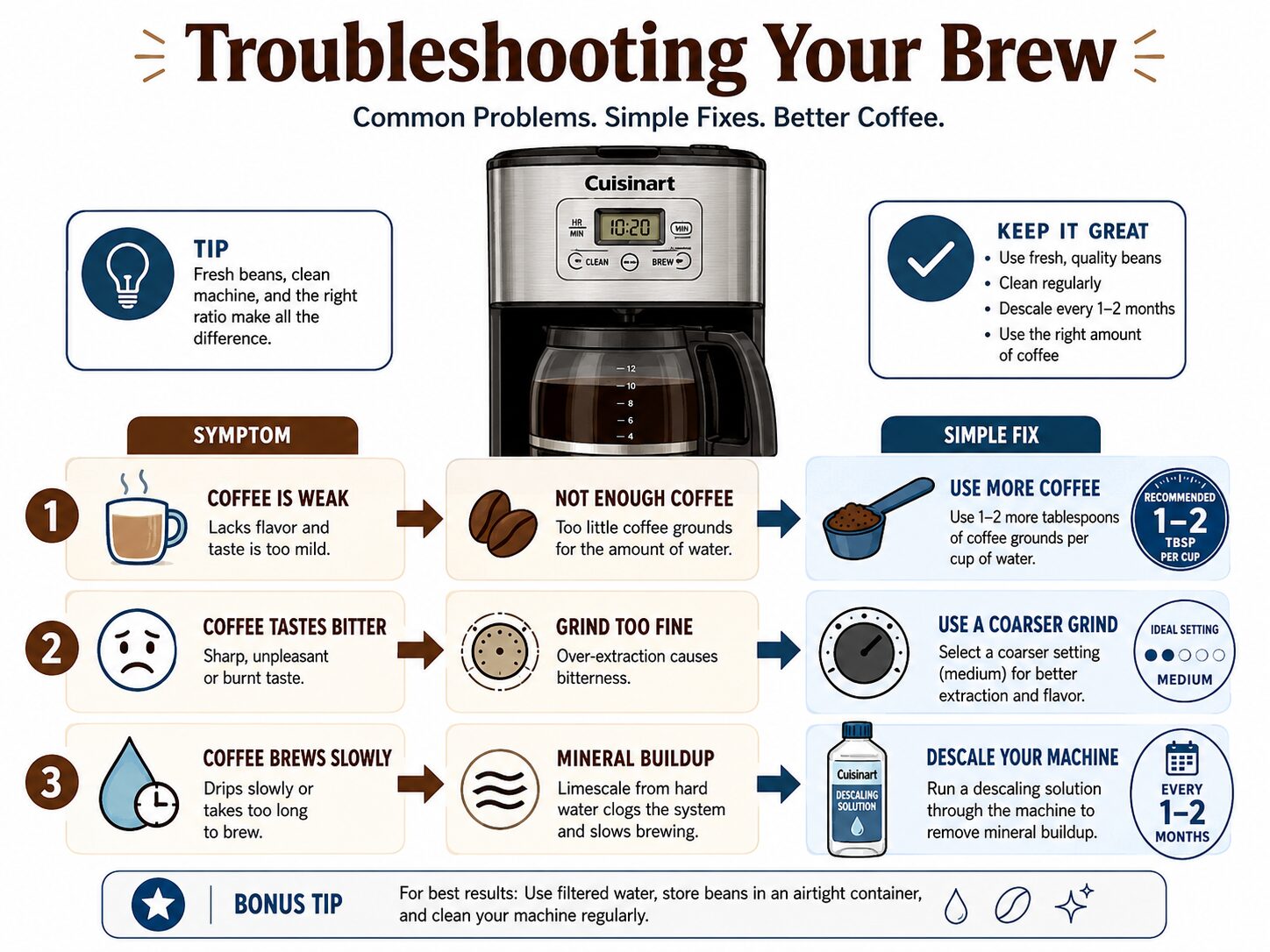
Sometimes things go wrong. Here is how to diagnose the common issues.
| Symptom | Likely Cause | Fix |
|---|---|---|
| Coffee tastes weak/watery | Too few grounds, grind too coarse, or ‘Regular’ strength setting. | Increase coffee dose by half a tablespoon per cup, use a finer grind, or select ‘Bold’. |
| Coffee tastes bitter/burnt | Too many grounds, grind too fine, or carafe left on ‘High’ plate too long. | Reduce coffee dose, use a coarser grind, or switch warming plate to ‘Medium’. |
| Machine brews very slowly | Mineral scale clogging internal tubes or a dirty permanent filter. | Run the self-clean descaling cycle immediately. Soak and scrub the permanent filter. |
| Grind & Brew makes grinding noise but no coffee flows | ‘GRIND OFF’ not selected with pre-ground coffee, causing a hopper clog. | Turn machine off. Press ‘GRIND OFF’. Run a brew cycle with water only to clear the chamber. |
| Water leaks from basket area | Paper filter used with permanent filter still in place, blocking flow. | Remove the permanent filter. Use only the paper filter in the basket. |
If your coffee has a strange, off flavor that is not covered here, consider your additives. A pinch of salt can counteract perceived bitterness without sweetener. Using brown sugar sweetener or almond milk can also introduce new flavors that clash with certain beans. Try the coffee black first to isolate the machine’s output.
Frequently Asked Questions
Can I use pre-ground coffee in a Cuisinart Grind & Brew?
Yes, but you must press the ‘GRIND OFF’ button on the control panel before starting the brew cycle. If you do not, the machine will attempt to grind an empty bean hopper, which can damage the grinder and cause grounds to back up into the mechanism.
How often should I clean my Cuisinart coffee maker?
Wipe the exterior and wash the carafe and brew basket weekly. Replace the charcoal water filter in the reservoir every 60 days. Descale the internal heating system with a vinegar solution every three months, or every six weeks if you have hard water.
What is the ‘Bold’ setting actually doing?
The ‘Bold’ setting on Cuisinart machines slightly reduces the speed at which water flows over the coffee grounds. This increases the contact time by a few seconds, leading to a more complete extraction and a stronger-tasting cup from the same amount of coffee.
Why does my coffee taste sour and bitter at the same time?
This is a classic sign of channeling, where water finds a path of least resistance through the coffee bed. It is often caused by an uneven grind from a blade grinder or by tapping the filter basket to level the grounds, which creates density pockets. Use a consistent medium-coarse grind and do not tap the basket.
Before You Go
Making great coffee in a Cuisinart is about respecting the machine’s design. Use cold, fresh water. Measure your coffee, do not guess. Know your model: press ‘GRIND OFF’ on the DGB if you are not using its grinder. Keep the warming plate on ‘Medium’ to preserve flavor.
The maintenance is non-negotiable. Swap the charcoal filter every two months. Descale quarterly. That vinegar smell during the clean cycle is the sound of your machine thanking you. This routine turns a generic appliance into a reliable producer of a genuinely good daily cup. It is worth the five minutes of attention.
