
Chai Tea Caffeine vs Coffee | The Calm vs Jolt Reality
Chai tea caffeine vs coffee is a choice between a calm focus and an energetic jolt. An 8-ounce cup of chai has 25-50 mg of caffeine, while coffee has 95-165 mg. Chai’s L-theanine smooths the caffeine effect, and its catechins offer different health benefits than coffee’s diterpenes, which can impact cholesterol.
Most comparisons stop at the caffeine milligram count. They miss why a cup of chai can feel like a focused calm while coffee delivers that familiar electric jolt. They also skip what happens to your cholesterol if you drink unfiltered coffee every day for a year—something the diterpene content directly influences.
This guide breaks down the caffeine content, the biochemistry of the buzz, and the long-term health trade-offs. You’ll know exactly which drink to reach for at 7 a.m. versus 3 p.m., and how to brew each one to control its effects.
Key Takeaways
- Chai’s caffeine range (25-50 mg per cup) is roughly one-third of coffee’s (95-165 mg), but the L-theanine in tea creates a calmer, more focused alertness.
- Unfiltered coffee methods (French press, Turkish) contain diterpenes that can raise LDL cholesterol; paper filters remove them, and chai presents no such risk.
- The health benefits diverge: coffee shows stronger links to reduced liver cancer risk, while tea’s catechins support metabolic and anti-inflammatory pathways.
- Brewing control is key: steeping chai for 3 minutes versus 5 changes caffeine yield by about 15%; coffee’s grind size and brew time have an even larger impact.
- For caffeine-sensitive individuals or afternoon consumption, chai is the default better choice. For a potent morning stimulant, coffee wins.
How Much Caffeine Is in Chai Tea vs Coffee?
You need specific numbers, not vague statements. A standard 8-ounce serving of masala chai, made with a black tea base like Assam or Ceylon, typically lands between 25 and 50 milligrams of caffeine. A same-size cup of brewed coffee swings from 95 to 165 milligrams.
The width of these ranges isn’t a mistake. It’s the entire point.
The caffeine in an 8-ounce cup of masala chai ranges from 25 to 50 milligrams, derived from the black tea base. An equivalent serving of brewed coffee contains 95 to 165 milligrams. This variation is controlled by tea leaf grade, coffee bean type, grind size, water temperature, and contact time.
For chai, the primary variable is the black tea itself. A robust Assam blend steeped for five minutes in boiling water will hit the top of that range. A lighter Darjeeling steeped for three minutes lands at the bottom. The milk and spices don’t reduce caffeine; they dilute the concentration per sip, but the total in the cup is set during the steep.
Coffee’s range is wider because the variables are more extreme. The bean type is the first split.
| Factor | Chai Tea (8 oz) | Brewed Coffee (8 oz) |
|---|---|---|
| Primary Source | Black Tea Leaves (Assam, Ceylon) | Coffee Beans (Arabica, Robusta) |
| Typical Caffeine Range | 25 – 50 mg | 95 – 165 mg |
| Key Variable #1 | Steep Time (3 vs. 5 min changes yield ~15%) | Bean Type (Robusta has ~2x Arabica’s caffeine) |
| Key Variable #2 | Leaf Grade (Broken leaf releases faster) | Grind Size & Contact Time (Espresso is concentrated) |
| Modulating Compound | L-theanine (smooths caffeine effect) | None – caffeine effect is direct |
A Robusta bean packs nearly double the caffeine of an Arabica bean. Then grind size and brew method take over. An espresso shot has about 63 milligrams of caffeine in just one ounce—but you rarely drink just one ounce. A 16-ounce drip coffee from a cafe, often made with a lighter roast and a longer brew cycle, can easily deliver over 300 milligrams.
TL;DR: Chai (25-50 mg) has about one-third the caffeine of coffee (95-165 mg) per cup, but bean type and brew method can push coffee’s content three times higher than chai’s.
The Biochemistry of the Buzz: Why They Feel Different
Sixty milligrams of caffeine from chai does not feel the same as sixty milligrams from coffee. Your nervous system knows the difference. The reason is L-theanine, an amino acid almost exclusively found in tea leaves.
Caffeine works by blocking adenosine receptors in your brain, the compounds that signal tiredness. It’s a blunt instrument. L-theanine promotes the production of alpha brain waves, which are associated with relaxed focus. When you drink chai, you get both compounds. The caffeine provides the alertness; the L-theanine takes the sharp, jittery edge off. It’s a moderated, smoother lift.
Coffee lacks L-theanine. The caffeine hits your adenosine receptors without a calming counterpart. The result is that characteristic sharp alertness—and for many, the subsequent crash when the blockade wears off and adenosine floods back in.
This isn’t theoretical. It’s why I switched my afternoon drink to chai years ago. A 3 p.m. coffee would wire me until 9 p.m., often with a side of anxiety. A cup of strong masala chai at the same time cuts through the post-lunch fog without touching my sleep. The focus is there, but the engine isn’t racing.
Common mistake: Assuming equal caffeine means equal effect — 50 mg from coffee will likely cause more jitteriness and a sharper crash than 50 mg from chai due to the absence of L-theanine.
The other biochemical players matter for long-term health, not just the immediate buzz. Black tea in chai is rich in catechins and theaflavins, antioxidants with anti-inflammatory properties. Coffee’s signature antioxidants are chlorogenic acids. They’re different tools for different jobs in the body, which explains why health studies don’t show a clear winner.
The Health Angle: More Than Just Caffeine
Looking only at caffeine misses the bigger health picture. These are complex plant-based beverages with hundreds of bioactive compounds. Their long-term impacts diverge in meaningful ways.
Cardiovascular health is a prime example. Observational studies often link moderate coffee and tea consumption with a lower risk of heart disease. But there’s a critical caveat for coffee: diterpenes.
Compounds called cafestol and kahweol, present in coffee oils, are potent elevators of LDL (the “bad”) cholesterol. They’re trapped in the paper filter in drip coffee. In unfiltered methods like French press, Turkish coffee, or boiled coffee, they end up in your cup.
I used a French press exclusively for two years, drawn to the rich body. My annual bloodwork showed a consistent, stubborn climb in LDL. My doctor’s first question was about unfiltered coffee intake. Switching to a paper-filter drip method brought the number back into range within six months. The connection is that direct.
Chai, as a tea, contains no diterpenes. This gives it a clean cardiovascular profile on that specific metric.
The cancer prevention chapter favors coffee. The evidence is strongest for coffee’s association with a reduced risk of liver and endometrial cancers. The link is consistent enough that health bodies note it. Tea’s evidence for cancer prevention is weaker and less consistent, though some studies suggest benefits for oral cancers.
For metabolic and brain health, both drinks show benefits. Both are linked to a reduced risk of type 2 diabetes and neurodegenerative diseases like Alzheimer’s and Parkinson’s. Tea’s catechins and coffee’s chlorogenic acids likely contribute through different antioxidant and anti-inflammatory pathways.
| Health Aspect | Chai Tea (Black Tea Base) | Coffee |
|---|---|---|
| Key Antioxidants | Catechins, Theaflavins | Chlorogenic Acids |
| Cholesterol Impact | Neutral – no diterpenes | Raised by unfiltered methods (French press, Turkish) |
| Strongest Cancer Link | Possible lower oral cancer risk | Lower liver & endometrial cancer risk |
| Cognitive Benefit | Reduced dementia risk (2-4 cups/day) | Reduced dementia & Parkinson’s risk (2-4 cups/day) |
| Iron Absorption | Inhibits non-heme iron (strong effect) | Inhibits non-heme iron (moderate effect) |
The iron warning applies to both. The tannins in tea (stronger) and polyphenols in coffee can inhibit the absorption of non-heme iron from plant-based foods. The fix is simple: avoid drinking either within an hour of a meal, especially if you have low iron levels.
TL;DR: Coffee has a stronger link to liver cancer prevention but can raise cholesterol if unfiltered; chai has no cholesterol risk but its tannins more strongly inhibit iron absorption.
Brewing Variables: How to Control Your Dose
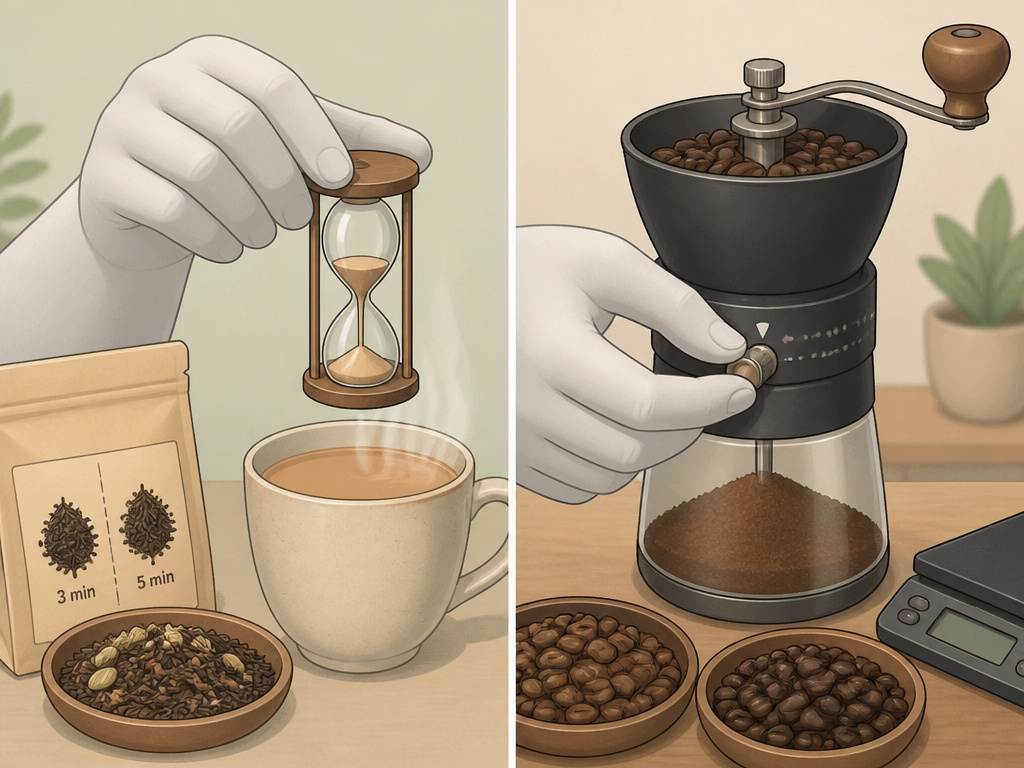 You are not stuck with whatever caffeine level a generic recipe gives you. You control the levers. For chai, the main lever is steep time. Caffeine extraction is fast initially, then slows.
- Steep for 3 minutes: You’ll extract most of the flavor and about 80-85% of the available caffeine.
- Steep for 5 minutes: You’ll get more tannins (bitterness) and nearly all the caffeine, maybe 95-98%.
- Using pre-ground tea vs. loose leaf: Broken leaves in a bag expose more surface area, leading to slightly faster caffeine release than whole loose leaves.
The water should be at a full boil (212°F/100°C) for black tea. Lower temperatures won’t extract caffeine efficiently.
For coffee, the controls are more powerful and numerous. 1. Bean Choice: Start with Arabica for less caffeine, Robusta for more. 2. Roast Level: A dark roast bean is slightly less dense, so by weight (as used for espresso), caffeine content is very similar to a light roast. By volume (as used in a scoop), a darker roast means fewer beans, so slightly less caffeine. 3. Grind Size: Finer grinds = more surface area = faster, more complete caffeine extraction. 4. Brew Time & Method: An espresso shot (25-30 seconds) extracts caffeine efficiently but briefly. A cold brew (12-24 hours) extracts slowly but completely, often resulting in a high total caffeine concentration.
If you’re trying to moderate caffeine, use a paper filter, choose an Arabica bean, and use a coarser grind for a shorter brew time (like a pour-over). To maximize it, use a fine grind, a Robusta blend, and a longer immersion method.
Chai vs Coffee: Which Should You Drink?
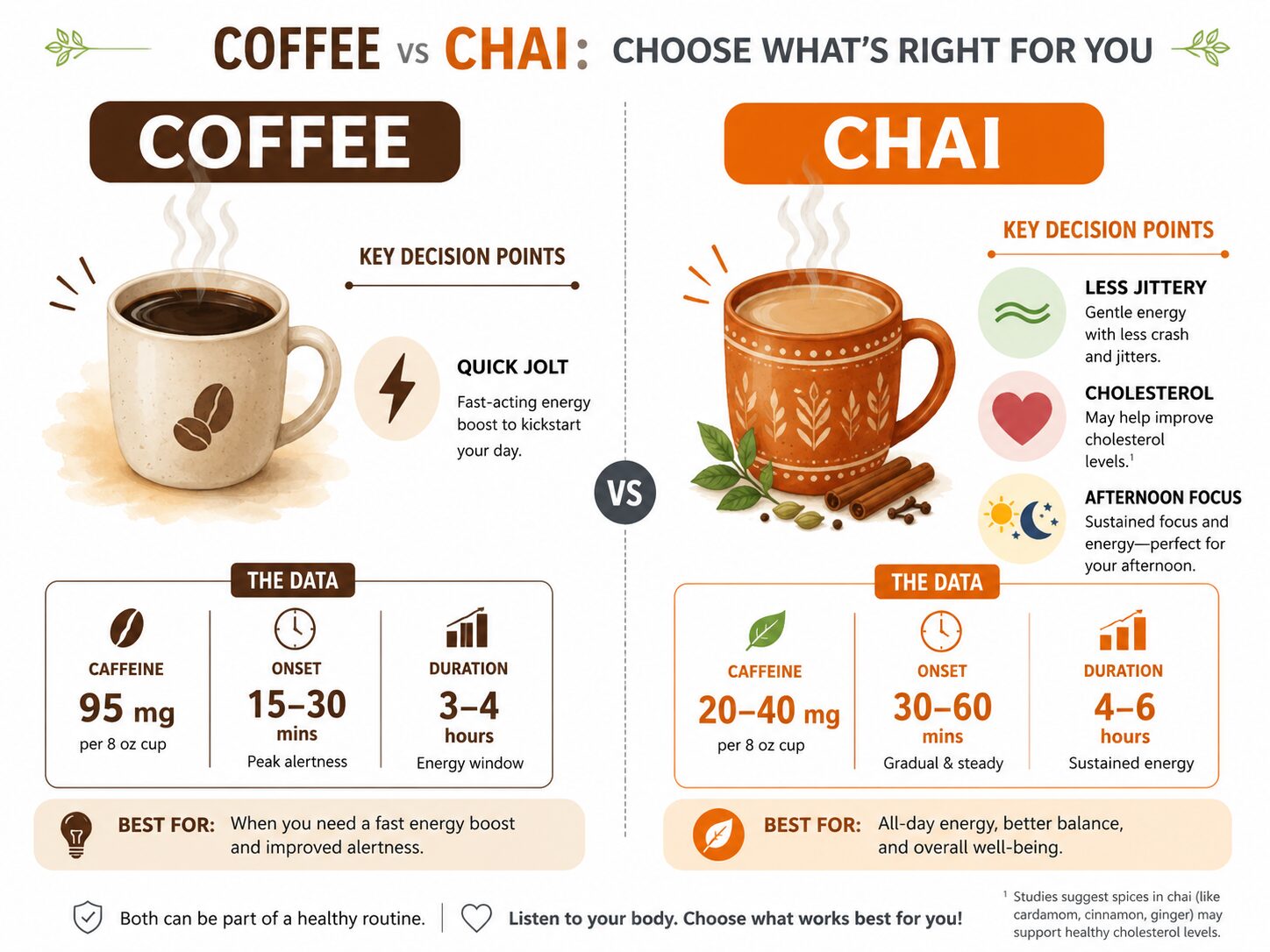 Stop looking for a universal winner. The right drink is the one that matches your physiology and your schedule. Use this decision framework.
Ask yourself these questions first thing in the morning: – Do I need a powerful, quick jolt to start my engine? → Coffee. – Do I often feel anxious or jittery after coffee? → Chai. – Am I managing high LDL cholesterol and dislike filtered coffee? → Chai. – Is it after 2 p.m. and I still need focus without ruining my sleep? → Chai.
The caffeine in tea vs coffee dynamic is about more than milligrams. It’s about the quality of alertness. For deep work sessions where I need sustained concentration, a strong chai is my tool. For a 5 a.m. wake-up before an early drive, it’s black coffee, no question.
Your tolerance changes. The health benefits comparison between the drinks means you can also choose based on long-term goals. If family history puts liver health top of mind, coffee’s data is compelling. If inflammation is a daily battle, the catechins in tea might be the better target.
Don’t forget about the acidity of tea vs coffee, either. If acid reflux is an issue, the perceived acidity of black coffee can be more problematic than a milk-based chai for many people.
Frequently Asked Questions
Does adding milk to chai reduce the caffeine?
No. Milk dilutes the concentration per sip, but the total milligrams of caffeine extracted from the tea leaves into the water during steeping remains the same. The milk is added after the caffeine is already in the brew.
Is chai tea okay to drink at night?
It depends on your caffeine sensitivity. A standard cup has 25-50 mg of caffeine, similar to a can of cola. If you’re sensitive, drinking chai within 3-4 hours of bedtime can disrupt sleep. Opt for a caffeine-free herbal “chai” spice blend if you want the flavor at night.
Which has more caffeine, chai latte or coffee?
coffee-based drink almost always wins. A 16-ounce chai latte, made with a standard concentrate or tea bag, might have 50-70 mg total caffeine. A 16-ounce brewed coffee from a cafe has 300+ mg. Even a 16-ounce latte with two espresso shots has roughly 126 mg of caffeine, still nearly double a typical chai latte.
Can I drink chai if I have high blood pressure?
The caffeine in chai can cause a short-term, mild increase in blood pressure. If your hypertension is well-managed, moderate consumption (1-2 cups) is likely fine, but consult your doctor. The potassium in the spices like cardamom might even offer a slight beneficial counter-effect, but don’t rely on it for management.
Does green tea chai have less caffeine?
Yes. If your “chai” is made with a green tea base instead of black tea, the caffeine content drops. An 8-ounce green tea chai would likely be in the 20-35 mg range, compared to 25-50 mg for black tea chai. The spice blend is the same; only the tea base changes.
The Bottom Line
Chai tea is not a low-caffeine coffee substitute. It’s a different system entirely. It delivers a moderated, focused alertness thanks to the L-theanine and black tea base, with a fraction of coffee’s typical caffeine punch and no cholesterol-risk compounds.
Coffee is the more potent stimulant, with stronger links to specific health benefits like liver cancer prevention, but it demands more brewing care to avoid negative side effects like cholesterol elevation from diterpenes.
Your choice isn’t permanent. Make coffee your morning accelerator. Use chai as your afternoon focus tool. Control the brew to control the dose. And let the drink serve your day, not the other way around.
