
History of the Coffee Filter: The 1908 Invention Explained
The paper coffee filter was invented by German housewife Melitta Bentz, who filed her German patent on 20 June 1908 and launched the first commercial 94 mm round paper filter on 8 July 1908. Her design used a brass pot with punched holes and blotting paper from her son’s notebook to strain out grounds, creating a cleaner cup.
Most retellings stop at the “housewife with a notebook” anecdote. They miss the specific dates, the exact dimensions of her first product, and the twenty-year engineering battle that happened between her flat-bottom design and the conical filters we use today.
This is the full timeline, from the brass pot prototype to the modern paper cone, including the patents and product evolutions most summaries skip.
Key Takeaways
- Melitta Bentz’s German patent (DRP 347895) was filed 20 June 1908, with the first commercial filter sold on 8 July 1908.
- Her original filter was a 94 mm round disk of blotting paper placed in a perforated brass pot, not a cone.
- The Melitta company’s first mass-market product was the reusable Schnellfilter porcelain holder (1932), which required a separate metal cone to press square paper into shape.
- The disposable pre-formed paper cone, the Filtertüte, wasn’t introduced until 1936 or 1937, nearly three decades after the initial invention.
- Key later innovations include the Chemex bonded paper filter (1941) and the Hario V60 with its 60-degree cone and spiral ribs (2004).
The 1908 Patent That Started It All
Melitta Bentz was frustrated with the pervasive grit in her coffee. The common brewing methods of the early 1900s, like the Mokka pot or simple infusion, left a sludge of grounds at the bottom of the cup. The bitterness from over-extracted fines ruined the flavor. She wanted a clean, grit-free brew.
Her solution was famously low-tech. She took a brass pot, likely a simple kitchen vessel, and punched holes in the bottom. Needing a fine sieve, she reached for blotting paper from her son’s school notebook. This paper was absorbent, relatively sturdy when wet, and fine enough to trap coffee particles. She cut a round sheet, placed it in the pot, added ground coffee, and poured hot water through.
The first commercial paper coffee filter was a 94 mm round disk, launched on 8 July 1908. This specific size, later designated “Melitta size 1,” became the foundation for all subsequent paper filter standardization.
The result was a revelation. The coffee was clear, aromatic, and free of sediment. She immediately recognized the commercial potential. With the support of her husband, Hugo, she filed for a German patent. The German Patent and Trade Mark Office records her filing on 20 June 1908. The commercial launch of the “Melitta” filter followed just weeks later, on 8 July 1908.
This wasn’t just a kitchen hack. It was a deliberate invention she patented and turned into a business. The Melitta company, founded that same year, was one of the first in Germany to be founded by a woman inventor.
TL;DR: Melitta Bentz patented a 94mm round paper filter on 20 June 1908, commercializing it on 8 July 1908 to solve the problem of gritty, bitter coffee.
From Brass Pot to Kitchen Staple: The Product Evolution
The original brass pot and blotting paper were a proof of concept, not a scalable product. For the invention to become a household staple, it needed a dedicated holder and easier-to-use paper. This evolution took nearly three decades and passed through two distinct product phases.
First came the Schnellfilter (quick filter) system, introduced in 1932. This was a reusable porcelain or metal holder with a cone-shaped interior. The bottom was circular and featured eight, later four, drainage holes. The filter paper for this system was not pre-formed. It came as square sheets that the user had to press into the conical shape using a separate metal tool called an Eindrücker (literally, “presser-in” or “negotiator”).
| Era | Product Name | Key Component | User Action Required |
|---|---|---|---|
| 1908 | Original Prototype | Brass pot, blotting paper | Cut round paper, place in pot |
| 1932 | Schnellfilter System | Porcelain holder, square paper sheets | Press paper into cone with metal Eindrücker |
| 1936/37 | Filtertüte | Pre-formed paper cone | Simply drop cone into holder |
The Schnellfilter was a step forward, but it was still fiddly. The breakthrough in convenience came with the Filtertüte, the disposable pre-formed paper cone. Patented in 1935 and launched in 1936 or 1937, this is the direct ancestor of the paper filter you buy today. It eliminated the metal presser tool and simplified the process to a single step: place the cone and add coffee. This innovation locked in the dominance of the paper filter types we now take for granted.
TL;DR: The invention evolved from a DIY brass pot (1908) to a reusable porcelain system with a separate presser tool (1932), and finally to the convenient disposable paper cone (1936/37).
The Evolution of a Simple Idea
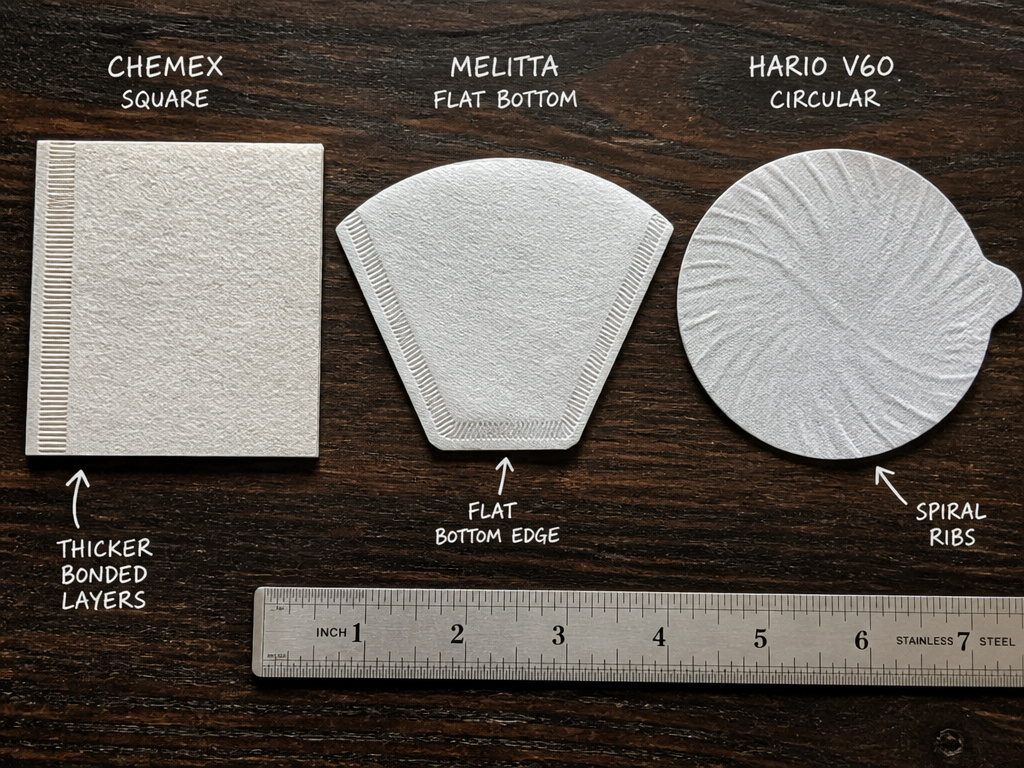
Melitta’s flat-bottom, round-filter design dominated for decades. But the quest for the perfect cup spurred rival geometries. The most significant shifts came from two later inventions: the Chemex and the Hario V60. These weren’t mere copies; they rethought the relationship between filter shape, paper, and flow rate.
The Chemex, invented by Dr. Peter Schlumbohm and patented in 1941, introduced a thick, bonded paper filter. It was folded into a cone, creating four layers of paper at the pour spout. This design filtered out more oils and sediment than Melitta’s paper, producing an exceptionally clean and tea-like cup. The design was so iconic it entered the Museum of Modern Art’s permanent collection in 1943.
The Hario V60, released in 2004, took a different approach. Its name denotes its 60-degree cone angle. This steeper angle, combined with a single large hole at the bottom and spiraled ribs along the interior wall, created a fast, predictable drawdown. The ribs prevent the paper from suctioning flat against the cone, which would stall the flow. This design hands control over extraction time directly to the brewer via pour technique, a fundamental shift from filters that regulate flow by themselves.
Common mistake: Assuming all paper filters are the same, the pore size, thickness, and shape of a Chemex filter versus a Melitta #4 versus a Hario tabbed filter radically change extraction, oil retention, and final cup clarity.
These innovations highlight that the story of the filter is ongoing. Each design makes a different trade-off between clarity and body, convenience and control. Your choice in the automatic drip machine filters aisle is the endpoint of this century-long engineering conversation.
Why the Filter Shape Matters for Your Brew
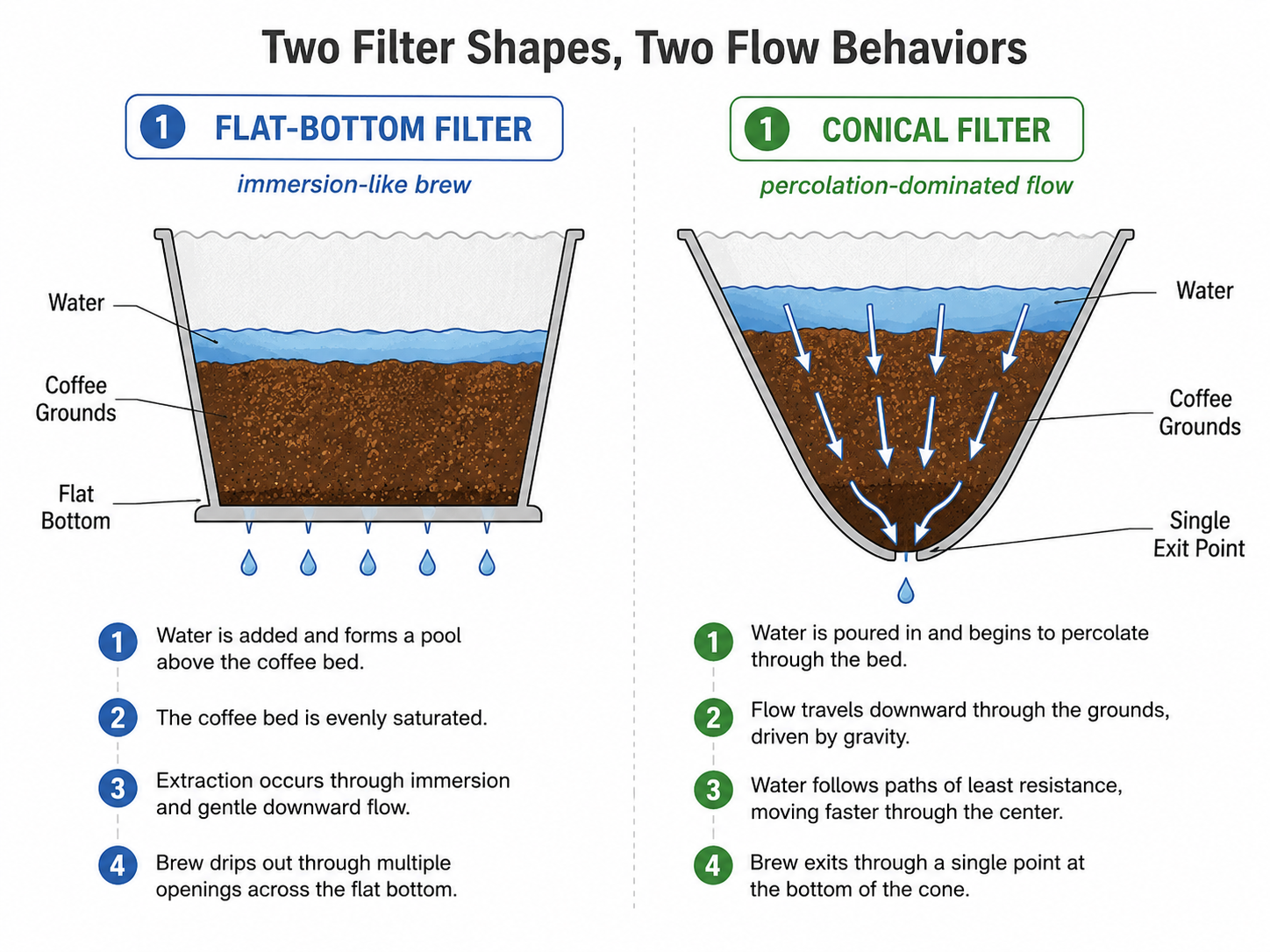
The physical design of a coffee filter isn’t just packaging. It directly dictates how water interacts with the coffee grounds, which in turn defines the flavor profile in your cup. The core tension is between immersion (soaking) and percolation (flow-through).
A flat-bottom filter, like the classic Melitta design, promotes a more even, immersion-like brew. The water pools slightly, ensuring all grounds get saturated. This can lead to a fuller-bodied, more consistent cup, which is why it’s the standard for most automatic drip machines. The trade-off is a slightly slower flow and less clarity in the high notes.
A conical filter, like the V60 or Chemex, is a percolation-dominated device. The water travels through a deeper bed of coffee, extracting as it goes. The steeper walls and single exit point encourage a faster flow, which requires a finer grind and a more controlled pour to avoid under-extraction. The reward is often a cup with brighter acidity and more distinct flavor separation.
| Filter Type | Brew Style | Typical Cup Profile | Best For |
|---|---|---|---|
| Flat-Bottom (e.g., Melitta) | Balanced immersion/percolation | Full-bodied, consistent, rounded | Set-and-forget automatic drip machines |
| Conical – Thick Paper (e.g., Chemex) | Slow percolation | Exceptionally clean, tea-like, bright | Drinkers who prioritize clarity and sediment-free coffee |
| Conical – Thin Paper (e.g., Hario V60) | Fast percolation | Bright, complex, high acidity | Manual pour-over enthusiasts who enjoy controlling extraction |
Your choice of filter therefore dictates your required coffee grind consistency. A flat-bottom machine needs a medium grind. A V60 demands a medium-fine grind to slow the fast water. Getting this wrong, using a V60 grind in a flat-bottom machine, clogs the paper and makes a bitter, over-extracted mess. The filter is the first variable you lock in, and every other step follows from it.
The Modern Filter Landscape

Today, the paper filter is just one option in a broad ecosystem. The original problem Melitta solved, removing grounds, has spawned solutions in metal, cloth, and nylon. Each material brings a different set of trade-offs that echo the design debates of the last century.
Permanent metal filters, often made of stainless steel mesh, are a popular alternative. They allow natural oils (cafestol) to pass into the cup, producing a brew with more body and a flavor profile closer to a French press. However, they require diligent cleaning to prevent clogging and oil rancidity. Some espresso machine filters also use fine metal meshes for a similar full-bodied result. The downside is that some very fine sediment, or “silt,” will always get through, leaving a trace at the bottom of your cup.
Cloth filters, like those used in traditional sock-brewing methods, offer a middle ground. They pass more oils than paper but filter more sediment than metal. Their major drawback is maintenance; they must be rinsed immediately and stored in water in the fridge to prevent mildew tastes. For the environmentally conscious, biodegradable coffee filters made from unbleached paper or other plant-based materials address the waste issue of traditional paper.
The choice ultimately circles back to Melitta’s original goal: what kind of cup do you want? The paper filter she invented gives you clarity and consistency. The alternatives trade some of that clarity for body, sustainability, or convenience. It’s a testament to her invention that we’re still iterating on it over a century later.
Frequently Asked Questions
Did Melitta Bentz invent the first coffee filter ever?
No, she invented the first paper coffee filter. Methods for straining coffee, like cloth bags or metal sieves, existed long before 1908. Her specific innovation was using a disposable, fine-pored paper to achieve a new level of clarity and convenience, which she then patented and commercialized.
What did people use before paper coffee filters?
Common methods included boiling ground coffee directly in water (and letting the grounds settle), using a cloth bag to steep and strain grounds (like a large tea bag), or using a metal Mokka pot that forced steam through a puck of coffee. All these methods typically resulted in a cup with some sediment or grit.
Are Melitta filters still made by the same company?
Yes. The Melitta Group, still headquartered in Germany and largely owned by the Bentz family, is a global company that sells coffee, filters, and coffee makers. They continue to produce the paper filter cones that evolved from Melitta’s original 1908 design.
What’s the difference between a #2 and a #4 coffee filter?
The numbers (1, 2, 4, etc.) correspond to Melitta’s original size designations for their Filtertüte paper cones. A #2 filter typically fits brewers designed for 2-6 cups (by American “cup” standards, about 4-12 oz of coffee). A #4 is larger, for 8-12 cup machines. The size refers to the cone’s physical dimensions and capacity, not a quality grade.
Why do some filters have a tab and others don’t?
The tab is a small folded extension on the side of a paper filter. Its primary purpose is to provide a dry, clean place to grip the filter when placing it in a brewer, especially after you’ve rinsed it with hot water. Some designs omit the tab for a simpler manufacturing process. It has no effect on the brewing performance.
Before You Go
Melitta Bentz’s story is more than a charming anecdote. It’s a case study in solving a specific, frustrating problem with materials at hand. Her 94mm blotting paper disk and brass pot launched not just a product, but an entire category of brewed coffee techniques. The evolution from the Schnellfilter to the disposable cone shows how convenience drives adoption. And the subsequent innovations from Chemex and Hario prove that even a solved problem can be re-solved in new, delicious ways. The next time you choose a filter, whether paper, metal, or cloth, you’re participating in a 115-year-old conversation about the perfect cup. The bean selection for brewing starts with the filter that defines its taste.
{
“@context”: “https://schema.org”,
“@type”: “HowTo”,
“name”: “How to Trace the Invention of the Paper Coffee Filter”,
“totalTime”: “PT10M”,
“tool”: [
{
“@type”: “HowToTool”,
“name”: “Historical patent records”
},
{
“@type”: “HowToTool”,
“name”: “Primary source documents like the German Patent and Trade Mark Office archive”
},
{
“@type”: “HowToTool”,
“name”: “Manufacturer histories from Melitta, Chemex, and Hario”
}
],
“step”: [
{
“@type”: “HowToStep”,
“name”: “Identify the inventor and date”,
“text”: “Confirm the inventor as Melitta Bentz and the filing date of her German patent as 20 June 1908, with commercial launch on 8 July 1908.”
},
{
“@type”: “HowToStep”,
“name”: “Examine the original design”,
“text”: “Study the specifications of her first filter: a brass pot with punched holes, lined with a 94 mm round sheet of blotting paper.”
},
{
“@type”: “HowToStep”,
“name”: “Track the product evolution”,
“text”: “Follow the development from the reusable *Schnellfilter* system (1932) to the disposable *Filtertüte* paper cone (1936/1937).”
},
{
“@type”: “HowToStep”,
“name”: “Compare later innovations”,
“text”: “Contrast Bentz’s flat-bottom filter with later conical designs like the Chemex (patent 1941) and Hario V60 (released 2004).”
}
]
}
{
“@context”: “https://schema.org”,
“@type”: “FAQPage”,
“mainEntity”: [
{
“@type”: “Question”,
“name”: “Did Melitta Bentz invent the first coffee filter ever?”,
“acceptedAnswer”: {
“@type”: “Answer”,
“text”: “No, she invented the first paper coffee filter. Methods for straining coffee, like cloth bags or metal sieves, existed long before 1908. Her specific innovation was using a disposable, fine-pored paper to achieve a new level of clarity and convenience, which she then patented and commercialized.”
}
},
{
“@type”: “Question”,
“name”: “What did people use before paper coffee filters?”,
“acceptedAnswer”: {
“@type”: “Answer”,
“text”: “Common methods included boiling ground coffee directly in water (and letting the grounds settle), using a cloth bag to steep and strain grounds (like a large tea bag), or using a metal Mokka pot that forced steam through a puck of coffee. All these methods typically resulted in a cup with some sediment or grit.”
}
},
{
“@type”: “Question”,
“name”: “Are Melitta filters still made by the same company?”,
“acceptedAnswer”: {
“@type”: “Answer”,
“text”: “Yes. The Melitta Group, still headquartered in Germany and largely owned by the Bentz family, is a global company that sells coffee, filters, and coffee makers. They continue to produce the paper filter cones that evolved from Melitta’s original 1908 design.”
}
},
{
“@type”: “Question”,
“name”: “What’s the difference between a #2 and a #4 coffee filter?”,
“acceptedAnswer”: {
“@type”: “Answer”,
“text”: “The numbers (1, 2, 4, etc.) correspond to Melitta’s original size designations for their Filtertüte paper cones. A #2 filter typically fits brewers designed for 2-6 cups (by American \”cup\” standards, about 4-12 oz of coffee). A #4 is larger, for 8-12 cup machines. The size refers to the cone’s physical dimensions and capacity, not a quality grade.”
}
},
{
“@type”: “Question”,
“name”: “Why do some filters have a tab and others don’t?”,
“acceptedAnswer”: {
“@type”: “Answer”,
“text”: “The tab is a small folded extension on the side of a paper filter. Its primary purpose is to provide a dry, clean place to grip the filter when placing it in a brewer, especially after you’ve rinsed it with hot water. Some designs omit the tab for a simpler manufacturing process. It has no effect on the brewing performance.”
}
}
]
}
