
Which Coffee Roast Has Most Caffeine? Light vs Dark Roast
This post contains affiliate links. As an Amazon Associate, we earn from qualifying purchases.
Light roast coffee has slightly more caffeine per scoop, but dark roast has a tiny edge per gram. The real answer depends entirely on whether you measure by volume or weight. Your brewing method and the bean species. Arabica or Robusta, matter far more than the roast color on the bag.
Most people assume the bold, smoky punch of a dark roast means a bigger caffeine kick. They’re tasting roast flavors, not caffeine. The roasting process itself burns off moisture and expands the bean, changing its density. That physical change, not the flavor, is what flips the answer between your scoop and your scale.
This guide cuts through the marketing. We’ll look at the peer-reviewed data on caffeine stability during roasting, explain why your scale tells a different story than your scoop, and show you how to actually get the most caffeine from your morning routine.
Key Takeaways
- Bean species beats roast. Robusta beans contain nearly double the caffeine of Arabica. A dark roast Arabica still has less caffeine than a light roast Robusta.
- Measure by weight, not volume. A scoop of light roast contains more small, dense beans than a scoop of puffed-up dark roast. Weighing 18 grams of each roast yields a nearly identical caffeine count.
- Brewing method is the biggest lever. An espresso shot has 50–965 mg of caffeine per 100 mL, while cold brew ranges from 48–179 mg. Your machine pulls more caffeine out than roast level puts in.
- Caffeine sublimates above 400°F. Scientific studies show significant caffeine loss only occurs at bean temperatures exceeding 400–420°F (204–215°C), which is beyond most commercial dark roasts.
- Extraction yield changes the game. If you get the same amount of coffee solids out of both roasts, the dark roast brew can actually show higher caffeine concentration because caffeine makes up a larger fraction of the remaining extractable material.
The Scoop vs. The Scale: How You Measure Changes the Answer
Head to any coffee forum and you’ll find two entrenched camps. One swears by light roast for a buzz. The other points to dark roast’s heavier body as proof. Both are right, depending on their tool.
If you use a scoop, light roast wins. A light roast bean is denser. It hasn’t expanded as much from prolonged heat. Your tablespoon grabs more of these smaller, tighter beans. More beans means more total caffeine molecules in your scoop. A dark roast bean is larger and lighter. Your same tablespoon grabs fewer of these puffed-up beans. Fewer beans, less caffeine.
Switch to a scale, and the difference evaporates. When you measure 18 grams of coffee, you’re counting caffeine molecules, not bean volume. That 18 grams of dark roast requires more individual beans to hit the weight, compensating for each bean’s slightly lower caffeine mass. Peer-reviewed work in Scientific Reports notes that at identical extraction yields, the caffeine difference by weight is statistically negligible. The scale doesn’t lie.
Common mistake: Assuming “strong” flavor equals more caffeine, the bitter, smoky notes in dark roast come from the Maillard reaction and caramelization of sugars, not from additional caffeine. Your taste buds are poor caffeine meters.
TL;DR: A scoop favors light roast; a scale shows no meaningful difference. Your brewing method matters 10 times more.
The Bean Species Factor: Robusta vs. Arabica
Forget roast level for a second. The biggest determinant of your cup’s caffeine content is written on the bag before the roaster even turns on the drum: Coffea arabica or Coffea canephora (Robusta).
Robusta is the caffeine heavyweight. It naturally contains about 1.4 to 1.8 times more caffeine than Arabica. The plant produces it as a natural insecticide. This is the single most important variable, full stop. A dark roast Robusta will still wallop a light roast Arabica in a caffeine contest.
The NIH caffeine content factors review confirms this, noting the highest recorded caffeine level in an espresso was from an Arabica/Robusta blend, hitting a staggering 10.3 grams per liter. Blends are a common way roasters boost potency without sacrificing all of Arabica’s nuanced flavor.
| Bean Species | Typical Caffeine Content | Flavor Profile | Best For |
|---|---|---|---|
| Arabica | ~1.2% by weight | Sweeter, softer, more complex | Drinkers prioritizing flavor nuance and acidity |
| Robusta | ~2.2% by weight | Strong, bitter, earthy | Those seeking maximum caffeine, crema in espresso, or budget-friendly beans |
You can’t roast in more caffeine. You start with what the plant gave you. If your goal is purely stimulation, the search begins with “Robusta” on the label.
What Actually Happens to Caffeine in the Roaster?
The drum turns. The beans heat up. They crack, darken, and lose mass. The folklore says caffeine burns away into the ether. The chemistry says something more interesting.
Caffeine sublimates, turns from a solid directly to a gas, at 352°F (178°C) at atmospheric pressure. Roasting regularly exceeds this. So, in theory, caffeine loss should be significant. In practice, it’s minimal until much higher temperatures. The Scientific Reports caffeine and roast study found that noticeable sublimation doesn’t kick in until bean temperatures surpass 400–420°F (204–215°C). Most commercial dark roasts finish between 430–450°F. That’s in the window, but the exposure time is short.
During a typical roast profile, the bean’s internal chemistry is a race between mass loss and compound degradation. Caffeine is remarkably stable compared to other compounds.
The real story is the caffeine-to-chlorogenic acid (CQA) ratio. As the RSC Food & Function journal article details, CQAs break down rapidly during roasting. Caffeine degrades only under harsh, extended heat. The study found the caffeine/CQA ratio jumps from 0.3 in green beans to 2.6 in dark roasts. That ratio is a more reliable marker of roast degree than caffeine content alone. The dark roast isn’t gaining caffeine; it’s losing everything else faster.
Brewing Method is Your Biggest Lever
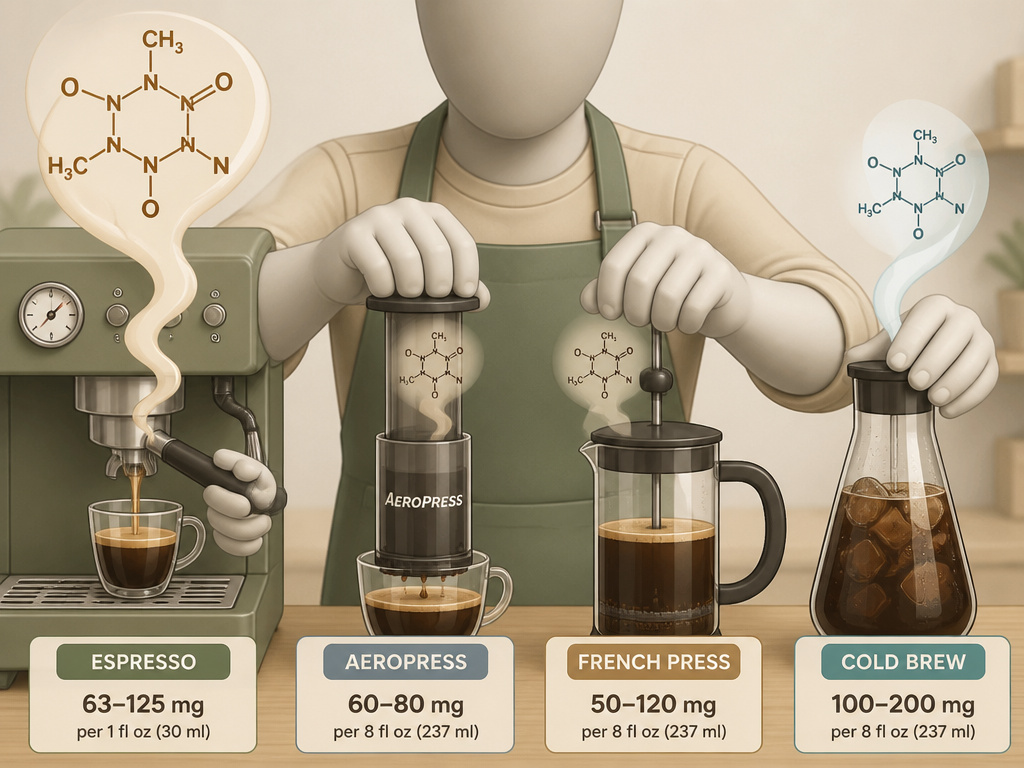
You can obsess over grams and roast levels, but your brewer calls the shots. Extraction efficiency, how much of the coffee’s soluble material ends up in your cup, varies wildly by method. This dwarfs the minor caffeine differences between roasts.
Consider the range from a 2024 review in Applied Sciences:
* Espresso: 50.40–965.60 mg caffeine per 100 mL
* AeroPress: 56.35–120.92 mg caffeine per 100 mL
* French Press: 52.00–123.90 mg caffeine per 100 mL
* Cold Brew: 48.50–179.95 mg caffeine per 100 mL
Espresso’s huge range shows how grind, dose, and pressure can extract vastly different amounts. The AeroPress, used in the Scientific Reports study with a 15:1 water-to-coffee ratio, is a caffeine extraction powerhouse due to its immersion and pressure combination.
Your action plan for maximum caffeine:
1. Grind finer. More surface area equals more extraction. This is especially critical for dark roasts, which are more brittle and create more fines.
2. Use hotter water. Temperature accelerates extraction. Aim for 200–205°F (93–96°C) for most methods.
3. Extend contact time. Immersion methods like French press or cold brew steep for minutes, not seconds.
4. Apply pressure. Espresso and AeroPress force water through the grounds, pulling out more solubles.
Skipping any of these will leave more caffeine in the grounds, regardless of your chosen light roast beans.
The Extraction Yield Wild Card
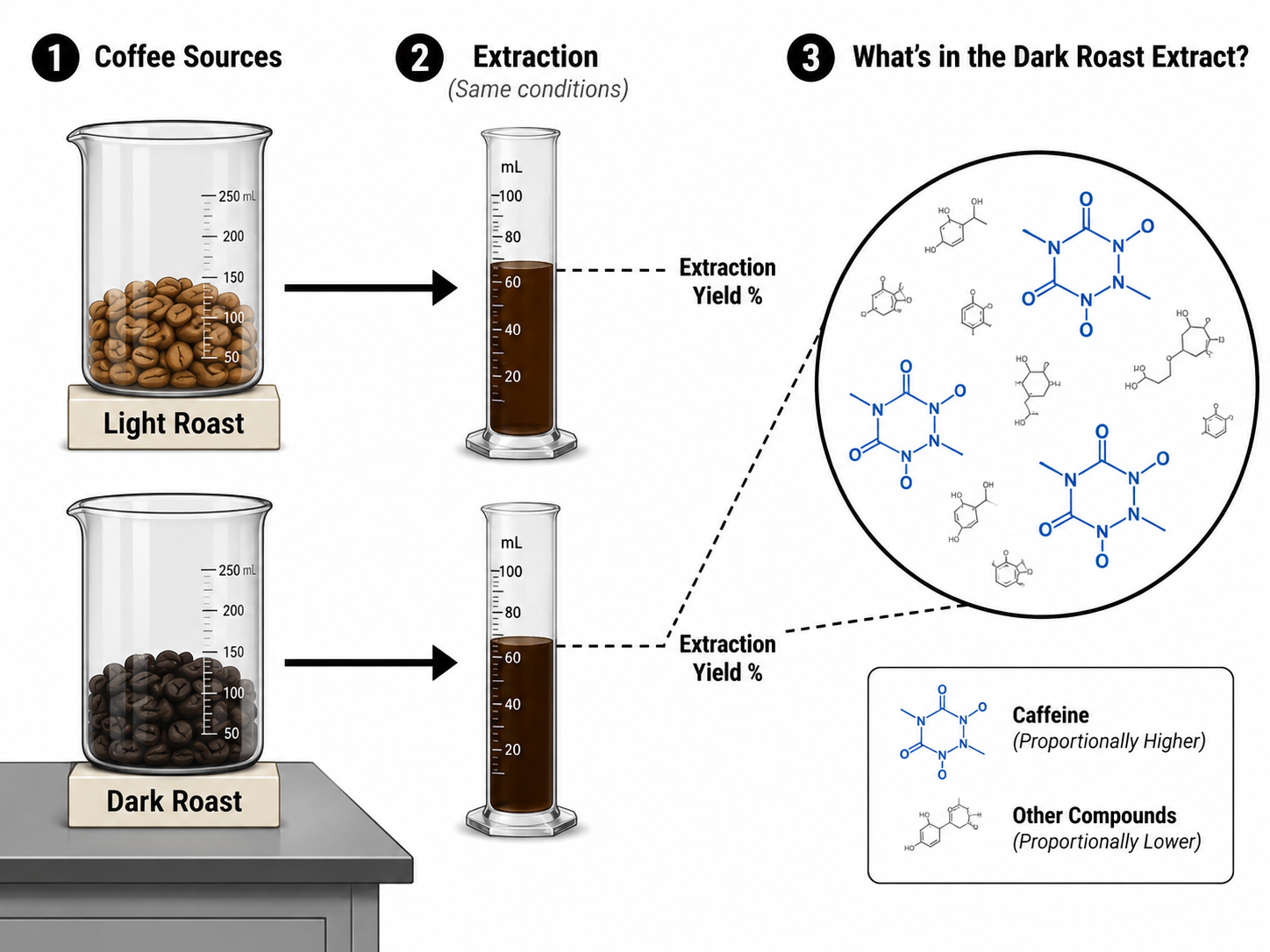
Here’s the twist that most guides miss. If you can achieve the same extraction yield, the percentage of the coffee’s mass dissolved into the water, from both a light and dark roast, the dark roast brew often tests higher in caffeine.
It sounds backward. But as beans roast darker, they lose chlorogenic acids and other compounds at a much faster rate than caffeine. Caffeine becomes a larger proportion of what’s left to extract. A 2024 study demonstrated this: when brews from light and dark roasts were standardized to the same extraction yield, the darker roasts generally showed higher caffeine concentrations.
Common mistake: Over-extracting a dark roast to chase caffeine, pushing a dark roast too long with too fine a grind pulls out bitter, ashy compounds that overpower any marginal caffeine gain. You get a harsh, undrinkable cup.
This is a lab scenario. In your kitchen, light roasts are harder to extract fully because their cellular structure is less developed. You might get 18% extraction from a light roast and 22% from a dark roast with the same grind and time. That higher extraction from the dark roast could deliver more caffeine to your cup, flipping the script. It’s why the question “which has more caffeine?” is fundamentally incomplete without asking, “extracted how?”
Practical Guide: Choosing Your High-Caffeine Coffee
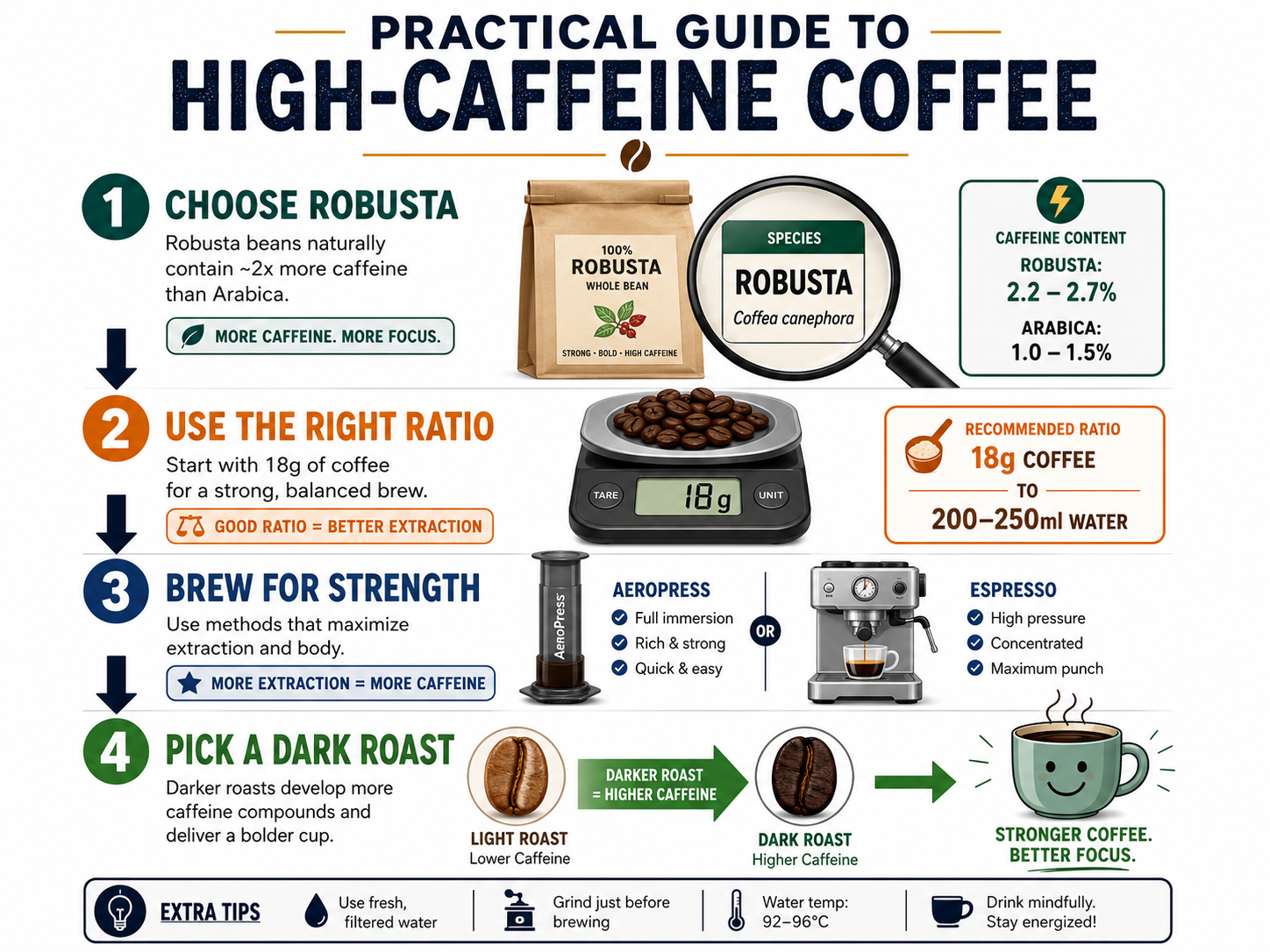
Forget the roast level on the front of the bag. Look at the back. Your decision tree looks like this:
- Priority one: Find Robusta. Scan the bag or description for Coffea canephora. Many Italian espresso blends include a Robusta percentage for crema and kick.
- Priority two: Weigh your dose. Ditch the scoop. Use a kitchen scale. Eighteen grams of any roast is 18 grams of coffee. This neutralizes the density variable.
- Priority three: Pick a high-extraction method. An AeroPress with a 2-3 minute steep or an espresso machine will pull more caffeine than a fast drip machine.
- Roast level is last. If you’ve followed steps 1-3, choose the roast you enjoy. For a final edge, a light roast measured by scoop or a dark roast pushed to a high extraction yield might give you a slight boost.
Your brewing technique has a far greater impact on your final caffeine in espresso than the roast profile. The same logic applies when comparing other sources; the caffeine in tea depends heavily on steeping time and water temperature, not just the type of leaf.
Frequently Asked Questions
Does dark roast coffee have more caffeine than light roast?
It depends how you measure. By scoop (volume), light roast has more because the beans are denser. By weight, the difference is negligible, with dark roast having a minuscule edge. The brewing method you use has a much larger effect on final caffeine content.
Which has more caffeine, blonde roast or dark roast?
Blonde roast (a very light roast) will have more caffeine per scoop. When measured by weight, the difference is too small to matter in a single cup. The intense flavor of dark roast comes from roasted sugars, not extra caffeine.
Why does dark roast coffee taste stronger if it doesn’t have more caffeine?
The bold, sometimes bitter flavor of dark roast comes from the Maillard reaction and the caramelization (and later, carbonization) of sugars during extended roasting. Caffeine is bitter, but its concentration doesn’t increase. You’re tasting the roast, not the stimulant.
Does espresso have more caffeine than regular coffee?
Yes, per ounce. A 1-ounce espresso shot typically has 40-80 mg of caffeine. However, a standard 8-ounce cup of drip coffee contains 80-120 mg. You get more total caffeine in the larger cup of “regular” coffee, but espresso is more concentrated. The espresso caffeine content range is vast, depending on the bean and pull.
How does caffeine in coffee compare to energy drinks?
It varies widely. A standard 8oz coffee can have 80-120mg. A 8.4oz can of Red Bull has about 80mg, while a 16oz Monster can have 160mg. The bigger difference is in other ingredients; energy drinks often contain high sugar and additives like taurine. For a direct energy drink comparison, check the labels.
The Bottom Line
Chasing caffeine by roast color is a distraction. The roast level on the bag changes the density, which changes the scoop, which changes the count. Weigh your coffee and that variable disappears. The species of bean. Robusta over Arabica, and the efficiency of your brewer are the dials that actually turn the caffeine volume up or down.
Your morning routine is a simple equation. Start with a scale and a light roast coffee if you scoop. Seek out Robusta beans if you need the jolt. Then, grind fine, use hot water, and give it time. That process extracts more caffeine than any roaster can ever put in.
{
“@context”: “https://schema.org”,
“@type”: “HowTo”,
“name”: “How to Choose a Coffee Roast for Maximum Caffeine”,
“totalTime”: “PT5M”,
“step”: [
{
“@type”: “HowToStep”,
“name”: “Identify the bean species”,
“text”: “Check the bag for ‘Arabica’ or ‘Robusta’. Robusta beans contain nearly twice the caffeine of Arabica, making species the single biggest factor.”
},
{
“@type”: “HowToStep”,
“name”: “Choose your measurement method”,
“text”: “Decide if you’ll measure coffee by scoop (volume) or by weight. A scoop of light roast packs more beans and slightly more caffeine. Weighed doses of dark and light roast are nearly identical.”
},
{
“@type”: “HowToStep”,
“name”: “Select a high-extraction brewing method”,
“text”: “Use methods like AeroPress, French press, or espresso to pull more caffeine from the grounds. The brewing process extracts more caffeine than roast level changes.”
},
{
“@type”: “HowToStep”,
“name”: “Grind finer for dark roasts”,
“text”: “Dark roast beans are more brittle. Grind them slightly finer than you would a light roast to increase surface area and maximize extraction, counteracting their lower density.”
}
]
}
{
“@context”: “https://schema.org”,
“@type”: “FAQPage”,
“mainEntity”: [
{
“@type”: “Question”,
“name”: “Does dark roast coffee have more caffeine than light roast?”,
“acceptedAnswer”: {
“@type”: “Answer”,
“text”: “It depends how you measure. By scoop (volume), light roast has more because the beans are denser. By weight, the difference is negligible, with dark roast having a minuscule edge. The brewing method you use has a much larger effect on final caffeine content.”
}
},
{
“@type”: “Question”,
“name”: “Which has more caffeine, blonde roast or dark roast?”,
“acceptedAnswer”: {
“@type”: “Answer”,
“text”: “Blonde roast (a very light roast) will have more caffeine per scoop. When measured by weight, the difference is too small to matter in a single cup. The intense flavor of dark roast comes from roasted sugars, not extra caffeine.”
}
},
{
“@type”: “Question”,
“name”: “Why does dark roast coffee taste stronger if it doesn’t have more caffeine?”,
“acceptedAnswer”: {
“@type”: “Answer”,
“text”: “The bold, sometimes bitter flavor of dark roast comes from the Maillard reaction and the caramelization (and later, carbonization) of sugars during extended roasting. Caffeine is bitter, but its concentration doesn’t increase. You’re tasting the roast, not the stimulant.”
}
},
{
“@type”: “Question”,
“name”: “Does espresso have more caffeine than regular coffee?”,
“acceptedAnswer”: {
“@type”: “Answer”,
“text”: “Yes, per ounce. A 1-ounce espresso shot typically has 40-80 mg of caffeine. However, a standard 8-ounce cup of drip coffee contains 80-120 mg. You get more total caffeine in the larger cup of \”regular\” coffee, but espresso is more concentrated. The espresso caffeine content range is vast, depending on the bean and pull.”
}
},
{
“@type”: “Question”,
“name”: “How does caffeine in coffee compare to energy drinks?”,
“acceptedAnswer”: {
“@type”: “Answer”,
“text”: “It varies widely. A standard 8oz coffee can have 80-120mg. A 8.4oz can of Red Bull has about 80mg, while a 16oz Monster can have 160mg. The bigger difference is in other ingredients; energy drinks often contain high sugar and additives like taurine. For a direct energy drink comparison, check the labels.”
}
}
]
}
