
What is Kona Coffee? Learn About Authentic Hawaiian Bean & Law
Kona coffee is 100% Arabica coffee grown exclusively on the volcanic slopes of the Kona district on Hawaii’s Big Island. Its unique flavor profile, bright, clean, with notes of brown sugar, milk chocolate, and mild citrus, comes from a specific 30-mile microclimate and strict processing methods. By law, any product labeled “Kona” in Hawaii must contain a minimum of 10% Kona coffee beans.
That 10% figure is the most important thing you’ll read today. It’s the reason a bag of “Kona Blend” at the grocery store can cost $12 while a half-pound of the real stuff from a farm costs $35. Most people think “Kona” on a bag means it’s from Hawaii. It doesn’t. It means at least one in ten beans inside might be.
This guide strips away the marketing. You’ll learn the real geography, the contested history, and the precise legal definitions that separate a genuine cup from a clever imitation.
Key Takeaways
- The “Kona Coffee Belt” is only 30 miles long. All authentic Kona grows on the western slopes of Hualalai and Mauna Loa volcanoes between 800 and 2,500 feet in elevation.
- “100% Kona Coffee” is the only label that guarantees purity. Any other phrasing, including “Kona Blend,” means the bag contains cheaper beans from other regions, often Central America.
- Hawaii’s labeling law sets a shockingly low bar. Since 1992, a product can be labeled “Kona” if it contains just 10% Kona beans. This is the lowest geographic protection threshold for any coffee in the world.
- The primary bean is Kona Typica. This is a specific strain of Guatemalan Arabica introduced in 1892 that adapted perfectly to Kona’s volcanic soil and climate.
- Authenticity comes at a price. True 100% Kona coffee retails between $40 and $65 per pound. If you’re paying less, you are buying a blend.
The Kona Coffee Belt: A 30-Mile Microclimate
Kona coffee doesn’t grow all over Hawaii. It doesn’t even grow all over the Big Island. The official growing region, the Kona Coffee Belt, is a narrow strip about 30 miles long and 2 miles wide on the western slopes. This isn’t an arbitrary marketing boundary. It’s defined by a specific combination of elements that simply don’t exist together anywhere else.
The soil is young, porous volcanic rock, rich in nitrogen, phosphorus, and iron. Morning sun heats the slopes, followed by consistent afternoon cloud cover that protects the delicate coffee cherries from burning. The elevation, between 800 and 2,500 feet, provides the cool nights that slow the maturation of the cherry, allowing complex sugars to develop. Farms here are small, averaging between one and five acres. This scale means harvesting is still done largely by hand, with pickers selecting only the ripest red cherries.
The Kona coffee belt is the only location where Kona coffee fields are found. Rich volcanic soil with nitrates, phosphates, iron and manganese in these mountainous regions encourages the growth of healthy plants.
You can’t replicate this terroir. Attempts to grow the same Kona Typica bean in other parts of Hawaii or the world produce a different cup. The combination of mineral-rich soil, precise elevation, and a daily weather pattern of sun, cloud, and rain is what creates the bean’s signature mild acidity and clean finish. It’s a single-origin coffee in the most literal sense.
From Seed to Sack: How Kona Coffee is Processed
The journey from cherry to bag is meticulous and mostly manual, a major factor in its cost and quality. After hand-picking, the cherries are pulped to remove the outer fruit. The beans, still covered in a sticky mucilage, then undergo a critical fermentation stage.
This fermentation lasts between 12 and 24 hours, depending on the farm’s elevation. Higher, cooler farms ferment longer. The process breaks down the mucilage so it can be washed away with fresh water. Skipping or shortening this step leaves a harsh, sour taste in the final cup. After washing, the beans are sun-dried on large decks called hoshidanas until they reach a moisture content between 9% and 12.2%.
Finally, the dried bean, now called “parchment coffee,” is milled to remove its papery husk, then sorted and graded. The top grade is “Kona Extra Fancy,” which requires beans to be at least 19/64th of an inch in diameter and have virtually zero defects.
TL;DR: Hand-picked cherries are fermented for 12-24 hours, sun-dried to 9-12% moisture, then milled and sorted by size, with the largest, most perfect beans earning the “Extra Fancy” grade.
The 10% Labeling Law and Why It Matters
Here is where the story turns. In 1992, the Hawaii Legislature passed a law, now codified as Hawaii Revised Statutes §486-120.6, that set the minimum requirement for using the name “Kona” on a coffee label. That minimum is 10%.
Common mistake: Buying a bag labeled “Kona Blend” thinking it’s mostly Kona coffee, by law, it can be 90% cheaper beans from other countries, with only 10% authentic Kona.
This means a roaster can mix 10% Kona beans with 90% less expensive beans from, say, Colombia or Brazil, and still legally sell it as a “Kona Blend” in Hawaii. For consumers, this creates massive confusion. A 2018 study by the Food and Agriculture Organization of the United Nations and the European Bank for Reconstruction and Development concluded that Kona coffee “does not enjoy any strong protection of its name” from the State of Hawaiʻi precisely because of this lax law.
The state’s own Hawaii coffee labeling guidelines PDF provides the examples: “100% KONA COFFEE” for the pure product, and “10% KONA COFFEE BLEND” for the mix. Act 222 of 2022 directed the Department of Agriculture to study the economic impact of changing this law, but as of now, the 10% rule stands. It is the lowest geographic protection threshold for any major coffee region in the world.
This legal landscape makes understanding geographic coffee labels more than academic, it’s financial. You are paying for the name. The difference between a 10% blend and the real thing is the difference between a hint of Kona’s character and its full, nuanced flavor profile.
| Label Term | Legal Minimum Kona Coffee | What It Really Means |
|---|---|---|
| 100% Kona Coffee | 100% | Every bean is from the Kona Coffee Belt. The most expensive and authentic product. |
| Kona Coffee | 100% | In Hawaii, this also means 100%. Outside Hawaii, this term is not regulated and is often misused. |
| Kona Blend, 10% Kona Blend | 10% | Contains as little as 10% Kona beans. The remaining 90% can be any other coffee. |
| Kona Style or Kona Roast | 0% | Contains no Kona coffee. This is a marketing term describing a roast profile or flavor imitation. |
How to Spot the Real Thing (And Avoid the Blends)
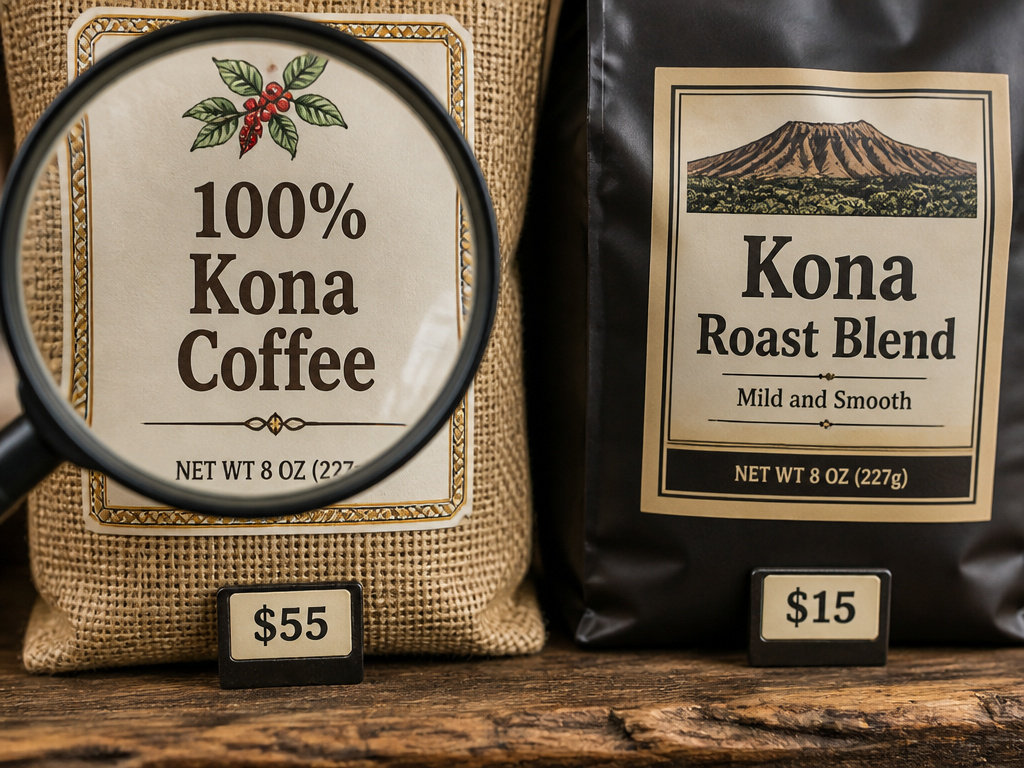
Given the labeling law, buying genuine Kona coffee requires a detective’s eye. Price is the first and most reliable filter. True 100% Kona, from a reputable farm, retails between $40 and $65 per pound for roasted beans. If you see a “Kona” bag for $15 a pound, it is unquestionably a blend.
Next, read the front label with extreme care. The phrase “100% Kona Coffee” is a regulated, specific claim. The “100%” must be there. Phrases like “Kona Blend,” “Kona Roast,” or “Kona Style” are deliberate dodges. Check the fine print on the back for origin statements. Legitimate 100% Kona will proudly state “Grown and roasted in Kona, Hawaii” or list the specific farm.
Finally, buy direct. The most foolproof method is to purchase from a farm’s own website. The Kona Coffee Farmers Association guide maintains a list of certified members. This cuts out the middleman and gives you traceability back to the exact slope where your coffee was grown.
TL;DR: Look for “100%” on the label, expect to pay over $40 per pound, and buy directly from a certified Kona farm’s website to guarantee authenticity.
Kona’s Flavor Profile: What You’re Actually Tasting
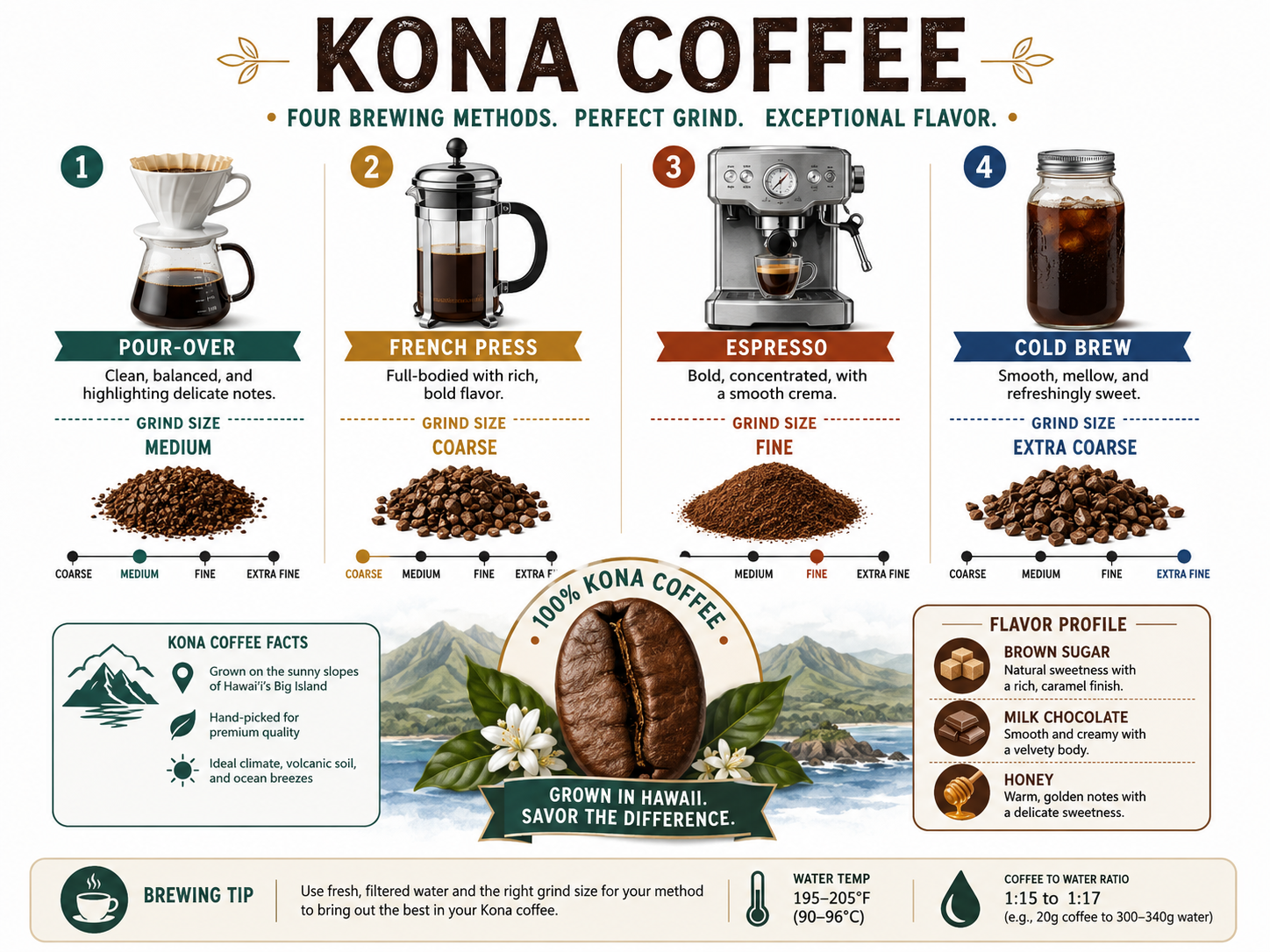
When you get a cup of real, 100% Kona, what should you expect? It’s not a bold, in-your-face coffee. Its appeal is balance and clarity. The Wikipedia entry on Kona coffee describes it as “smooth and rich,” which is accurate but undersells the nuance.
A properly roasted Kona coffee presents a medium body with a noticeable but gentle acidity, think of a bright citrus note that quickly mellows. The dominant flavors are often brown sugar, milk chocolate, and a subtle, honey-like sweetness. There’s sometimes a faint, almost nutty aftertaste. The lack of bitterness or harshness is its hallmark, a direct result of the careful processing and mineral-rich soil.
This delicate profile is easily overwhelmed. Using a blade grinder that creates uneven particles will extract bitter compounds alongside the sweetness, muddying the cup. A burr coffee grinder set to a medium-coarse grind is non-negotiable for pour-over or French press. For espresso, a finer, consistent grind is key, but the relatively mild caffeine content compared to some African beans means it won’t punch through milk as strongly in a latte.
| Brewing Method | Recommended Grind | Why It Works for Kona |
|---|---|---|
| Pour-Over / Drip | Medium-Coarse | Even extraction highlights the clean, bright notes without pulling out bitterness. |
| French Press | Coarse | The immersion method emphasizes the coffee’s body and chocolatey sweetness. |
| Espresso | Fine | Can work, but best as a straight shot or macchiato to appreciate the nuanced flavor before milk dominates. |
| Cold Brew | Coarse | Produces a very smooth, sweet concentrate that downplays acidity and amplifies the brown sugar notes. |
Frequently Asked Questions
Why is Kona coffee so expensive?
The cost comes from three factors: tiny geography, manual labor, and U.S. wages. The coffee grows on only about 2,000 acres total. Every cherry is hand-picked, and the entire processing chain is labor-intensive. Farming and processing in Hawaii, with its high cost of living, is far more expensive than in Central America or Africa.
Is Kona coffee stronger or have more caffeine?
No. Kona is a variety of Arabica, which has less caffeine than Robusta beans. Its “strength” is in its smooth, complex flavor, not its caffeine kick. A typical cup has a caffeine content similar to other single-origin Arabica coffees.
Can I grow Kona coffee at home?
You can grow the Kona Typica plant, but you cannot replicate the terroir. The unique combination of volcanic soil, specific cloud cover, and elevation on the Kona slopes is what creates the signature flavor. Beans grown elsewhere will taste different.
What’s the best way to brew Kona coffee?
To honor its delicate flavor, use a clean, paper-filter method like pour-over. Paper coffee filters remove oils and sediment, resulting in the brightest, cleanest cup that lets Kona’s nuanced notes shine. Avoid dark roasts, which will obliterate its subtle characteristics.
What happened with the Kona coffee lawsuit?
In the late 1990s, a major distributor was caught selling cheap Central American coffee as “100% Kona.” This scandal led to a class-action lawsuit and heightened awareness of the labeling issue, but it did not change the underlying 10% blending law. It reinforced the importance of buying from certified, traceable sources.
Before You Go
Kona coffee is a lesson in terroir and labeling. Its value lies in a precise place and a painstaking process. The 10% blending law means the word “Kona” on a bag is not a guarantee of origin, it’s a starting point for scrutiny. Your best defense is to look for “100%,” understand the realistic price, and buy directly from the farm. When you do, you’re not just buying coffee. You’re buying 30 miles of volcanic slope, a daily dance of sun and cloud, and a tradition of handcrafted agriculture that survives on a razor-thin margin. That first sip of the real thing, with its clear notes of brown sugar and citrus, makes the search worth it.
{
“@context”: “https://schema.org”,
“@type”: “HowTo”,
“name”: “How to Identify and Buy Authentic Kona Coffee”,
“totalTime”: “PT10M”,
“step”: [
{
“@type”: “HowToStep”,
“name”: “Check the label for origin statements”,
“text”: “Look for the exact phrase ‘100% Kona Coffee’ on the front label. Phrases like ‘Kona Blend’ or ‘10% Kona Coffee Blend’ indicate the product contains other, cheaper beans.”
},
{
“@type”: “HowToStep”,
“name”: “Verify the roaster’s location”,
“text”: “Genuine 100% Kona coffee is roasted in Hawaii, almost always on the Big Island. A mainland US roaster selling ‘Kona’ is likely selling a blend.”
},
{
“@type”: “HowToStep”,
“name”: “Understand the price point”,
“text”: “Real 100% Kona coffee retails for $40 to $65 per pound for roasted beans. Prices significantly lower than this almost guarantee a blend.”
},
{
“@type”: “HowToStep”,
“name”: “Look for certification marks”,
“text”: “Reputable farms display logos from the Kona Coffee Farmers Association or the Hawaii Department of Agriculture, which audits and certifies authentic Kona coffee.”
},
{
“@type”: “HowToStep”,
“name”: “Buy direct from the farm”,
“text”: “The most reliable method is to purchase from a recognized Kona farm’s website. This cuts out distributors and ensures traceability from the specific slope where the beans were grown.”
}
]
}
{
“@context”: “https://schema.org”,
“@type”: “FAQPage”,
“mainEntity”: [
{
“@type”: “Question”,
“name”: “Why is Kona coffee so expensive?”,
“acceptedAnswer”: {
“@type”: “Answer”,
“text”: “The cost comes from three factors: tiny geography, manual labor, and U.S. wages. The coffee grows on only about 2,000 acres total. Every cherry is hand-picked, and the entire processing chain is labor-intensive. Farming and processing in Hawaii, with its high cost of living, is far more expensive than in Central America or Africa.”
}
},
{
“@type”: “Question”,
“name”: “Is Kona coffee stronger or have more caffeine?”,
“acceptedAnswer”: {
“@type”: “Answer”,
“text”: “No. Kona is a variety of Arabica, which has less caffeine than Robusta beans. Its \”strength\” is in its smooth, complex flavor, not its caffeine kick. A typical cup has a caffeine content similar to other single-origin Arabica coffees.”
}
},
{
“@type”: “Question”,
“name”: “Can I grow Kona coffee at home?”,
“acceptedAnswer”: {
“@type”: “Answer”,
“text”: “You can grow the Kona Typica plant, but you cannot replicate the terroir. The unique combination of volcanic soil, specific cloud cover, and elevation on the Kona slopes is what creates the signature flavor. Beans grown elsewhere will taste different.”
}
},
{
“@type”: “Question”,
“name”: “What’s the best way to brew Kona coffee?”,
“acceptedAnswer”: {
“@type”: “Answer”,
“text”: “To honor its delicate flavor, use a clean, paper-filter method like pour-over. Paper coffee filters remove oils and sediment, resulting in the brightest, cleanest cup that lets Kona’s nuanced notes shine. Avoid dark roasts, which will obliterate its subtle characteristics.”
}
},
{
“@type”: “Question”,
“name”: “What happened with the Kona coffee lawsuit?”,
“acceptedAnswer”: {
“@type”: “Answer”,
“text”: “In the late 1990s, a major distributor was caught selling cheap Central American coffee as \”100% Kona.\” This scandal led to a class-action lawsuit and heightened awareness of the labeling issue, but it did not change the underlying 10% blending law. It reinforced the importance of buying from certified, traceable sources.”
}
}
]
}
