
What Is Chicory in Coffee? The Twice-Used Coffee Substitute
Chicory in coffee is the roasted, ground root of the Cichorium intybus plant, used as a caffeine-free additive or complete coffee substitute. It contributes an earthy, woody, and slightly bitter-sweet flavor, historically embraced during coffee shortages in 19th-century New Orleans and Napoleonic France.
Most people think chicory is just a cheap filler. The real story is about a resilient root that kept coffee culture alive when the beans ran out, twice. Its signature flavor isn’t an accident; it’s chemistry.
This guide unpacks the botany, the forced historical marriages, and the precise reasons its taste profile works. You’ll learn how to brew it, why it might upset your stomach, and what the blue flower in your yard has to do with your morning cup.
Key Takeaways
- Chicory is the roasted taproot of the Cichorium intybus plant, containing up to 40% inulin, a prebiotic fiber that caramelizes during roasting.
- Its use in coffee surged during two specific blockades: Napoleon’s Continental Blockade (1806-1814) and the Union naval blockade of New Orleans (1861-1865).
- The flavor transformation from raw root to coffee substitute hinges on the Maillard reaction; under-roasting tastes grassy, over-roasting turns acrid.
- Modern agriculture distinguishes at least four cultivated varieties: root chicory for coffee, witloof for Belgian endive, leaf chicories like radicchio, and forage chicory for livestock.
- Brewing with more than a 30% chicory ratio often leads to a laxative effect within a few hours due to its high soluble fiber content.
What Is Chicory, Exactly? (Botany & Processing)
Cichorium intybus is an erect perennial herb. You’ve probably seen its wiry stem and bright blue flower on roadsides. The commercial product comes from its taproot, which can plunge 75 centimeters into the soil. That root is a storage organ, packing energy as inulin.
Raw chicory root has a mild, slightly sweet, and earthy character. Roasting develops the characteristic bitter, coffee-like, and nutty profile through Maillard reactions and caramelization of inulin and other carbohydrates.
Farmers harvest roots that look like pale, skinny parsnips. They are washed, diced, dried, and then roasted at temperatures similar to coffee, anywhere from 180°C to 230°C. This is where the magic happens. The inulin, a polymer of fructose molecules, breaks down. It caramelizes, producing deep, sweet, and bitter compounds that mimic the roasted notes of coffee beans. Get the roast wrong and the flavor falls apart. Too light, and it tastes vegetal and sweet like a raw beet. Too dark, and it becomes harshly bitter with a burnt sugar aftertaste.
TL;DR: Chicory coffee comes from the roasted taproot of a common blue-flowered weed; its coffee-like flavor is created by roasting, which caramelizes the root’s stored inulin.
The Inulin Engine: Why Chicory Tastes Sweet and Acts as a Fiber
Inulin is the key. This soluble fiber makes up to 40% of the chicory root’s dry weight, according to a 1970s discovery cited in the NIH phytochemistry of chicory article. Your body doesn’t digest inulin. It passes to the lower gut where it feeds beneficial bacteria, that’s the prebiotic effect. In your cup, it’s also the source of chicory’s inherent sweetness and body.
During roasting, the long chains of inulin break into shorter fructose chains and other compounds. This is why chicory coffee can taste sweet without adding sugar. It’s also why overdoing it can cause digestive upset. That undigested fiber pulls water into your colon. A strong cup on an empty stomach delivers a noticeable effect.
| Chicory Component | Role in Raw Root | Effect After Roasting |
|---|---|---|
| Inulin (up to 40%) | Energy storage, prebiotic fiber | Caramelizes, creating sweetness & body; source of soluble fiber |
| Sugars (e.g., fructose) | Minimal free sugars | Released from inulin breakdown, contribute direct sweetness |
| Proteins & Amino Acids | Cellular structure | Undergo Maillard reaction, creating bitter, roasted, nutty flavors |
| Phenolic Compounds | Antioxidants, defense | Some volatilize, some contribute to bitter/astringent notes |
A Root of Necessity: The Unavoidable History of Chicory Coffee
Chicory didn’t blend with coffee because someone thought it was a delicious idea. It was a last resort. The first recorded pivot happened in 1766 Prussia. Frederick the Great banned coffee imports to keep wealth within the kingdom. An innkeeper named Christian Gottlieb Förster got a royal concession to manufacture a coffee substitute from chicory by 1770.
The practice truly cemented itself in France a few decades later. During Napoleon’s Continental Blockade (1806-1814), the British navy cut off coffee imports. The French, desperate for their daily ritual, turned to the locally grown root. The taste persisted even after the blockade ended, leading to blends like Ricoré, a 60/40 mix of chicory and coffee still sold today.
The story repeated across the Atlantic. By the 1840s, New Orleans was the second-largest coffee importer in the US. The Civil War changed that. Union blockades from 1861 to 1865 severed the port’s supply lines. Locals stretched their dwindling coffee stocks with roasted chicory root. The practice stuck, defining the city’s coffee culture. Café Du Monde, founded in 1862, built its legacy on serving café au lait with chicory.
Common mistake: Assuming chicory was added to coffee because it tastes better. It was always about scarcity and economics. The acquired taste came later.
These weren’t isolated incidents. Chicory saw use in East Germany’s Mischkaffee during the 1970s coffee crisis and in Camp Coffee, a British essence sold since 1885. Every time coffee became too expensive or unavailable, chicory was there. Its resilience is literally rooted in the fact it grows like a weed in temperate climates.
The Modern Chicory Landscape: More Than Just a Coffee Stretcher
Today, chicory is a precision crop. Agricultural science optimizes it for different goals. A 2023 review in Discover Plants notes that applying 100 kg of nitrogen per hectare maximizes amino acid quality in the root, while 200 kg/ha actually degrades it. Under ideal conditions, farmers can harvest over 62 metric tons of roots per hectare, yielding about 8 tons of extractable inulin.
Not all chicory is grown for your cup. The species Cichorium intybus has been split into distinct cultivated varieties, each with a dedicated purpose. Confusing them leads to the wrong product.
| Chicory Variety | Primary Use | Key Characteristic | Where Grown |
|---|---|---|---|
| var. sativum (Root Chicory) | Coffee substitute, inulin extraction | Long, thick taproot; high inulin content | NW Europe, India, South Africa, Chile |
| Witloof / Brussels Chicory | Etiolated buds (chicons, Belgian endive) | Grown for forced, blanched leaf buds | Primarily Europe |
| var. latifolium (Leaf Chicories) | Leafy vegetables (radicchio, Catalogne) | Red or green leaves; bitter salad component | Italy, NW Europe |
| Forage Chicory | Livestock feed | High-protein, mineral-rich leaves | Domesticated since mid-1970s |
This specialization matters. The genetic profile of witloof is closer to industrial root chicory than to leafy radicchio. If you’re buying chicory for coffee, you want root chicory. The inulin from these roots is further processed: short-chain inulin becomes fructose syrup for sodas, while long-chain inulin acts as a fat replacer in ice cream or a foam stabilizer in beer.
Its byproducts are valuable, too. Chicory leaves and pulp left after inulin extraction have a total phenolic content as high as 4600 mg/100g, rivaling fruits like acerola. The modern story isn’t about stretching coffee; it’s about extracting maximum value from a versatile plant.
How to Brew With Chicory (And Why You Might Want To)
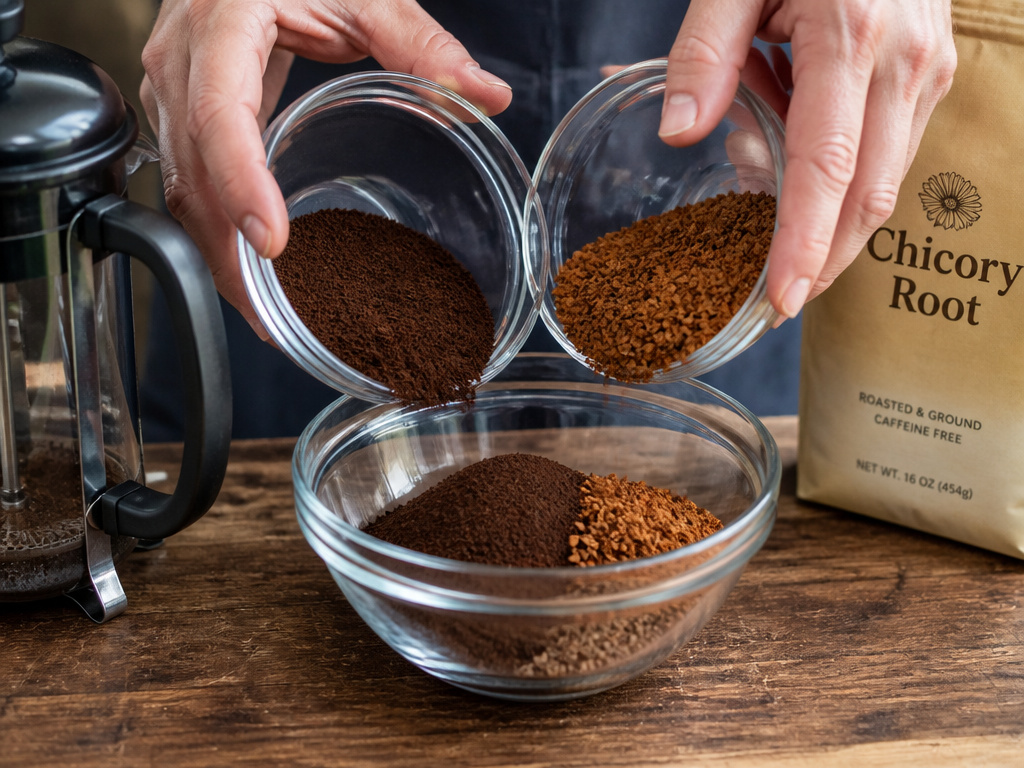
You have two paths: blend it with coffee or go solo. Blending is the gentlest introduction. It adds body and a unique sweet-bitter note that can round out a harsh, acidic coffee. Going 100% chicory gives you a full-bodied, caffeine-free brew that smells surprisingly like coffee but tastes distinctly of its own earth and wood.
Start with a 70/30 coffee-to-chicory ratio. Use your normal coffee dose and replace 30% of it with ground chicory root. The grind should match your method, medium for drip, coarse for French press. Brew with water just off the boil. The chicory extracts quickly, so don’t over-extract by letting it steep too long in a French press.
I tried a 50/50 blend once, eager for the full experience. The cup was syrupy and sweet, but within two hours my stomach made its objections clear. Now I never go above 30% unless I’m planning a very quiet morning at home.
The flavor is what sells it. It cuts the sharp acidity of some African coffees and adds a malty depth to milder Central American beans. It’s a classic partner for the dark, chocolaty roasts used in traditional New Orleans-style coffee. A small pinch of salt in the grounds can further soften any lingering harsh bitterness from the chicory.
Why bother? For some, it’s the caffeine-free alternative. For others, it’s the historical connection, drinking a cup is a taste of 19th-century New Orleans. For many, it’s simply a pleasant change, a way to add a new dimension to a daily routine without learning a new brewing technique. It’s also inexpensive. A bag of pure ground chicory root costs a fraction of specialty coffee.
TL;DR: Blend 1 part chicory with 3 parts coffee, brew as normal, and expect a smoother, sweeter, heavier cup. Exceeding that ratio often leads to digestive side effects.
Frequently Asked Questions
Does chicory coffee taste like real coffee?
It tastes like coffee’s earthy, woody cousin. The aroma is remarkably similar due to shared roasting compounds, but the flavor profile is distinct, less acidic, more inherently sweet, and with a pronounced bitter-woody note. It mimics the experience of coffee more than it replicates the exact taste.
Is chicory in coffee good for you?
Chicory root is a source of prebiotic inulin, which can support gut health. It’s also caffeine-free and contains antioxidants. However, the high soluble fiber content can cause bloating, gas, or a laxative effect, especially in larger amounts or for individuals with sensitive guts. It is not a magical health elixir; it’s a fibrous root.
Why is chicory added to coffee?
Historically, it was added to stretch scarce coffee supplies during blockades and economic crises in 18th-century Prussia, Napoleonic France, and Civil War-era New Orleans. Today, it’s added for its unique flavor profile, to add sweetness, body, and a bitter complexity, and to reduce caffeine content.
Can you drink chicory coffee every day?
You can, but listen to your body. Many people in New Orleans do. If you’re using a typical blend (20-30% chicory), it’s generally fine. If you drink 100% chicory coffee daily, the high inulin intake will likely have a persistent effect on your digestion. Moderation is key, as with any high-fiber food.
Where can I buy chicory for coffee?
Look for it in the coffee aisle of well-stocked grocery stores, especially in areas with French or Creole cultural ties. You can find it online sold as “roasted chicory root” or “chicory coffee blend.” Brands like Café Du Monde, Luzianne, and Teeccino are widely available. Ensure you’re buying root chicory, not a salad green.
Before You Go
Chicory in coffee is a testament to adaptation. A humble roadside weed became a historical stopgap, then a cultural staple, and now a modern functional food. Its value lies in that journey as much as in its flavor.
Remember the root. It’s not just a filler; it’s a reservoir of inulin that transforms under heat into something warm and familiar. Start with a small blend. Respect its potency as a fiber. And the next time you see that blue flower by the highway, you’ll know the story beneath the soil.
Whether you use it to smooth out a bitter cup, explore caffeine-free options, or connect with a centuries-old tradition, chicory adds a layer of depth to the simple act of brewing a drink. That’s a pretty good legacy for a root that just wanted to grow.
{
“@context”: “https://schema.org”,
“@type”: “HowTo”,
“name”: “How to Brew Coffee with Chicory”,
“totalTime”: “PT10M”,
“tool”: [
{
“@type”: “HowToTool”,
“name”: “French press, drip machine, or pour-over setup”
},
{
“@type”: “HowToTool”,
“name”: “Kitchen scale or measuring spoon”
},
{
“@type”: “HowToTool”,
“name”: “Kettle for hot water”
}
],
“step”: [
{
“@type”: “HowToStep”,
“name”: “Choose your ratio”,
“text”: “Start with a blend of 70% coffee to 30% ground chicory root. For a caffeine-free cup, use 100% chicory.”
},
{
“@type”: “HowToStep”,
“name”: “Measure and combine”,
“text”: “Use your standard coffee dose (e.g., 15g for a 250ml cup) and replace the appropriate portion with chicory. Grind size should match your brew method—medium for drip, coarse for French press.”
},
{
“@type”: “HowToStep”,
“name”: “Brew as usual”,
“text”: “Add the blend to your brewer. Pour water just off the boil (around 96°C / 205°F) over the grounds and follow your normal brew time.”
},
{
“@type”: “HowToStep”,
“name”: “Taste and adjust”,
“text”: “The first sip will be earthier and slightly sweeter than plain coffee. If the bitterness is too sharp, reduce the chicory percentage next time.”
}
]
}
{
“@context”: “https://schema.org”,
“@type”: “FAQPage”,
“mainEntity”: [
{
“@type”: “Question”,
“name”: “Does chicory coffee taste like real coffee?”,
“acceptedAnswer”: {
“@type”: “Answer”,
“text”: “It tastes like coffee’s earthy, woody cousin. The aroma is remarkably similar due to shared roasting compounds, but the flavor profile is distinct, less acidic, more inherently sweet, and with a pronounced bitter-woody note. It mimics the experience of coffee more than it replicates the exact taste.”
}
},
{
“@type”: “Question”,
“name”: “Is chicory in coffee good for you?”,
“acceptedAnswer”: {
“@type”: “Answer”,
“text”: “Chicory root is a source of prebiotic inulin, which can support gut health. It’s also caffeine-free and contains antioxidants. However, the high soluble fiber content can cause bloating, gas, or a laxative effect, especially in larger amounts or for individuals with sensitive guts. It is not a magical health elixir; it’s a fibrous root.”
}
},
{
“@type”: “Question”,
“name”: “Why is chicory added to coffee?”,
“acceptedAnswer”: {
“@type”: “Answer”,
“text”: “Historically, it was added to stretch scarce coffee supplies during blockades and economic crises in 18th-century Prussia, Napoleonic France, and Civil War-era New Orleans. Today, it’s added for its unique flavor profile, to add sweetness, body, and a bitter complexity, and to reduce caffeine content.”
}
},
{
“@type”: “Question”,
“name”: “Can you drink chicory coffee every day?”,
“acceptedAnswer”: {
“@type”: “Answer”,
“text”: “You can, but listen to your body. Many people in New Orleans do. If you’re using a typical blend (20-30% chicory), it’s generally fine. If you drink 100% chicory coffee daily, the high inulin intake will likely have a persistent effect on your digestion. Moderation is key, as with any high-fiber food.”
}
},
{
“@type”: “Question”,
“name”: “Where can I buy chicory for coffee?”,
“acceptedAnswer”: {
“@type”: “Answer”,
“text”: “Look for it in the coffee aisle of well-stocked grocery stores, especially in areas with French or Creole cultural ties. You can find it online sold as \”roasted chicory root\” or \”chicory coffee blend.\” Brands like Café Du Monde, Luzianne, and Teeccino are widely available. Ensure you’re buying root chicory, not a salad green.”
}
}
]
}
