
What Is Americano Coffee? Learn Its Italian Origin & How-To
An Americano coffee is a diluted espresso drink, made by adding hot water to a shot of espresso. The standard ratio is one part espresso to two parts hot water, creating a cup similar in strength to filter coffee but with espresso’s distinct flavor profile.
Most guides stop at the basic recipe. They miss the specific technique that preserves the crema and the historical detail that rewrites the drink’s supposed origin. Getting the water-to-espresso sequence wrong turns a bright, complex cup into a flat, bitter one.
This guide covers the correct build order, the artisanal ratio for powerful single-origin beans, and the real story behind the name.
Key Takeaways
- Always add hot water to the espresso, not the other way around, to preserve the layer of crema on top.
- For standard beans, use a 1:2 espresso-to-water ratio. For intense single-origin beans like Ethiopian or Sumatran, a 1:1 ratio balances strength without overpowering.
- The modern Americano is tied to post-1948 espresso technology, not WWII G.I.s, espresso wasn’t concentrated enough before then.
- In Italy, “caffè americano” means espresso with water, while “caffè all’americana” refers to American-style filter coffee.
- Machines like the InstaCuppa 3-in-1 simplify the process by pulling a shot and heating water in the same device.
What Exactly Is in Your Cup?
An Americano is not brewed coffee. It is a post-extraction dilution. You fully extract a concentrated coffee shot under pressure, then add hot water to reach your preferred volume and strength. This matters because it locks in espresso’s specific solubles, oils, sugars, and acids, before any water touches them.
The defining characteristic is the preserved crema. That tan-colored foam on top of a fresh shot is a mix of CO2 and coffee oils. Pouring water over the shot floats this layer. Pouring the shot into water shatters it instantly. The visual cue is your first quality check.
An Americano is prepared by adding hot water to espresso, giving it a similar strength to but different flavor from traditionally brewed coffee. The ratio of espresso to hot water varies, with common recipes calling for 1:1 to 1:4 parts espresso to water.
TL;DR: It’s diluted espresso, not brewed coffee. The crema on top is your sign it was made correctly.
The Standard Americano Recipe
Follow this sequence. Swapping steps two and three is the most common error in home preparation.
You need an espresso shot and hot water. The shot should be a standard double: 18 grams of ground coffee yielding about 36 grams of liquid espresso in 25–30 seconds. Heat your water to just below boiling, between 195°F and 205°F (90°C–96°C).
- Pull the espresso shot directly into your serving cup. This is non-negotiable. The shot must land in its final vessel.
- Heat the water while the shot pulls. A gooseneck kettle gives you control, but any kettle works. An all-in-one machine like the InstaCuppa 3-in-1 handles both steps, using its kettle mode to heat water to 100°C.
- Pour the hot water gently over the espresso. Aim for the side of the cup to minimize turbulence. The standard ratio is one part espresso to two parts water. For that 36g double shot, add 72g (about 2.5 oz) of hot water.
Skipping the scale and eyeballing the water is the second most common mistake. A 36g shot with 150g of water tastes weak and hollow. With only 50g of water, it’s just a lukewarm espresso. The scale guarantees consistency.
| Component | Standard Measure | Consequence of Deviation |
|---|---|---|
| Espresso Shot | 36g (double shot) | Under-extracted (<30g): sour, weak base. Over-extracted (>40g): bitter, astringent base. |
| Water Temperature | 200°F (93°C) | Too cold (<185°F): drink cools too fast. Too hot (boiling): scalds the espresso, creating harsh notes. |
| Water Volume | 72g (1:2 ratio) | Too little (<1:1): overpowering. Too much (>1:4): diluted, flat flavor. |
| Pour Technique | Gently, down cup side | Aggressive pour into center: destroys crema, accelerates cooling. |
TL;DR: Pull shot into cup, heat water to 200°F, pour water over shot at a 1:2 ratio. Use a scale.
Why the Order Matters
Pouring water first, then adding the espresso on top, makes a different drink entirely, a long black. The technique is popular in Australia and New Zealand. The espresso shot splashes through the water, which can preserve a thicker crema but also traps volatile aromatics underneath the water layer.
For an Americano, the water-first method is wrong. It defeats the purpose. The definition of an Americano coffee specifies adding water to espresso. Doing the opposite changes the drinking experience from the first sip.
Common mistake: Pulling the espresso into a small shot glass, then transferring it to a cup with water, the shot cools 10–15 degrees during the transfer, and the drink starts lukewarm.
The difference is tactile. A correct Americano has a warm, intact crema that gives a velvety first sip. A long black has a cooler, thicker foam that can taste sharper. Choose your method, but name it correctly.
The Art of the Ratio: When 1:1 Beats 1:2
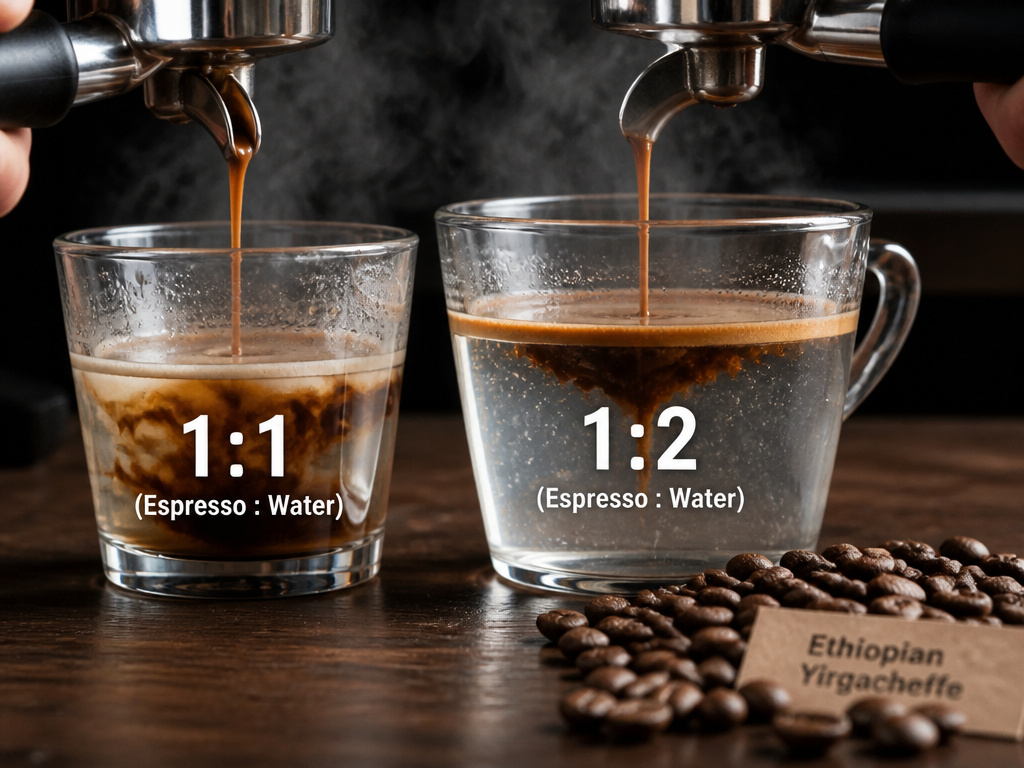
The 1:2 ratio is the safe default. It works for most coffee bean blends and medium roasts. It produces a cup familiar to drip coffee drinkers.
Move to a 1:1 ratio when using intense single-origin beans. This is the non-commodity spec that most recipe lists omit. Ethiopian Yirgacheffe or Sumatran Mandheling beans produce espresso with explosive floral, berry, or earthy notes. A full-strength shot can be overwhelming. A standard 1:2 dilution washes out the unique characteristics.
The 1:1 ratio is an artisanal adjustment. You pull the shot directly into a cup containing an equal amount of hot water. This minimal dilution softens the intense edges without masking the origin flavor. It’s for experienced drinkers who want the bean’s story, not just a caffeine vehicle.
| Bean Type / Roast | Recommended Ratio | Reason |
|---|---|---|
| Standard Blend / Medium Roast | 1:2 (Espresso to Water) | Balances strength and drinkability, the crowd-pleaser. |
| Single-Origin (e.g., Ethiopian, Sumatran) | 1:1 | Preserves unique origin notes while cutting intensity. |
| Dark Roast / Italian Style | 1:3 or 1:4 | Mitigates bitterness and roast char, creates a longer, smoother drink. |
| Blonde roast beans | 1:1.5 | Highlights delicate, bright acidity without making the drink too sharp. |
Your espresso caffeine content remains constant, the dilution only affects flavor strength and volume. A 1:1 drink is stronger per ounce but contains the same total caffeine as a 1:2 made from the same shot.
The Name and Its Real History

The story that American G.I.s in WWII Italy diluted espresso to mimic their home drip coffee is a good myth. It’s probably wrong on timing. The modern, highly concentrated espresso we use today didn’t exist until around 1948, after the war, with Achille Gaggia’s patent for the lever-driven machine that created high-pressure extraction and crema.
Before Gaggia, “espresso” was weaker, more similar to a strong standard brewed coffee. The Americano as we know it, diluting a potent, syrupy shot, couldn’t have originated earlier. The name likely came from 1950s Italian cafes labeling the drink for American tourists who found straight espresso too strong.
There’s also a linguistic nuance in Italy. “Caffè americano” typically means espresso with hot water. If you want what Americans call drip or filter coffee, you ask for “caffè all’americana” (American-style coffee). Confusing the two in a Roman cafe might get you a different drink than you expected.
The mobile Wikipedia Americano article notes this distinction. It’s a small detail that underscores the drink’s identity as an Italian adaptation for a foreign palate, not a wartime improvisation.
Americano vs. Your Other Coffee Options
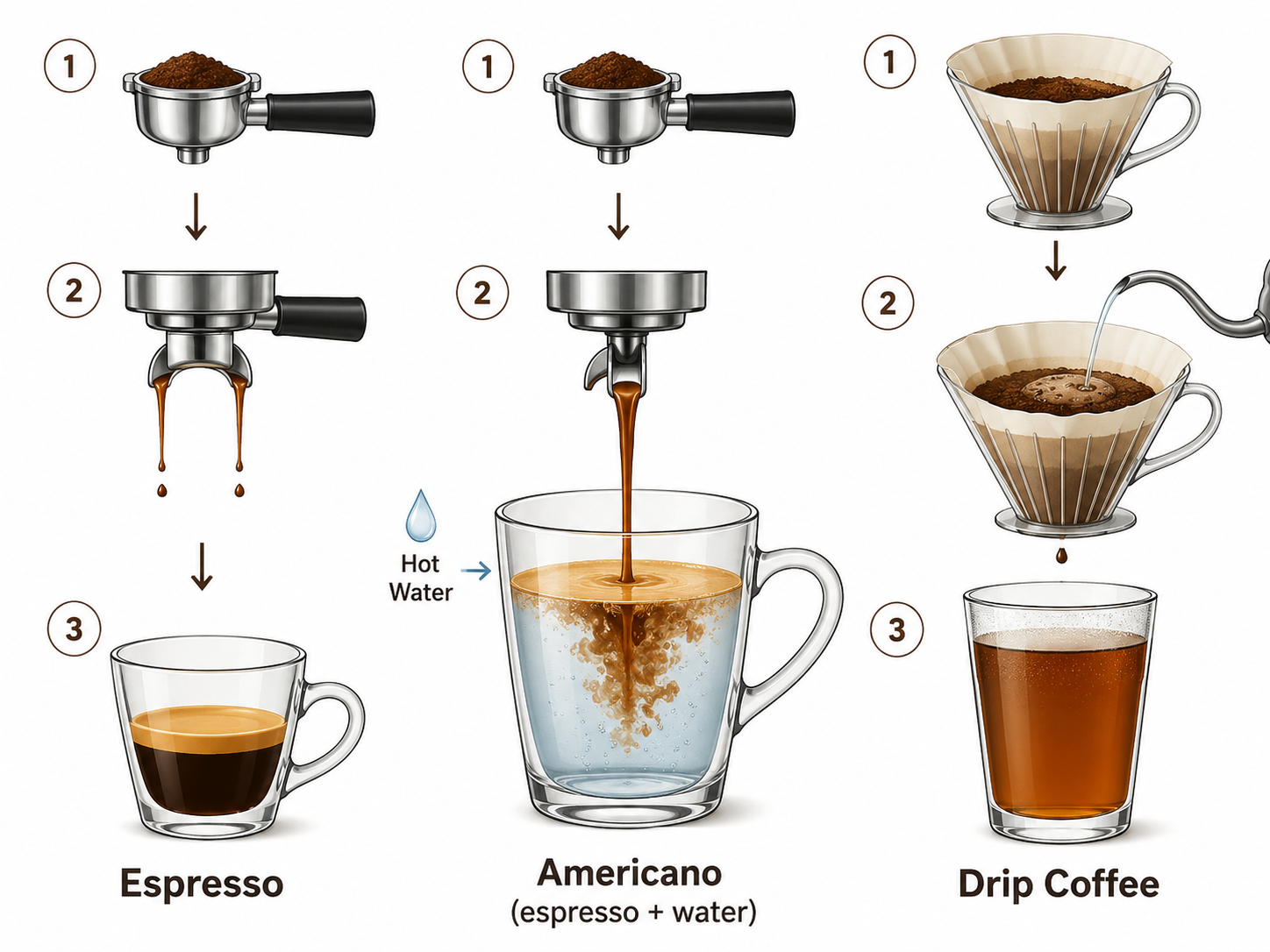
It sits in a unique spot between espresso and drip coffee. Understanding the differences helps you choose the right drink for the moment.
Compared to a straight espresso, an Americano is longer, cooler, and less intense. You trade the concentrated punch for a sippable experience. Compared to a drip coffee comparison, the Americano has a heavier body, more pronounced acidity, and that signature crema. Drip coffee, filtered through paper coffee filters, tends to be cleaner and brighter.
The closest relative is the long black, as mentioned. The difference is construction: Americano = water added to espresso. Long black = espresso added to water. The result is subtly different in texture and temperature.
Here’s a quick guide for when to choose each:
* Choose an Americano: You want espresso flavor in a larger, longer-lasting cup. It’s your midday drink when a shot is too quick and drip is too bland.
* Choose Espresso: You need a quick, potent coffee hit or are tasting a new single-origin coffee beans.
* Choose Drip Coffee: You’re serving multiple people, need a hands-off brew, or prefer a cleaner, lighter cup.
Your equipment choice matters too. A good Americano starts with a consistent grind from a burr coffee grinder. A blade grinder creates uneven particles that lead to a sour, uneven shot no amount of water can fix.
Essential Equipment (Beyond the Obvious)
You need an espresso machine and a hot water source. The machine can be a manual lever, a semi-automatic, a super-automatic, or even a stovetop moka pot for a similar effect. The moka pot won’t create true crema, but it makes a strong concentrate suitable for dilution.
The InstaCuppa 3-in-1 Espresso Coffee Maker is a specific solution for small spaces. It combines an espresso maker with a kettle that heats to 75°C or 100°C. You pull your shot, switch to kettle mode, and heat your dilution water in the same device. It eliminates the need for a separate kettle.
Your other non-negotiable tool is a scale with 0.1-gram resolution. Measuring your coffee dose and your water output is the single biggest improvement you can make. Eyeballing leads to inconsistent strength day after day.
Finally, consider your water. If your tap water is hard, the minerals will scale your machine and flatten your coffee’s taste. Use filtered or bottled water with low mineral content. This is as important as your coffee bean origins.
Frequently Asked Questions
Does an Americano have more caffeine than coffee?
No, not necessarily. A standard Americano made with a double shot has roughly the same caffeine (about 80-100mg) as an 8-ounce cup of drip coffee. Caffeine content depends on the coffee beans and shot volume, not the added water.
Is an Americano just watered-down espresso?
Yes, but that’s its purpose. The dilution is intentional to transform a small, intense shot into a larger, sippable beverage while retaining the core espresso flavor profile. It’s not a mistake; it’s the recipe.
What’s the difference between an Americano and a long black?
The difference is the order of assembly. An Americano is made by pouring hot water over espresso. A long black is made by pouring espresso over hot water. This affects the temperature and the integrity of the crema layer.
Can I make an Americano without an espresso machine?
You can approximate it using a strongly brewed concentrate from a moka pot or an AeroPress. It won’t be a true Americano due to the lack of pressure-extracted crema, but it creates a similar style of drink. Use a 1:2 concentrate-to-hot-water ratio.
What’s the best coffee bean for an Americano?
Medium roast Arabica beans or blends are the most versatile and popular. For a more unique experience, try a light roast coffee with a 1:1.5 ratio to highlight its bright, acidic notes.
Before You Go
An Americano is a simple drink with precise rules. Pull a good espresso shot first, that’s 90% of the battle. Always pour hot water over the shot, not the other way around. Stick to a 1:2 ratio for your daily drink, but try 1:1 with a powerful single-origin bean to taste the difference.
Forget the WWII story. The drink is a product of modern espresso, a testament to how a simple adjustment can create an entirely new experience from the same core ingredients. Now you know not just what it is, but how to make one that’s better than the cafe’s.
{
“@context”: “https://schema.org”,
“@type”: “HowTo”,
“name”: “How to Make a Caffè Americano”,
“totalTime”: “PT5M”,
“tool”: [
{
“@type”: “HowToTool”,
“name”: “Espresso machine or moka pot”
},
{
“@type”: “HowToTool”,
“name”: “Coffee grinder”
},
{
“@type”: “HowToTool”,
“name”: “Kettle or hot water source”
},
{
“@type”: “HowToTool”,
“name”: “Scale”
}
],
“supply”: [
{
“@type”: “HowToSupply”,
“name”: “Freshly roasted coffee beans (18g for a double shot)”
},
{
“@type”: “HowToSupply”,
“name”: “Filtered water (4-6 oz)”
}
],
“step”: [
{
“@type”: “HowToStep”,
“name”: “Grind and pull a double espresso shot”,
“text”: “Grind 18g of coffee to a fine espresso consistency. Tamp firmly and pull a 36g double shot directly into your cup.”
},
{
“@type”: “HowToStep”,
“name”: “Heat your water”,
“text”: “While the shot pulls, heat 4-6 ounces of water to just below boiling, around 200°F (93°C).”
},
{
“@type”: “HowToStep”,
“name”: “Add hot water to the espresso”,
“text”: “Pour the hot water gently over the espresso shot. For a standard drink, use a 1:2 ratio (one part espresso to two parts water).”
}
]
}
{
“@context”: “https://schema.org”,
“@type”: “FAQPage”,
“mainEntity”: [
{
“@type”: “Question”,
“name”: “Does an Americano have more caffeine than coffee?”,
“acceptedAnswer”: {
“@type”: “Answer”,
“text”: “No, not necessarily. A standard Americano made with a double shot has roughly the same caffeine (about 80-100mg) as an 8-ounce cup of drip coffee. Caffeine content depends on the coffee beans and shot volume, not the added water.”
}
},
{
“@type”: “Question”,
“name”: “Is an Americano just watered-down espresso?”,
“acceptedAnswer”: {
“@type”: “Answer”,
“text”: “Yes, but that’s its purpose. The dilution is intentional to transform a small, intense shot into a larger, sippable beverage while retaining the core espresso flavor profile. It’s not a mistake; it’s the recipe.”
}
},
{
“@type”: “Question”,
“name”: “What’s the difference between an Americano and a long black?”,
“acceptedAnswer”: {
“@type”: “Answer”,
“text”: “The difference is the order of assembly. An Americano is made by pouring hot water over espresso. A long black is made by pouring espresso over hot water. This affects the temperature and the integrity of the crema layer.”
}
},
{
“@type”: “Question”,
“name”: “Can I make an Americano without an espresso machine?”,
“acceptedAnswer”: {
“@type”: “Answer”,
“text”: “You can approximate it using a strongly brewed concentrate from a moka pot or an AeroPress. It won’t be a true Americano due to the lack of pressure-extracted crema, but it creates a similar style of drink. Use a 1:2 concentrate-to-hot-water ratio.”
}
},
{
“@type”: “Question”,
“name”: “What’s the best coffee bean for an Americano?”,
“acceptedAnswer”: {
“@type”: “Answer”,
“text”: “Medium roast Arabica beans or blends are the most versatile and popular. For a more unique experience, try a light roast coffee with a 1:1.5 ratio to highlight its bright, acidic notes.”
}
}
]
}
