
What Is a Light Roast Coffee? The SCA Standard & Key Traits
Light roast coffee is defined by the Specialty Coffee Association (SCA) as a “cupping level roast” with an Agtron Gourmet scale reading of 63, correlating to a ground coffee lightness (CIELAB L*) between 26 and 29. The beans are roasted to an internal temperature of 180–205°C, stopped just after first crack, resulting in a dense, dry bean that preserves origin flavor, bright acidity, and higher levels of chlorogenic acid.
Most people mistake its light color for mildness. They brew it like a dark roast and get a sour, thin cup that tastes like lemon juice and disappointment. That sourness isn’t the coffee’s fault. It’s an extraction failure.
This guide walks through the SCA’s technical definition, explains why light roast is both brighter and stronger than you think, and lays out the non-negotiable brewing adjustments it demands.
Key Takeaways
- The SCA Standard 102-2024 defines a true light roast as Agtron 63 (CIELAB L* 26–29), darker than many “blonde” roasts.
- Light roast beans are denser. A scoop holds more coffee by weight than a scoop of dark roast, which is where the “more caffeine” myth originates.
- Under-extraction is the default failure. It requires a finer grind, water at 93–96°C, and often a longer contact time than darker roasts.
- A well-developed light roast is sweet and complex. An underdeveloped one is grassy, bready, and a roasting flaw.
- Brew temperature significantly impacts the color of light roast coffee, with cold brew appearing redder and hot brew blacker.
The Official SCA Definition of a Light Roast
Forget vague descriptions about “light brown” beans. The industry measures roast level with instruments, not poetry. The Specialty Coffee Association’s Standard 102-2024 for Coffee Value Assessment pins it down.
The SCA defines the “cupping level roast” as a medium roast corresponding to an Agtron “Gourmet” scale reading of 63, or a CIELAB L* (lightness) value for ground coffee between 26 and 29. Samples must be air-cooled, rested 8–24 hours post-roast, and cupped in identical 200–350 mL vessels.
That Agtron 63 number is your anchor. Commercial roasters use Agtron or similar spectrophotometers to hit this target consistently. A reading higher than 63 (like 70 or 80) indicates an extremely light, likely underdeveloped roast. A reading lower than 63 drifts into medium territory.
This standard exists for professional cuppings, but it gives you a concrete benchmark. If a bag is labeled “light roast,” its ground coffee should reflect light in that L* 26–29 range. The beans themselves will be a uniform light brown with a completely dry, matte surface. No oil. Ever.
TL;DR: True professional light roast targets Agtron 63. If your “light” roast is oily or blackened, it’s not light.
Light vs. Medium vs. Dark: The Physical Changes
Roasting is a series of chemical reactions driven by heat. Where you stop the process determines everything about the bean in your hand.
| Roast Level | Internal Temp | Stopping Point | Bean Density | Surface | Dominant Taste |
|---|---|---|---|---|---|
| Light | 180–205°C | Just after 1st crack | High, hard | Dry, matte | Origin (fruity, floral, tea-like) |
| Medium | 210–220°C | Between 1st & 2nd crack | Moderate | Dry to slight sheen | Balanced (chocolate, nut, caramel) |
| Dark | 225–245°C+ | During or after 2nd crack | Low, porous | Oily, shiny | Roast (smoky, bitter, charred) |
The journey from green to dark is a story of water loss, sugar caramelization, and structural breakdown. Light roast halts that story early.
During a light roast, the bean heats to 180–205°C. It loses about 12–14% of its mass as water evaporates. The first crack, an audible popping sound like popcorn, signals the breakdown of the cellulose structure. Stop soon after, and you lock in the bean’s original cellular integrity. That’s why light roast beans are so dense. They’ve puffed up a little, but their cell walls are mostly intact.
Medium roast continues the heat application, breaking down more cellulose and starting to caramelize sugars. The bean becomes less dense, more brittle. Dark roast pushes into second crack, where the cellulose matrix fractures completely. Oils migrate to the surface, and the bean’s own sugars are burned away, leaving carbonized bitterness.
This density difference isn’t academic. It dictates every brewing parameter you’ll use later.
Flavor, Acidity, and the Caffeine Myth
The flavor profile of a light roast is a direct transmission from the farm. You taste the soil, the climate, the varietal. Expect bright, sparkling acidity, think citrus, green apple, or berry. The body is lighter, often described as tea-like or juicy.
This brightness comes from preserved organic acids like citric and malic. More importantly, light roasts retain the highest levels of chlorogenic acid, a significant antioxidant that breaks down as roasting progresses.
Then there’s caffeine. The myth that dark roast has more caffeine is persistent and backwards.
Common mistake: Measuring coffee by volume, a scoop of dark roast vs. a scoop of light roast. Because dark roast beans are larger and less dense, a scoop holds fewer beans by weight. Less mass, less caffeine.
By weight, the caffeine content in coffee is nearly identical across roasts, around 1.1% for Arabica. But if you use a scoop, you’re using less actual coffee with a dark roast. Switch to a scale. You’ll use more grams of light roast to fill the same volume, which can mean a slightly more caffeinated cup. The real driver of caffeine in your cup is the brewed coffee methods you choose and the coffee-to-water ratio, not the roast color.
The perceived “strength” of dark roast is its bitterness and heavy body. Light roast strength is a clarity and intensity of flavor that can be just as potent, just different. It’s the difference between a shouted order and a precisely articulated sentence.
The Critical Line: Well-Developed vs. Underdeveloped
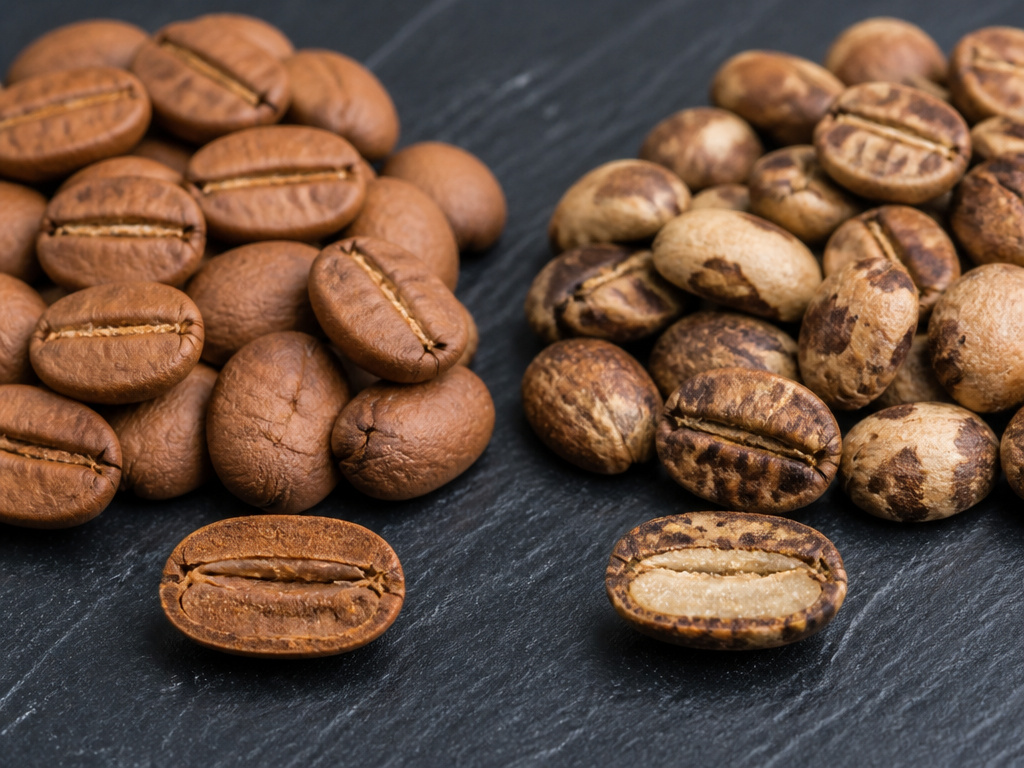
Not all light brown beans are good beans. This is the most important distinction for drinkers frustrated by sour, grassy coffee.
A well-developed light roast spends enough time in the roaster after first crack for the sugars to develop fully. The heat penetrates the dense bean evenly. The result is a coffee that is bright but also sweet, with a balanced acidity and no raw, vegetal notes.
An underdeveloped light roast is a roasting flaw. The roaster stopped the process too early, before the interior of the bean caught up with the exterior. It tastes grassy, green, bready, or like raw peanuts. The acidity is sharp and unpleasant, like under-ripe fruit.
How can you tell? Taste. A good light roast from a skilled roaster should have a sweetness that balances the acid. It might taste like peach or jasmine tea, not lemon rind and hay. If your light roast is relentlessly sour and thin with no sweet finish, it’s probably underdeveloped. No amount of brewing tweaks will fix it. This is why buying from reputable roasters who understand single-origin coffee development is non-negotiable.
Brewing Light Roast: The Non-Negotiables
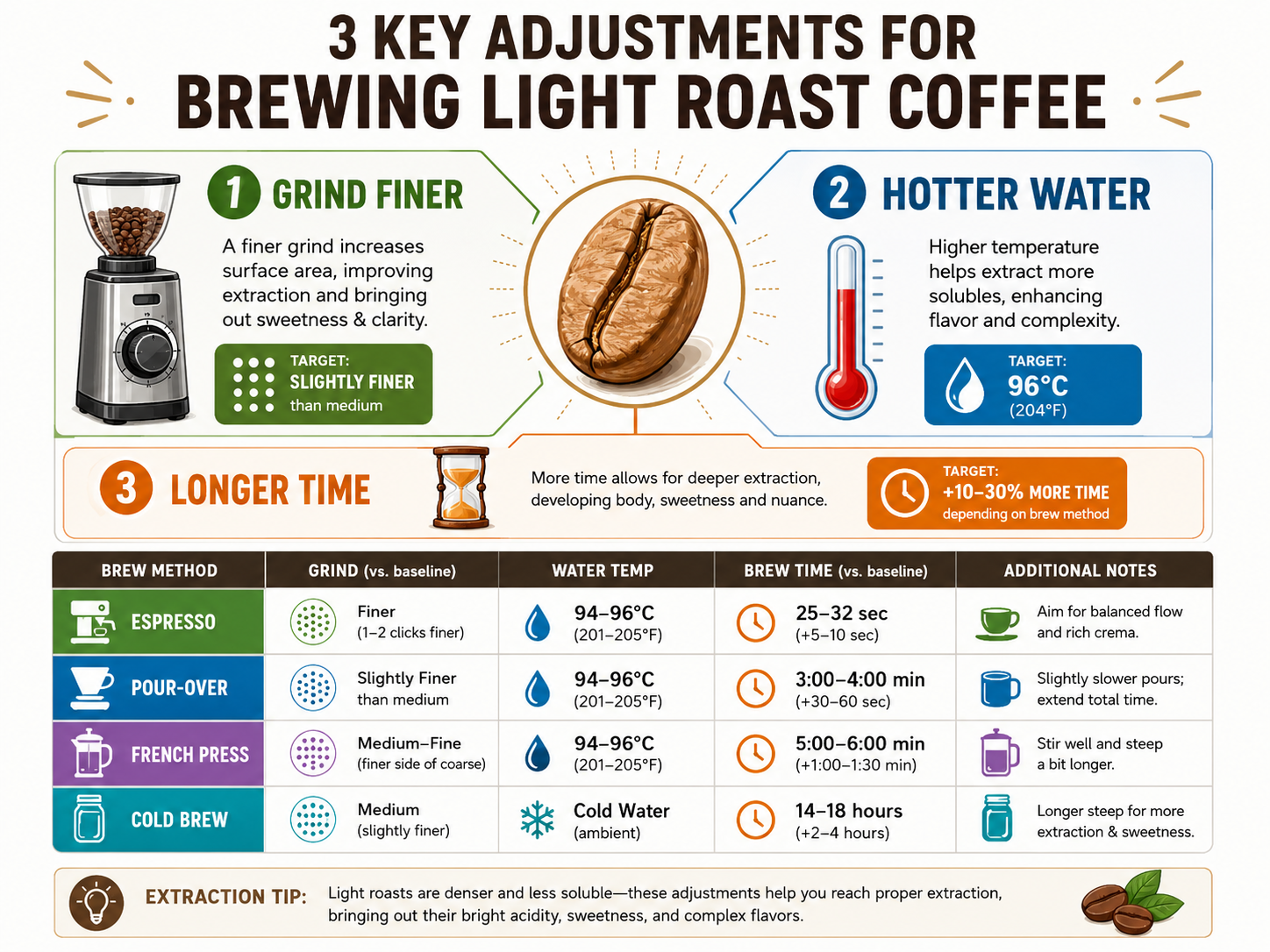
Light roast’s density and intact cellular structure make it less soluble than dark roast. It resists giving up its flavors. Your job is to persuade it. This requires a three-part adjustment: grind size, water temperature, and time.
First, grind finer. You need to create more surface area to compensate for the bean’s resistance. A consistent grind from a burr coffee grinder is mandatory. Blade grinders produce too many boulders and fines, guaranteeing uneven extraction.
Second, use hotter water. The SCA recommends a brewing temperature between 93°C and 96°C (200–205°F) for light roasts. This higher thermal energy is required to break down the dense cell walls and extract the sugars. Using water off the boil (around 96°C) is often perfect. A PMC study on roast level effects confirmed that brew temperature significantly affects the color and extraction of light roasts more than dark ones.
Third, allow for longer contact time. In a pour-over, this might mean a slower, more controlled pour. For espresso, expect to grind fine enough to get a 30-35 second shot time for a balanced extraction.
| Brew Method | Grind Setting | Water Temp | Key Adjustment | Risk of Skipping |
|---|---|---|---|---|
| Espresso | Very fine | 93–96°C | Extend shot time to 30–35s | Sour, under-extracted shot that runs too fast |
| Pour-Over | Medium-fine | 96°C | Slower pour rate for longer contact | Thin, tea-like body with sharp acidity |
| French Press | Coarse | 96°C | Extend steep time to 5–6 minutes | Weak, insipid brew lacking sweetness |
| Cold Brew | Coarse | Room temp / Cold | Steep 18–24 hours | Flat, overly acidic result without sweetness |
Ignore these adjustments and you will under-extract. The cup will be sour, salty, and thin. It’s not the coffee’s fault. You didn’t meet it on its terms.
TL;DR: Grind finer, use water at 93–96°C, and extend your brew time. All three, not just one.
Health and Chemical Profile
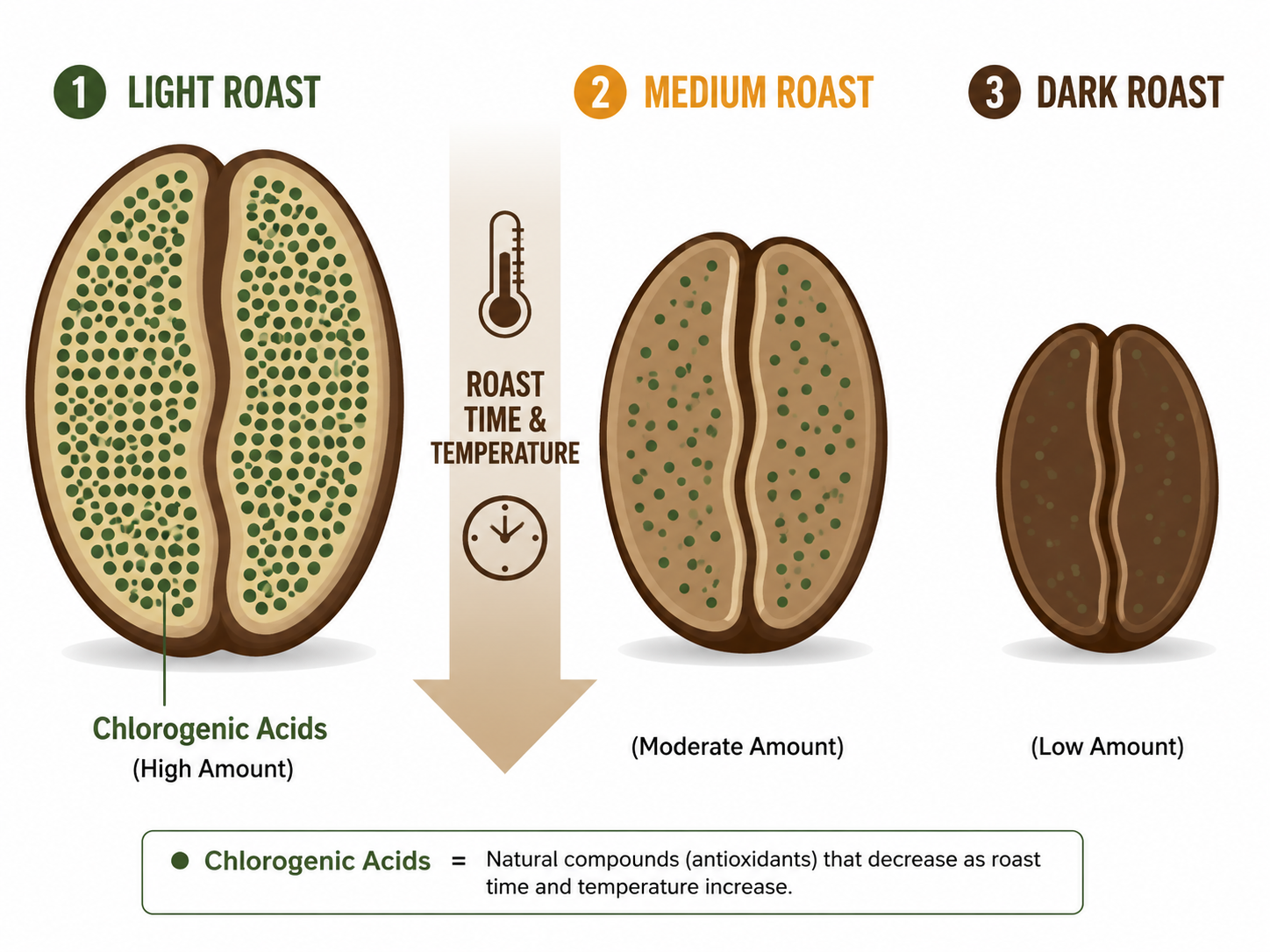
The shorter roasting time preserves more of the coffee cherry’s original compounds. The most notable are antioxidants, specifically chlorogenic acids (CGAs). These compounds are linked to various health benefits, including anti-inflammatory effects and improved blood sugar metabolism.
Light roasts retain the highest concentration of chlorogenic acids. As roasting progresses, these molecules break down. By the dark roast stage, a significant portion is gone.
This doesn’t make light roast a “health food,” but it does mean you’re getting a different phytochemical profile. The health benefits of coffee are often tied to these antioxidants. You’re also preserving more of the natural caffeine content, though the difference by weight is minimal.
The acidity in coffee is another factor. The brighter, perceived acidity in light roast is often mistaken for high pH, which can worry those with sensitive stomachs. In reality, the pH of all coffee is roughly similar (around 5). The perceived “zing” is from those organic acids like citric and malic, not higher stomach-irritating acidity. If you’re sensitive, focus on brewing parameters, a longer, full immersion brew like French press can reduce perceived acidity compared to a fast pour-over.
Choosing and Storing Light Roast Beans
Start with the roaster. Look for bags that list a roast date, not a “best by” date. Light roast is best consumed within 3–5 weeks of roasting. The vibrant top notes fade first.
Look for origin information. Light roast is the showcase for Arabica coffee beans from specific farms or regions. Ethiopian Yirgacheffe (floral, bergamot), Kenyan (blackcurrant, tomato), and Costa Rican Tarrazú (stone fruit, brown sugar) are classic candidates.
Avoid any bag where you see oily beans shining through. That’s not light roast. The surface should be dry and matte.
Storage is simple but strict:
1. Keep it in an airtight container.
2. Store it in a cool, dark place (a cupboard, not the counter).
3. Do not refrigerate or freeze unless you’re storing it for months (and even then, vacuum seal first).
Grind only what you need immediately. The increased surface area of ground coffee makes those delicate aromatics vanish within minutes. This is why that burr coffee grinder is your most important tool after the beans themselves.
Frequently Asked Questions
Does light roast coffee have more caffeine?
By weight, no, caffeine content is nearly identical across roasts. By volume, yes. Because light roast beans are denser, a scoop or tablespoon holds more coffee mass than the same scoop of dark roast. If you measure by volume, your light roast cup will have slightly more caffeine. Always use a scale for consistency.
Why does my light roast coffee taste sour?
It’s almost certainly under-extracted. Light roast requires more energy (hotter water) and more time (finer grind/longer contact) to dissolve its flavors. If your water is below 93°C, your grind is too coarse, or your brew time is too short, you’ll only extract the bright acids and miss the sugars. The result is sourness.
Is light roast the same as blonde roast?
Not exactly. “Blonde roast” is a marketing term popularized by large chains, often referring to an extremely light roast that may be lighter than the SCA’s Agtron 63 standard. It can sometimes veer into underdeveloped territory. A true light roast follows the SCA standard and is developed enough to taste sweet, not grassy. You can explore the specifics of a blonde roast coffee to see the nuances.
Can I use light roast for espresso?
Absolutely, but it demands precision. You’ll need to grind finer than for a medium roast, likely increase your dose slightly (because the grounds are denser), and aim for a longer extraction time (30-35 seconds). It makes for a stunning, complex shot with intense clarity, but it’s less forgiving than a dark roast.
How do I reduce the acidity in light roast coffee?
Try a full-immersion brew method like a French press or AeroPress, which allows for a more even, complete extraction of sugars. You can also use slightly cooler water (90–93°C) to temper the sharpest acids, but be careful not to go too cool and cause under-extraction. The acidity in coffee is also influenced by the bean’s origin.
The Bottom Line
Light roast coffee isn’t a weaker version of dark roast. It’s a different product with a different goal: transparency. It wants to tell you the story of its origin, not the story of the roaster’s flame.
Respect its density. Brew it with hotter water and a finer grind. Listen for sweetness, not just acid. When you get it right, the cup is a revelation, bright, complex, and alive in a way darker roasts can’t be. It’s the choice for when you want to taste the coffee, not just drink it.
