
Find Out What Country Produces the Most Coffee Today
This post contains affiliate links. As an Amazon Associate, we earn from qualifying purchases.
Brazil produces the most coffee in the world, consistently accounting for roughly one-third of global supply. For the 2025/2026 crop year, the USDA Foreign Agricultural Service forecasts Brazil’s output at a pivotal moment, with national agency Conab projecting a potential record harvest of 66.7 million 60-kilogram bags.
Most people look at a headline number and assume it translates directly to cheap, abundant coffee on shelves. The reality is more tangled. A record crop forecast can coincide with tight immediate supply because producers hold beans back, waiting for better prices. Logistics snarls halfway across the world can add a premium to your bag before it’s even roasted.
This guide cuts through the basic rankings. We’ll examine Brazil’s dominance with the latest 2026 data, explain why Vietnam and Colombia follow, and unpack how the split between Arabica and Robusta beans shapes everything from futures prices to your morning cup.
Key Takeaways
- Brazil’s projected 2026 harvest of 66.7 million bags would be an 18% year-on-year increase and potentially a new national record.
- Vietnam is the undisputed leader in Robusta production, a bean crucial for espresso blends and instant coffee.
- Global coffee supply is bifurcated: Arabica makes up about 60% of production, Robusta about 40%.
- Record forecasts don’t always mean cheap coffee; producer withholding and supply chain costs create market friction.
- Private trade analysts often project higher crop yields than government agencies, indicating bullish underlying expectations.
The Global Coffee Production Leader: Brazil by a Landslide
Brazil’s position isn’t just first place. It’s a commanding lead that defines the global market. The country routinely produces over twice the volume of its nearest competitor, Vietnam. This dominance is rooted in geography, with vast, flat plantations in states like Minas Gerais and Espirito Santo allowing for mechanized harvesting on a scale impossible in the mountainous terrain of Colombia or Central America.
The latest figures underscore this. For the 2026 crop, Brazil’s national supply agency Conab projects production of 66.7 million 60-kilogram bags. That’s an 18% jump from the previous year. To put that in perspective, the entire annual output of a major producer like Colombia is around 12-14 million bags. Brazil’s surplus alone could supply several other top-producing nations.
According to the May 2026 CropGPT report citing Conab data, Brazil’s 2026 coffee production is forecast at 66.7 million 60-kilogram bags. This represents an 18% increase year-on-year and would challenge the country’s prior record harvest of 69.9 million bags set in 2020/21.
This scale grants Brazil immense influence. A good Brazilian harvest can suppress global prices. A frost or drought in Minas Gerais can send futures markets soaring. The country grows both major coffee types, but with a focus on Arabica beans from its southeastern regions. The sheer volume means shifts in Brazilian Colombian coffee production directly affect the global balance for premium, mild coffees.
TL;DR: Brazil grows more coffee than the next two countries combined, and its 2026 forecast points to a potentially record-breaking harvest that will set the tone for global supply.
The Contenders: Vietnam and Colombia
Behind Brazil, the race for second place has a clear and steady winner. Vietnam firmly holds the silver medal, but its coffee profile is entirely different. While Brazil is an Arabica powerhouse, Vietnam is the world’s undisputed king of Robusta. This distinction matters. Robusta beans have higher caffeine content, a stronger, more bitter flavor, and are generally hardier plants. They are the backbone of commercial espresso blends for crema and body, and the primary raw material for instant coffee.
Vietnam’s rise was strategic and rapid. Government-led initiatives in the 1990s transformed the country into a Robusta juggernaut. In the first four months of 2026, Vietnam exported 810,000 tonnes of coffee, demonstrating its massive and consistent export engine. Its output creates a parallel market to Brazil’s Arabica beans, often with different price drivers.
Colombia, typically in third place, is almost synonymous with high-quality Arabica. Its mountainous terrain and consistent climate produce the balanced, clean profiles celebrated in single-origin coffee. However, Colombia faces volatility. Cumulative production from October 2025 to April 2026 fell 26% year-on-year. Rolling annual production was down 17% to 12.4 million bags. This highlights how smaller, terrain-dependent producers are more vulnerable to weather and economic shifts than the continental-scale operations in Brazil.
| Country | Rank | Primary Coffee Type | Key Characteristic |
|---|---|---|---|
| Brazil | 1 | Arabica & Conilon (Robusta) | Scale; dominates global supply & price sentiment. |
| Vietnam | 2 | Robusta | Volume leader for espresso/instant blends; distinct market. |
| Colombia | 3 | Arabica | Quality icon; output is smaller and more variable. |
TL;DR: Vietnam dominates Robusta production for espresso and instant coffee, while Colombia’s reputation for quality Arabica is tempered by recent production declines.
Arabica vs. Robusta: The Two Coffee Giants
Understanding global production requires splitting the tally. Arabica beans (Coffea arabica) and Robusta (Coffea canephora) are different species with different economic footprints. Arabica is the premium variety, offering a wider range of nuanced flavors, higher acidity, and about half the caffeine of Robusta. It’s also more delicate, requiring higher altitudes, cooler temperatures, and more care, which makes it more expensive to grow.
Robusta is the workhorse. It thrives at lower altitudes, is more resistant to pests and disease, and yields more cherries per plant. Its flavor is stronger, earthier, and often described as woody or nutty. This makes it ideal for providing body and caffeine punch in coffee blends, and its stability is perfect for espresso shots and soluble products.
Globally, Arabica accounts for about 60% of production, Robusta for about 40%. This ratio shifts yearly. The USDA’s 2025/26 forecast shows this dynamic: world Arabica production is projected at 95.5 million bags (down 4.7%), while Robusta is forecast at 83.3 million bags (up 10.9%). The growth in Robusta, led by Vietnam and Brazil’s Conilon regions, reflects demand from the instant and espresso sectors.
Common mistake: Assuming all “coffee” is the same — a surge in Brazilian Robusta (Conilon) exports doesn’t lower the price of Colombian Arabica. They are separate, though related, commodity streams.
Your brewing method often dictates which type you’re using. A drip coffee from a specialty shop is likely 100% Arabica. A classic Italian espresso blend will contain a significant percentage of Robusta for that signature crema and bite. The choice between bleached coffee filters or unbleached coffee filters matters more for the delicate flavors of a light-roast Arabica than for a dark-roast Robusta.
Digging into the 2026 Data and Forecasts
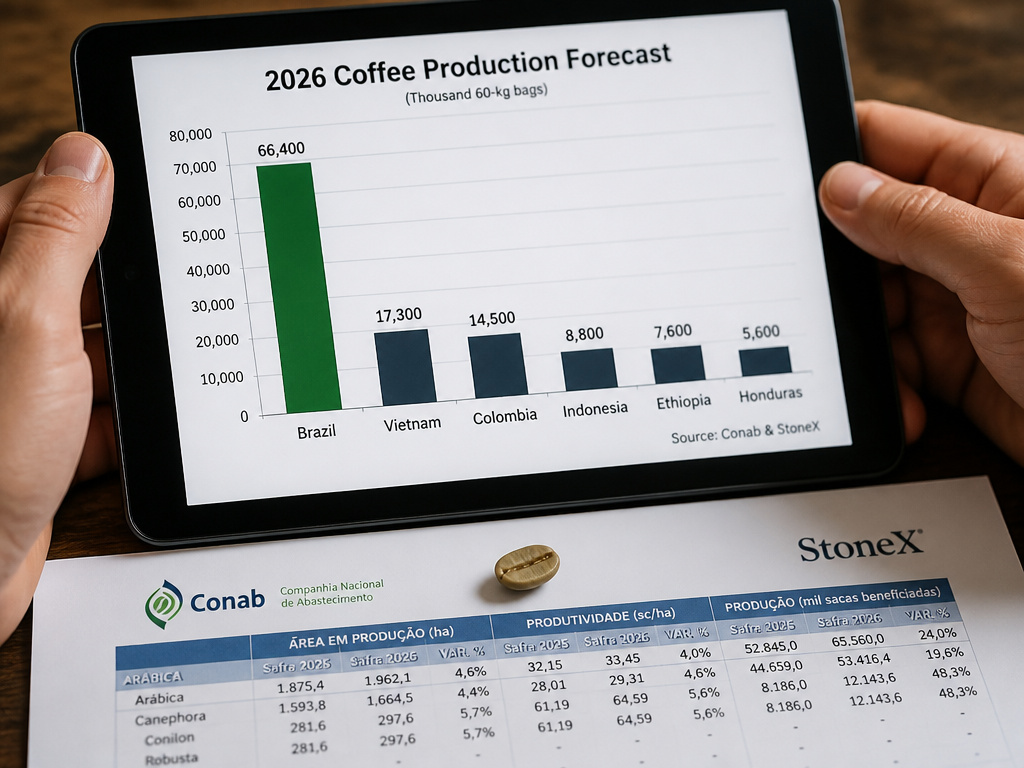
The numbers for the current season tell a story of potential abundance shadowed by immediate constraints. The USDA’s initial 2025/26 global production forecast is 178.85 million bags. That’s above the ten-year average of 169.53 million. The driver? Primarily Brazil.
Brazil’s own agency, Conab, projects 66.7 million bags for 2026. But here’s where it gets interesting. Private trading houses and analysts are even more bullish. For the following 2026/27 cycle, while Conab projects 66.2 million bags, private forecasts range from 71.4 million (Marex Group) to 75.9 million (StoneX). This discrepancy between official and private estimates is a key market signal. Traders on the ground often see yield potential that cautious government models initially miss.
Yet, in early 2026, physical Arabica supply was tight. ICE certified stocks fell to a 3.25-month low. Why? Brazilian producers, facing a strengthening local currency, withheld beans from the market. January-to-April Arabica shipments were 23.4% below prior-year levels. This creates a paradox: a record future harvest projected alongside scarce present supply.
TL;DR: Official 2026 forecasts point to a large global crop, but private analysts predict even bigger Brazilian harvests. Current market tightness is due to producer withholding, not a lack of coffee.
How Production Affects Your Cup and the Market
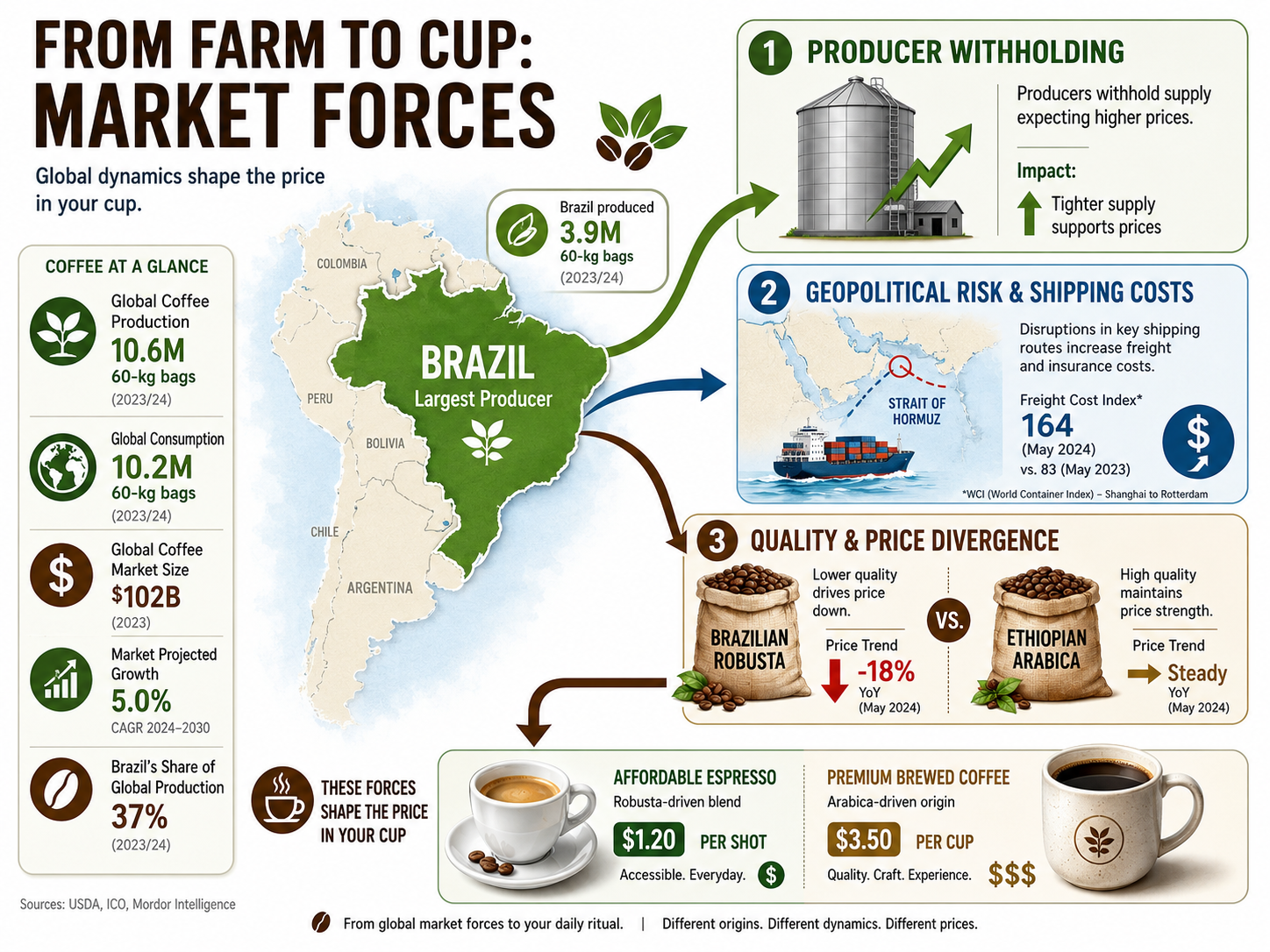
The journey from a record forecast in Brazil to the price of your beans is not a straight line. Several layers of friction exist. First, producer withholding. When farmers believe prices will rise, they store beans. This happened dramatically in early 2026, creating a supply squeeze that supported prices despite the giant crop on the horizon.
Second, logistics. In May 2026, disruptions in the Strait of Hormuz elevated global freight and insurance costs. While the premium eased later in the month, such events add a tangible cost to green coffee before it ever reaches a roaster. This cost gets baked into the final price, whether you’re buying single-origin coffee or a mainstream coffee blend.
Finally, the type of coffee matters. A surplus of Brazilian Conilon (Robusta) puts downward pressure on the price of instant coffee and espresso blend components. It does little for the cost of a high-end Ethiopian Yirgacheffe (Arabica). The markets are linked but distinct. The projected global surplus of 10 million bags for 2026/27, as estimated by StoneX, would be the largest in six years. This generally points to softer prices, but the effect will be felt more in supermarket blends than in specialty coffee brewing methods.
| Market Factor | Effect on Supply | Likely Impact on Consumer |
|---|---|---|
| Record Harvest Forecast | Increases long-term supply expectations. | Potential for lower prices on commercial blends over time. |
| Producer Withholding | Reduces immediate available supply. | Supports or raises prices in the short term, especially for Arabica. |
| Logistics Cost Spike | Adds a fixed cost to transportation. | Adds a few cents to every bag, regardless of origin or quality. |
| Robusta vs. Arabica Split | Creates separate supply dynamics. | Robusta-heavy products (instant, some espresso) may see different price moves than single-origin Arabica. |
For the home brewer, this means the advertised caffeine content of your espresso shots may become more affordable if Robusta stays abundant, while your favorite delicate brewed coffee from Colombia might remain premium-priced due to local production struggles.
Frequently Asked Questions
What country produces the most coffee in the world?
Brazil is the largest coffee-producing country by a significant margin. It typically produces over one-third of the world’s total coffee supply, growing both Arabica and Robusta (Conilon) varieties.
Which country is the largest producer of Arabica coffee?
Brazil is also the largest producer of Arabica coffee. States like Minas Gerais are major Arabica-growing regions. Colombia is the most famous high-quality Arabica producer but ranks third in total volume behind Brazil and Vietnam.
Is Vietnam the second-largest coffee producer?
Yes, Vietnam is consistently the world’s second-largest coffee producer. However, it specializes almost exclusively in Robusta beans, which are used primarily in instant coffee and espresso blends, unlike Brazil’s Arabica focus.
How much coffee does Brazil produce in a year?
Production varies by crop cycle. For the 2026 harvest, Brazil’s Conab agency projects a crop of 66.7 million 60-kilogram bags. Private analysts forecast even higher numbers for the following 2026/27 cycle, with estimates reaching up to 75.9 million bags.
Why does coffee price change if there’s a record harvest?
Prices are set by immediate, available supply, not future forecasts. If producers withhold their current crop from the market (as happened in Brazil in early 2026), it creates a short-term shortage that can keep prices firm even amid news of a large future harvest. Logistics costs and currency exchange rates also play a major role.
The Bottom Line
Brazil’s coffee dominance is a fact of geography and agricultural scale. The latest 2026 data doesn’t just confirm this; it suggests a potential record-breaking harvest is on the way. But the bigger story is in the details. Vietnam’s lock on Robusta and Colombia’s struggle with Arabica yields show a two-track global industry. A giant crop number is just the starting point. The real price of your morning ritual is decided in the spaces between—by farmers holding bags in Brazilian warehouses, by shipping costs through troubled straits, and by the relentless global demand for both the bitter kick of an espresso-based drink and the nuanced clarity of a single-origin coffee. Knowing which bean type is driving the headline helps you understand why your cup costs what it does.
