
Using Pre Ground Coffee for Espresso: Techniques That Work
Using pre ground coffee for espresso requires three specific things: a dual wall filter basket, dosing by volume with the manufacturer’s scoop, and coffee ground for espresso within the last week. The dual wall basket regulates pressure, compensating for the inconsistent grind and stale grounds that cause channeling and weak shots in a standard basket.
Most guides tell you it’s impossible. They’re wrong, but they’re wrong for a reason. The standard single wall basket expects a perfect, fresh, fine grind. Pre-ground coffee is neither perfect nor fresh. You can’t win that fight.
You can win a different one. Breville’s manuals have the exact specs for pre-ground dosing and timing. The method works, but it has a short shelf life and a narrow margin for error. This is how you pull a shot that’s worth drinking, not just a brown, bitter puddle.
Key Takeaways
- The dual wall filter basket (pressurized) is mandatory. It creates backpressure mechanically, so grind consistency and tamp pressure matter less.
- Dose by volume, not weight. Pre-ground coffee is coarser and fluffier. Breville specifies 2 level scoops (8-11g) for a single, 3 level scoops (16-19g) for a double.
- Freshness is a hard deadline. Ground coffee stales within 7 days. After that, shots taste flat and hollow no matter the basket.
- Watch the infusion time. On a Breville Barista Express, flow should start in 4–7 seconds. On a Bambino, expect 8–12 seconds. Faster means under-extracted, slower means over-extracted.
- Old whole beans past 30 days need the dual wall basket too. The manual says so.
Why Pre-Ground Coffee Fails in a Standard Basket
A standard single wall basket is a sieve. Water at 9 bars of pressure seeks the path of least resistance. If your coffee grounds are uneven, some fine powder, some coarse chunks, the water blasts through the coarse channels. It doesn’t extract the oils and sugars from the finer grounds around them. You get a shot that’s both weak and bitter, with little to no crema.
Common mistake: Using a single wall basket with pre-ground coffee, the shot will run fast and pale, with sharp, sour notes dominating the cup within 10 seconds.
Pre-ground coffee loses about 60% of its volatile aromatics within 15 minutes of grinding. By the time you open a bag from the grocery store, those compounds are long gone. What’s left are the less-soluble, often bitter compounds. The dual wall basket’s job is to force a slower, more even extraction despite this, by creating a physical barrier that builds pressure before the water hits the coffee bed.
TL;DR: Single wall baskets need perfect, fresh grinds. Pre-ground coffee is neither. The dual wall basket is your workaround.
The Mandatory Tool: Your Dual Wall Basket
Look at the bottom of your portafilter basket. A single wall basket has many small holes, like a showerhead. A dual wall basket has one small, pin-sized hole in the center of a raised dome. That dome is the pressure regulator. Water pools behind it, building pressure before it’s forced through the single exit. This system forgives a multitude of sins, inconsistent grind, stale coffee, uneven tamping.
Breville calls this out explicitly. The BES500 Bambino manual states dual wall baskets are for “pre-ground coffee and older beans that are past the 30 day roast date.” It’s not a suggestion. It’s the only way the machine can produce something resembling espresso with those inputs.
| Basket Type | Best For | What It Forgives | Risk If Skipped |
|---|---|---|---|
| Single Wall | Freshly ground beans, dialed-in grind | Nothing – it reveals every flaw | Channeling, weak extraction, no crema |
| Dual Wall | Pre-ground coffee, beans >30 days old | Inconsistent grind, stale coffee, light tamp | Over-extraction if dose is too high |
If your machine didn’t come with one, you’re out of luck. Third-party dual wall baskets exist, but they must match your portafilter size (usually 54mm for Breville Bambino, 58mm for Barista Express) and thread pattern. Getting the wrong one means it won’t lock in.
Dosing Pre-Ground Coffee: Scoops, Not Scales
This is where people second-guess the manual and ruin the shot. You are used to weighing 18g of freshly ground coffee for a double. Throw that out.
Pre-ground coffee is coarser and less dense. It occupies more volume for the same weight. The Breville manuals account for this. They provide a scoop and tell you to use it.
- For a 1 CUP (single) basket: 2 level scoops. That’s 8-11 grams.
- For a 2 CUP (double) basket: 3 level scoops. That’s 16-19 grams.
Weigh it once to believe it. Put 3 level scoops of pre-ground coffee on your scale. It will land around 17 grams, not the 18g you’re used to. That extra gram of volume is air. If you cram 18g by weight into the basket, you overfill it. The portafilter won’t lock in cleanly, or it will lock and choke the machine.
I ignored the scoop for a month. I weighed 18g of pre-ground into the dual wall basket every morning. The portafilter required a hard shove to turn, and my shots took 15 seconds to start. They tasted like burnt rubber. The manual was right.
TL;DR: Use the scoop that came with your machine. Two for a single, three for a double. Weighing leads to overfilling.
The Step-by-Step Process for a Balanced Shot

Follow this sequence exactly. The timing is tighter than with fresh beans.
- Lock in the dual wall basket. Ensure it’s seated in the portafilter. Any grounds on the rim will break the seal.
- Add pre-ground coffee. Use the provided scoop. Level it off with the back of a knife. Two scoops for a single, three for a double. Do not tamp yet.
- Distribute gently. Tap the portafilter on the counter to settle the grounds. Use a finger to sweep any stray grounds off the basket’s sealing edge.
- Tamp with moderate pressure. You don’t need a 30-pound force tamp. The dual wall system doesn’t require it. A firm, even press is enough. The goal is a flat surface, not a brick.
- Lock the portafilter in and start immediately. Stale grounds lose what little gas they have left quickly.
- Watch the clock. Start timing when you press the brew button. On a Barista Express, the first drops should appear between 4 and 7 seconds. On a Bambino, expect 8 to 12 seconds. The stream should look like warm, dripping honey.
- Stop at weight or volume. Aim for a 1:2 ratio. If you started with 17g of coffee, stop at around 34g of liquid espresso. If you’re going by volume, stop when the shot fills your 2-ounce cup about three-quarters of the way.
Skip the distribution tap, and grounds stick to the basket rim. The seal fails, and hot water and steam spray out the side. It’s a mess. Tamp too hard, and you compress the puck so much the water can’t penetrate evenly. The machine hesitates, then delivers a slow, bitter over-extraction.
What “Fresh” Really Means for Pre-Ground
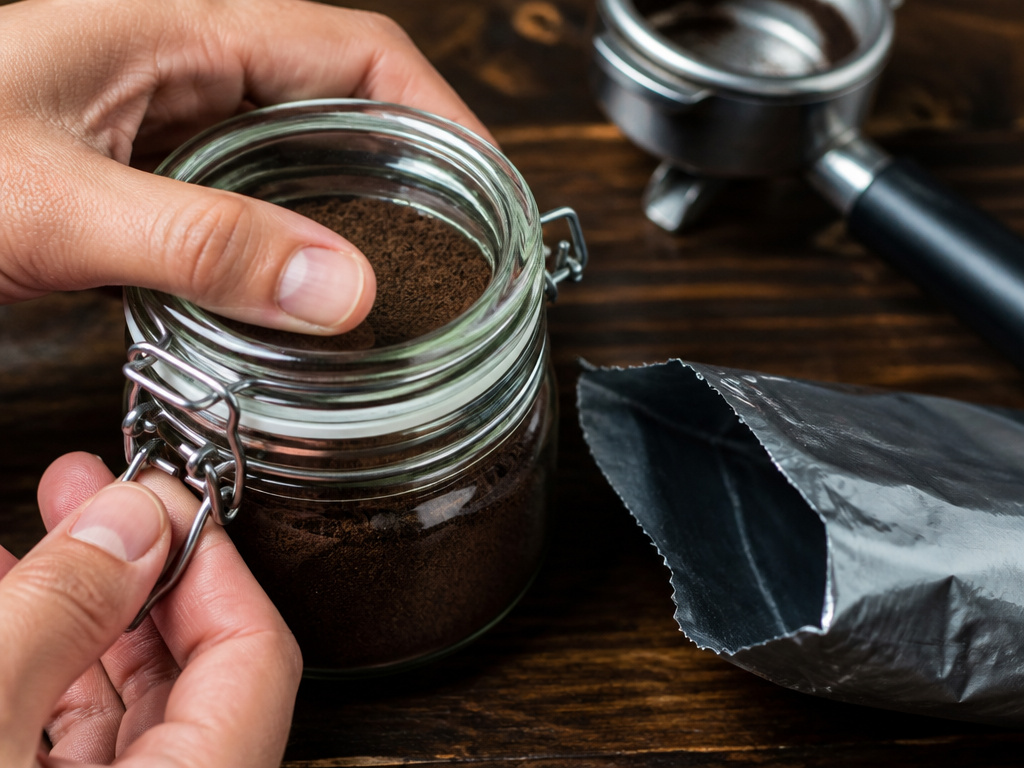
The Breville BES870 manual is blunt: “Pre-ground coffee should be used within a week of grinding.” That’s the outer limit. For peak flavor, you have about 72 hours after the bag is opened.
Oxidation is the enemy. Whole beans have a protective waxy layer. Grinding shatters that layer, exposing thousands of tiny surfaces to oxygen. The flavorful oils and gases, the things that create crema and complexity, evaporate or break down. After a week, you’re left with the woody, bitter structure of the bean. No basket can bring back what’s gone.
Store an opened bag of pre-ground in an airtight container in a cool, dark cupboard. The freezer introduces moisture each time you open it, which accelerates staling. The fridge smells your coffee.
If your shot flows in under 4 seconds and looks pale, the coffee is probably too stale and degassed to offer any resistance. The dual wall basket can only do so much.
When It Works, When It Doesn’t: Real-World Scenarios
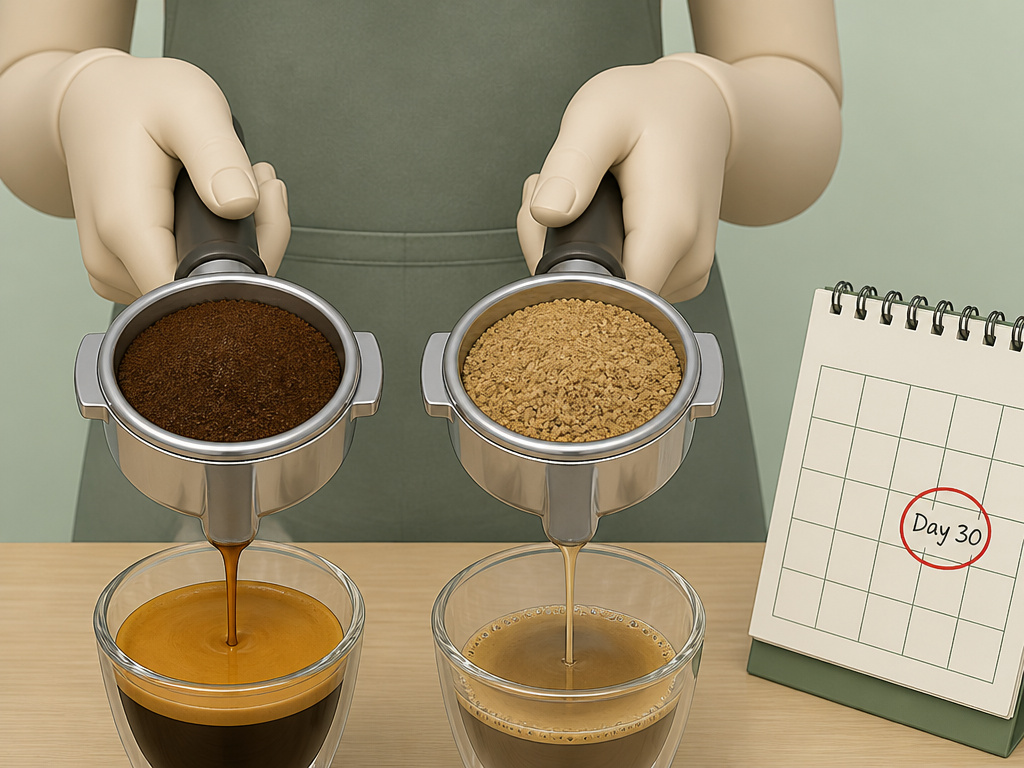
This method isn’t for every coffee or every desire.
It works for:
- Dark roasts. Their bold, chocolaty notes survive staling better than delicate florals.
- Espresso blends. They’re engineered for stability.
- Emergency coffee. When your grinder breaks or you’re traveling.
- Older whole beans. The manual says beans past 30 days need the dual wall basket too. The principle is the same, lost gases, needing help building pressure.
It fails for:
- Light roasts. Their nuanced, acidic, tea-like flavors are the first to oxidize. Pre-ground light roast tastes like paper.
- Single-origin coffees. You bought them for terroir, specific notes of berry or jasmine. Those notes vanish within days of grinding.
- Any pre-ground not labeled for espresso. Drip grind is too coarse. The water will rush through even a dual wall basket.
Choosing a blended coffee designed for espresso gives you a fighting chance. A dark espresso blend masks the shortcomings of pre-ground better than a fragile single-origin.
Troubleshooting Your Pre-Ground Espresso Shot
The feedback loop is simple. Watch the time, look at the output, taste the result.
| Symptom | Likely Cause | Fix |
|---|---|---|
| Shot starts in <3 secs, pale, sour | Coffee is too stale or grind is too coarse | Use newer coffee, ensure it’s espresso grind, check basket seal |
| Shot starts after >12 secs, dark, bitter | Dose is too high, tamp is too hard, coffee is too fine | Reduce to 2 scoops (single) or 3 scoops (double), tamp lighter |
| No crema, ever | Coffee is far too stale (>2 weeks old) | Source fresher pre-ground, use within a week of opening |
| Spraying or leaking from portafilter | Grounds on basket rim breaking seal | Wipe rim clean before locking in, distribute gently |
If you’re adding a pinch of salt to cut bitterness, the coffee is already past its prime. That’s a salvage move, not a recipe.
The Grinder Question: Is It Worth It?
A decent burr coffee grinder is the single biggest upgrade you can make. It’s not about snobbery. It’s about control.
A blade grinder smashes beans randomly. You get a mix of dust, chunks, and everything in between. A burr grinder crushes beans between two surfaces to a consistent size. That consistency is what a single wall basket needs. With a grinder for espresso, you can dial in the exact fineness for your machine and beans. You can grind single doses, so every shot starts with fresh grounds.
The caffeine in espresso content doesn’t change. The flavor transforms. You move from “coffee-flavored water” to something with body, sweetness, and that elusive crema. If you find yourself regularly using pre-ground, a grinder pays for itself in rescued bad shots within a few months.
Frequently Asked Questions
Can I use pre-ground coffee in any espresso machine?
Only if the machine comes with or supports a dual wall (pressurized) filter basket. Most beginner and mid-level machines like Breville, De’Longhi, and Gaggia include one. High-end commercial or prosumer machines typically do not.
My pre-ground espresso shot is always bitter. What did I do wrong?
You likely over-dosed or tamped too hard. The dual wall basket needs room for the pressure dome to work. Reduce your dose to the recommended scoops and tamp with just enough pressure to level the grounds, not compress them into a brick.
Does pre-ground coffee have less caffeine?
No. Caffeine is a stable molecule. The espresso caffeine content comes from the bean, not the grind freshness. A shot from stale pre-ground coffee will have the same caffeine as a shot from freshly ground beans, but without the flavor.
Can I use pre-ground to make an Americano?
Yes. An americano is just espresso diluted with hot water. If your pre-ground shot is weak or bitter, the hot water will dilute those flaws, making a more palatable, if simple, cup. It’s a good use for older pre-ground.
Before You Go
Using pre-ground coffee for espresso is a compromise, not a destination. The dual wall basket and volumetric dosing are your tools to make that compromise drinkable. It works reliably for dark roasts and blends, within a strict one-week freshness window. For everything else, for the clarity of a light roast, the nuance of a single-origin, the pleasure of a real crema, you need freshly ground beans. Keep the pre-ground for the emergencies. Invest in a grinder for the everyday. Your machine is capable of more than the grocery store shelf can provide.
{
“@context”: “https://schema.org”,
“@type”: “HowTo”,
“name”: “How to Use Pre Ground Coffee for Espresso”,
“totalTime”: “PT5M”,
“tool”: [
{
“@type”: “HowToTool”,
“name”: “Espresso machine with dual wall filter basket”
},
{
“@type”: “HowToTool”,
“name”: “Breville-provided coffee scoop”
},
{
“@type”: “HowToTool”,
“name”: “Pre-ground coffee labeled for espresso”
}
],
“step”: [
{
“@type”: “HowToStep”,
“name”: “Confirm your basket type”,
“text”: “Locate the dual wall filter basket included with your machine. It has a single small hole on the bottom, not a shower of holes.”
},
{
“@type”: “HowToStep”,
“name”: “Dose by volume, not weight”,
“text”: “Use the provided scoop. For a single shot, use 2 level scoops (8-11g). For a double, use 3 level scoops (16-19g).”
},
{
“@type”: “HowToStep”,
“name”: “Tamp lightly and evenly”,
“text”: “Press down firmly but don’t compress with full force. A light, even tamp is sufficient for the dual wall system.”
},
{
“@type”: “HowToStep”,
“name”: “Start the shot and watch the clock”,
“text”: “Initiate the brew. Espresso should start flowing in 4-7 seconds on a Barista Express, or 8-12 seconds on a Bambino, with the consistency of dripping honey.”
}
]
}
{
“@context”: “https://schema.org”,
“@type”: “FAQPage”,
“mainEntity”: [
{
“@type”: “Question”,
“name”: “Can I use pre-ground coffee in any espresso machine?”,
“acceptedAnswer”: {
“@type”: “Answer”,
“text”: “Only if the machine comes with or supports a dual wall (pressurized) filter basket. Most beginner and mid-level machines like Breville, De’Longhi, and Gaggia include one. High-end commercial or prosumer machines typically do not.”
}
},
{
“@type”: “Question”,
“name”: “My pre-ground espresso shot is always bitter. What did I do wrong?”,
“acceptedAnswer”: {
“@type”: “Answer”,
“text”: “You likely over-dosed or tamped too hard. The dual wall basket needs room for the pressure dome to work. Reduce your dose to the recommended scoops and tamp with just enough pressure to level the grounds, not compress them into a brick.”
}
},
{
“@type”: “Question”,
“name”: “Does pre-ground coffee have less caffeine?”,
“acceptedAnswer”: {
“@type”: “Answer”,
“text”: “No. Caffeine is a stable molecule. The espresso caffeine content comes from the bean, not the grind freshness. A shot from stale pre-ground coffee will have the same caffeine as a shot from freshly ground beans, but without the flavor.”
}
},
{
“@type”: “Question”,
“name”: “Can I use pre-ground to make an Americano?”,
“acceptedAnswer”: {
“@type”: “Answer”,
“text”: “Yes. An americano is just espresso diluted with hot water. If your pre-ground shot is weak or bitter, the hot water will dilute those flaws, making a more palatable, if simple, cup. It’s a good use for older pre-ground.”
}
}
]
}
