
Should You Store Coffee in the Refrigerator? | The 10°C Rule
No. You should not store coffee in the refrigerator. The humidity and temperature fluctuations inside a fridge cause condensation to form on the beans, accelerating staling and introducing off-flavors. Store coffee in an airtight, opaque container in a cool, dark pantry, and only freeze pre-portioned, vacuum-sealed batches if you must extend shelf life beyond a few weeks.
The universal mistake is treating coffee like a perishable vegetable. People see “keep cool” and default to the fridge, not realizing its 40-60% relative humidity and daily temperature cycles from door openings are a coffee bean’s worst enemy. Condensation wicks into the porous roasted bean, washing out soluble flavor compounds and promoting rancidity.
This guide breaks down why the fridge fails, what the peer-reviewed science says about ideal storage conditions, and the one scenario where the freezer might make sense.
Key Takeaways
- Refrigerator humidity condenses on cold beans, leading to a flat, stale cup within days.
- Coffee stored at 20°C (68°F) ages faster than coffee stored at 10°C (46°F) or -10°C (14°F).
- The upper limit for water activity in specialty-grade coffee is 0.70; fridge moisture pushes beans past this threshold.
- If you must freeze coffee, pre-portion it, vacuum-seal each dose, and thaw it sealed overnight.
- The best daily storage is an opaque, airtight container with a one-way valve, kept in a pantry below 20°C.
Why Your Fridge is a Flavor Killer
Refrigerators are designed to keep food moist. Coffee beans are porous, roasted structures designed to stay dry.
Opening the fridge door introduces warm, humid air that hits the cold surface of your coffee bag or container. That moisture condenses. On beans, it acts like a solvent, pulling out the volatile aromatic compounds, the fruity notes, the chocolate tones, the floral hints, that define a great cup. A 2023 study in Scientific Reports established that water activity above 0.70 disqualifies coffee from specialty grade. Fridge humidity routinely pushes beans past that limit.
Common mistake: Storing an opened bag of beans in the fridge door, temperature swings there are most extreme, and every time you grab the milk, you’re showering the beans in a warm, humid draft. The coffee tastes muted and papery within a week.
The process is mechanical, not magical. Condensed water dissolves and washes away the oils and soluble solids on the bean’s surface. What’s left brews into a hollow, flat-tasting cup. You also risk picking up odors. Coffee absorbs aromas. That leftover garlic paste or strong cheese will eventually whisper into your morning brew.
TL;DR: Fridge humidity condenses on beans, dissolving flavor compounds and pushing water activity past the 0.70 specialty-grade threshold, resulting in a stale, flat cup.
The 10°C Rule No One Talks About
Conventional wisdom says “store in a cool, dark place.” It’s vague. Science gives us a number: 10°C (50°F).
Research published in Foods journal used accelerated testing to model shelf life. Their data shows a dramatic cliff. Coffee stored in high-barrier packaging at 10°C had a projected shelf life exceeding 600 days. At 20°C (a typical pantry temperature), that lifespan halved to about 250 days. The Scientific Reports coffee storage study was even more direct, finding that green beans stored at 20°C aged the fastest compared to those stored at 10°C or -10°C.
This isn’t about freezing. It’s about avoiding the thermal sweet spot for staling reactions. The chemical processes that make coffee taste stale, oxidation of oils, degradation of chlorogenic acids, accelerate with heat. Every 10°C increase roughly doubles the reaction rate.
| Storage Temperature | Relative Shelf Life | Practical Implication |
|---|---|---|
| 10°C (50°F) | 600+ days | Ideal, but requires a wine cooler or dedicated cool cellar |
| 20°C (68°F) | ~250 days | Standard pantry; acceptable for 2-3 week consumption |
| 30°C (86°F) | ~125 days | Hot garage or above-stove cabinet; flavor degrades rapidly |
Your goal isn’t a wine fridge. It’s to get as far below 20°C as you practically can. A basement cupboard, a closet on an north-facing wall, any spot away from the oven, dishwasher, or direct sun. That’s the single biggest lever you have for freshness.
Packaging Is Everything (And Your Bag Probably Fails)
The bag your beans came in is likely your first enemy. Most roaster bags are lined with a thin metallic layer and have a one-way valve. That’s good for the first week. After you break the seal, that valve works both ways, it lets CO2 out, but it also lets oxygen in. Oxygen is the enemy.
High-barrier packaging changes the game. The PMC full-text research article compared materials. GrainPro® bags, a standard in green coffee transport, have a defined air permeability of 0.538. DFAB packaging (a laminate) extended green bean shelf life to 55 days at 40°C in testing. Ecotac vacuum bags (EV) performed well for roasted beans, offering 33 days at 40°C.
For home use, you need an airtight, opaque container. Clear glass jars on the counter fail twice: they let in light (which catalyzes oxidation) and rarely seal perfectly. Opaque canisters with silicone gaskets and clamp lids, like the Fellow Atmos or Airscape, create a positive seal that pushes out excess air. The one-way valve is non-negotiable for whole beans, as they continue to degas for weeks after roasting.
Coffee stored in double-laminated aluminum foil and aluminum bags at 10°C can have its shelf life extended to more than 600 days, compared to 250 days at 20°C.
If you’re buying single-origin coffee or precious blonde roast beans, the container is not an accessory. It’s part of the brewer. A poor container shaves days off your enjoyment.
Grounds vs. Beans: The Staling Clock
Grinding coffee is like tearing open a fortress. Whole beans have a protective, waxy layer. Ground coffee exposes every particle to air.
The same Foods journal study quantified this. Ground roasted coffee in the best packaging (TBDVZ) had a shelf life of just over 12 days at 40°C. The worst packaging (PCB) dropped to under 8 days. At room temperature (20°C), you can extrapolate a lifespan of a few weeks for grounds versus several months for whole beans.
| Coffee Form | Best Packaging Tested | Shelf Life at 40°C | Key Risk |
|---|---|---|---|
| Green Beans | DFAB laminate | 55.13 days | High water activity from humidity |
| Roasted Beans | Ecotac Vacuum (EV) | 33.25 days | Oxidation & volatile compound loss |
| Ground Coffee | TBDVZ laminate | 12.18 days | Rapid oxidation & aroma dissipation |
The implication is simple. Never buy pre-ground if you can avoid it. Invest in a decent burr grinder for consistent particle size. Grind only what you need for the immediate brew. Those sealed cans of ground coffee on the supermarket shelf? Their clock started ticking the moment they were packed.
TL;DR: Grinding increases surface area exponentially, accelerating oxidation. Pre-ground coffee stales in weeks; whole beans last months in good packaging.
The Freezer Gambit: A Strict Protocol
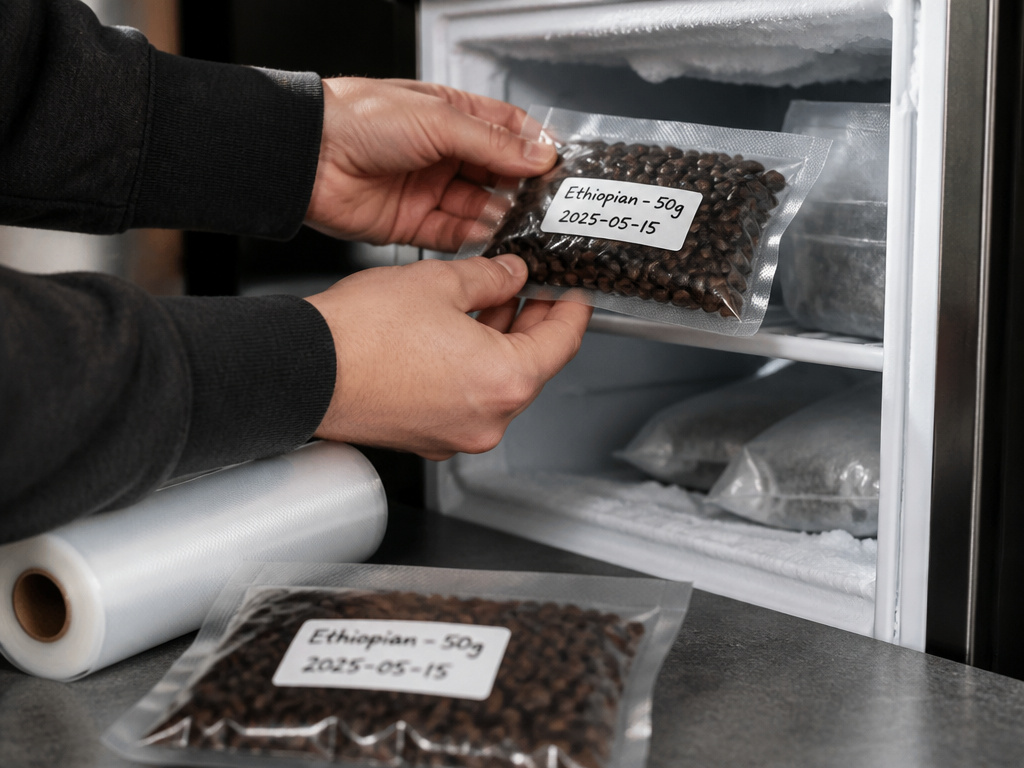
The freezer is a last resort, not a first step. It makes sense for one scenario: you have a large quantity of special single-origin beans you won’t finish in a month. The protocol is strict because the cost of error is high.
First, portion. If your typical drip coffee brew uses 50 grams, divide the bag into 50-gram batches. Second, vacuum seal each portion individually. Ziplock bags with the air squeezed out are not sufficient; residual air is your enemy. Third, label with the date and bean type.
The critical rule: thaw sealed. Take the portion out of the freezer and let it sit on your counter until it reaches room temperature, inside its sealed bag. Opening a frozen bag immediately causes condensation to form on the cold beans, which then soaks in. That’s the “freezer burn” taste people describe. It’s water damage.
I once ruined a half-pound of a limited Ethiopian roast by pulling the vacuum bag from the freezer, cutting it open while still cold, and pouring the frosty beans into my grinder. Within minutes, they were damp. The resulting cups tasted hollow and papery, all the vibrant blueberry notes washed away. Now, I take the bag out the night before.
Before you start: Freezing and thawing coffee introduces condensation risk which can permanently damage flavor. Portioning incorrectly leads to repeated freeze-thaw cycles. Always thaw sealed, and never refreeze.
If you can’t vacuum-seal, skip the freezer. The repeated opening and closing of a main coffee bag in the freezer guarantees condensation and flavor loss every time.
Your Daily Storage System
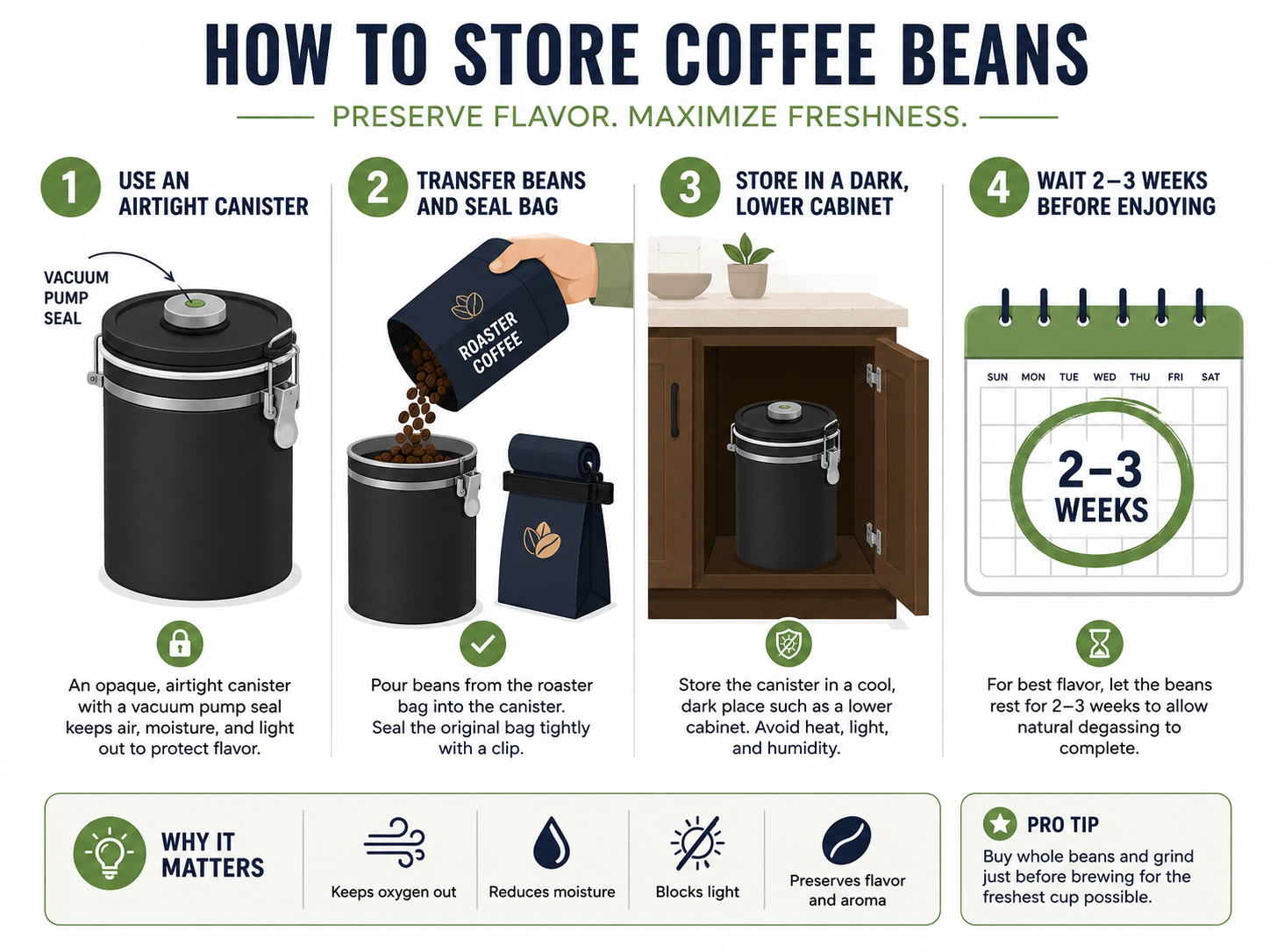
For the coffee you’ll drink within the next two to three weeks, a simple, dedicated system beats any appliance.
- Get an opaque, airtight canister. It must block light and have a solid seal. The Fellow Atmos uses a vacuum pump; the Airscape has a plunger lid. Both work.
- Fill it from your roaster bag, then close the bag. Don’t pour beans back and forth. Keep the original bag sealed with a clip in a cool, dark place as a reserve.
- Store the canister in the coolest, darkest part of your kitchen. Not on the counter by the window. Not above the stove. A lower cabinet, away from the oven and dishwasher.
- Buy only what you’ll drink in 2-3 weeks. Freshness has a linear decline. The best packaging can’t stop time.
This system protects against the three great destroyers: air, light, and heat. It also simplifies your routine. Your coffee filters and Breville filter need care, but the beans come first.
Frequently Asked Questions
Does freezing coffee kill the flavor?
Freezing itself doesn’t kill flavor if done correctly. The damage comes from improper thawing, which causes condensation, and from using poor packaging that allows freezer odors to penetrate. Vacuum-sealed, single-use portions thawed while still sealed preserve flavor well.
Can I store coffee in its original bag?
You can for the first week after opening. After that, the bag’s seal is compromised and the one-way valve can let in oxygen. For longer storage, transfer the beans to an airtight, opaque container. The original bag isn’t designed for long-term storage after opening.
How long do whole beans last?
In an ideal airtight container at or below 20°C (68°F), whole bean coffee retains peak flavor for about 2-3 weeks post-roast. It remains drinkable for 4-6 weeks, but the bright, complex notes will fade. Ground coffee lasts 1-2 weeks at best.
Does the type of roast affect storage?
Yes. Darker roasts are more porous and brittle, making them slightly more vulnerable to oxygen and moisture. Light roasts, like many blonde roast beans, are denser and can retain their delicate floral/fruit notes a bit longer under identical storage conditions, but the fundamental rules (airtight, cool, dark) apply to all.
Is it okay to store coffee in the refrigerator if it’s sealed?
No. The refrigerator’s environment is humid and undergoes temperature fluctuations every time the door opens. Even a sealed container will eventually experience condensation on its cold exterior, and any flaw in the seal allows humid air inside. The risk far outweighs any theoretical benefit.
What about storing coffee in the pantry with a clip?
clip is better than an open bag, but it’s the weakest form of sealing. It doesn’t create an oxygen-free environment. For short-term storage of a few days, it’s fine. For anything beyond that, an airtight canister is a necessary upgrade to prevent staling.
The Bottom Line
Stop putting coffee in the refrigerator. The constant humidity and thermal cycling actively destroy the delicate compounds you paid for. Your daily beans belong in an airtight, opaque container in the coolest, darkest spot in your kitchen, a pantry cupboard away from appliances. Reserve the freezer only for long-term archival of special lots, and even then, follow the strict protocol of portioning, vacuum-sealing, and thawing sealed. Your brewing methods deserve beans that taste like they were roasted yesterday, not like the inside of your fridge.
{
“@context”: “https://schema.org”,
“@type”: “HowTo”,
“name”: “How to Store Coffee to Preserve Freshness”,
“totalTime”: “PT5M”,
“tool”: [
{
“@type”: “HowToTool”,
“name”: “Airtight, opaque storage container”
},
{
“@type”: “HowToTool”,
“name”: “Vacuum sealer with bags”
},
{
“@type”: “HowToTool”,
“name”: “Digital scale for portioning”
}
],
“step”: [
{
“@type”: “HowToStep”,
“name”: “Choose the right container”,
“text”: “Transfer beans from the original bag into an airtight, opaque container with a one-way degassing valve. The container must block light and seal against air.”
},
{
“@type”: “HowToStep”,
“name”: “Store in a cool, dark place”,
“text”: “Place the container in a pantry or cupboard away from heat sources like the oven, stove, or direct sunlight. Ideal temperature is below 20°C (68°F).”
},
{
“@type”: “HowToStep”,
“name”: “Portion before freezing”,
“text”: “If freezing, weigh out single-use portions (e.g., 40-50g for a brew), vacuum seal each portion individually, and label with the date.”
},
{
“@type”: “HowToStep”,
“name”: “Thaw sealed”,
“text”: “When ready to use a frozen portion, remove it from the freezer and let it thaw completely to room temperature inside its sealed bag before opening. This prevents condensation.”
}
]
}
{
“@context”: “https://schema.org”,
“@type”: “FAQPage”,
“mainEntity”: [
{
“@type”: “Question”,
“name”: “Does freezing coffee kill the flavor?”,
“acceptedAnswer”: {
“@type”: “Answer”,
“text”: “Freezing itself doesn’t kill flavor if done correctly. The damage comes from improper thawing, which causes condensation, and from using poor packaging that allows freezer odors to penetrate. Vacuum-sealed, single-use portions thawed while still sealed preserve flavor well.”
}
},
{
“@type”: “Question”,
“name”: “Can I store coffee in its original bag?”,
“acceptedAnswer”: {
“@type”: “Answer”,
“text”: “You can for the first week after opening. After that, the bag’s seal is compromised and the one-way valve can let in oxygen. For longer storage, transfer the beans to an airtight, opaque container. The original bag isn’t designed for long-term storage after opening.”
}
},
{
“@type”: “Question”,
“name”: “How long do whole beans last?”,
“acceptedAnswer”: {
“@type”: “Answer”,
“text”: “In an ideal airtight container at or below 20°C (68°F), whole bean coffee retains peak flavor for about 2-3 weeks post-roast. It remains drinkable for 4-6 weeks, but the bright, complex notes will fade. Ground coffee lasts 1-2 weeks at best.”
}
},
{
“@type”: “Question”,
“name”: “Does the type of roast affect storage?”,
“acceptedAnswer”: {
“@type”: “Answer”,
“text”: “Yes. Darker roasts are more porous and brittle, making them slightly more vulnerable to oxygen and moisture. Light roasts, like many blonde roast beans, are denser and can retain their delicate floral/fruit notes a bit longer under identical storage conditions, but the fundamental rules (airtight, cool, dark) apply to all.”
}
},
{
“@type”: “Question”,
“name”: “Is it okay to store coffee in the refrigerator if it’s sealed?”,
“acceptedAnswer”: {
“@type”: “Answer”,
“text”: “No. The refrigerator’s environment is humid and undergoes temperature fluctuations every time the door opens. Even a sealed container will eventually experience condensation on its cold exterior, and any flaw in the seal allows humid air inside. The risk far outweighs any theoretical benefit.”
}
},
{
“@type”: “Question”,
“name”: “What about storing coffee in the pantry with a clip?”,
“acceptedAnswer”: {
“@type”: “Answer”,
“text”: “clip is better than an open bag, but it’s the weakest form of sealing. It doesn’t create an oxygen-free environment. For short-term storage of a few days, it’s fine. For anything beyond that, an airtight canister is a necessary upgrade to prevent staling.”
}
}
]
}
