
Find Your Perfect Reusable Cone Coffee Filter: A Full Guide
A reusable cone coffee filter replaces disposable paper in a cone-shaped brewer, made from stainless steel, cloth, or silicone. It fits specific brewer sizes (#1, #2, #4, #6) and requires matching your grind size to the filter’s mesh to prevent sludge. The right choice cuts about 0.5g of paper waste per cup and lasts for hundreds of brews.
Most people pick the wrong material for their machine and end up with a drawer full of gritty cups. They buy a generic #4 stainless steel filter for their 10-cup brewer, but the fit is sloppy or the mesh lets too much fine sediment through. The coffee tastes muddy, cleaning becomes a chore, and the filter gets retired after a month.
This guide walks through the three material types, how to match a filter to your specific brewer model, the one cleaning step everyone misses, and how to dial in your grind to get a clean, full-bodied cup every time.
Key Takeaways
- Stainless steel filters (like the Able KONE) produce a fuller-bodied cup but require a coarser grind and immediate cleaning to avoid clogging.
- Cloth filters offer the cleanest taste, closest to paper, but need a weekly boil in baking soda water to prevent mold and off-flavors.
- Filter size is non-negotiable: a #4 filter will not seal in a machine designed for a #2 cone, causing water to bypass the grounds entirely.
- Never use a reusable filter and a paper filter together in the same basket, this creates a pressure seal that can damage your machine’s pump or spray head.
- For cold brew in machines like the Sage Precision Brewer, you must remove the cone filter basket entirely and use a large paper filter or a dedicated cold brew bag.
What Even Is a Reusable Cone Filter?
It’s a permanent basket that sits inside your drip machine’s showerhead or your manual pour-over cone. Instead of a disposable paper liner, it uses a fine mesh, stainless steel, cloth, or silicone, to hold the grounds while letting water flow through. The cone shape is crucial because it matches the geometry of most home drip machines and manual brewers like the Hario V60 or Chemex.
A reusable cone coffee filter is a permanent, washable basket designed to fit specific cone-shaped brewers, eliminating the need for disposable paper filters. Its mesh material, stainless steel, cloth, or silicone, determines the body, clarity, and maintenance routine of your coffee.
The design isn’t new. The Able Brewing KONE filter, one of the most popular stainless steel versions, was literally invented because a co-founder ran out of paper filters one morning. He designed a metal version with 40,000 laser-etched holes to stop sludge. That’s the origin story for a lot of these products, solving a moment of frustration with a permanent tool.
TL;DR: It’s a permanent, cone-shaped basket that replaces paper. The material changes your coffee’s body and your cleaning routine.
Stainless Steel vs. Cloth vs. Silicone: The Real Trade-Offs
You have three main options. Your choice here decides your coffee’s mouthfeel and your weekly cleaning commitment.
| Material | Best For | Biggest Drawback | Taste Profile |
|---|---|---|---|
| Stainless Steel (SUS304) | Daily use, durability, fuller body | Can let fine sediment through (sludge) | Oils pass through, giving a heavier, more French-press-like cup. |
| Cloth (Cotton/Flannel) | Cleanest taste, paper-like clarity | High maintenance; molds if stored damp | Very clean, bright, and tea-like—closest to a high-quality paper coffee filter. |
| Silicone | Ease of cleaning, flexibility | Can impart a slight plastic taste if cheap | Neutral, but often muted compared to cloth or metal. |
Stainless steel is the workhorse. Look for SUS304-grade steel, it’s food-safe and resists corrosion. The mesh design matters. A cheap filter with a simple woven grid will let too much sludge through. A well-designed one, like the Able KONE or the Precise Brew filters, uses overlapping circular holes or a specific etching pattern to block fines while allowing flow. These filters are built for devices like the Hario V60 No. 2 or Chemex 6-cup.
Cloth filters, often called “socks,” give you the cleanest cup. They trap almost all sediment and oils, resulting in a very bright, tea-like clarity. This makes them fantastic for highlighting the delicate flavor profiles of a high-quality single-origin beans. The trade-off is labor. You must rinse them impeccably after every use and boil them weekly in a water-and-baking-soda solution. Store them damp in the fridge, and they’ll still develop a musty smell within two weeks if you skip a boil.
Silicone is the easy option. It’s flexible and often comes with a fine nylon mesh. It cleans under the tap in seconds. The problem is taste. Lower-grade silicone can leave a faint plastic note in your coffee, especially with hotter water. It also doesn’t last as long as metal, the mesh can detach from the frame after a year of daily use.
Common mistake: Choosing a cloth filter for convenience, the cloth holds onto oils and becomes rancid within 7 days if you don’t boil it weekly, ruining the taste of every subsequent cup.
TL;DR: Metal for body, cloth for clarity, silicone for ease. Your choice dictates your cleaning schedule.
The One Compatibility Check Everyone Forgets
A #4 filter is not a #4 filter. Well, it is, but your machine might disagree.
The numbered sizing system (#1, #2, #4, #6) is a rough guide, not a universal standard. A #4 filter from Brand A might have a slightly wider flange or a steeper cone angle than a #4 from Brand B. If it doesn’t seat perfectly in your brewer’s basket, water will flow around the filter, not through it. Your coffee will be weak and underwhelming.
First, identify what you have. Check your machine’s manual. The Sage Precision Brewer BDC450 manual, for example, specifies it uses a “#2 cone filter basket” for single-cup mode. If you lost the manual, measure the basket’s base diameter. A #2 cone typically has a base around 2.5 inches; a #4 is about 3.25 inches.
Second, buy the filter made for your machine. Don’t guess. Manufacturers like Precise Brew list compatibility right on the product page: “Fits: Hario V60 No. 2, Kalita Wave 155, Orea V3.” If your brewer isn’t listed, assume it won’t fit.
I bought a generic “universal #4” stainless filter for my older Bonavita machine. It sort of fit. The first brew was a disaster, half the water channeled down the sides of the filter, bypassing the grounds entirely. I spent the next week drinking weak, sour coffee until I found the OEM-branded replacement. The difference was a millimeter in the flange width.
This is especially critical for automatic drip filters in commercial settings or high-volume home machines. A misfit doesn’t just make bad coffee; it can lead to overflow if water isn’t draining correctly.
TL;DR: “Fits #4 cones” is a suggestion. “Fits Chemex 6-cup” is a guarantee. Buy the latter.
Which Grind Size Prevents Sludge?
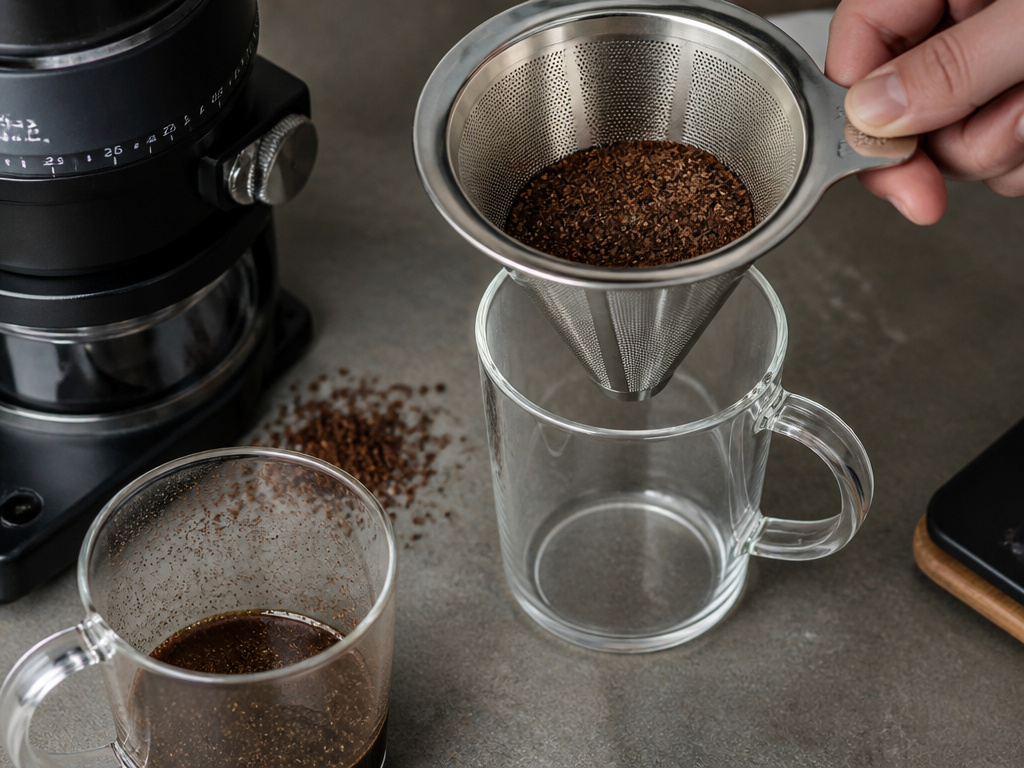
Your grind size must match your filter’s mesh. Get this wrong, and you get a cup full of silt or a weak, hollow brew.
For stainless steel filters, you need a medium-coarse grind. Think sea salt, not powder. If your coffee grind consistency is too fine, like table salt or flour, the particles will clog the tiny holes and either stall the brew or push through as sludge. A burr grinder benefits here immensely over a blade grinder because it produces uniform particles without dust.
For cloth and silicone filters, you can go a touch finer, a standard medium grind, like for a drip machine. The tighter weave of cloth stops most fines, so a slightly finer grind increases extraction without the silt penalty. This is perfect for extracting more from delicate blonde roast beans.
Here’s the test: Brew a cup. Let it sit for 60 seconds. If you see a layer of fine sediment settling at the bottom thicker than a credit card, your grind is too fine for that filter. If the coffee tastes weak and sour, your grind is too coarse.
TL;DR: Metal filter = coarse grind. Cloth/silicone filter = medium grind. Let the cup sit for a minute to diagnose.
The 4-Step Cleaning Ritual That Actually Works
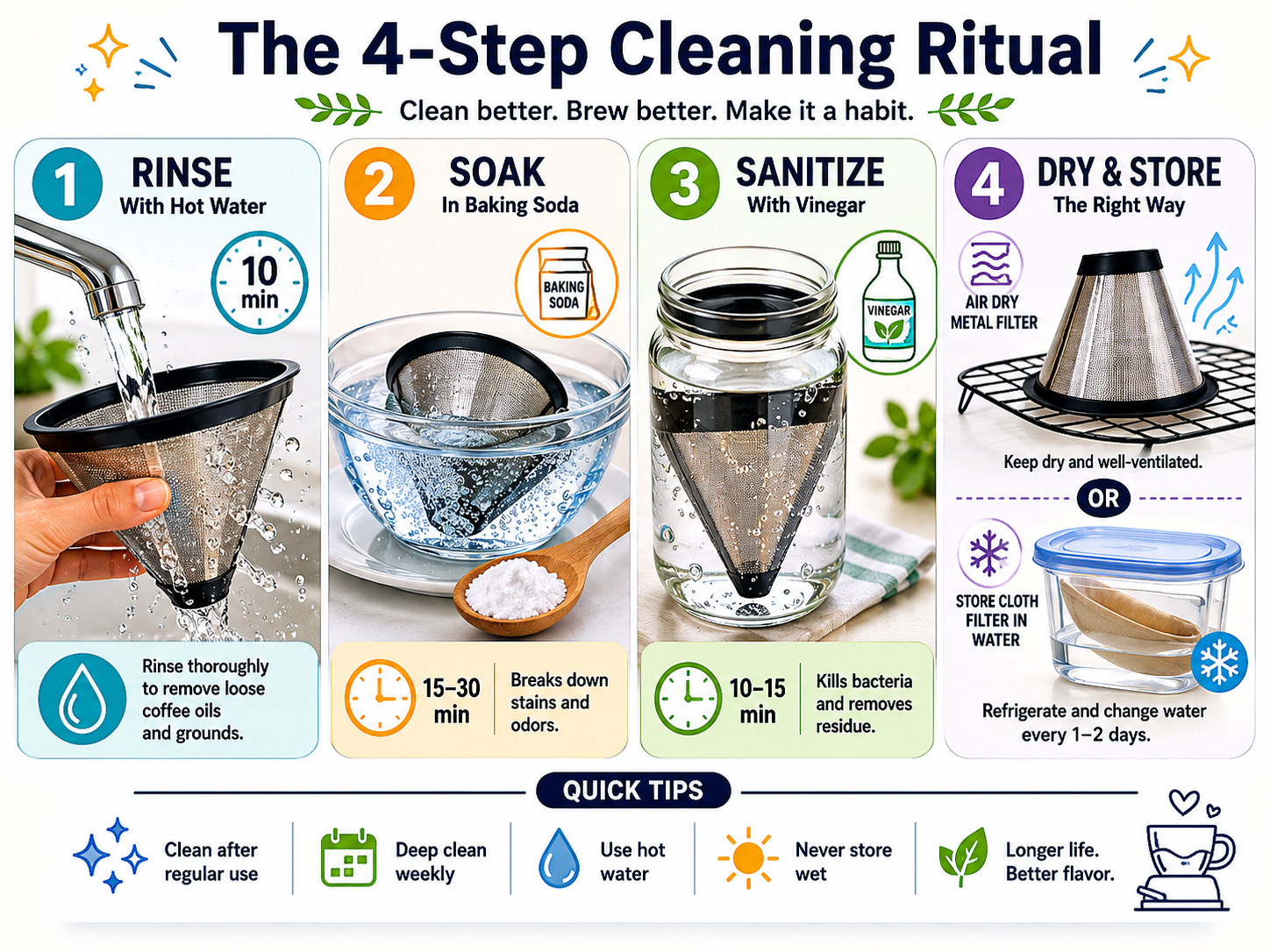
Cleaning a reusable filter isn’t just rinsing. It’s a ritual that prevents off-flavors and extends the filter’s life by years.
- Rinse immediately. Do not let the filter sit with wet grounds. Coffee oils solidify as they cool, gluing fine particles to the mesh. Rinse under the hottest tap water you have within 10 minutes of finishing your brew. Use your fingers to wipe the mesh clean.
- Weekly deep clean. Once a week, submerge the filter in a solution of 1 tablespoon baking soda per cup of hot water. Let it soak for 30 minutes. For metal filters, scrub gently with a soft-bristle brush (an old toothbrush works). For cloth filters, boil them in this solution for 5 minutes, then rinse thoroughly.
- Monthly descale (for metal). If you have hard water, limescale will build up in the microscopic holes of a stainless filter. Soak it overnight in a 50/50 mix of white vinegar and water. Rinse extremely well the next morning, you do not want vinegar-coffee.
- Store correctly. Metal and silicone filters should be bone-dry before storage. Cloth filters should be stored submerged in clean water in the refrigerator, and the water changed every 2-3 days. Never store a damp cloth filter in a sealed container at room temperature.
Common mistake: Storing a cloth filter damp in a drawer, within four days, it will develop a visible mildew spot and smell like a wet basement. That smell transfers directly to your next cup.
Skipping the weekly boil on a cloth filter is the fastest way to ruin it. The oils go rancid. The cloth stiffens. The flavor it imparts is unmistakably foul.
TL;DR: Rinse hot and fast, deep-clean weekly, descale monthly, and store based on material. Dry for metal, wet and cold for cloth.
When Not to Use a Reusable Filter

These filters are not universal tools. There are brewer modes and scenarios where you must use paper.
The Sage Precision Brewer manual is explicit about its “COLD BREW” mode: you must remove both the cone insert and the mesh basket filter. You then use a large paper filter with a coffee ratio 2-3 times normal. The machine’s programming for cold brew assumes a different flow rate and saturation. Forcing a reusable metal cone in there will likely cause overflow or improper extraction.
Also, never double up. The manual has a bold, all-caps warning: “Never use both mesh basket filter and paper filter at the same time.” This creates a seal that can block water flow, causing the machine’s pump to strain or the spray head to leak.
Some espresso machine filters and pressurized portafilter baskets are designed for a specific paper or metal mesh. Swapping in a generic reusable cone will cause channeling and weak shots. If your machine has a specialized basket, use what it was designed for.
Finally, if you are serving coffee to someone with a severe gluten intolerance, use a brand-new paper filter. Reusable filters, especially cloth, can retain traces of proteins from previous brews, even after cleaning.
TL;DR: Skip the reusable filter for dedicated cold brew modes, never layer it with paper, and don’t substitute it in specialized espresso baskets.
Frequently Asked Questions
Do reusable coffee filters change the taste of coffee?
Yes, dramatically. Stainless steel allows oils and fine particles through, creating a heavier, more full-bodied cup similar to a French press. Cloth and paper produce a cleaner, brighter cup. Silicone is the most neutral but can mute subtle flavors.
How long does a reusable coffee filter last?
high-quality stainless steel filter (SUS304 grade) can last a decade with proper care. Cloth filters last about 3-6 months with weekly boiling. Silicone filters typically last 1-2 years before the mesh detaches or the frame warps.
Can you use a reusable filter in a Keurig?
Only if you purchase a Keurig-specific reusable pod. A standard cone filter will not fit the K-cup chamber. These reusable pods are a different product altogether and require a fine grind to work properly.
Are reusable filters better for the environment?
They eliminate paper waste, saving roughly 0.5g of paper per cup. Over a year of daily use, that’s over 180 grams of paper not going to landfill or composting. However, their environmental impact depends on manufacturing energy and how long you use them. For a true sustainable brewing setup, cloth filters are often considered the best eco-friendly filter materials.
Why does my coffee taste metallic with a new stainless steel filter?
You didn’t season it. Brew 2-3 batches of coffee through a new metal filter and discard the coffee. This coats the microscopic pores with coffee oils, creating a barrier between the steel and your drinking brew. The metallic taste disappears after this process.
The Bottom Line
A reusable cone filter is a commitment to a specific taste and a cleaning routine, not just a green alternative. Match the material to your desired cup profile: steel for body, cloth for clarity. Match the size to your brewer’s model, not just the number. Your grind size for pour-over must shift coarser for metal, and your maintenance schedule must include a weekly deep clean. Get those three things right, and you’ll save a small mountain of paper while drinking a better, more intentional cup. Get one wrong, and you’ll be back to buying paper filters by the hundred within a month.
