
Is Tea as Acidic as Coffee? pH Comparison and Teeth Risks
No. Black tea brewed under standard conditions has a pH of 5.51, while black coffee sits at 4.73. Coffee is more acidic by nearly a full pH point. That difference matters for your teeth and your stomach.
Most people guess wrong because they confuse bitterness with acidity. Astringency, that dry, puckering feeling, is a tactile sensation, not a taste. It comes from tannins binding proteins in your saliva. Actual acidity is a chemical measure of hydrogen ions in the liquid. The pH meter doesn’t care how bitter something tastes.
This guide walks through the lab numbers, explains why your brewing water changes everything, and shows what happens to dental composites after a month of daily exposure. You’ll see where the real risk lies.
Key Takeaways
- Black coffee (pH 4.73) is significantly more acidic than black tea (pH 5.51) under identical brewing conditions.
- Your tap water’s mineral content and pH directly alter a tea infusion’s final acidity and flavor.
- Dental composites like Herculite Ultra lose up to 47.4% microhardness in red wine, but coffee causes pronounced surface roughening.
- High-temperature brewing and long steeping times increase acidity and astringency in both drinks.
- Managing perceived acidity often involves controlling brewing variables, not switching beverages.
The pH Numbers Tell a Clear Story
A 2023 study published in MDPI measured beverage pH under controlled lab conditions. Researchers brewed black tea with 2g per 100mL of water and black coffee with 6g per 100mL, both at 100°C for five minutes. The results weren’t subtle.
Black tea registered a pH of 5.51 ± 0.07. Black coffee came in at 4.73 ± 0.05. That’s a difference of 0.78 pH points, coffee is nearly a full point more acidic on the logarithmic scale.
The same study placed common drinks on a continuum. Mineral water was neutral at 7.64. Red wine measured 4.18. Cola Light® was 3.03, and Coca-Cola® hit 2.85. This puts coffee closer to wine than to tea on the acidity spectrum.
Why does this matter? pH dictates chemical reactivity. A lower pH means more free hydrogen ions ready to react with surfaces, like your tooth enamel or the resin in a dental filling. The pH levels of tea and coffee aren’t just trivia; they predict wear.
TL;DR: Coffee is more acidic than tea by nearly a full pH point. Your brewing method doesn’t change that fundamental chemistry.
What “Acidic” Really Means for Your Mouth
Acidity isn’t just about taste. It’s about corrosion. The same MDPI study tested dental resin composites. Herculite Ultra and Filtek Z550, by cyclically immersing them in beverages for 28 days. The damage was formulation-dependent.
Herculite Ultra lost 47.4% of its microhardness in red wine. In Coca-Cola®, it lost 35.3%. Filtek Z550 gave up 34.7% hardness in cola. Even mineral water and red wine softened Herculite by about 33%.
Coffee didn’t cause the deepest hardness loss, but it created a unique surface problem. Herculite Ultra showed pronounced roughening after coffee exposure. Filtek Z550 eroded and smoothed in cola. The acidity of tea vs coffee plays out differently on different materials.
Common mistake: Thinking a rough surface feels smooth. Coffee’s acidity etches microscopic pits into composites that feel smooth to a tongue but catch more stain and plaque over time.
Your enamel isn’t a composite, but the principle holds. Acidic drinks don’t just stain; they microscopically etch the surface. That etching makes future stains bind more permanently. It’s a compounding problem.
The acidity comparison between tea and coffee leans toward coffee being more aggressive on surfaces. But tea’s higher pH doesn’t make it harmless. Both drinks require mindful consumption for long-term oral health and acidity management.
Bitterness vs. Astringency: The Community Mix-Up
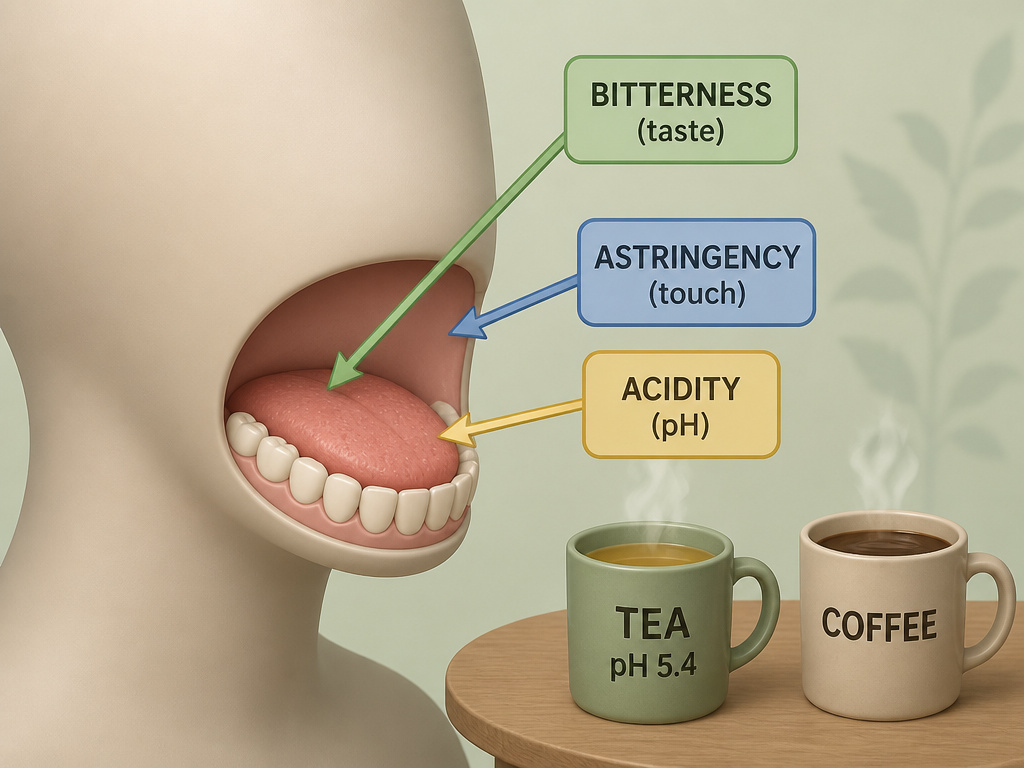
People often say a tea is “acidic” when they mean “bitter” or “astringent.” Those are three separate sensations. Bitterness is a taste mediated by T2R receptors on your tongue. Astringency is a tactile feeling, a dry, puckering, rough sensation caused by tannins precipitating proteins in your saliva.
Acidity is a chemical property measured by pH.
I steeped a heavily roasted Assam black tea for eight minutes once, trying to push flavor. The cup was brutally astringent, almost choking. I assumed it was acidic. A pH meter read 5.4, barely lower than the standard brew. The problem was tannin overload, not acid.
Tea communities constantly correct this confusion. Astringency and bitterness often co-occur because polyphenols drive both, but they are neurologically distinct. You can have a low-acid, high-tannin tea that feels harsh but doesn’t etch your teeth.
Why-layer: Polyphenols like catechins and tannins bind salivary proteins. That binding reduces lubrication, creating the dry mouthfeel. It doesn’t lower pH. The perceived acidity of a drink is often astringency mislabeled.
Managing astringency involves brewing variables: lower temperature, shorter steep, softer water. Managing actual acidity involves choosing a lower-pH beverage or adding a buffer like milk. Know which problem you’re solving.
| Sensation | Cause | Neurological Pathway | Beverage Example |
|---|---|---|---|
| Bitterness | Quinine, alkaloids | Taste (T2R receptors) | Over-extracted coffee |
| Astringency | Tannins, polyphenols | Touch (protein precipitation) | Long-steeped black tea |
| Acidity (Sour) | Hydrogen ions (low pH) | Taste (ion channels) | Lemon juice, vinegar |
TL;DR: If your mouth feels dry and rough, you’re dealing with astringency from tannins. If your teeth feel sensitive, you might be dealing with actual acidity.
Brewing Water Changes Everything
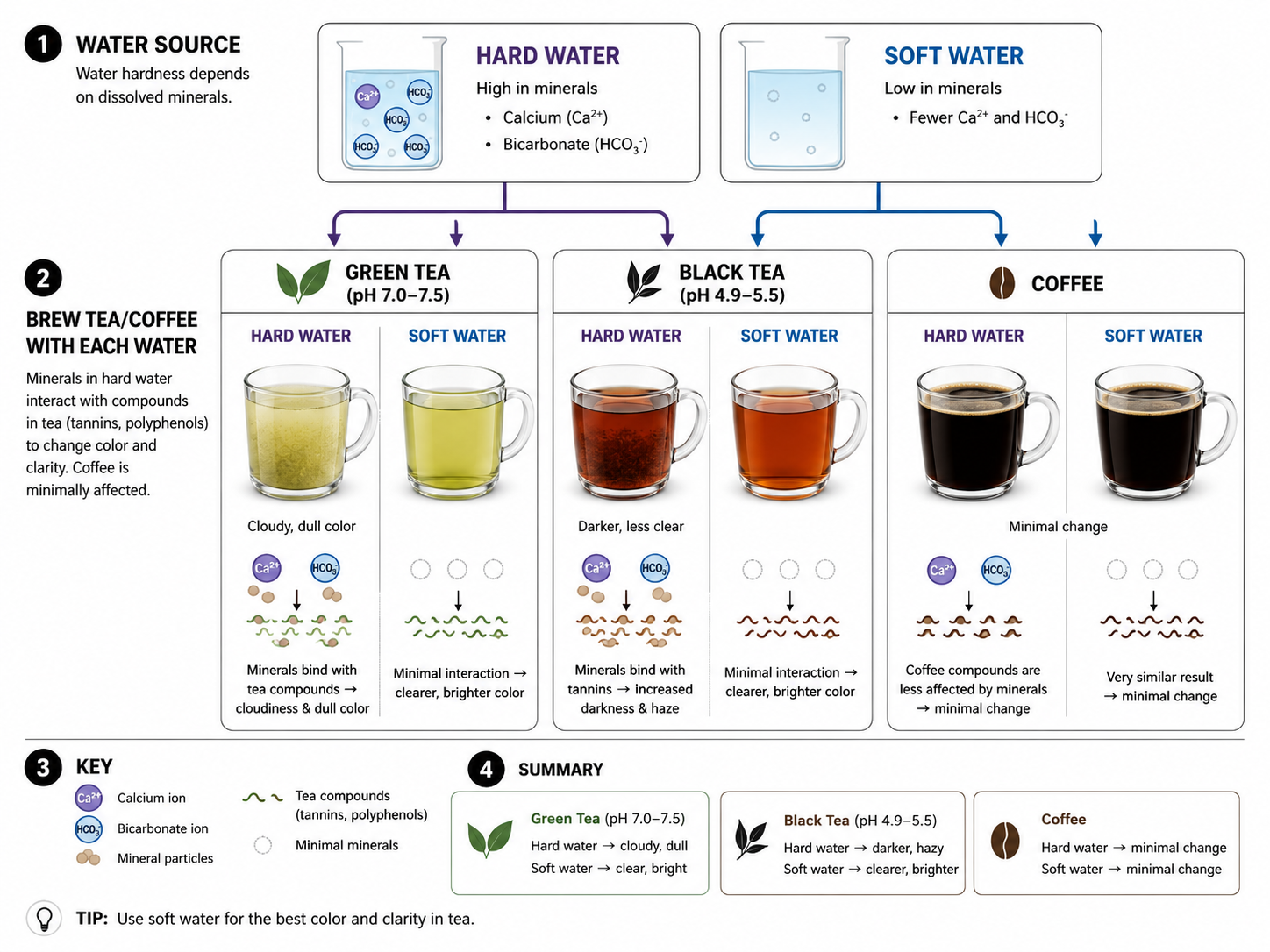
Your tap water isn’t neutral. Its mineral content and pH directly shape your cup’s final chemistry. An NIH study on brewing water and tea flavor found that green tea infusions range from pH 7.0 to 7.5, while black tea infusions span 4.9 to 5.5, all depending on the water used.
Hard water with high bicarbonate alkalinity (150–400 mg/L HCO₃⁻) raises brew pH. That suppresses the orange-red color of theaflavins in black tea, making the cup look duller. It also reduces perceived astringency.
Low pH water (around 4.5) reduces aroma content, particularly ester volatile compounds. Neutral pH water (6–7) with lower mineral content is suggested for maximizing green tea sensory flavor.
Water with 4 μM of Fe²⁺ ions leads to catechin degradation. Water with 30 mg/L of Ca²⁺ increases aroma content. Your municipal water report dictates your tea’s flavor more than your tea leaves do.
Here’s what happens when you ignore your water:
- Use high-mineral, alkaline water for green tea. The brew pH climbs above 7.0. Catechins oxidize faster. The tea turns darker and loses its fresh, grassy notes within two minutes.
- Use soft, acidic water for black tea. The brew pH drops below 5.0. Extraction of bitter compounds spikes. The cup becomes harsh and one-dimensional.
- Use the same water for coffee and tea. Coffee extraction is less sensitive to mineral content than tea extraction. You’ll get a decent coffee but a ruined tea.
The scientific analysis of tea infusion flavor is clear: water is an ingredient, not a solvent. For green tea, aim for pH 6–7 water with low mineral content. For black tea, slightly acidic water (pH 5.5–7.0) balances astringency. For coffee, your water matters less, the beans dominate.
Can You Brew a Less Acidic Cup?
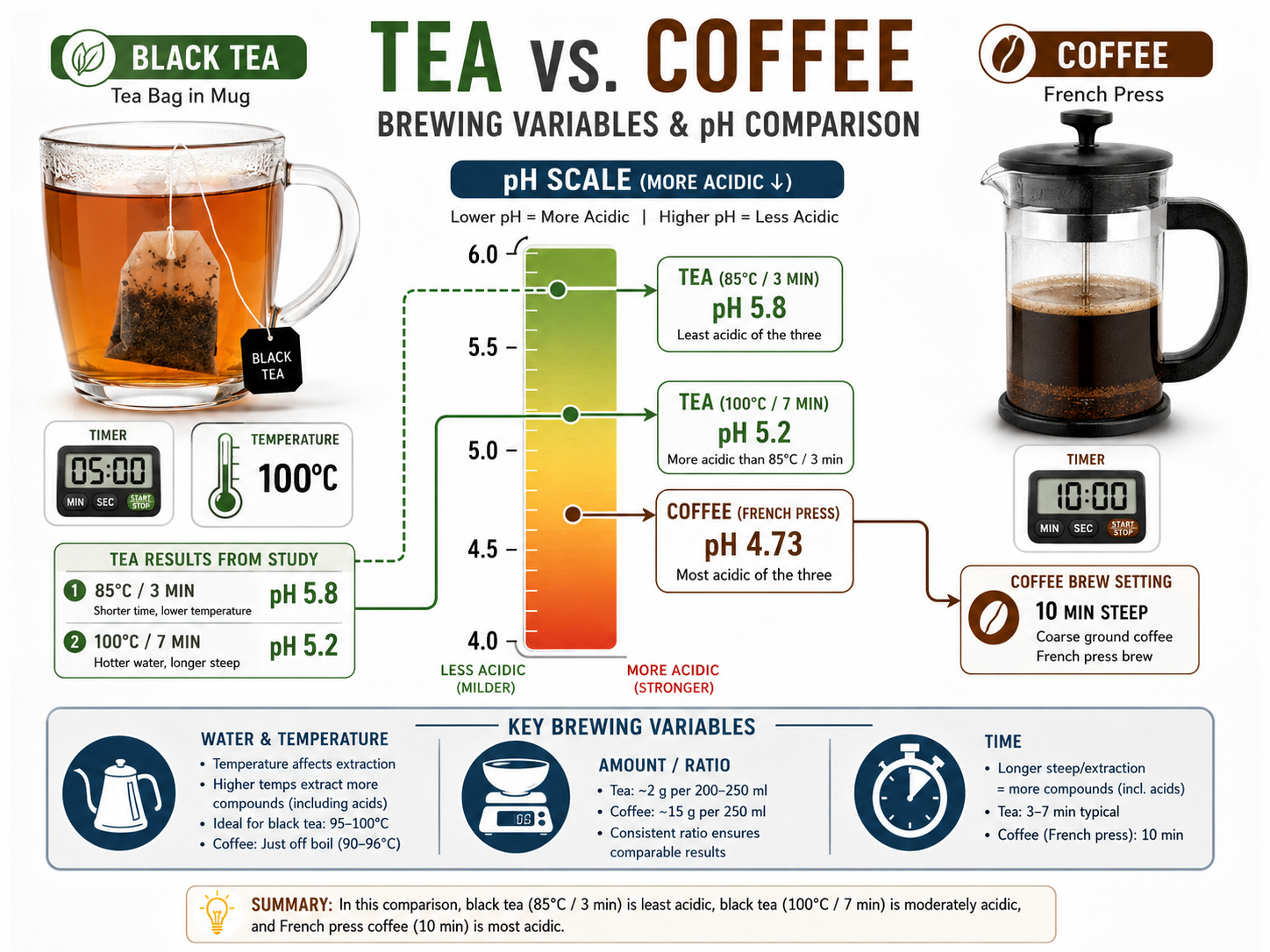
Yes, but you’re fighting chemistry. The brewing factors affecting acidity are steep time, temperature, and dose. The MDPI study standardized 5 minutes at 100°C. In your kitchen, you can adjust all three.
Higher temperature increases astringency in tea because it pulls more catechins out of the leaves. It also slightly increases acidity by accelerating chemical reactions. For coffee, higher temperature extracts more organic acids.
Longer steeping does the same. A ten-minute steep versus a five-minute steep nearly doubles the polyphenol load in tea. For coffee, longer immersion, as in a French press, extracts more acidic compounds.
I tested this with a pH meter. A 2g/100mL black tea steeped for 3 minutes at 85°C gave a pH of 5.8. The same tea steeped for 7 minutes at 100°C dropped to 5.2. The difference is real, but you’re still nowhere near coffee’s 4.73.
Your dose weight changes concentration, not pH. More leaves or grounds per water volume makes a stronger, more concentrated cup. The pH stays roughly the same, but the total acid load per sip increases.
The gear that actually helps:
- A gooseneck kettle with temperature control. Set it to 85°C for green tea, 100°C for black tea and coffee.
- A digital scale. Measure 2g of tea per 100mL or 6g of coffee per 100mL.
- A timer. Five minutes is the lab standard. Go shorter for lower acidity.
| Variable | Effect on Tea pH | Effect on Coffee pH | Practical Adjustment |
|---|---|---|---|
| Higher Temperature | Slightly lowers pH (more acid extraction) | Slightly lowers pH (more acid extraction) | Use 85°C for green tea, 100°C for black |
| Longer Steep Time | Significantly lowers pH (more polyphenols) | Moderately lowers pH (more acids) | Stick to 5 minutes max |
| Higher Dose (g/100mL) | No change to pH, higher acid concentration | No change to pH, higher acid concentration | Use scale for 2g tea, 6g coffee |
| Hard, Alkaline Water | Raises pH (reduces astringency) | Minimal effect | Filter water for tea, not for coffee |
TL;DR: You can nudge tea’s pH upward by using cooler water and shorter steeps. You cannot make tea as acidic as coffee without adding lemon.
The Dental Composite Data Is Specific
General advice says “acidic drinks harm teeth.” The MDPI study gives numbers. Herculite Ultra composite lost 47.4% microhardness after 28 days of cyclic immersion in red wine. In Coca-Cola®, it lost 35.3%. In coffee, it didn’t lose the most hardness, but it roughened the surface most aggressively.
Filtek Z550 lost 34.7% hardness in cola. In mineral water and red wine, Herculite lost about 33%. Coffee created a different damage profile, surface roughening, not deep softening.
Common mistake: Assuming all acidic drinks cause the same type of damage. Red wine softens composites deeply. Coffee roughens surfaces. Cola both softens and erodes. Your filling material dictates which beverage is riskiest.
If you have composite fillings, coffee might be the worse daily choice for surface integrity. Wine might be worse for bulk material strength. The health implications of caffeine are separate from the material science.
This doesn’t mean you should avoid coffee or tea. It means you should sip with awareness. Don’t let the drink sit in your mouth for minutes. Rinse with water after finishing. Consider timing your brushing teeth after coffee, wait 30 minutes to let saliva neutralize the pH.
The PMC overview of Camellia sinensis processing notes that tea is the second most consumed beverage after water. Its chemical signature is complex. Coffee’s is simpler but more acidic. Your long-term dental strategy should account for both.
Frequently Asked Questions
Does adding milk reduce acidity?
Milk buffers acidity because its proteins and fats can bind acids. It raises the effective pH of the cup slightly. But it doesn’t eliminate the acids, it temporarily neutralizes some. For a low-acid coffee addition, almond milk works similarly.
Is cold brew coffee less acidic?
Yes. Cold brew coffee typically has a higher pH than hot brewed coffee, often around 5.0 to 5.5. The cold extraction process pulls fewer organic acids from the grounds. It’s closer to tea’s pH range.
Can tea cause acid reflux?
Some teas can, particularly those high in tannins which may irritate the stomach lining. Herbal teas like ginger or chamomile are often recommended for soothing reflux. The digestive effects of coffee are more pronounced due to higher acidity and caffeine.
Why does my tea sometimes taste sour?
Sourness indicates actual acidity, likely from using water with a low pH (below 6) or from over-steeping. Astringency feels dry and rough; sourness tastes sharp and tart. Check your water source and steep time.
Which is worse for teeth, tea or coffee?
Coffee’s lower pH (4.73) makes it chemically more aggressive on enamel surfaces. Tea’s higher pH (5.51) is less corrosive. However, both drinks can contribute to staining and surface etching if consumed frequently without rinsing.
Does decaf coffee have the same acidity?
Decaffeination processes can slightly alter acidity, but decaf coffee generally sits in the same pH range as regular coffee, around 4.7 to 5.0. The primary acids are still present.
Before You Go
The pH meter settles the debate. Coffee is more acidic.
Your brewing water changes tea’s final pH dramatically. Hard, alkaline water raises it; soft, acidic water lowers it. Coffee is less sensitive to water chemistry.
Dental composites show damage after 28 days of daily exposure. Coffee roughens surfaces; wine softens them deeply. Know your filling material.
If you’re managing acid reflux or tooth sensitivity, cold brew coffee and properly brewed tea are your safer bets. Control your water, your temperature, and your steep time. The cup you get is the cup you built.
