
Your Guide on How to Work the De’Longhi Coffee Machine
This post contains affiliate links. As an Amazon Associate, we earn from qualifying purchases.
To work a De’Longhi coffee machine, first turn on the rear power switch, then the front power button. Perform an initial rinse with a large container under the spouts. Finally, program the shot buttons for your preferred volume. This two-stage power system is mandatory for operation.
To work a De’Longhi coffee machine, you must engage two separate power switches, perform a mandatory initial rinse with a large container, and correctly program the shot buttons for volume. Most models require a 13A dedicated socket and a 0.5 liter container under the spouts for the first rinse to prevent overflow. Skipping the side power switch is the most common reason a De’Longhi appears dead out of the box.
People assume these machines have a simple on/off button. The reality is a two-stage power system that confuses even experienced baristas coming from commercial machines. You can press the front button all day, but if the rear switch is off, nothing happens.
This guide walks through the correct startup sequence, shot programming, milk steaming, and essential maintenance drawn directly from the official De’Longhi manuals. You will learn the model-specific quirks, like why you should never add pre-ground coffee while the machine is off and what happens if you interrupt a descaling cycle.
Key Takeaways
- Every De’Longhi has a main power switch on the side or back in addition to the front control button; missing the side switch is the top support call.
- The initial rinse cycle requires a container under the spouts that holds at least 0.5 liters (16.9 fl oz); a small cup will overflow and flood your counter.
- Never add pre-ground coffee to a machine that is powered off. The grounds can spill into the internal brewing chamber, causing a jam that requires disassembly.
- If you interrupt a descaling cycle by unplugging the machine, it will remain in descaling mode when powered back on. You must complete the full cycle to resume normal operation.
- For steaming, purge the wand first, use milk straight from the fridge, and stop when the pitcher feels hot. Going longer than 60 seconds can damage the steam thermostat.
The Two-Switch Startup Sequence Every De’Longhi Needs
Head to the side or back panel of your machine. You are looking for a physical rocker switch, often marked with a ‘0’ and ‘I’. This is the main power isolator. Flip it to ‘I’.
Now locate the front panel power button, usually marked with a circle or a power symbol. Press it. The machine should wake up, lights will illuminate, and you will hear the pump and heater begin their work. This two-step process is non-negotiable for safety and is detailed on page 3 of the ECAM22X6Y manual.
Before you start: Your electrical outlet must be rated for a minimum 13A current (per the ECAM22X6Y manual). Using a shared outlet or power strip can cause the machine to brown out, tripping internal thermal cutoffs. The heating element draws 1250–1450 watts; a weak circuit cannot sustain that load.
TL;DR: Find the side power switch first, flip it on, then use the front button. Plug into a dedicated 13A outlet.
The Mandatory Rinse Cycle You Can’t Skip
Once the machine is on, it will likely begin an automatic rinse. This is the machine pushing water through its internal heated circuit to stabilize temperature and clear any air pockets. Do not try to stop it.
You must be prepared. According to the EC885 manual, you need a container under the coffee spouts that holds at least 0.5 liters (16.9 fl oz). A standard coffee mug holds about 350ml. It will overflow.
The machine will discharge up to that full half-liter of water in a series of pulses. This is normal. Let it finish completely before you attempt to brew coffee. The process also primes the pump, preventing the dry-run damage that occurs if you try to pull a shot without water in the lines.
Common mistake: Using a small cup for the initial rinse — the water overflows, runs down the machine’s body, and can seep into the electronics tray below the drip tray. This moisture leads to error codes within a week.
Programming Your First Shot
De’Longhi machines use volumetric programming. The buttons are not preset to a specific amount; you teach them.
- Grind and dose. If your machine has a grinder, the EC9555 manual recommends a setting between 5 and 11 for most coffees. Use the 1–4 range only for very light roasts. Dose your portafilter with 14–18 grams of coffee. Tamp firmly.
- Insert the portafilter. Lock it into the group head securely.
- Program the button. Press and hold the desired coffee button (e.g., the one-cup symbol). Coffee will begin to flow. Keep holding until your target volume is in the cup—typically 30–40 grams for a single shot, 60–80 grams for a double. Release the button. The machine beeps and saves that volume.
- Pull the shot. For every subsequent use, simply press the button once. It will deliver the programmed volume and stop automatically.
If your shot tastes sour and runs too fast (under 20 seconds), your grind is too coarse. Go finer. If it tastes bitter and drips slowly (over 35 seconds), your grind is too fine. Go coarser. The grind setting drives extraction speed more than any other variable.
Why Dose Weight Matters More Than Button Presses
The volumetric system measures water output, not coffee input. If you dose 14 grams one day and 18 grams the next, pressing the same button pushes the same water volume through different amounts of coffee. The 14-gram shot will be over-extracted and bitter; the 18-gram shot will be under-extracted and sour. Weighing your dose every time is the only way to get consistent results from a programmable machine.
Steaming Milk on a De’Longhi
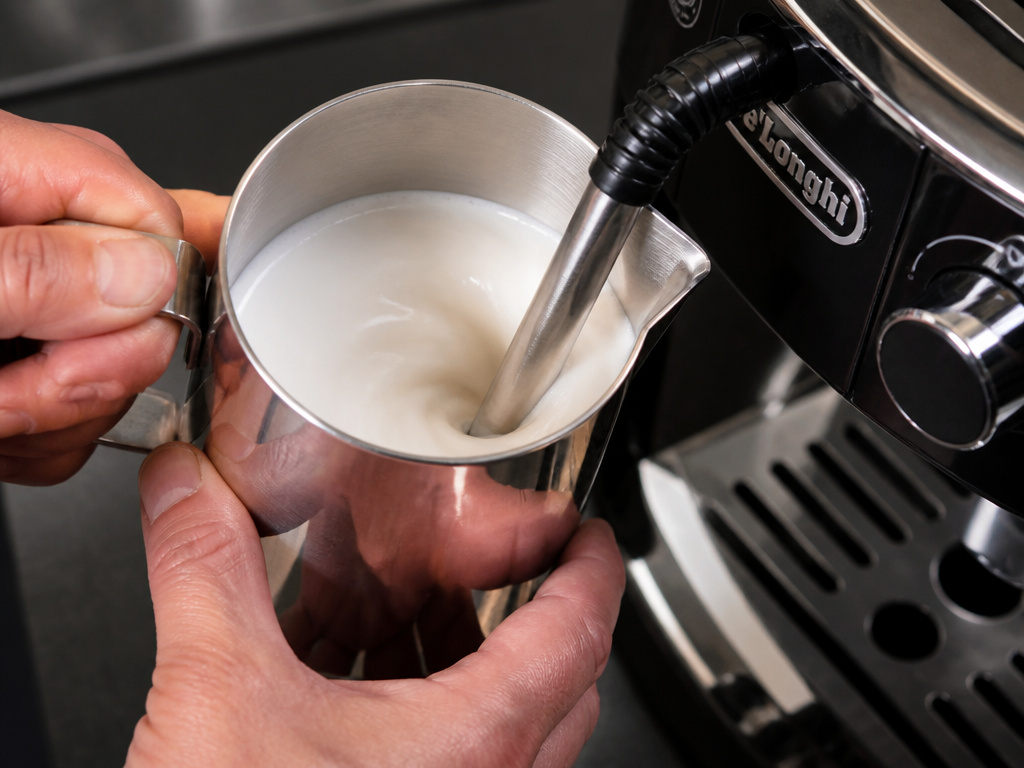
The steam wand is the part most people get wrong. The goal is texture, not temperature.
First, purge the wand. Turn the steam knob for 3–5 seconds until you get a steady, dry jet of steam. This clears the condensation that has built up in the pipe—that water will make your milk watery if you don’t expel it.
Use a stainless steel pitcher and cold milk straight from the fridge. Submerge the steam wand tip just below the surface in the pitcher, held at a slight angle. Turn the steam knob to full.
You will hear a distinct paper-tearing sound. That’s the wand introducing air and creating microfoam. Keep the wand near the surface to maintain that sound. As the milk expands and the pitcher warms, slowly submerge the wand deeper to roll the milk and create a vortex. This incorporates the foam evenly.
Stop when the base of the pitcher feels hot to the touch—around 60°C (140°F). Do not wait for it to be scalding. The EC885 manual explicitly states a maximum steam delivery duration of 60 seconds; exceeding this can overheat the thermostat.
| Step | Action | Visual/Sensory Cue | Risk If Skipped |
|---|---|---|---|
| Purge | Blast steam for 3-5 sec | Steam goes from wet sputter to dry hiss | Watery, thin milk with poor foam |
| Position | Wand tip just below surface, pitcher tilted | Paper-tearing “chh-chh” sound | Large, bubbly foam instead of microfoam |
| Texture | Keep vortex rolling | Milk doubles in volume, becomes glossy | Separated foam and liquid |
| Stop | Remove at pitcher base heat | Too hot to hold for more than a second | Burnt milk taste, potential thermostat damage |
Wipe the wand immediately with a damp cloth. Give it another short purge to clear the milk from the tip. That milk will bake onto the metal if you leave it, and it’s a nightmare to scrape off later.
The Critical Cleaning and Descaling Schedule
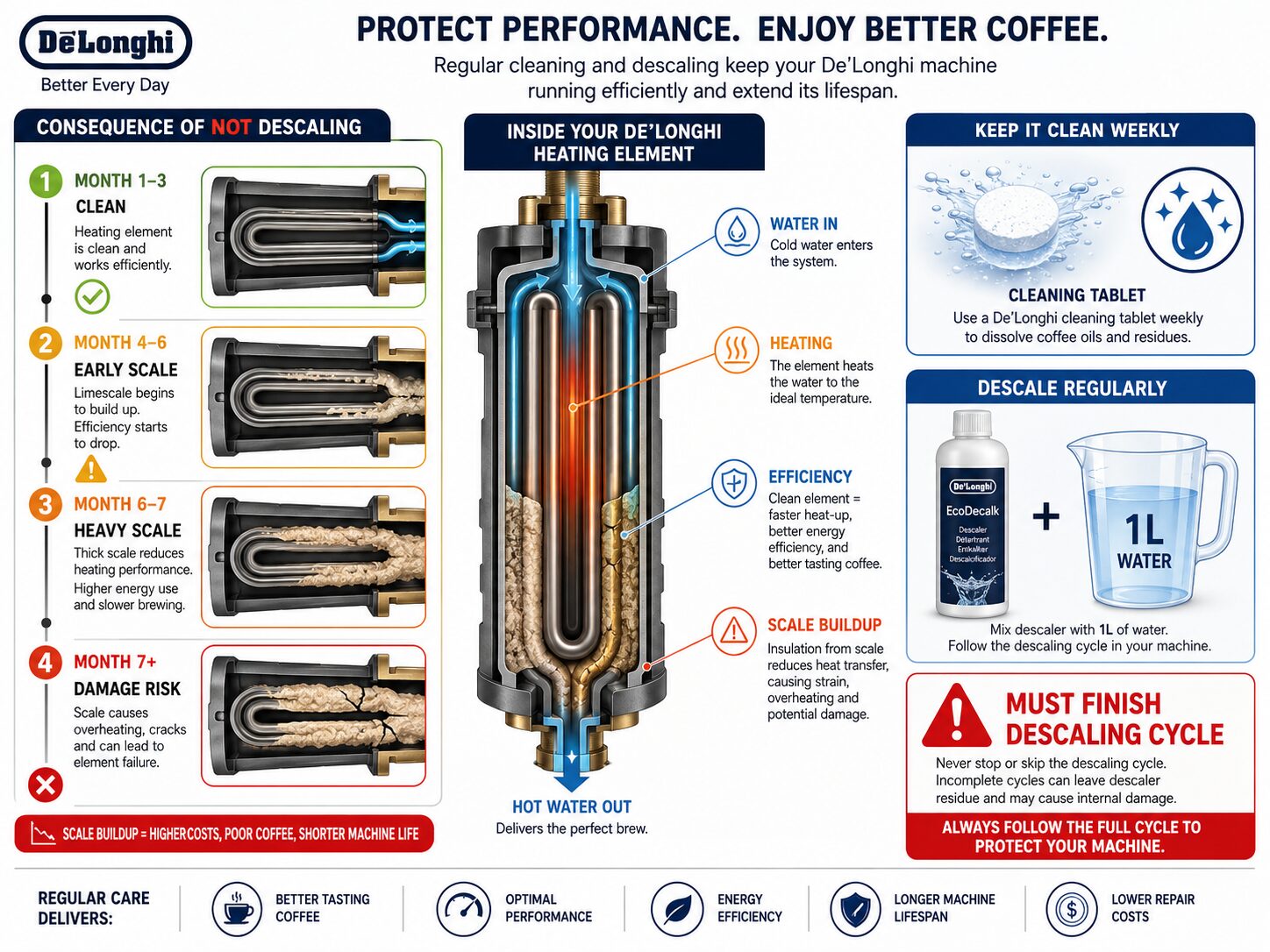
Coffee oils and mineral scale are the two things that will kill your machine. They work together: oil residue traps mineral particles, creating an insulating crust on the heating element.
Weekly Cleaning: Run the cleaning cycle with a De’Longhi cleaning tablet (EAN 8004399333307). This dissolves coffee oils from the brew group and internal pipes. The EC9555 uses an orange indicator light (B11) to tell you when this is needed.
Descaling: Frequency depends on your water hardness. The machine may prompt you. Use only De’Longhi descaler or a citric-acid-based solution approved for espresso machines. The DEDICA MAESTRO EC900 manual specifies a mix of 100 ml descaler with 1 liter of water.
Critical warning: If you start a descaling cycle, you must finish it. If the power fails mid-cycle, the machine will remain in descaling mode when power returns. You cannot bypass it. You must complete the rinsing steps, which can involve running several tanks of water through the system.
Here is the hard-stop consequence timeline most guides omit:
* Day 1-30: Machine works fine. Minor scale buildup is invisible.
* Month 2-3: Heating time increases by 15-20 seconds. The pump sounds slightly strained.
* Month 4-6: The machine starts throwing intermittent overheating errors. Shot temperature becomes erratic.
* Month 7+: The heating element fails. The repair cost often exceeds the value of a mid-range De’Longhi.
Descaling is not optional. It is a mandatory service interval, like changing the oil in your car.
Troubleshooting Common De’Longhi Problems
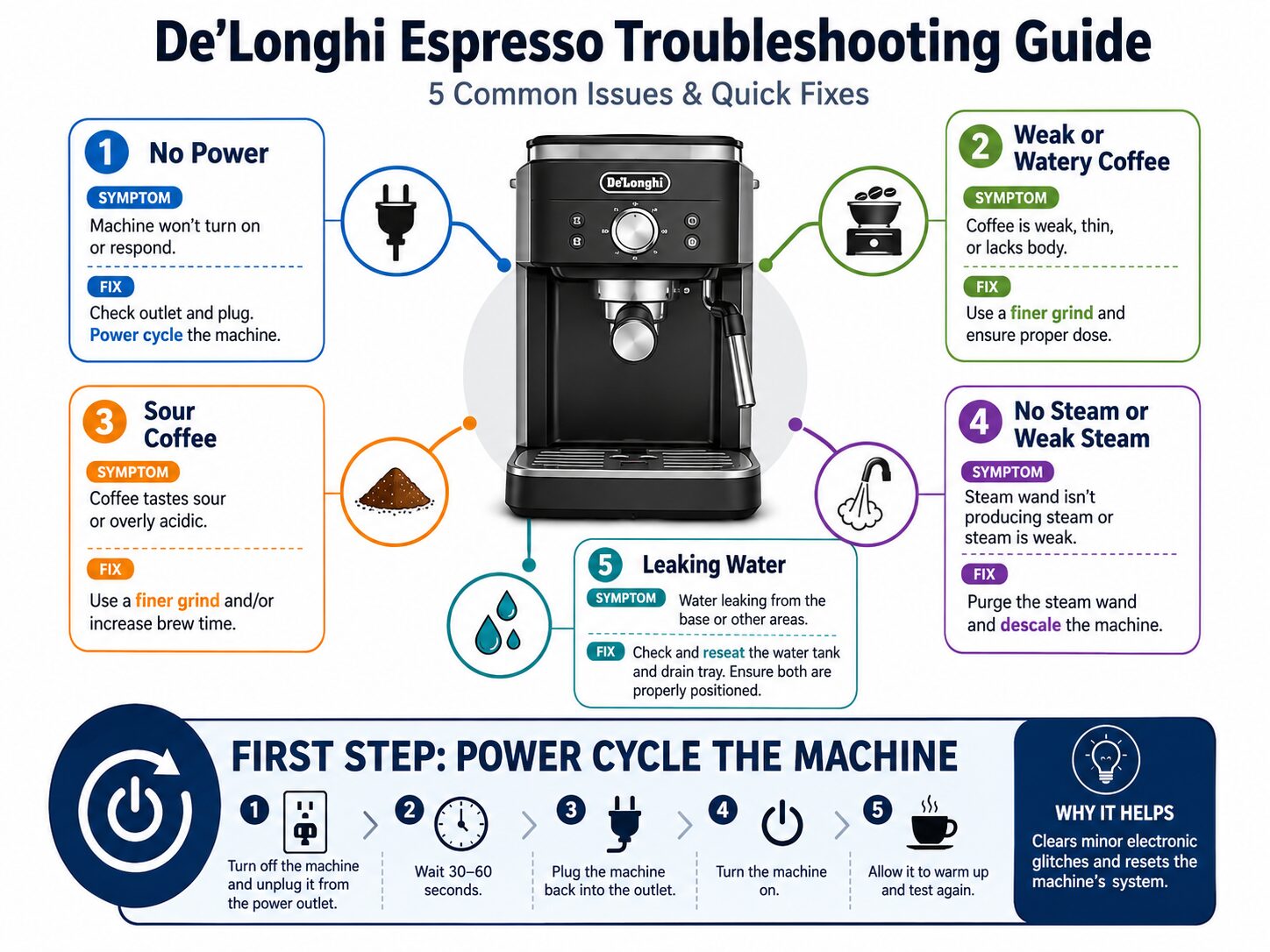
The machine gives you clues. Learn to read them.
| Symptom | Most Likely Cause | Immediate Fix |
|---|---|---|
| Machine is completely dead, no lights | Main side power switch is OFF; plugged into a low-amperage outlet. | Flip the side switch to ‘I’. Plug into a dedicated 13A socket. |
| Coffee runs out very fast, tastes sour | Grind is too coarse; coffee dose is too low. | Adjust grinder to a finer setting. Increase dose weight by 1-2 grams. |
| Coffee drips very slowly, tastes bitter | Grind is too fine; coffee is tamped too hard. | Adjust grinder to a coarser setting. Use less tamping pressure. |
| Steam wand spits water | Wand was not purged before use. | Always purge for 3-5 seconds before inserting into milk. |
| ‘Descaling’ message won’t clear | Previous descaling cycle was interrupted. | You must complete a full descaling cycle to reset the system. |
If you encounter an error code, the first step is always to turn the machine off at the side switch, wait 60 seconds, and turn it back on. This reboots the internal computer and clears many transient errors. For persistent issues, your first resource should be the official Braun coffee maker manual style of troubleshooting, which follows similar logic for European appliances.
Choosing and Using Pre-Ground Coffee
If you use pre-ground espresso, there is one non-negotiable rule. Never add it to the machine when the power is off. The ECAM22X6Y manual states this clearly: adding grounds to a static machine can cause them to spill and soil the interior, leading to clogs.
The correct way is to turn the machine on first. Let it complete its heat-up and rinse cycle. Then, and only then, add your pre-ground coffee to the designated chamber or portafilter. The vibration and ready state of the machine prevent grounds from settling where they shouldn’t.
For the best results with pre-ground, store it in an airtight container and use it within two weeks of opening. After that, it loses enough volatile aromatics that even perfect extraction will taste flat. This staleness is a bigger factor in your cup’s quality than the minor difference between bleached coffee filters and unbleached ones for pour-over.
Frequently Asked Questions
Why won’t my De’Longhi coffee machine turn on?
Check the main power switch on the side or back of the machine. It’s a physical rocker switch, separate from the front panel button. It must be in the ‘I’ position. Also, ensure it’s plugged into a wall outlet rated for at least 13 amps, not a power strip.
How much water should I put in my De’Longhi?
Fill the removable tank to the maximum line with fresh, cold water. For the initial rinse cycle, you must also place a separate container under the coffee spouts that holds at least 0.5 liters to catch the water the machine expels.
How do I make my De’Longhi coffee stronger?
Increase the coffee dose (aim for 18 grams in the double basket) and grind finer. Do not simply program the button to deliver less water. A stronger drink requires more dissolved solids, not just a higher concentration of water. Understanding this principle is similar to grasping the difference between an Americano coffee and a straight espresso.
Why is my coffee so weak and watery?
Your grind is almost certainly too coarse, or your dose is too light. The water is passing through the coffee puck too quickly, resulting in under-extraction. Adjust your grinder to a finer setting and ensure you are using enough coffee by weight.
How often should I descale my De’Longhi machine?
If you have a water softener filter, replace it every 3 months as per the EC9255 manual. Without one, descale every 1-3 months based on your water hardness. The machine will display a reminder. Use 100 ml of De’Longhi descaler mixed with 1 liter of water.
Can I use any descaler in my De’Longhi?
No. Use only descaler recommended for espresso machines, preferably De’Longhi’s own brand or a citric-acid-based formula. Vinegar or harsh acidic cleaners can damage internal seals and the aluminum heating element. The wrong cleaner can void your warranty.
Before You Go
Working a De’Longhi machine boils down to respecting its engineered sequences. Power comes from two switches, not one. The first rinse needs a big container. The shot buttons require programming. Steam needs a purge.
Ignore these steps, and the machine will fight you. Follow them, and it delivers consistent, cafe-quality results. The line between a perfect shot and a frustrating mess is often just a flipped switch or a 0.5-liter container you didn’t know you needed. Keep the Breville coffee machine filter style of regular maintenance in mind—these machines reward diligence. Now go heat it up, purge the wand, and pull that shot.
