
How to Work a Coffee Machine | The Step Most People Miss
This post contains affiliate links. As an Amazon Associate, we earn from qualifying purchases.
To work a coffee machine, you match three things: the machine type (drip, espresso, or capsule), the correct preparation for its brewing method, and a mandatory initial system flush. Skipping the flush leaves manufacturing residue or stale water in the lines, and your first several cups will taste metallic or flat.
Most people plug in a new machine, add water and coffee, and hit start. The machine hums, coffee drips, and the result is underwhelming. They blame the beans or the machine itself. The real miss is simpler. They didn’t prime the system.
This guide walks through the startup ritual for drip brewers, semi-automatic espresso machines, and pod systems. It covers the non-negotiable first steps buried in OEM manuals, the model-specific settings that actually matter, and what to do when the coffee still tastes wrong.
Key Takeaways
- Always run a water-only brew cycle before your first coffee. Machines like the De’Longhi 9555 require 4-5 sacrificial cups to clear internal lines.
- Never use distilled or softened water in an espresso machine. It corrodes internal parts and strips mineral content needed for temperature sensors to function correctly.
- Match your grind size to the machine. Espresso needs a fine, powdery grind; drip coffee needs a medium-coarse sand consistency.
- Lock the portafilter handle firmly to the right until you feel definite resistance. A loose lock causes leaking and pressure loss.
- Clean the group head and steam wand immediately after every use. Milk and coffee oils solidify into a cement-like gunk within an hour.
The First-Time Startup Sequence
Your machine’s first job is not making coffee. It’s cleaning itself. Internal lines hold antifreeze, machining oil, or stagnant water from testing. The De’Longhi 9555 manual states plainly you need to make 4-5 cups of coffee before it gives satisfactory results. That’s not a suggestion. It’s a requirement.
Fill the reservoir with fresh, cold tap water. Do not use distilled water. The Breville Barista Express BES870 manual explicitly warns against it, stating it may affect taste and machine function. The minerals in tap water help the heating element and sensors operate correctly.
Run a full water-only cycle through the brew head. For an espresso machine, lock an empty portafilter into the group head and run a shot. For a drip machine, place a clean carafe underneath and start a brew cycle without coffee. Discard this water.
Technical Snippet: Modern semi-automatic espresso machines, such as the Breville Dual Boiler BES920, feature adjustable extraction temperatures (86–96°C) and programmable shot durations. The factory default is often 93°C for temperature and 30 seconds for shot time, optimized for medium-roast beans.
TL;DR: Flush the machine with fresh water before any coffee. Use tap water, not distilled, and expect to waste the first few brews.
How to Prepare Coffee for Your Machine Type
The grind is the single biggest variable you control. Get it wrong and no amount of button pressing will fix it.
For a blade grinder, pulse in short bursts. Hold the button for two seconds, release for one, and repeat. Continuous grinding creates heat that cooks the oils and makes the coffee taste bitter. A burr grinder is better. It crushes beans between two surfaces for a consistent particle size. Consistency is what matters. Inconsistent grounds extract at different rates, giving you a cup that’s both sour and bitter.
Use this table as a starting point. Your specific beans and machine will demand fine-tuning.
| Machine Type | Grind Consistency | Dose per Cup | What Happens If Wrong |
|---|---|---|---|
| Drip Coffee Maker | Medium-coarse (like sea salt) | 2 Tbsp (10g) per 6 oz water | Too fine = over-extracted, bitter sludge in carafe. |
| French Press | Coarse (like breadcrumbs) | 1:15 coffee-to-water ratio | Too fine = grit in your cup, impossible to press. |
| Espresso Machine | Fine (like powdered sugar) | 18g for double shot | Too coarse = shot runs fast, tastes sour and weak. |
| Moka Pot | Fine (but slightly coarser than espresso) | Fill basket without tamping | Too fine = clogging and steam pressure locks the safety valve. |
The dose matters as much as the grind. A kitchen scale is the only reliable tool. Scoops vary by bean density and roast. For espresso, the Breville Barista Express manual recommends a tamping pressure of 30–40 lbs. That’s firm, even pressure. Don’t polish or twist. Just press straight down until the coffee is compact and level.
Common mistake: Using pre-ground coffee labeled “espresso” in a drip machine — the fine powder passes through the filter paper and into your cup, creating a muddy, over-extracted brew.
Operating an Espresso Machine Step-by-Step
Espresso machines look complicated. The process is a short, strict sequence. Break it and the shot breaks.
- Grind, dose, tamp. Grind fresh beans directly into your portafilter. Dose to the recommended weight (e.g., 18g for a double). Distribute the grounds evenly with a finger or tool, then tamp straight down with 30–40 lbs of pressure. Skip distribution and the water will find the path of least resistance, causing channeling.
- Purge the group head. Before locking in your portafilter, run the machine for a few seconds with no portafilter attached. This flushes out any old coffee grounds or water that cooled in the lines. It also brings the group head up to temperature.
- Lock and brew. Insert the portafilter into the group head. Turn the handle firmly to the right until it stops. Do not force it past this point. Select your shot (1 CUP or 2 CUP). The Breville BES920 preset is 30 seconds. Start the shot.
- Watch the pressure. If your machine has a pressure gauge, like the commercial La Marzocco GB5-FB80, it should read around 9 bar during extraction. If it spikes to 11-12 bar, your grind is too fine. If it stays low, the grind is too coarse.
- Stop and evaluate. The shot should pour like warm honey, starting thin and blonding at the end. A good double shot yields about 36g of liquid in 25–30 seconds. Taste it. Sour means under-extracted (grind finer or increase dose). Bitter means over-extracted (grind coarser or decrease dose).
I won’t recommend a bottomless portafilter for your first year with an espresso machine. The visual feedback is honest, but new users overcorrect on every shot and chase ghosts. Found that out the hard way dialing in a new grinder.
TL;DR: Grind fine, dose accurately, tamp evenly, lock firmly, and brew for 25–30 seconds. Adjust your grind based on the taste, not the clock.
What Those Buttons and Dials Actually Do
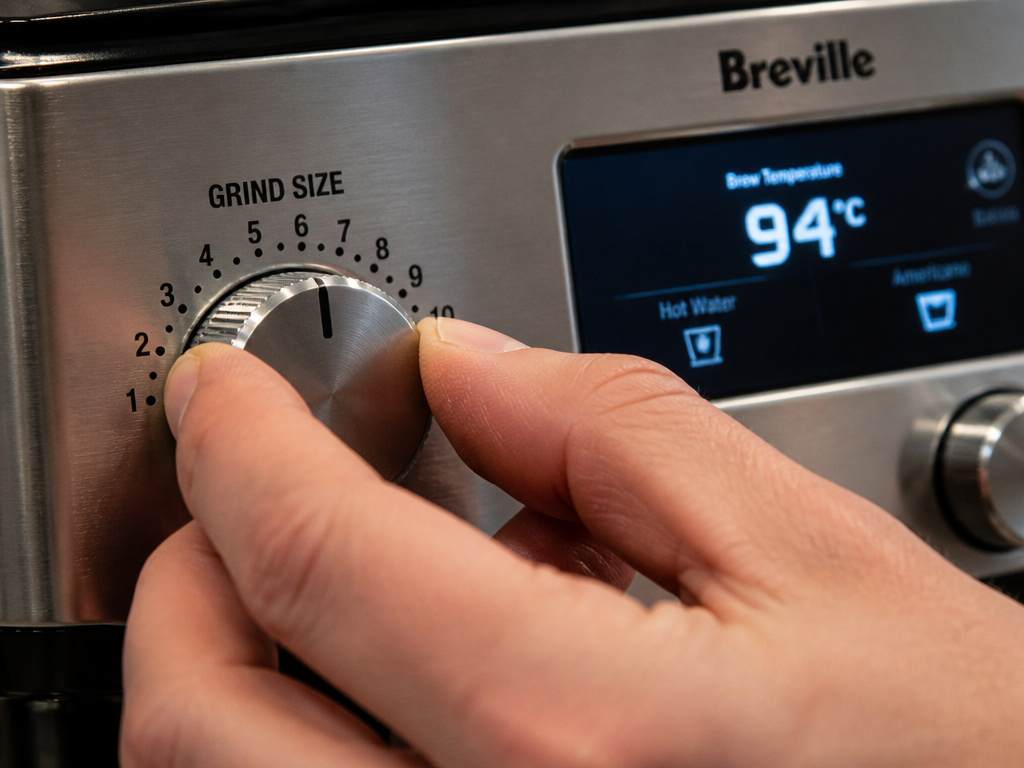
Machine interfaces range from a single power button to a digital dashboard. Knowing which settings to touch saves frustration.
The Grind Size dial on a grinder or all-in-one machine controls particle size. The Breville Barista Express manual says to start at setting 5. The De’Longhi 9555 manual says start at 9, with 1-4 reserved for light roasts only. Turn it one click finer if your espresso runs too fast, one click coarser if it drips slowly or the machine groans.
The Brew Temperature setting matters for light and dark roasts. Light roasts need higher temperatures (94–96°C) to extract their delicate fruity notes. Dark roasts do better at lower temperatures (88–90°C) to avoid pulling out bitter, ashy flavors. The Breville Dual Boiler BES920 allows adjustment from 86°C to 96°C.
Water Hardness is a set-and-forget setting inside many machines. It tells the machine how often to remind you to descale. If you have soft water, set it to 1 or 2. For hard water, set it to 4 or 5. Ignoring this means the machine won’t warn you before limescale chokes the thermoblock.
For capsule machines, the buttons usually control volume: a short espresso or a longer lungo. Some have a “strong” button that just adds more water, diluting the coffee. It’s a misnomer.
Troubleshooting Your First Brews
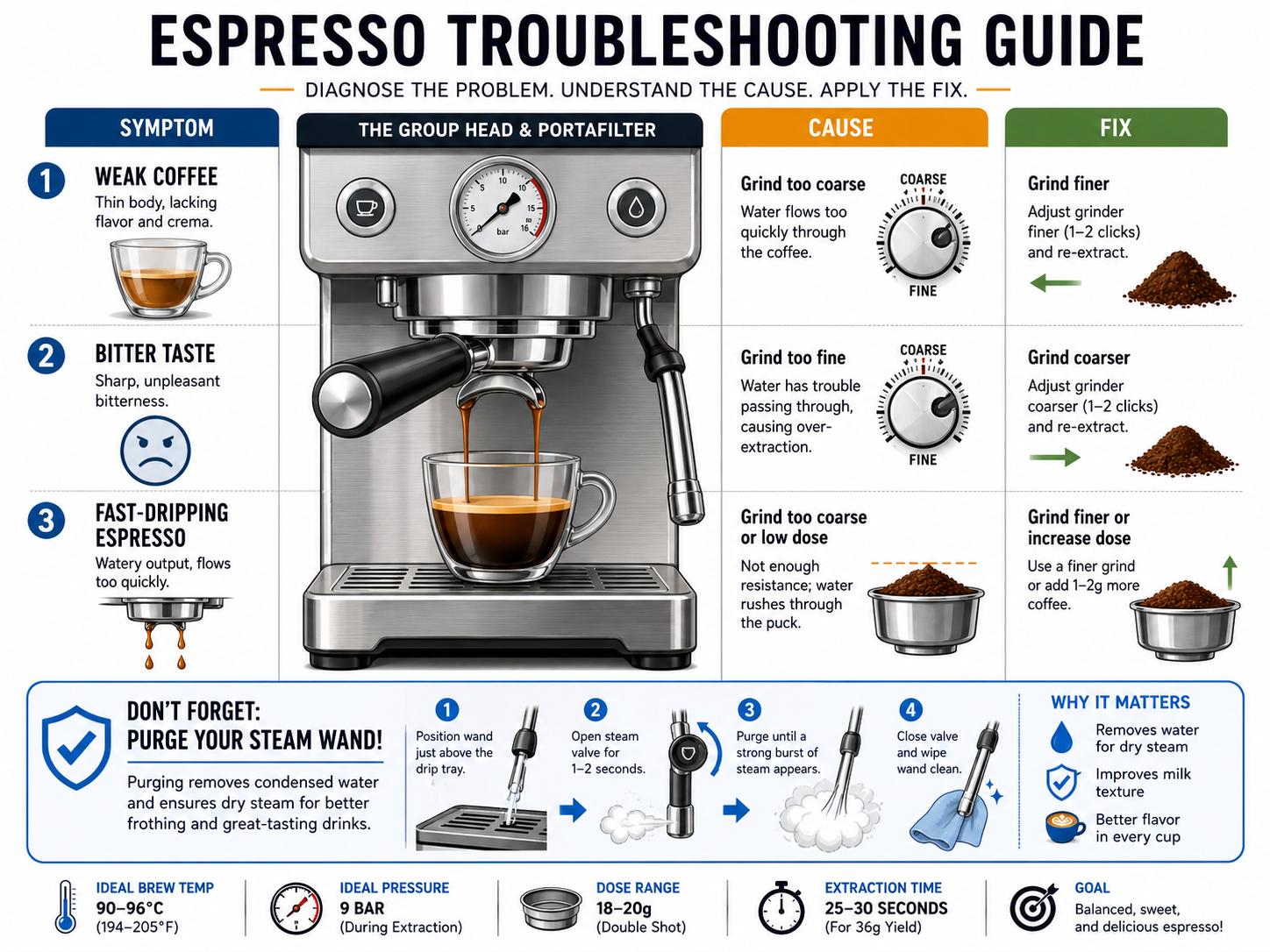
Coffee didn’t turn out right? Run through this diagnostic table before you blame the beans.
| Symptom | Likely Cause | Fix |
|---|---|---|
| Coffee tastes weak, watery | Grind is too coarse, dose is too low | Grind finer, increase dose by 1-2 grams, ensure proper tamp pressure. |
| Coffee tastes bitter, harsh | Grind is too fine, water is too hot | Grind coarser, lower brew temperature by 2°C, reduce brew time. |
| Espresso pours too fast | Grind is too coarse, tamp was too light | Grind finer, apply firm, even tamp pressure of 30-40 lbs. |
| Machine makes noise but no coffee | Clogged grinder chute, empty water tank | Check water level, run grinder without beans to clear chute, descale. |
| Steam wand spits water, not steam | Wand wasn’t purged after steaming milk | Always open the steam valve for a second after turning off steam to clear the wand. |
If your machine has a pressure gauge and it reads 0 during extraction, you likely have a loose portafilter lock or a severely clogged group head. For commercial machines like the La Marzocco GB5-FB80, the manual states if the coffee boiler pressure gauge reaches 14-15 bar during heating, the expansion valve needs adjustment. That’s a job for a technician.
Common mistake: Not purging the steam wand before and after frothing milk — leftover water dilutes the milk, and leftover milk solidifies inside the wand, requiring a full disassembly to clean.
Essential Maintenance That Keeps It Working
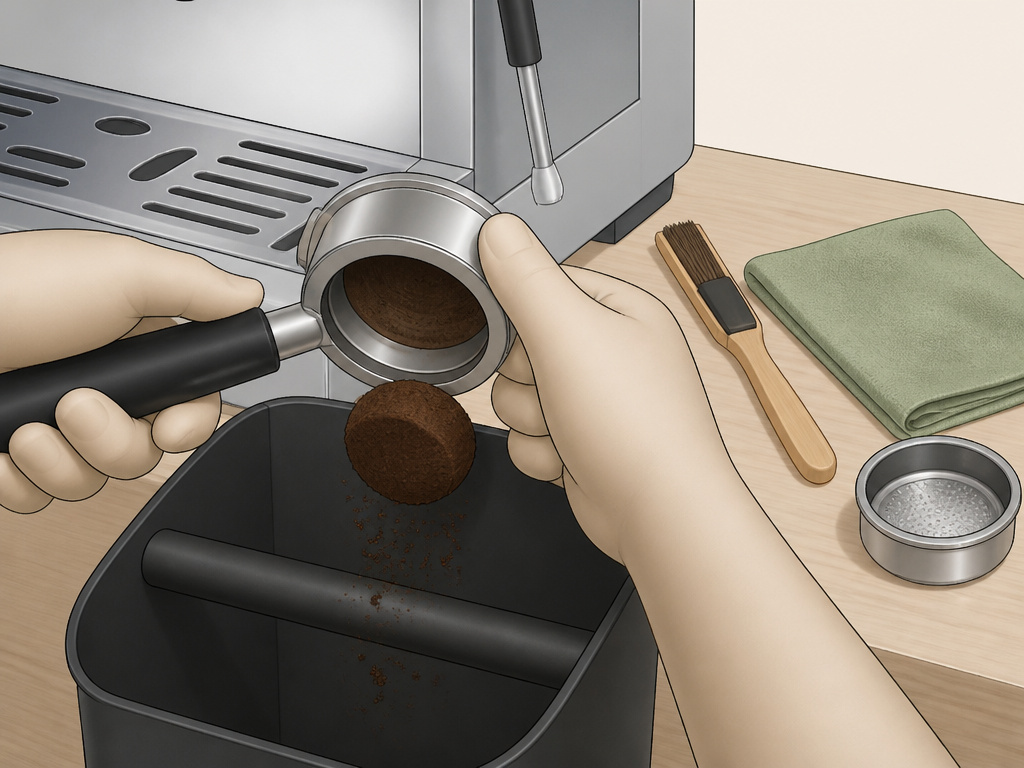
Your machine needs more than coffee and water. It needs a five-minute daily ritual.
After every brewing session, remove the portafilter. Knock out the spent puck into the trash. Rinse the portafilter and basket under warm water. Use a soft brush to scrub the group head gasket to remove any coffee grounds. Wipe the steam wand with a damp cloth, then open the steam valve for one second to blast out any residual milk.
Backflush an espresso machine with a blind filter and cleaning detergent once a month. This forces water and cleaner back through the group head’s internal valves, dissolving coffee oils. Descale according to your water hardness setting. If you ignore descaling, limescale will eventually insulate the heating element, causing it to overheat and fail.
Replace water filters if your machine has them. A clogged Breville coffee machine filter reduces flow rate and affects heating efficiency. For drip machines, know your Bunn coffee maker filters size and consider the taste difference between bleached and unbleached coffee filters.
TL;DR: Clean the group head and wand daily, backflush monthly, and descale when the machine tells you to. A clean machine is a consistent machine.
Frequently Asked Questions
Why does my new coffee machine’s first coffee taste bad?
It’s not the coffee. New machines have residual oils, dust, and testing fluids inside. All OEM manuals instruct you to flush the system with several cycles of clean water first. The De’Longhi 9555 manual explicitly says the first 4-5 cups will be unsatisfactory.
Can I use bottled water in my coffee machine?
You can, but avoid distilled or softened water. Espresso machines, in particular, need the minerals found in spring or tap water for proper sensor operation and to prevent corrosion. If your tap water tastes bad, use a bottled spring water.
What’s the difference between a burr grinder and a blade grinder?
burr coffee grinder crushes beans between two surfaces for a consistent particle size, essential for even extraction. A blade grinder chops beans randomly, creating a mix of fine powder and large chunks. This inconsistency leads to uneven brewing.
My espresso is sour. What did I do wrong?
Sour espresso means under-extraction. Your grind is likely too coarse, your dose too low, or your water temperature too low. Try grinding one click finer, increasing your dose by a gram, or raising your brew temperature by 1-2°C. Ensure your tamp is firm and even.
How do I froth milk properly?
Start with cold milk in a small, cold pitcher. Submerge the steam wand tip just below the surface and open the valve. Lower the pitcher to introduce air for 3-5 seconds until the milk expands, then submerge the wand deeper to heat and incorporate the foam. Stop when the pitcher is too hot to touch.
Where can I find my machine’s specific manual?
Always refer to the manufacturer’s official documentation. We host resources like the Braun coffee maker manual and Black & Decker coffee maker manual for convenience, but the OEM site is the definitive source.
The Bottom Line
Working a coffee machine is about respecting its engineering. That means priming it, grinding correctly for its method, and cleaning it relentlessly. The best cup comes from a machine that’s been broken in with a few sacrificial brews and maintained with a simple daily wipe-down.
Remember the three matches: machine type, preparation, and that mandatory flush. Keep your coffee brewing methods straight—don’t use espresso grind in a drip maker. And when in doubt, go back to the manual. Those model-specific details, like the Breville’s starting grind of 5 or the De’Longhi’s requirement for 5 test cups, exist because the engineers tested it that way. Your machine already knows how to make great coffee. You just have to learn how to work with it.
