
Learn How to Use a Mr. Coffee Espresso Machine Step by Step
To use a Mr. Coffee espresso machine, fill its 40 oz reservoir, grind 14g of coffee slightly coarser than table salt, tamp with 15-20 lbs of pressure, and brew for 25-35 seconds. The 15-bar pump and pressurized basket are forgiving, but descaling every 80 cycles with a 1:1 vinegar solution is non-negotiable to prevent pump failure.
Most guides treat these machines like miniature pro setups. They tell you to chase a “true espresso grind” and tamp like you’re compacting concrete. That’s the mistake. The Mr. Coffee design, specifically its pressurized filter basket, changes the rules entirely. Following pro advice here chokes the machine, floods the basket, and produces a bitter, weak shot.
This guide breaks down the actual process, from that first counterintuitive grind to steaming milk without the infamous screech. We’ll cover what the manual gets right, what it glosses over, and the maintenance step that keeps the pump alive past its first year.
Key Takeaways
- The Mr. Coffee “espresso grind” recommendation is misleading; use a grind slightly coarser than table salt to match the pressurized basket.
- Tamp with 15-20 lbs of pressure, just enough to level and compress, not to create an immovable brick.
- Always purge the steam wand for 2 seconds before and after frothing to clear water and milk residue.
- Descaling every 80 brew cycles (or 2-3 months) with a 1:1 vinegar solution is critical; scale clogs the thermoblock within 6 months in hard water areas.
- The machine’s 1040W heating element and 15-bar pump are designed for speed, not slow extraction; a 25-35 second shot time is the sweet spot.
What You’re Actually Working With
The Mr. Coffee ECMP50, ECMP1000, and similar models share a nearly identical core design. Knowing the specs isn’t trivia, it explains why the procedure works.
The 40 oz (1.2 L) reservoir sits at the back. It feeds a 1040W thermoblock heater, not a boiler. This means it heats water on demand, which is fast but less temperature-stable than a pro machine. The pump is rated at 15 bars of pressure. That number is about creating enough force to push water through the coffee, not about achieving the 9 bars of extraction pressure used in commercial machines.
The most important part is the filter basket. It’s a pressurized, or “double-wall,” basket. A small plastic disc with a single exit hole creates back pressure, helping to form crema even with a less-than-perfect grind. This is the key that unlocks the machine’s forgiving nature.
Technical Specs: The Mr. Coffee ECMP50 operates on a 1040W, 120V AC system. Its stainless steel thermoblock heats water to an estimated 92-96°C for brewing. The pump generates up to 15 bars of pressure, regulated by the pressurized basket system to approximately 7-9 bars at the coffee puck. The 40 oz polypropylene reservoir is BPA-free.
TL;DR: You have a fast, simple system built around a pressurized basket. Don’t fight it with pro techniques designed for a different tool.
The Grind That Actually Works
The manual says “espresso grind.” Ignore that as a literal instruction. A true espresso grind, fine as powdered sugar, will jam a Mr. Coffee basket solid. The water has nowhere to go, pressure builds, and eventually it finds a path, usually a channel straight through one side of the puck. You get a fast, sour, and weak shot all at once.
The pressurized basket does some of the extraction work for you by creating its own resistance. Your job is to give it a grind it can actually flow through.
Aim for a consistency just a bit coarser than table salt. If you’re using a blade grinder, pulse for 8-10 seconds. For a consistent result, a burr vs blade grinder comparison shows burrs win every time for even particle size. Uneven chunks from a blade grinder lead to uneven extraction.
Dose matters. The double basket holds 14g of coffee, the single holds 7g. A kitchen scale is the only reliable way to know. Guessing by volume leads to overfilling, which prevents the portafilter from locking in, or underfilling, which creates a soupy mess and no crema.
| Grind Target | Visual Cue | What Happens If You Miss |
|---|---|---|
| Ideal (Coarse Salt) | Granules just barely cling to your skin | Even flow, 25-35 sec shot, balanced flavor |
| Too Fine (Powder) | Looks like flour, feels like dust | Machine chokes, shot drips or floods, tastes bitter and sour |
| Too Coarse (Sand) | Clearly separate, gritty pieces | Water blasts through in <15 sec, shot is weak, watery, pale |
Common mistake: Using a true espresso fine grind, the machine’s pump strains, the shot takes over 45 seconds to dribble out, and the resulting coffee is harsh and over-extracted.
Dosing, Tamping, and the Brew
With your 14g of correctly ground coffee in the basket, distribution is next. Tap the portafilter on the counter to settle the grounds. Use your finger to sweep away any mound, creating a level surface.
Now, tamp. The included plastic tamper works, but a basic 51mm metal tamper feels better. Pressure is the secret everyone overcomplicates. You are not compacting the coffee for a skyscraper foundation.
Apply 15-20 pounds of pressure. That’s about the force of a firm handshake. The goal is to create an even, level bed that water will permeate uniformly. If you tamp hard enough to make the coffee feel like a brick, you’ve recreated the “too fine” problem.
Lock the portafilter into the group head. Turn it firmly until it seats with resistance, then give it a final snug turn. Don’t wrench it. Place your cup underneath, a standard coffee mug is fine.
Press the brew button. The pump will engage with a steady hum. Watch the stream. It should start as a dark, honey-like drip that quickly merges into a steady, mouse-tail-thick stream. The color will lighten from dark brown to a golden blond.
Your target time for a 2 oz (60 ml) double shot is 25 to 35 seconds, starting from when you press the button. This timing maximizes the espresso vs coffee caffeine content extraction while working within the machine’s thermal limits.
If the shot runs too fast (under 20 seconds), your grind is too coarse or your tamp was too light. If it runs too slow (over 40 seconds) or barely drips, your grind is too fine or your tamp was too hard.
Steaming Milk Without the Screech
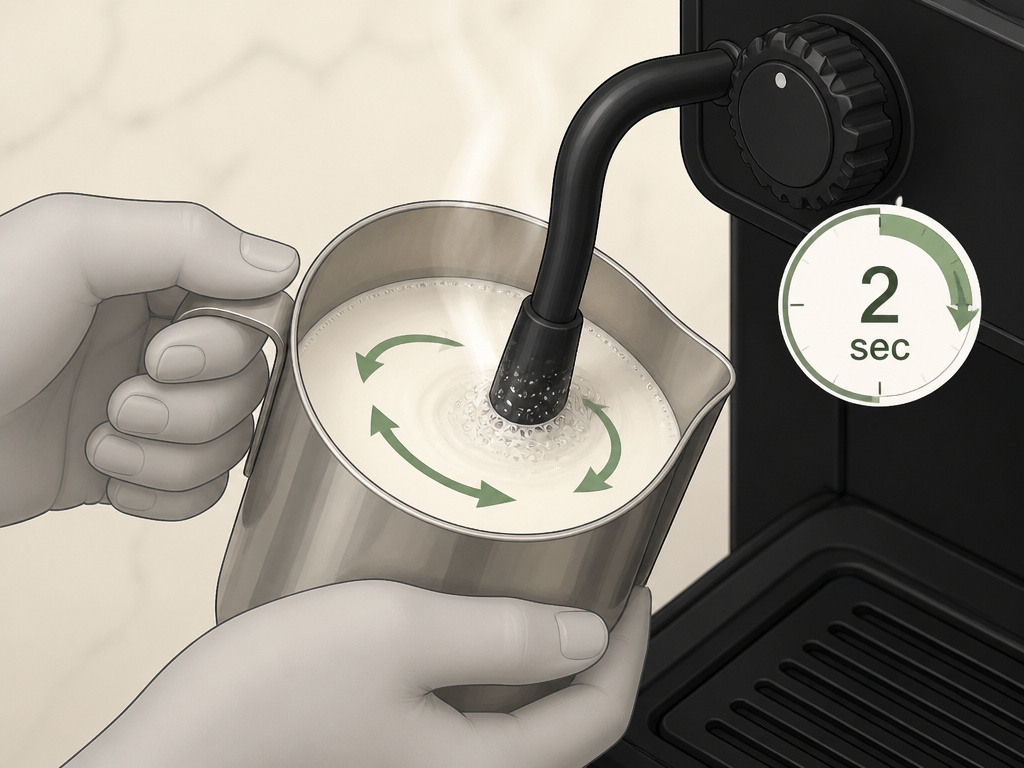
The steam wand on a Mr. Coffee is a single-hole, pannarello-style wand often covered with a plastic sheath. It’s designed to be easy, not precise. The goal is textured, hot milk, not microfoam for latte art.
First, always purge. Turn the steam knob for 2 seconds before inserting the wand into milk. This clears any water that has condensed in the wand. That water will thin your milk if you don’t.
Use a small metal pitcher, about 12 oz. Fill it one-third full with cold milk. Whole milk froths most easily due to its fat and protein content. For alternatives, know that frothing almond milk requires a colder start and less aeration time.
Submerge the steam wand’s tip just below the milk’s surface. Turn the steam knob fully on. Almost immediately, you’ll hear a faint chirping or paper-tearing sound, that’s air being incorporated. Keep the tip at that shallow depth for 3-5 seconds to stretch the milk.
Then, submerge the wand deeper to about an inch below the surface. Position the pitcher so the milk begins to spin in a vortex. This rolls the bubbles you created into a smooth, silky texture. Heat the milk until the pitcher is almost too hot to touch on the bottom (about 65°C or 150°F).
Turn off the steam knob. Remove the pitcher. Immediately wipe the steam wand with a damp cloth. Then, purge it again for another 2 seconds to clear milk from the internal tube. If you skip this, milk cooks inside the wand and clogs it.
Common mistake: Not purging the wand after steaming, cooked milk residue solidifies inside the tube within two uses, blocking steam and leading to a weak, sputtering output.
The Non-Negotiable Maintenance Ritual
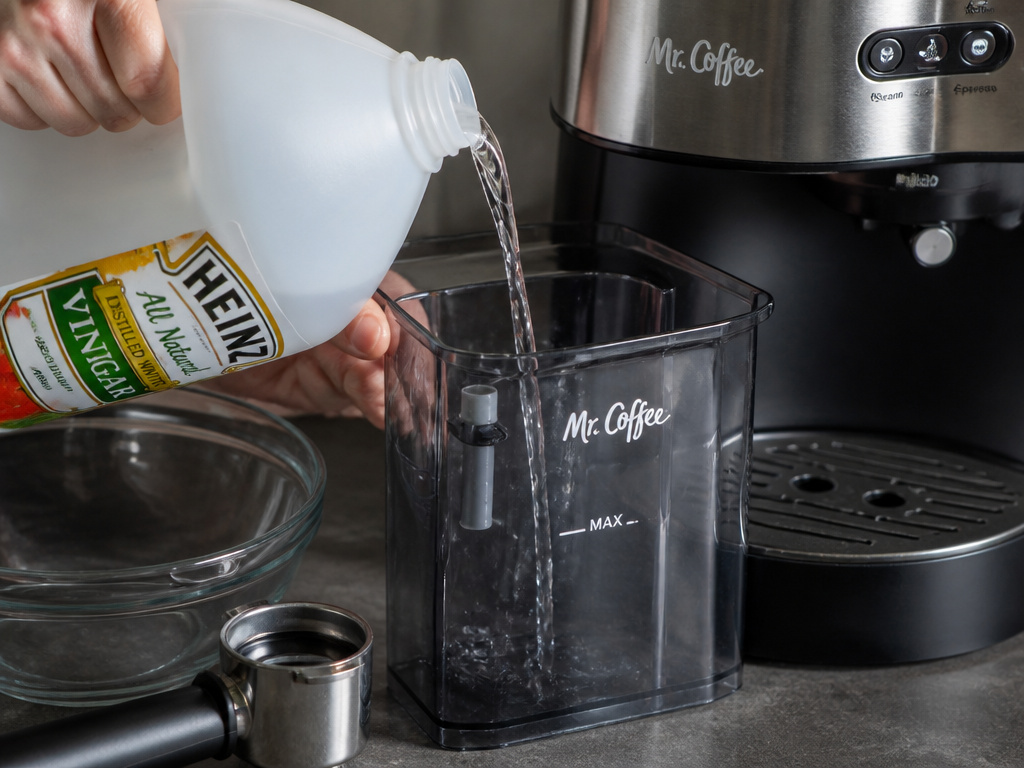
This is where most Mr. Coffee machines die. The manual says to descale every 80 cycles or 2-3 months. Treat that as a maximum, not a suggestion. In areas with hard water, you might need to do it monthly.
The thermoblock has tiny internal waterways. Mineral scale (calcium carbonate) from your water builds up there, acting as an insulator. The heater works harder, gets hotter than designed, and can eventually fail. Scale can also clog the pump.
The official descaling solution is a 1:1 mix of white vinegar and water. Fill the reservoir with this solution. Run the machine through a brew cycle without coffee in the portafilter, collecting the vinegar water in a large bowl or pitcher. Pour the collected solution back into the reservoir and repeat the process 2-3 times.
Finally, run at least two full reservoirs of clean water through the brew cycle to rinse out any vinegar taste. You can also use a dedicated descaling solution like citric acid powder, which often rinses cleaner.
For the group head and shower screen, remove the portafilter after each use and knock out the spent puck. Wipe the rubber gasket inside the group head with a damp cloth to remove coffee oils. These oils go rancid and taste terrible.
Backflushing, common on pro machines, is not possible or recommended here. The three-way solenoid valve that enables it isn’t present in this design.
TL;DR: Vinegar and water every 2-3 months keeps the pump alive. Wipe the group head after every shot to keep flavors clean.
Troubleshooting Your Shot
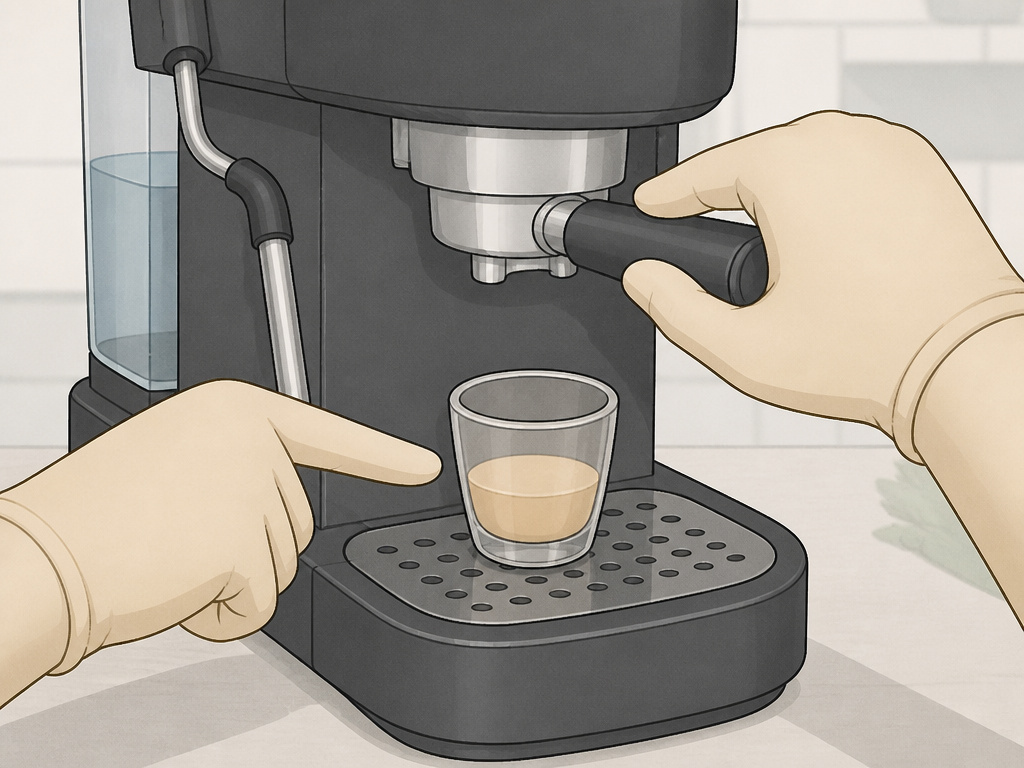
Sometimes things go wrong. Here’s how to diagnose the usual suspects.
No crema, pale shot: This is almost always a coffee freshness issue. Beans older than 3-4 weeks from roast date have lost too much CO2, which is essential for crema formation in a pressurized system. Grind right before brewing.
Machine makes noise but no water comes out: The pump is running dry. You either forgot to fill the reservoir, or more seriously, the intake tube inside the reservoir has become disconnected or cracked. Check the tube connection first.
Water leaks from under the machine: This is often a failed internal seal or a cracked water reservoir. Unplug the machine immediately. This usually requires disassembly or replacement.
Steam wand sputters, no pressure: The wand is clogged with dried milk. Try cleaning it with a pin, but persistent issues mean the internal steam pathway is scaled up. A thorough descaling might help, but the damage may be done.
Shot tastes bitter and sour at the same time: This is the classic sign of channeling, water blasting through a crack in the puck. The cause is usually uneven distribution or tamping. Make sure your grounds are level before you tamp.
Frequently Asked Questions
Can I use pre-ground espresso coffee?
Yes, but it must be the right grind. Most supermarket “espresso grind” is still too fine for a Mr. Coffee. Look for a grind labeled for “stovetop espresso makers” or “moka pots,” which is closer to the coarse-salt consistency you need.
Why does my espresso taste weak?
Weak, watery espresso is caused by the water passing through the coffee too quickly. The two main culprits are a grind that is too coarse or using too little coffee. Make sure you’re dosing a full 14g for a double and check your grind size first.
How do I make a latte or cappuccino?
For a latte, brew a double shot directly into your cup. Steam about 6-8 oz of milk until it’s hot and has a small amount of velvety foam (less than a cappuccino). Pour the steamed milk over the espresso. For a cappuccino, use less milk and create more, drier foam. The result is closer to a brewed coffee vs americano in volume but with a completely different texture.
What’s the difference between the ECMP50 and ECMP1000?
Functionally, for brewing espresso, there is no difference. Both have the same 40 oz reservoir, 15-bar pump, 1040W heater, and use identical filter baskets. The ECMP1000 may have different exterior styling or bundled accessories, but the core brewing mechanism is the same.
Can I use distilled or softened water?
No. Distilled water is too pure and can leach metals from the machine’s internals. Softened water often has high sodium content, which can also be corrosive. Use filtered tap water or bottled spring water for the best balance of taste and machine longevity. Using an espresso machine water filter cartridge, if compatible, is an excellent idea.
How can I sweeten my espresso without sugar?
For a different flavor profile, try a pinch of cinnamon in coffee stirred into the grounds before tamping, or a dash of adding salt to coffee in the cup to counteract bitterness. For a functional boost, some people blend in MCT oil in coffee for sustained energy.
Before You Go
Using a Mr. Coffee espresso machine well means embracing its design, not fighting it. The pressurized basket is your friend, allowing for a more forgiving grind and tamp. Hit that 25-35 second brew window with a coarse-salt grind and a firm handshake tamp. Steam milk with a consistent purge-and-wipe routine. And please, mark your calendar for descaling. That single habit adds years to the pump’s life.
The machine won’t produce the god-shot you see from a $3,000 setup. But it will deliver a consistent, enjoyable espresso-based drink every morning with minimal fuss. That’s the real win. Now, go pull a shot.
{
“@context”: “https://schema.org”,
“@type”: “HowTo”,
“name”: “How to Use a Mr. Coffee Espresso Machine”,
“totalTime”: “PT15M”,
“tool”: [
{
“@type”: “HowToTool”,
“name”: “Mr. Coffee espresso machine (e.g., ECMP50, ECMP1000)”
},
{
“@type”: “HowToTool”,
“name”: “Burr coffee grinder”
},
{
“@type”: “HowToTool”,
“name”: “Kitchen scale (grams)”
},
{
“@type”: “HowToTool”,
“name”: “Tamper (if not included)”
},
{
“@type”: “HowToTool”,
“name”: “Steaming pitcher (minimum 12 oz)”
}
],
“step”: [
{
“@type”: “HowToStep”,
“name”: “Prepare the machine”,
“text”: “Fill the 40 oz water reservoir with fresh, cold water. Plug in the machine and press the power button to begin heating. The ready light will illuminate.”
},
{
“@type”: “HowToStep”,
“name”: “Dose and grind the coffee”,
“text”: “Weigh 14g of coffee beans for a double shot. Grind to a consistency slightly coarser than table salt, not powder-fine.”
},
{
“@type”: “HowToStep”,
“name”: “Load and tamp the portafilter”,
“text”: “Distribute grounds evenly in the basket. Tamp with about 15-20 lbs of pressure—enough to compact, not crush.”
},
{
“@type”: “HowToStep”,
“name”: “Brew the espresso”,
“text”: “Lock the portafilter into the group head. Place your cup under the spout. Press the brew button. A double shot should yield about 2 oz in 25-35 seconds.”
},
{
“@type”: “HowToStep”,
“name”: “Steam the milk”,
“text”: “Fill a pitcher 1/3 full with cold milk. Purge the steam wand for 2 seconds. Submerge the tip, turn the steam knob, and position the pitcher to create a vortex.”
},
{
“@type”: “HowToStep”,
“name”: “Clean immediately”,
“text”: “After brewing, remove the portafilter and knock out the spent puck. Wipe the group head gasket. After steaming, wipe the wand and purge it again.”
}
]
}
{
“@context”: “https://schema.org”,
“@type”: “FAQPage”,
“mainEntity”: [
{
“@type”: “Question”,
“name”: “Can I use pre-ground espresso coffee?”,
“acceptedAnswer”: {
“@type”: “Answer”,
“text”: “Yes, but it must be the right grind. Most supermarket \”espresso grind\” is still too fine for a Mr. Coffee. Look for a grind labeled for \”stovetop espresso makers\” or \”moka pots,\” which is closer to the coarse-salt consistency you need.”
}
},
{
“@type”: “Question”,
“name”: “Why does my espresso taste weak?”,
“acceptedAnswer”: {
“@type”: “Answer”,
“text”: “Weak, watery espresso is caused by the water passing through the coffee too quickly. The two main culprits are a grind that is too coarse or using too little coffee. Make sure you’re dosing a full 14g for a double and check your grind size first.”
}
},
{
“@type”: “Question”,
“name”: “How do I make a latte or cappuccino?”,
“acceptedAnswer”: {
“@type”: “Answer”,
“text”: “For a latte, brew a double shot directly into your cup. Steam about 6-8 oz of milk until it’s hot and has a small amount of velvety foam (less than a cappuccino). Pour the steamed milk over the espresso. For a cappuccino, use less milk and create more, drier foam. The result is closer to a brewed coffee vs americano in volume but with a completely different texture.”
}
},
{
“@type”: “Question”,
“name”: “What’s the difference between the ECMP50 and ECMP1000?”,
“acceptedAnswer”: {
“@type”: “Answer”,
“text”: “Functionally, for brewing espresso, there is no difference. Both have the same 40 oz reservoir, 15-bar pump, 1040W heater, and use identical filter baskets. The ECMP1000 may have different exterior styling or bundled accessories, but the core brewing mechanism is the same.”
}
},
{
“@type”: “Question”,
“name”: “Can I use distilled or softened water?”,
“acceptedAnswer”: {
“@type”: “Answer”,
“text”: “No. Distilled water is too pure and can leach metals from the machine’s internals. Softened water often has high sodium content, which can also be corrosive. Use filtered tap water or bottled spring water for the best balance of taste and machine longevity. Using an espresso machine water filter cartridge, if compatible, is an excellent idea.”
}
},
{
“@type”: “Question”,
“name”: “How can I sweeten my espresso without sugar?”,
“acceptedAnswer”: {
“@type”: “Answer”,
“text”: “For a different flavor profile, try a pinch of cinnamon in coffee stirred into the grounds before tamping, or a dash of adding salt to coffee in the cup to counteract bitterness. For a functional boost, some people blend in MCT oil in coffee for sustained energy.”
}
}
]
}
