
How to Make Nespresso Coffee | Avoid the Pre-Heat Mistake
To make Nespresso coffee, pre-heat your machine with two water cycles, use only Nespresso-brand capsules inserted correctly for your machine line (Original or Vertuo), and always brew into a warm cup. This sequence guarantees the water and brew chamber are at the optimal 85–90°C temperature for full extraction, which most guides skip.
People assume the machine’s 30-second warm-up is enough. It heats the boiler, not the entire water path. Your first shot always runs cooler, extracting less flavor and aroma from the expensive capsule you just popped in.
This guide covers the exact steps for both Original and Vertuo lines, the critical maintenance most owners delay until the machine flashes a warning, and the tweaks that turn a standard pod into a noticeably better cup.
Key Takeaways
- Run two blank water cycles before your first coffee. The machine’s ready light signals boiler temperature, not brew-path temperature.
- Never use third-party capsules in Original Line machines. The aluminum seal and grind density are wrong, causing pressure spikes that wear out the 19-bar pump over 6–12 months.
- Descale every 2–3 months if you have hard water, not the 6-month manual suggestion. Calcium builds up silently, reducing heating efficiency by about 15% before the alert ever lights.
- Store Vertuo capsules dome-side down. The barcode on the rim reads reliably every time. Storing them on their side or rim-up risks misreads and aborted brews.
- Pre-heat your cup with hot tap water while the machine cycles. A cold ceramic mug steals 8–10°C from your coffee in the first 30 seconds.
Your Machine Line Dictates the Process
You own either a Nespresso Original Line machine or a Nespresso Vertuo Line machine. They are not cross-compatible. The Original Line, like the Essenza Mini, uses a high-pressure 19-bar pump to force hot water through a small, packed coffee bed. The Vertuo Line, like the Vertuo Next, uses Centrifusion™, it spins the capsule at high speed, using centrifugal force to blend hot water with the coffee.
Original Line machines brew a concentrated espresso shot. Vertuo machines brew larger cups of coffee, from espresso to alto sizes, by reading a barcode on the capsule rim to adjust spin speed, water volume, and temperature.
This difference changes your prep. Original Line capsules go in flat-side down. Vertuo capsules go in dome-side down. Getting this wrong means the capsule doesn’t seat, the head won’t close, or the barcode won’t scan. The machine will blink at you, and you’ll waste a pod.
| Feature | Nespresso Original Line | Nespresso Vertuo Line |
|---|---|---|
| Brewing Method | 19-bar pressure pump | Centrifusion™ (spinning) |
| Capsule Orientation | Flat side down | Dome side down |
| Output | Espresso (25–40ml) | Espresso to Coffee (40–414ml) |
| Capsule Recognition | Manual (you choose size) | Automatic via barcode |
| Primary Risk | Third-party capsule damage | Barcode misread, pump clog from scale |
TL;DR: Identify your machine line first. Original uses pressure, Vertuo uses spin. The capsule goes in opposite ways.
The 7-Step Brewing Sequence (for Both Lines)
Follow this order every time. Skipping step two is why the first coffee of the day tastes weak.
- Fill the Tank with Cold Water. Use fresh, cold tap or filtered water. Hot tap water can contain more dissolved minerals, speeding up scale buildup in the thermoblock. Never let the tank run dry mid-cycle.
- Power On and Double Pre-Heat. Press the button. When the ready light steadies, press it again to run a blank water cycle into your cup. Dump that water. Do it a second time. This brings the entire grouphead and water path up to temperature. The machine’s 25–30 second warm-up only heats the core.
- Pre-Heat Your Cup. Fill your cup with hot tap water while the machine runs its pre-heat cycles. Dump it just before brewing. A cold cup is a heat sink.
- Insert the Capsule Correctly. Open the lever. For Vertuo, place the capsule with the rounded dome facing down, barcode rim facing up. For Original, place it with the flat aluminum seal facing down. Close the lever firmly until it locks.
- Brew. Place your warm cup under the spout. Press the brew button. For Vertuo, the machine reads the barcode and starts automatically. For Original, hold the button for your desired volume (espresso or lungo).
- Eject the Capsule. After the flow stops, unlock and open the lever. The used capsule drops into the container.
- Rinse. Press the brew button once more for a 2–3 second water flush. This clears coffee oils from the brew chamber and spout, preventing bitter residue from tainting your next shot.
Common mistake: Brewing immediately after the ready light, the water path is still 10–15°C below target, so your extraction is uneven and the cup cools faster. The first sip tells you.
Why Your Nespresso Coffee Tastes Weak or Bitter
The coffee inside a Nespresso capsule is ground and dosed to a precise specification. If your output tastes off, the machine or your water is the variable.
A weak, sour, or thin cup means under-extraction. The water isn’t hot enough, or it’s passing through too quickly.
– Cause: Skipped pre-heat cycles, a cold cup, or an old machine needing descaling. Scale insulates the heating element.
– Fix: Implement the double pre-heat. If the problem persists, descale.
A harsh, bitter, or ashy cup means over-extraction. The water is too hot, or it’s in contact with the grounds too long.
– Cause: Very soft water, or using the same capsule twice (don’t). In Original machines, running a lungo setting on an espresso capsule over-extracts it.
– Fix: Use water with moderate mineral content. Match the brew size to the capsule’s intended volume.
The water itself matters. Very soft water (like distilled) can taste flat and over-extract. Very hard water scales the machine rapidly. Filtered tap water is the best starting point for balancing flavor and machine health, a principle that applies when comparing any brewed coffee methods.
Descaling and Maintenance You Can’t Skip
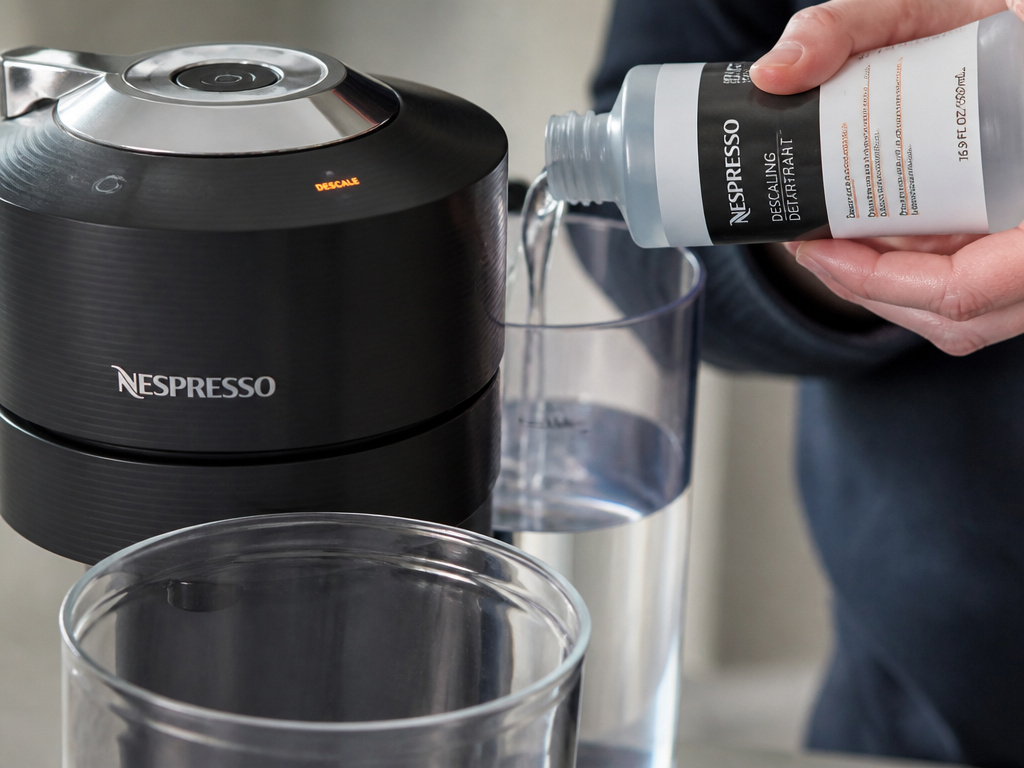
Nespresso machines have a small, fast-heating thermoblock. Minerals from water (calcium, magnesium) precipitate out as scale when heated. This scale coats the heating element and internal waterways.
I followed the manual’s “descaling alert” schedule for two years on a Vertuo Next. By the time the light came on, the machine’s warm-up time had crept from 30 to nearly 50 seconds, and coffee temperature dropped noticeably. A repair tech showed me the thermoblock, it was crusted. Now I descale quarterly, no exceptions.
The official advice is to descale when the machine’s indicator light flashes. In areas with hard water, that’s too late. Scale reduces heating efficiency long before the sensor trips.
Descale every 3 months as a baseline. Make it every 2 months if you have known hard water or brew multiple times daily.
You need the Nespresso Descaling Kit or an equivalent liquid descaling solution certified for coffee makers. Vinegar is banned, it leaves an odor and can damage internal seals.
| Symptom | Likely Cause | Severity | Immediate Action |
|---|---|---|---|
| Machine flashes descale light | Significant scale buildup | High – Act Now | Run a descaling cycle within a week. |
| Longer warm-up times | Early scale accumulation | Medium – Schedule | Plan a descaling cycle soon. |
| Coffee not as hot | Reduced heating efficiency | Medium – Schedule | Descaling will likely restore temperature. |
| Strange gurgling noises | Air in scaled waterways | High – Act Now | Descaling is urgent; pump could be struggling. |
| No water flow, machine errors | Severe scale blockage | Critical – Stop Use | Descale immediately. If error persists, contact service. |
The process is machine-led. You enter descaling mode, empty the capsule container, place a large container (at least 1 liter) under the spout, and pour in the descaler mixed with water. The machine then pumps the solution through its system in intervals, followed by multiple rinse cycles. The whole sequence takes 15–20 minutes. Do not interrupt it.
TL;DR: Descaling is non-negotiable. Do it quarterly with the official kit to prevent slow performance and eventual failure.
Capsules, Compatibility, and Hacks
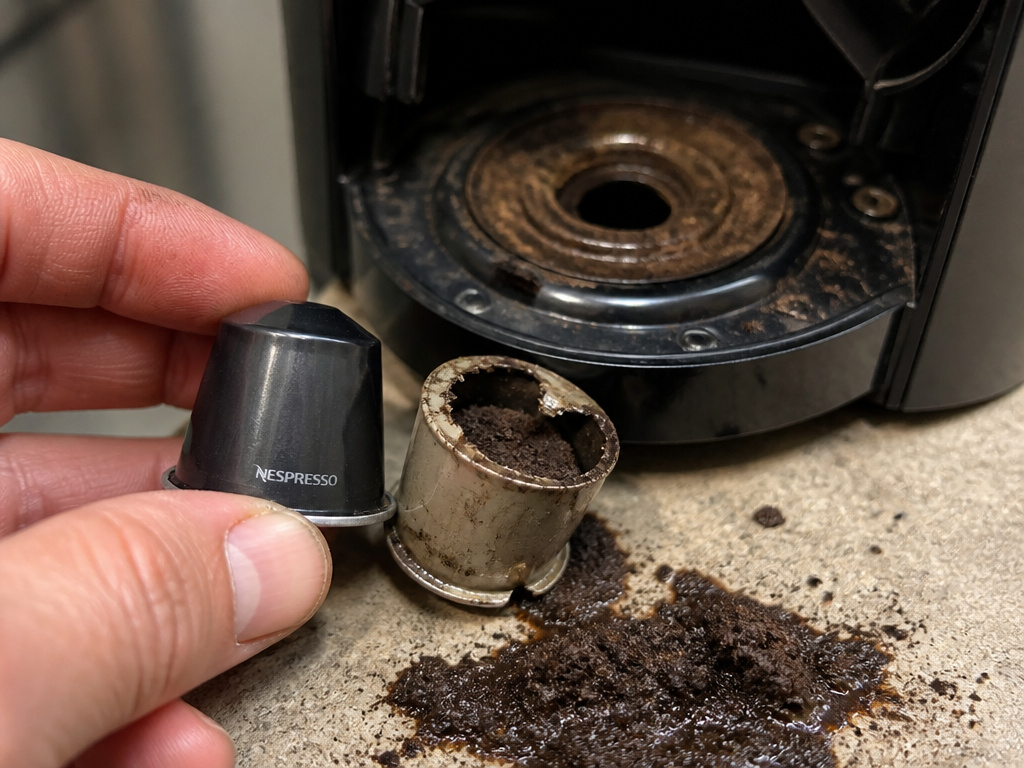
Nespresso designs its system as a closed loop. The capsule material, grind size, and seal are engineered for the specific pressure or spin of their machines.
Third-party compatible capsules for Original Line machines are a gamble. The aluminum might be thinner, the seal less precise, or the grind inconsistent. This can lead to:
– Poor extraction (channeling, weak coffee).
– Capsule rupture, leaving wet grounds in the brew chamber.
– Increased pressure on the pump, potentially shortening its lifespan.
Nespresso’s warranty explicitly excludes damage from non-Nespresso capsules. The financial risk outweighs the minor per-capsule savings.
Refilling used capsules is a popular hack. You cut off the foil, fill with ground coffee, and reseal with new foil. It requires a specific grind, finer than drip but coarser than true espresso, and a perfect seal to withstand pressure. The Scientific Reports capsule extraction study highlights how ground coffee properties directly impact extraction dynamics and cup quality in single-serve systems. Your homemade grind will almost never match the OEM specification. The result is often messy and the coffee underwhelming. It’s a fun experiment, not a daily solution.
For the best experience, stick with Nespresso’s own capsules. Explore their range, different blonde roast beans offer brighter, more acidic notes, while dark roasts are bolder.
Advanced Tweaks and Troubleshooting
Once the basics are automatic, a few tweaks can refine your cup further.
For a Hotter Coffee: Beyond double pre-heating, store your cups in a warm spot or run a third water cycle. The cup’s mass is your biggest heat thief.
At High Altitude: Water boils at a lower temperature. Your machine will still work, but the maximum brew temperature may be slightly reduced. Compensate by being militant about pre-heating your machine and cup to minimize any heat loss.
After Extended Storage (or First Use): If the machine has been off or in a cold garage for weeks, run 3–4 blank water cycles through it. This flushes stale water from the lines and ensures the thermoblock is fully up to temp. Check the capsule container for debris before first brew.
Machine Won’t Brew / Lights Blinking:
- Ensure the water tank is seated firmly. A misaligned tank breaks the water circuit.
- Check the capsule container isn’t full. Most hold 6–13 used pods.
- Confirm the head is fully locked. The lever must turn to the lock symbol.
- For Vertuo, ensure the capsule barcode is clean and facing the right way. A smudge can cause a misread.
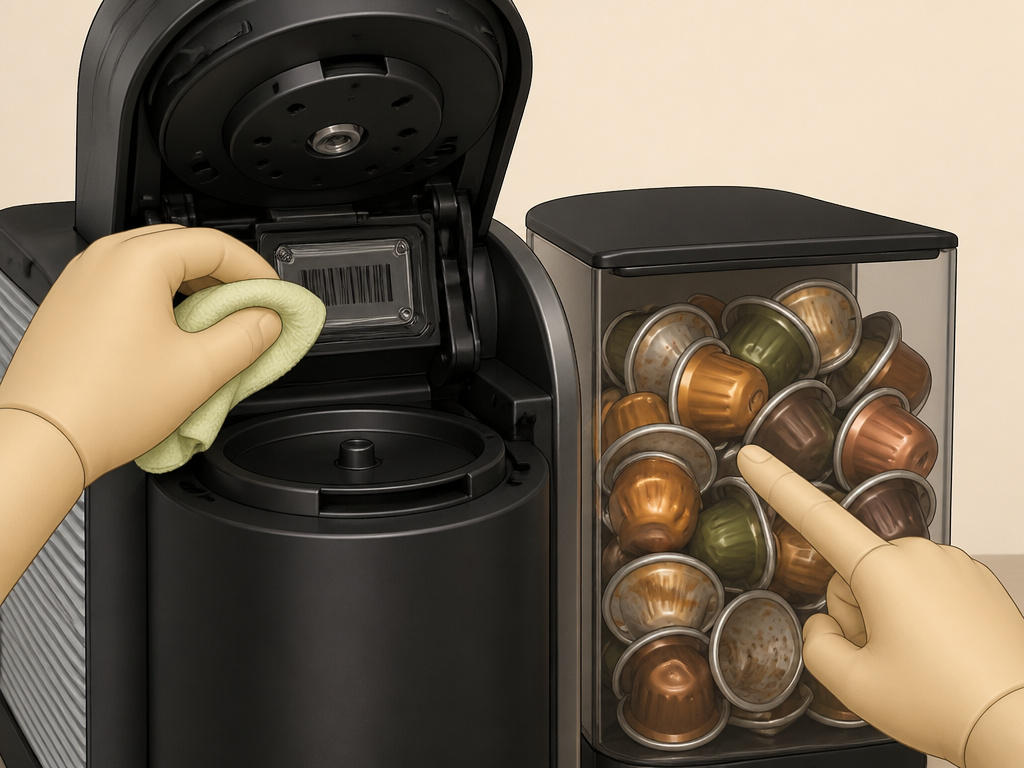
Coffee Volume is Wrong (Vertuo): The machine reads the barcode each time. If your lungo is coming out as espresso, the barcode reader might be dirty. Power off, wipe the inside of the brew head (especially the clear plastic window) with a dry cloth, and try again.
Frequently Asked Questions
Can I use Original Line capsules in a Vertuo machine, or vice versa?
No. The capsules are physically different and the brewing technologies are incompatible. Original capsules are small and designed for high pressure. Vertuo capsules are larger, have a barcode, and are designed to spin. Using the wrong type will damage the machine or simply not work.
How do I make a latte or cappuccino with my Nespresso?
For milk-based drinks, you need an espresso shot as a base. Use an Original Line machine or a Vertuo espresso capsule. Brew the espresso directly into your cup. Then, froth your milk separately. You can use a standalone milk frother, the Aeroccino frother from Nespresso, or the built-in steam wand on higher-end models like the Lattissima. Pour the frothed milk over the espresso. For a dairy-free option, almond milk in coffee froths decently with a powerful frother.
Is Nespresso coffee stronger than regular coffee?
It depends on your definition. In terms of caffeine per shot, a Nespresso Original espresso shot has roughly 55–65 mg of caffeine, similar to a standard espresso shot but more concentrated than a typical 8-oz drip coffee. In terms of flavor concentration, yes, it is stronger and more intense than a mug of filter coffee. For a detailed breakdown, see our comparison of espresso caffeine content.
What can I add to my Nespresso coffee to make it taste better?
Start with a well-extracted base from a clean machine. Then, experiment. A pinch of salt in coffee can neutralize perceived bitterness. Brown sugar sweetener adds a molasses depth that white sugar lacks. For spice, try a cinnamon coffee sprinkle. For a functional boost, some add MCT oil coffee for sustained energy.
Why is my Nespresso machine so loud?
Some noise is normal. Original Line machines have a vibration pump that makes a buzzing sound during extraction. Vertuo machines have a motor that spins the capsule, creating a whirring noise. Loud grinding, screeching, or knocking sounds are not normal and could indicate a foreign object in the brew chamber, a failing motor, or severe scale blockage. Stop use and investigate.
Before You Go
Making great Nespresso coffee hinges on three things the manual understates: aggressive pre-heating, strict descaling, and using the right capsules. The machine’s convenience is a promise, but it’s not maintenance-free. Treat the thermoblock like the heart of the system, keep it clean with regular descaling.
Pre-heat every time, not just in the morning. Your fifth cup of the day will taste as consistent as your first. Dump the refillable capsule experiments and invest in Nespresso’s own range, exploring different roasts and intensities. Finally, listen to your machine. A change in sound or speed is its first cry for help, usually solved by a descaling kit before a repair bill arrives.
{
“@context”: “https://schema.org”,
“@type”: “HowTo”,
“name”: “How to Make Nespresso Coffee with Original and Vertuo Machines”,
“totalTime”: “PT5M”,
“tool”: [
{
“@type”: “HowToTool”,
“name”: “Nespresso Original or Vertuo machine”
},
{
“@type”: “HowToTool”,
“name”: “Nespresso-brand capsules”
},
{
“@type”: “HowToTool”,
“name”: “Fresh drinking water”
},
{
“@type”: “HowToTool”,
“name”: “A pre-heated cup or mug”
}
],
“step”: [
{
“@type”: “HowToStep”,
“name”: “Fill and Pre-Heat”,
“text”: “Fill the machine’s water tank with fresh water. Turn the machine on and run two blank water cycles without a capsule to pre-heat the internal system and your cup.”
},
{
“@type”: “HowToStep”,
“name”: “Insert the Capsule”,
“text”: “Open the machine head. For Vertuo, insert the capsule dome-side down. For Original Line, insert it flat-side down. Close and lock the head securely.”
},
{
“@type”: “HowToStep”,
“name”: “Start the Brew”,
“text”: “Place your pre-heated cup under the spout. Press the brew button. The machine will automatically read the capsule barcode (Vertuo) or use preset pressure (Original) to begin extraction.”
},
{
“@type”: “HowToStep”,
“name”: “Eject and Clean”,
“text”: “Wait for the brew cycle to finish. Unlock and open the head to automatically eject the used capsule into the container. Run a quick water rinse cycle to clean the brew chamber.”
}
]
}
{
“@context”: “https://schema.org”,
“@type”: “FAQPage”,
“mainEntity”: [
{
“@type”: “Question”,
“name”: “Can I use Original Line capsules in a Vertuo machine, or vice versa?”,
“acceptedAnswer”: {
“@type”: “Answer”,
“text”: “No. The capsules are physically different and the brewing technologies are incompatible. Original capsules are small and designed for high pressure. Vertuo capsules are larger, have a barcode, and are designed to spin. Using the wrong type will damage the machine or simply not work.”
}
},
{
“@type”: “Question”,
“name”: “How do I make a latte or cappuccino with my Nespresso?”,
“acceptedAnswer”: {
“@type”: “Answer”,
“text”: “For milk-based drinks, you need an espresso shot as a base. Use an Original Line machine or a Vertuo espresso capsule. Brew the espresso directly into your cup. Then, froth your milk separately. You can use a standalone milk frother, the Aeroccino frother from Nespresso, or the built-in steam wand on higher-end models like the Lattissima. Pour the frothed milk over the espresso. For a dairy-free option, almond milk in coffee froths decently with a powerful frother.”
}
},
{
“@type”: “Question”,
“name”: “Is Nespresso coffee stronger than regular coffee?”,
“acceptedAnswer”: {
“@type”: “Answer”,
“text”: “It depends on your definition. In terms of caffeine per shot, a Nespresso Original espresso shot has roughly 55–65 mg of caffeine, similar to a standard espresso shot but more concentrated than a typical 8-oz drip coffee. In terms of flavor concentration, yes, it is stronger and more intense than a mug of filter coffee. For a detailed breakdown, see our comparison of espresso caffeine content.”
}
},
{
“@type”: “Question”,
“name”: “What can I add to my Nespresso coffee to make it taste better?”,
“acceptedAnswer”: {
“@type”: “Answer”,
“text”: “Start with a well-extracted base from a clean machine. Then, experiment. A pinch of salt in coffee can neutralize perceived bitterness. Brown sugar sweetener adds a molasses depth that white sugar lacks. For spice, try a cinnamon coffee sprinkle. For a functional boost, some add MCT oil coffee for sustained energy.”
}
},
{
“@type”: “Question”,
“name”: “Why is my Nespresso machine so loud?”,
“acceptedAnswer”: {
“@type”: “Answer”,
“text”: “Some noise is normal. Original Line machines have a vibration pump that makes a buzzing sound during extraction. Vertuo machines have a motor that spins the capsule, creating a whirring noise. Loud grinding, screeching, or knocking sounds are not normal and could indicate a foreign object in the brew chamber, a failing motor, or severe scale blockage. Stop use and investigate.”
}
}
]
}
