
Find How Much Coffee to Put in Your Drip Coffee Maker
To put coffee in a coffee maker, use a digital scale to measure 55 to …… water. This ratio, roughly 1:18, is the standard starting point for drip machines. Your specific machine’s manual may list a different target, and your personal taste or bean roast will require fine-tuning from there.
Most people grab a scoop and guess. They either under-extract a weak, sour pot or over-extract a bitter, harsh one. Both waste beans. The difference between a good morning and a great one is a few grams on a scale.
This guide walks through the numbers from manufacturers and standards, shows you how to measure accurately, and explains when to deviate from the so-called golden ratio.
Key Takeaways
- Manufacturer manuals often specify exact ratios, the Bonavita Connoisseur wants 55g/L, the Moccamaster KBGV wants 60g/L. Ignoring this is like ignoring the oil grade for your car.
- A tablespoon of coffee can weigh anywhere from 4 to 7 grams depending on grind and roast. Measuring by volume guarantees inconsistency. A $20 digital scale fixes it.
- Dark roasts extract faster. Using the standard 55g/L ratio with a dark French roast usually produces a bitter cup. Drop to 50-53g/L.
- Light roasts are harder to extract. Sticking to 55g/L with a light Ethiopian often yields a weak, tea-like brew. Bump the ratio to 58-60g/L.
- Cold brew and espresso operate on completely different ratio planets, 1:8 and 1:2, respectively. Applying drip coffee logic to them ruins the drink.
The Golden Ratio Isn’t a Single Number
The “golden ratio” you see everywhere, 1:15 to 1:18 coffee to water, is a consensus starting point. It’s not a law. In practice, it’s a range where most drip brewing falls when you want a balanced, medium-strength cup. The Specialty Coffee Association recommends 55 grams of coffee per liter of water, which sits neatly at 1:18.18.
The ISO 6668:2020 standard for preparing laboratory coffee samples specifies 55 g ± 1 g of coffee per litre of water. This precision-targeted ratio is the baseline for professional sensory analysis.
Your coffee maker likely has a stronger opinion. I learned this after a month of mediocre pots from my Bonavita. The manual for the Bonavita Connoisseur 8-Cup (BV1901TS) states “55 grams of coffee per liter of water” right in the brewing tips. My lazy spoon-scooping was missing by 3-4 grams per liter. The Technivorm Moccamaster KBGV Select manual pushes for 60g/L. Your Black & Decker coffee maker or Braun coffee maker manual will have its own number.
Why the variation? Heating element power, showerhead design, and brew time differ. A machine with a faster, hotter brew might need more coffee to avoid under-extraction. One with a longer, gentler infusion might need less. Your first stop should be your machine’s guide, not a generic blog post.
TL;DR: Start with 55g of coffee per liter of water, but check your machine’s manual for its specific target, it’s the engineered starting point.
Why Tablespoons and Scoops Lie to You
A “standard” tablespoon of coffee is a myth. The weight varies wildly. A tablespoon of finely ground dark roast coffee is dense and compact. It can weigh 7 grams. A tablespoon of coarsely ground light roast is fluffy and light, maybe 4 grams.
If a recipe calls for “2 tablespoons per 6 oz cup,” you could be dosing anywhere from 8 to 14 grams for that same cup. The resulting brew will be completely different each time.
Common mistake: Measuring coffee by volume with a scoop, your dose weight swings by up to 40% depending on grind and roast, making consistent brewing impossible.
The fix is a digital kitchen scale with 0.1-gram resolution. It costs less than two bags of specialty beans. Weigh your whole beans before grinding, or weigh your ground coffee directly into the filter. Weigh your water in the carafe. This locks in the ratio, regardless of whether you’re using a burr coffee grinder for perfect consistency or pre-ground from the store.
For a full 12-cup (1.8L) pot aiming for a 1:18 ratio, you need 100 grams of coffee. That’s not a scoop count you can guess. It’s a scale reading.
Step-by-Step: Measuring for Your Next Pot
Follow this sequence once, and you’ll have a reference for every pot after.
Step 1: Find Your Baseline Ratio
Open the manual for your machine. Look for “coffee,” “ratio,” “grams,” or “brewing tips.” If it’s lost, a web search for your model number and “manual” usually finds a PDF. For example, the OXO 8-Cup and Hamilton Beach Smart Connected Coffee Maker (49700) manuals are online.
If no manual exists, start with the SCA standard of 55g/L (1:18). Write this number down.
Step 2: Weigh Your Coffee and Water
Place your empty carafe on your scale. Tare it to zero. Pour in cold water until you reach your desired volume, for example, 1 liter (1000g). Note the weight.
Now, calculate your coffee dose. For a 1:18 ratio with 1000g of water: 1000 ÷ 18 = 55.5g. Round to 55g.
Tare your scale again with an empty container on it. Add coffee until you hit 55g.
Step 3: Adjust for Your Beans and Taste
This is where you move from textbook to your kitchen. Brew the pot with your measured dose. Taste it.
- If it’s weak, sour, or tea-like: Your coffee is under-extracted. Next time, increase your coffee dose by 2-3 grams per liter. Or, use a finer grind if you have a grinder.
- If it’s bitter, harsh, or drying: Your coffee is over-extracted. Next time, decrease your dose by 2-3 grams per liter. Or, use a coarser grind.
Roast level is your biggest adjustment lever. Blonde roast beans and other light roasts are dense and extract slower. They often need a higher ratio, closer to 1:16 or 1:17 (62-68g/L), to get full flavor. Dark roasts are more porous and soluble. They often taste better at a lower ratio, like 1:19 or 1:20 (50-53g/L), to avoid ashy bitterness.
| Scenario | Recommended Ratio (Coffee:Water) | Grams Coffee per Liter | Why It Works |
|---|---|---|---|
| Standard Medium Roast, Drip Machine | 1:18 | 55g | Balanced extraction, SCA/ISO standard. |
| Light Roast (Ethiopian, Blonde) | 1:16 to 1:17 | 62–68g | Compensates for lower solubility, pulls more flavor. |
| Dark Roast (French, Italian) | 1:19 to 1:20 | 50–53g | Prevents over-extraction of bitter compounds. |
| Common mistake: Using the same ratio for all roasts — light roasts taste weak, dark roasts taste bitter within two brews. |
When the Standard Ratio Doesn’t Apply
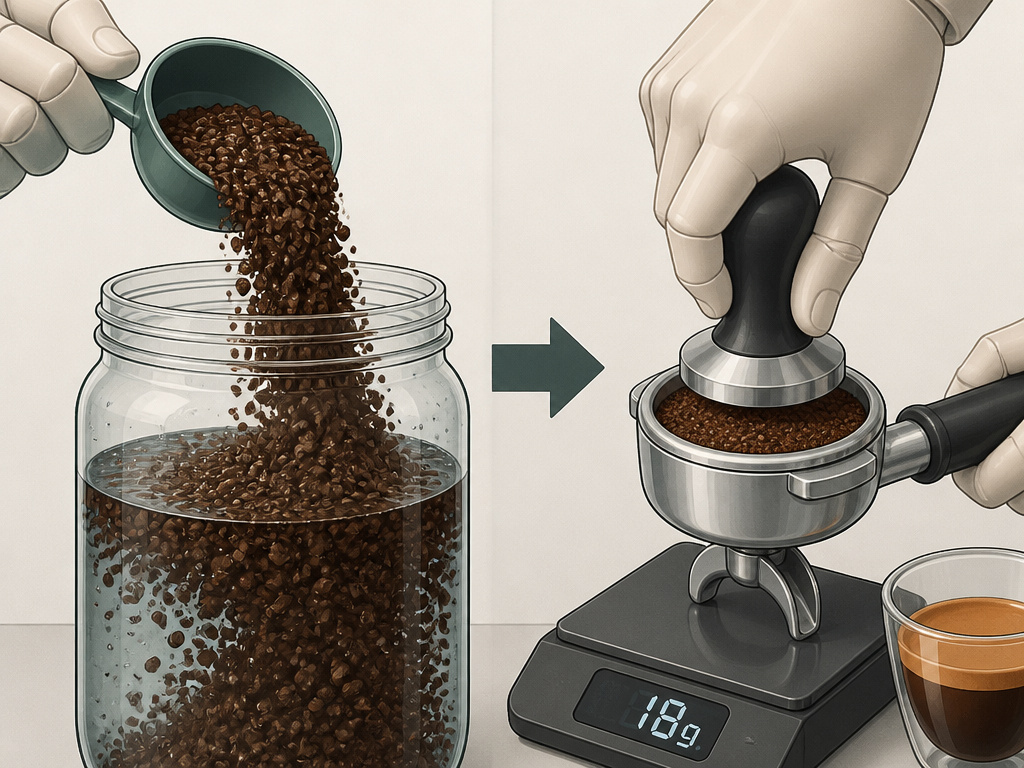
Drip coffee ratios assume hot water passing through grounds for a few minutes. Other methods break the rulebook.
Cold Brew uses a massive coffee dose because cold water extracts so slowly and inefficiently. A typical cold brew ratio is 1:8 (125g coffee per liter of water). You steep for 12-24 hours, then dilute the concentrate. Using a 1:18 ratio here makes flavored water.
Espresso is a high-pressure, short-time extraction. A double shot uses 18-21g of coffee to produce about 36-42g of liquid, a ratio of 1:2. Applying drip coffee logic would choke the machine instantly. The brewed coffee methods for espresso and drip are fundamentally different technologies.
Even within drip, a machine with a weak pump or poor showerhead might require a tweak. If your coffee always tastes weak even at 55g/L, your machine might be under-extracting. Try increasing the dose before blaming the beans.
Tools You Actually Need (It’s a Short List)
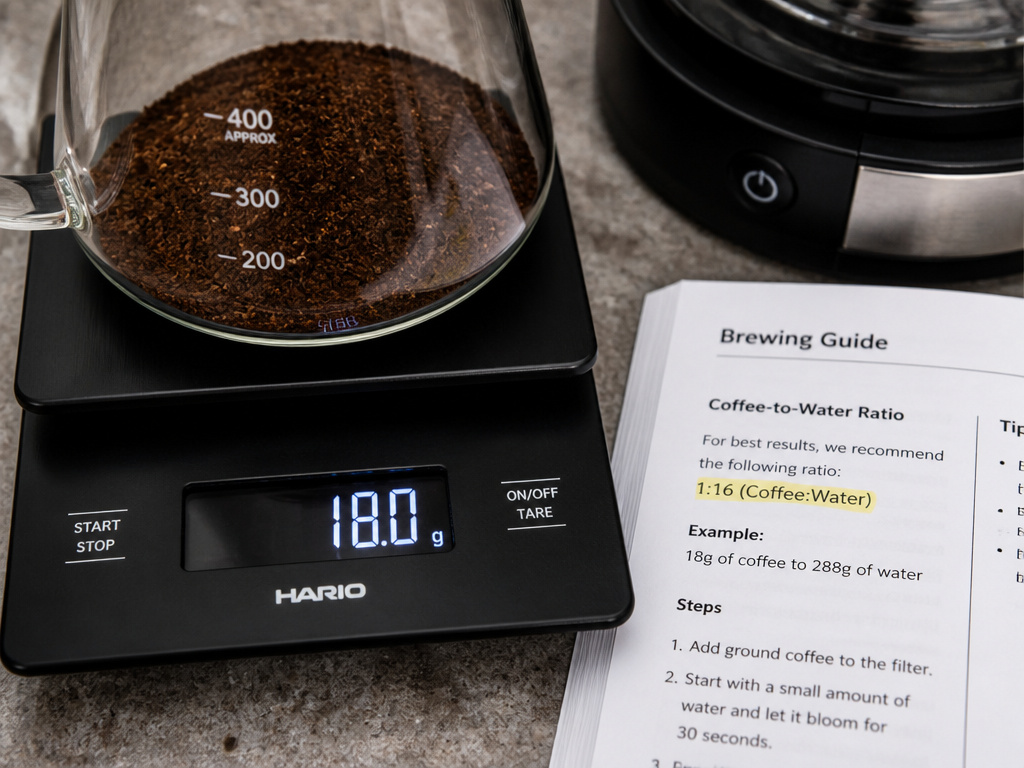
You don’t need expensive gear. You need the right gear.
- Digital Scale ($20-30): The non-negotiable. Look for 0.1g resolution, a tare function, and a flat platform. This one tool eliminates 90% of brewing variables.
- Grinder (Optional but Recommended): A burr coffee grinder provides consistent particle size, which makes extraction even and your ratio more predictable. Blade grinders create a mix of dust and boulders, so your 55g dose extracts unevenly.
- Your Machine’s Manual: The free document you probably ignored. It holds the engineered starting point.
- Fresh Coffee: Stale beans won’t taste right at any ratio. Use beans roasted within the last 3-4 weeks.
A good paper coffee filters or the correct Bunn coffee filters also matter. A filter that clogs or passes too many fines changes extraction. But the scale is the foundation.
Frequently Asked Questions
How many scoops of coffee for a 12-cup pot?
I don’t recommend scoops. But if you must, a “12-cup” pot typically holds about 1.8 liters (60 oz). At a 1:18 ratio, that’s 100 grams of coffee. If your scoop holds 10 grams, that’s 10 scoops. But since scoop weight varies, your results will too. Use a scale.
Is it better to use more or less coffee?
It depends on the outcome. More coffee (a higher ratio, like 1:15) makes a stronger, more intense cup, but risks under-extraction (sourness) if the water can’t pull enough out. Less coffee (a lower ratio, like 1:20) makes a lighter, more tea-like cup, but risks over-extraction (bitterness) as the water overworks the grounds. Start at 1:18 and adjust based on taste.
Does the type of coffee maker change the ratio?
Yes. The recommended 55g/L is for standard drip machines. Pour-over methods like V60 or Chemex often use a slightly tighter ratio, like 1:16 or 1:17, for more control. Single-origin coffee with delicate flavors might shine better with a pour-over’s precise ratio. Always check your specific brewer’s guidelines.
Why does my coffee taste bitter even when I follow the ratio?
Bitterness usually means over-extraction. With dark roast beans, try lowering your ratio to 1:19 or 1:20. Your water might also be too hot, or your grind might be too fine, causing over-extraction even at the “correct” ratio. Check your machine’s temperature if possible, and consider a coarser grind.
Before You Go
Stop guessing. Grab your machine’s manual and find its number. If it’s gone, start with 55 grams of coffee per liter of water. Put a scale between your beans and your filter basket.
Taste the next pot. If it’s off, adjust the ratio for your roast, down for dark, up for light. Write the winning number on a piece of tape stuck to your machine. That’s your personal golden ratio.
It takes three brews to dial it in. After that, every morning is the good kind of predictable. The scale pays for itself in wasted beans you didn’t brew by the fourth bag.
{
“@context”: “https://schema.org”,
“@type”: “HowTo”,
“name”: “How to Measure Coffee for a Drip Coffee Maker”,
“totalTime”: “PT5M”,
“tool”: [
{
“@type”: “HowToTool”,
“name”: “Digital kitchen scale (0.1g resolution)”
},
{
“@type”: “HowToTool”,
“name”: “Drip coffee maker”
},
{
“@type”: “HowToTool”,
“name”: “Fresh coffee beans or pre-ground coffee”
}
],
“step”: [
{
“@type”: “HowToStep”,
“name”: “Check your machine’s manual”,
“text”: “Locate the manufacturer’s recommended coffee-to-water ratio, usually listed in grams per liter. This is your starting point.”
},
{
“@type”: “HowToStep”,
“name”: “Weigh your coffee and water”,
“text”: “Place your carafe on the scale, tare it, and add cold water to your desired volume. Then weigh your coffee grounds separately to match the target ratio.”
},
{
“@type”: “HowToStep”,
“name”: “Adjust for roast and taste”,
“text”: “For dark roasts, reduce coffee by 1-2 grams per liter to avoid bitterness. For light roasts, you may need to add 1-2 grams per liter for full flavor.”
},
{
“@type”: “HowToStep”,
“name”: “Brew and evaluate”,
“text”: “Run the brew cycle. Taste the coffee. If it’s weak or sour, increase the coffee dose slightly next time. If it’s bitter or harsh, decrease the dose.”
}
]
}
{
“@context”: “https://schema.org”,
“@type”: “FAQPage”,
“mainEntity”: [
{
“@type”: “Question”,
“name”: “How many scoops of coffee for a 12-cup pot?”,
“acceptedAnswer”: {
“@type”: “Answer”,
“text”: “I don’t recommend scoops. But if you must, a \”12-cup\” pot typically holds about 1.8 liters (60 oz). At a 1:18 ratio, that’s 100 grams of coffee. If your scoop holds 10 grams, that’s 10 scoops. But since scoop weight varies, your results will too. Use a scale.”
}
},
{
“@type”: “Question”,
“name”: “Is it better to use more or less coffee?”,
“acceptedAnswer”: {
“@type”: “Answer”,
“text”: “It depends on the outcome. More coffee (a higher ratio, like 1:15) makes a stronger, more intense cup, but risks under-extraction (sourness) if the water can’t pull enough out. Less coffee (a lower ratio, like 1:20) makes a lighter, more tea-like cup, but risks over-extraction (bitterness) as the water overworks the grounds. Start at 1:18 and adjust based on taste.”
}
},
{
“@type”: “Question”,
“name”: “Does the type of coffee maker change the ratio?”,
“acceptedAnswer”: {
“@type”: “Answer”,
“text”: “Yes. The recommended 55g/L is for standard drip machines. Pour-over methods like V60 or Chemex often use a slightly tighter ratio, like 1:16 or 1:17, for more control. Single-origin coffee with delicate flavors might shine better with a pour-over’s precise ratio. Always check your specific brewer’s guidelines.”
}
},
{
“@type”: “Question”,
“name”: “Why does my coffee taste bitter even when I follow the ratio?”,
“acceptedAnswer”: {
“@type”: “Answer”,
“text”: “Bitterness usually means over-extraction. With dark roast beans, try lowering your ratio to 1:19 or 1:20. Your water might also be too hot, or your grind might be too fine, causing over-extraction even at the \”correct\” ratio. Check your machine’s temperature if possible, and consider a coarser grind.”
}
}
]
}
