
How Much Coffee for a French Press? Master Your Brew Ratio
For a standard 1-liter (34 oz) French press, use between 55 and 67 grams of coffee, which is a 1:15 to 1:16 coffee-to-water ratio by weight. That translates to roughly 8 to 10 tablespoons of pre-ground coffee, but a scale is the only way to get it right every time.
Most people dump in a few random scoops, guess at the water level, and wonder why their French press coffee tastes weak or bitter. The guesswork ends with a ten-dollar kitchen scale.
This guide breaks down the exact ratios for every press size, why weight matters more than volume, and how to adjust for your specific beans and taste. You will also learn the one stir most instructions get wrong and how to adapt the method for cold brew.
Key Takeaways
- Use a scale. A 1:15 coffee-to-water ratio (67g coffee per liter of water) is the pro starting point. Tablespoons vary wildly.
- Grind size dictates sediment, not strength. A coarse grind keeps sludge out of your cup but under-extracts light roasts. A medium grind pulls more flavor but leaves more grit.
- Skip the early stir. Stirring after the initial pour breaks the crust and sends fines to the bottom too early, trapping flavor.
- Roast level changes the ratio. Use a 1:16 ratio (62g/L) for dark roasts to avoid bitterness. Use a 1:14 ratio (71g/L) for light roasts to get enough extraction.
- Cold brew needs a completely different math. A 1:8 ratio with a 12-hour steep in the fridge makes a concentrate you dilute later.
The Golden Ratio: Grams, Not Scoops
A tablespoon of light, fluffy coffee is not the same weight as a tablespoon of dense, dark roast. Volume lies. Weight tells the truth.
The industry standard for French press coffee, used by roasters like Counter Culture Coffee and Stumptown Coffee Roasters, is a ratio of coffee weight to water weight. Counter Culture recommends a 1:16 ratio. Stumptown suggests 1:15. The difference is about 4 grams of coffee per liter, enough to shift a cup from bright to bold.
For a 1-liter French press, a 1:16 ratio means 62.5 grams of coffee. A 1:15 ratio means 66.7 grams. That 4-gram gap is the difference between a well-balanced cup and one that tastes slightly hollow.
You need a digital scale that measures in 0.1-gram increments. The $15 models work fine. Place your empty French press on it, tare to zero, add beans until you hit your target, then grind.
What if you only have pre-ground coffee and a scoop? The math gets fuzzy. A standard tablespoon of a medium roast coffee holds about 5-7 grams. For a 1:15 ratio in a 1-liter press, you would need between 9 and 13 tablespoons. The range is too wide to be consistent.
TL;DR: Weigh your beans. A 1:15 coffee-to-water ratio (67g per liter) is the reliable starting point.
Press Size and Manufacturer Guidance
Manufacturer cup markings are notoriously optimistic. A “34 oz / 8-cup” Bodum Chambord press assumes a 4-ounce cup, which is half a standard mug. If you fill it to the 1-liter line, you are brewing about four real mugs of coffee.
| Press Size (Manufacturer Claim) | Real Capacity (Water Weight) | Coffee Weight (1:15 Ratio) | Coffee Weight (1:16 Ratio) |
|---|---|---|---|
| 12 oz (3-cup) | 340g | 23g | 21g |
| 34 oz / 1.0L (8-cup) | 1000g | 67g | 62g |
| 36 oz (Frieling) | 1020g | 68g | 64g |
| 51 oz (12-cup) | 1500g | 100g | 94g |
Frieling’s product page for their 36 oz press says it yields “approximately 4-5 cups.” Using a 1:15 ratio, that’s 68 grams of coffee, enough for four strong mugs. Their guidance aligns with the weight-based approach, even if they do not spell out the grams.
Common mistake: Filling the press to the manufacturer’s “cup” line, you will end up with weak, over-diluted coffee. Ignore the cup marks and measure water by weight or fluid ounces instead.
If your morning ritual involves a single large mug, you do not need to brew a full press. A burr coffee grinder lets you dose precisely for a half batch. Grind only what you need.
Grind Size: The Sediment Trade-Off
Every manual says “coarse grind.” The logic is simple: a coarse grind creates fewer tiny particles (fines), which slip through the mesh filter and turn your cup muddy. But coarse grounds extract slower. For a light roast bean packed with dense cellular structure, a coarse grind can leave it under-extracted and sour.
The pro move is to go one click finer than “coarse” on your grinder, into medium territory. This looks like rough sand, not pebbles. You trade a bit of sediment for a much fuller extraction.
I learned this the hard way with a bag of Ethiopian single origin coffee. Following the coarse rule gave me a bright, tea-like cup that lacked body. Grinding it medium, like I would for a pour-over, brought out the blueberry notes and a syrupy mouthfeel. The cup had more silt at the bottom, but the flavor was worth it.
The trade-off only works with a quality burr grinder that produces a consistent particle size. A blade grinder creates a wide range of chunks and powder, guaranteeing sludge if you go finer. This is why the grinder comparison always favors a burr model for immersion brewing.
TL;DR: For light roasts, use a medium grind. For dark roasts, stick with coarse. Expect more sediment with the finer grind.
Water Temperature and the Four-Minute Steep
Water at a rolling boil is too hot. It scorches the grounds and pulls out harsh, bitter compounds. Water off the boil, around 200°F (93°C), is the sweet spot.
Here is the sequence that most people mess up.
1. Add your ground coffee to the dry press.
2. Start your timer and pour just enough 200°F water to wet all the grounds. Give the press a gentle swirl to ensure no dry pockets.
3. Let it sit for 30 seconds. This is the bloom phase, where CO2 escapes. If you skip it, the gas interferes with water contact and extraction is uneven.
4. Pour the rest of your water up to the fill line. Place the lid on top with the plunger pulled all the way up.
5. Wait 3 minutes and 30 seconds. Do not stir.
6. At the 4-minute total mark, gently press the plunger down. Take about 20 seconds to do it.
7. Pour all the coffee into a separate carafe immediately. Leaving it in the press with the grounds leads to over-extraction and bitterness within minutes.
Common mistake: Stirring the crust at the 1-minute mark, this breaks the floating grounds and sends the fines straight to the bottom, where they over-extract and make the last sip taste like mud.
The total steep time is not sacred. For a darker roast, try 3:30 to avoid bitterness. For a dense light roast, push to 4:30. The James Hoffmann method extends this to 8-10 minutes with no stir and a careful plunge, which produces an incredibly clean cup but demands more patience.
How Roast Level Changes Your Math
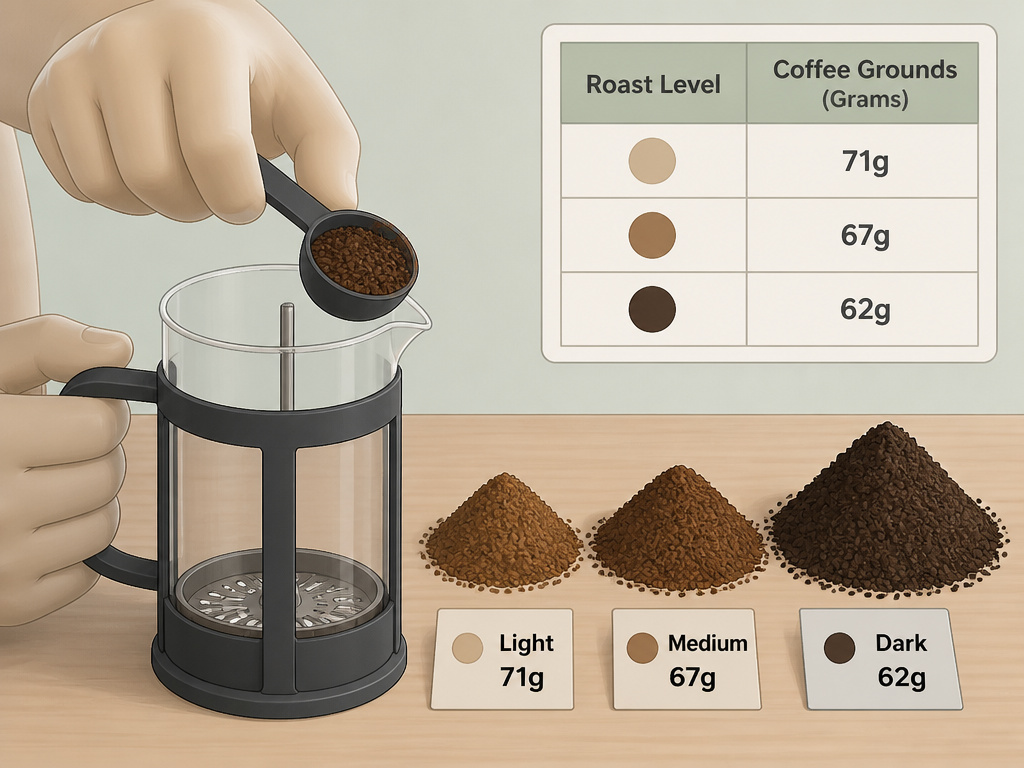
Dark roast beans are less dense. They weigh less per scoop. They also extract faster because the roasting process has made them more porous. If you use the same 1:15 ratio for a dark roast that you use for a medium, the cup will taste bitter and ashy.
For dark roasts, use a 1:16 or even 1:17 ratio. That is 62 grams per liter instead of 67. The higher water-to-coffee ratio dilutes the intense, quickly extracted flavors.
Light roasts are the opposite. They are dense, hard, and resist extraction. To get enough flavor out of them, you need a higher coffee-to-water ratio, closer to 1:14. That is 71 grams per liter. You also need hotter water (205°F) and a longer or finer grind, as mentioned above.
This is why knowing your coffee roast levels matters. A blonde roast needs more coffee and more heat. An Italian roast needs less coffee and slightly cooler water.
| Roast Level | Recommended Ratio | Coffee per 1L Water | Water Temp | Grind Size |
|---|---|---|---|---|
| Light / Blonde | 1:14 | 71g | 205°F (96°C) | Medium |
| Medium | 1:15 | 67g | 200°F (93°C) | Medium-Coarse |
| Dark | 1:16 | 62g | 195°F (90°C) | Coarse |
If you are using a pre-blended dark roast, the bitterness can be tamed not just with ratio but with a pinch of salt in coffee. A couple grains on the grounds before brewing neutralize harsh perceived bitterness.
Adapting the Ratio for Cold Brew
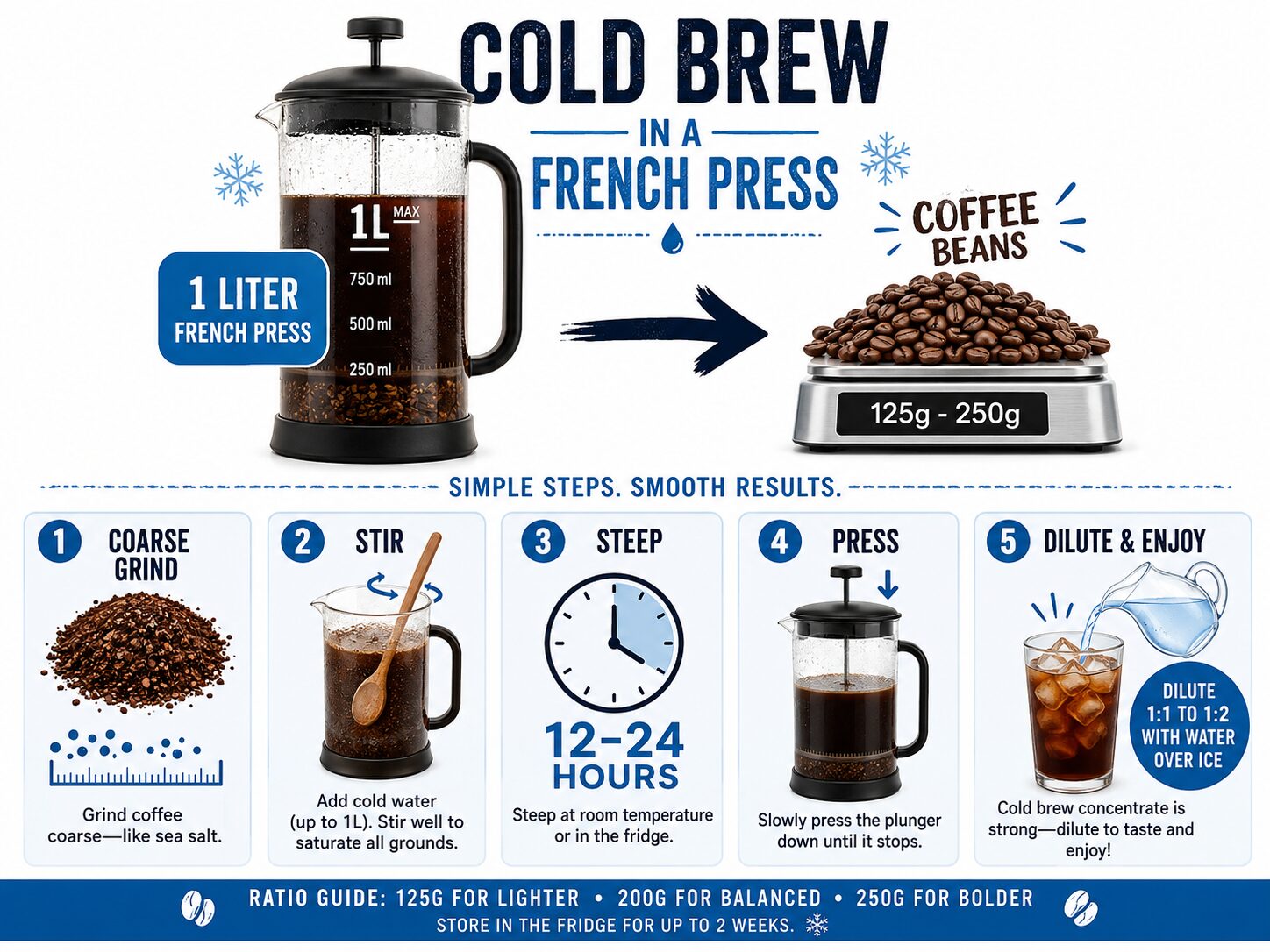
Cold brew in a French press uses a completely different ratio because you are making a concentrate to dilute later. The standard is 1:4 to 1:8 coffee to water.
For a 1-liter press, that means 125 to 250 grams of coffee. Yes, that is a lot. You are not drinking it straight.
The process is simple but long.
1. Use a coarse grind to minimize sediment after the long steep.
2. Add cold or room-temperature water. Stir to ensure all grounds are wet.
3. Place the lid on top (plunger up) and let it sit at room temperature or in the fridge for 12-24 hours.
4. Press slowly and pour the concentrate into a separate jar.
5. Dilute 1:1 with water or milk over ice.
The longer steep time extracts differently, producing a smoother, less acidic cup. It is perfect for batch brewing and summer drinking. The high coffee cost per batch is the main drawback.
Frequently Asked Questions
Can I use pre-ground coffee for French press?
Yes, but you lose control over grind size. Most pre-ground coffee is ground for drip machines, which is too fine for a standard French press and will result in a muddy cup. If you must use it, shorten the steep time to 3 minutes to avoid over-extraction.
Why does my French press coffee taste bitter?
Two likely reasons: your water was too hot, or you let the coffee sit in the press after plunging. Once the plunger is down, the grounds are still in contact with the water. Pour the coffee into a separate carafe immediately after pressing to stop the extraction.
Is the French press better than drip coffee?
It produces a different profile. A drip coffee machine filters out oils and sediment, yielding a cleaner cup. French press coffee retains those oils, resulting in a heavier body and more intense flavor. It is not better or worse, just different. For a closer strength comparison, look at how an Americano coffee differs from drip.
How do I clean a French press?
Rinse it immediately after use. Do not let the grounds dry on the mesh. Once a week, disassemble the plunger assembly and soak all parts in a mixture of warm water and baking soda or a dedicated coffee cleaner to dissolve baked-on oils.
Does French press coffee have more caffeine?
Not necessarily. Caffeine extraction is mostly a function of time and temperature. While immersion brewing is efficient, a standard 4-minute steep does not extract more caffeine than a 5-minute drip brew. The difference in perceived strength comes from body and oil content, not caffeine. For a detailed breakdown, see our guide on espresso caffeine versus brewed coffee.
The Bottom Line
Stop counting scoops. Buy a $15 scale and weigh your beans. Start with 67 grams of coffee per liter of water, a 1:15 ratio. Grind a notch finer than “coarse” if you are using light roast beans. Pour 200°F water, wait 30 seconds for the bloom, fill it up, and set a 4-minute timer. Do not stir. When the timer goes off, press slowly and pour everything into your mug or a carafe.
That is it. The difference between a good press and a great one is about four grams and a little patience. Your first weighed batch will taste like a different drink.
{
“@context”: “https://schema.org”,
“@type”: “HowTo”,
“name”: “How to Measure Coffee for a French Press”,
“totalTime”: “PT10M”,
“tool”: [
{
“@type”: “HowToTool”,
“name”: “French press (34 oz / 1.0 L or similar)”
},
{
“@type”: “HowToTool”,
“name”: “Digital kitchen scale”
},
{
“@type”: “HowToTool”,
“name”: “Burr coffee grinder”
},
{
“@type”: “HowToTool”,
“name”: “Gooseneck kettle”
}
],
“step”: [
{
“@type”: “HowToStep”,
“name”: “Preheat and weigh the press”,
“text”: “Fill your empty French press with hot water to preheat it, then pour that water out. Place the empty press on your scale and tare it to zero.”
},
{
“@type”: “HowToStep”,
“name”: “Measure coffee by weight”,
“text”: “Add whole beans to the press until the scale reads your target weight. For a 1.0L press, that’s 55-67 grams for a standard brew, depending on your preferred strength.”
},
{
“@type”: “HowToStep”,
“name”: “Grind the beans”,
“text”: “Grind the weighed beans to a coarse consistency, similar to rock salt. A finer medium grind extracts more but produces more sediment.”
},
{
“@type”: “HowToStep”,
“name”: “Add water and bloom”,
“text”: “Pour just enough 200°F water to saturate all the grounds, then swirl gently. Wait 30 seconds for the coffee to bloom and release gases.”
},
{
“@type”: “HowToStep”,
“name”: “Add remaining water and steep”,
“text”: “Fill the press to just below the rim. Place the lid on top but do not plunge. Set a timer for 4 minutes.”
},
{
“@type”: “HowToStep”,
“name”: “Plunge and pour”,
“text”: “After 4 minutes, press the plunger down slowly and steadily. Pour all the coffee into a carafe immediately to prevent over-extraction.”
}
]
}
{
“@context”: “https://schema.org”,
“@type”: “FAQPage”,
“mainEntity”: [
{
“@type”: “Question”,
“name”: “Can I use pre-ground coffee for French press?”,
“acceptedAnswer”: {
“@type”: “Answer”,
“text”: “Yes, but you lose control over grind size. Most pre-ground coffee is ground for drip machines, which is too fine for a standard French press and will result in a muddy cup. If you must use it, shorten the steep time to 3 minutes to avoid over-extraction.”
}
},
{
“@type”: “Question”,
“name”: “Why does my French press coffee taste bitter?”,
“acceptedAnswer”: {
“@type”: “Answer”,
“text”: “Two likely reasons: your water was too hot, or you let the coffee sit in the press after plunging. Once the plunger is down, the grounds are still in contact with the water. Pour the coffee into a separate carafe immediately after pressing to stop the extraction.”
}
},
{
“@type”: “Question”,
“name”: “Is the French press better than drip coffee?”,
“acceptedAnswer”: {
“@type”: “Answer”,
“text”: “It produces a different profile. A drip coffee machine filters out oils and sediment, yielding a cleaner cup. French press coffee retains those oils, resulting in a heavier body and more intense flavor. It is not better or worse, just different. For a closer strength comparison, look at how an Americano coffee differs from drip.”
}
},
{
“@type”: “Question”,
“name”: “How do I clean a French press?”,
“acceptedAnswer”: {
“@type”: “Answer”,
“text”: “Rinse it immediately after use. Do not let the grounds dry on the mesh. Once a week, disassemble the plunger assembly and soak all parts in a mixture of warm water and baking soda or a dedicated coffee cleaner to dissolve baked-on oils.”
}
},
{
“@type”: “Question”,
“name”: “Does French press coffee have more caffeine?”,
“acceptedAnswer”: {
“@type”: “Answer”,
“text”: “Not necessarily. Caffeine extraction is mostly a function of time and temperature. While immersion brewing is efficient, a standard 4-minute steep does not extract more caffeine than a 5-minute drip brew. The difference in perceived strength comes from body and oil content, not caffeine. For a detailed breakdown, see our guide on espresso caffeine versus brewed coffee.”
}
}
]
}
