
How Much Coffee Grounds Per Cup for a French Press Brew
Use 60 grams of coffee per liter of water for a standard 1:16.7 ratio. That’s 30 grams for a 500ml (17 oz) press or 15 grams for a 250ml (8.5 oz) single-serving press. A digital scale is non-negotiable for this measurement.
Most people fill the press with a scoop of grounds and hope for the best. The result is either a weak, sour tea or a bitter, muddy sludge that sticks to your teeth. The problem isn’t the press; it’s the guesswork.
This guide gives you the exact numbers, explains why they matter, and shows you a professional method that eliminates the common grit. We’ll cover standard ratios, press-size conversions, and the advanced technique that changed how I brew.
Key Takeaways
- The standard 1:15 to 1:17 coffee-to-water ratio is a starting point, but the grind size and plunge technique determine the final quality more than a few grams of coffee.
- Using a scale is the only reliable way to measure. A “scoop” can vary by 5 grams or more, throwing your entire brew off.
- The James Hoffmann method—a 4-minute steep followed by a 5-minute rest before a gentle plunge—cuts sediment by over half compared to the traditional immediate plunge.
- Grind size is your primary control for strength and clarity. Too fine and you get bitter over-extraction and silt; too coarse and the brew tastes weak and sour.
- Your ideal ratio shifts with the coffee. Light roasts often need a slightly finer grind or a tighter ratio (like 1:15) to pull out more sweetness, while dark roasts can handle a coarser grind or a wider ratio (like 1:17).
The Golden Ratio and Why It’s Not Enough
A coffee-to-water ratio is a mass-based formula, not a volume guess. Specialty roasters like Counter Culture Coffee and Stumptown Coffee Roasters publish their tested ratios as gospel for a reason.
The standard brewing ratio for French press coffee falls between 1:15 and 1:17. This means for every 1 gram of coffee, you use 15 to 17 grams of water. Counter Culture recommends 1:15, Stumptown suggests 1:16, and James Hoffmann uses 1:16.7.
The math is simple. For a 1-liter French press:
– At a 1:15 ratio: 67 grams of coffee (1000g water / 15)
– At a 1:16 ratio: 63 grams of coffee
– At a 1:16.7 (Hoffmann) ratio: 60 grams of coffee
– At a 1:17 ratio: 59 grams of coffee
That’s an 8-gram swing from the strongest to the weakest recommendation. Your taste decides.
But the ratio is only half the story. It tells you how much coffee to use, not how to extract it properly. You can nail 60 grams per liter and still make a terrible cup if your grind is wrong or you plunge like you’re trying to win a bet. The ratio sets the stage; the grind and the time direct the play.
TL;DR: Start with 60g coffee per liter of water (a 1:16.7 ratio). Adjust finer or coarser by 2-3 grams based on your roast and taste, but never skip the scale.
How Your French Press Size Dictates the Dose
French presses don’t come in standard “cups.” A “4-cup” press might hold 500ml, while another holds 600ml. The only measurement that matters is the carafe’s maximum liquid capacity, usually marked in milliliters (ml) or ounces (oz) on the bottom.
Use this table to find your starting dose. These numbers assume the 1:16.7 (60g/L) ratio.
| Press Capacity | Water Weight | Coffee Weight | Serves (approx.) |
|---|---|---|---|
| 250 ml (8.5 oz) | 250 g | 15 g | 1 small mug |
| 350 ml (12 oz) | 350 g | 21 g | 1 large mug |
| 500 ml (17 oz) | 500 g | 30 g | 2 small mugs |
| 1 L (34 oz) | 1000 g | 60 g | 4 small mugs |
| 1.5 L (51 oz) | 1500 g | 90 g | 6 small mugs |
Here’s the critical step everyone misses: you must account for displacement. Coffee grounds absorb roughly twice their weight in water. If you put 60 grams of grounds in a 1-liter press and fill it to the 1-liter mark with water, you’ll only get about 900ml of brewed coffee. The grounds swallow the rest.
The fix is easy. Add your measured grounds to the empty carafe first. Then, add your calculated water weight on top of them. The water level will rise past the “1 liter” mark, but the final liquid yield after pressing will be right at 1 liter. This is why weighing beats eyeballing every time.
Why Grind Size Matters More Than a Perfect Gram
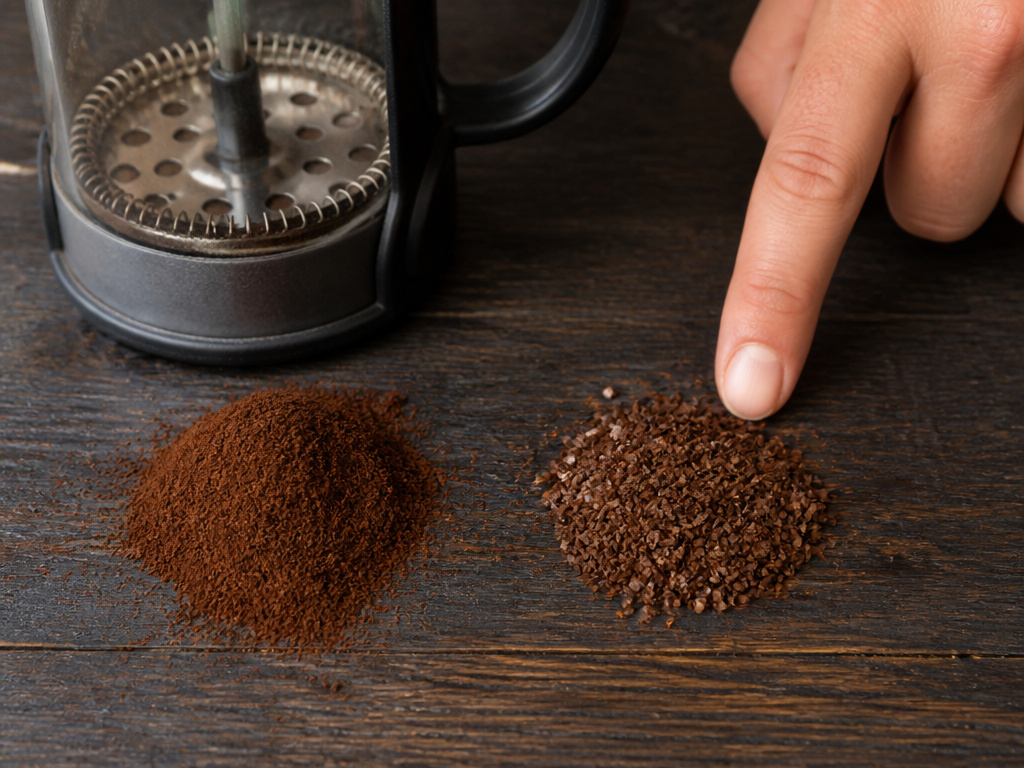
You can measure 60.0 grams on a lab scale, but if you grind those beans to a powder, you’ll get a cup of bitter, over-extracted mud. Grind size controls the surface area exposed to water, which directly dictates extraction speed and sediment.
A proper burr grinder vs blade grinder is the single best upgrade for French press coffee. Burr grinders crush beans into uniform particles, while blade grinders hack them into a random mix of dust and boulders. The dust over-extracts instantly, causing bitterness, while the boulders under-extract, leaving sour notes. The uniform coarse grind from a burr grinder extracts evenly.
Common mistake: Using a “coarse” setting from a blade grinder — the inconsistent fines slip past the mesh filter during the plunge, guaranteeing a gritty cup with visible silt at the bottom.
Aim for a grind that looks like coarse sea salt or very coarse breadcrumbs. If you pinch it between your fingers, it should feel gritty, not powdery. This large particle size slows extraction, preventing the bitter compounds from dissolving too quickly during the steep. It also creates a dense bed of grounds that the mesh filter can actually trap.
Your choice of beans also interacts with the grind. A dense, hard blonde roast coffee often needs a slightly finer grind than a dark roast to reach full extraction. Conversely, a dark roast can become ashy and bitter if ground too fine. Think of grind size as your primary dial for strength, with the ratio as your secondary fine-tuner.
The James Hoffmann Method: A 9-Minute Fix for Gritty Coffee
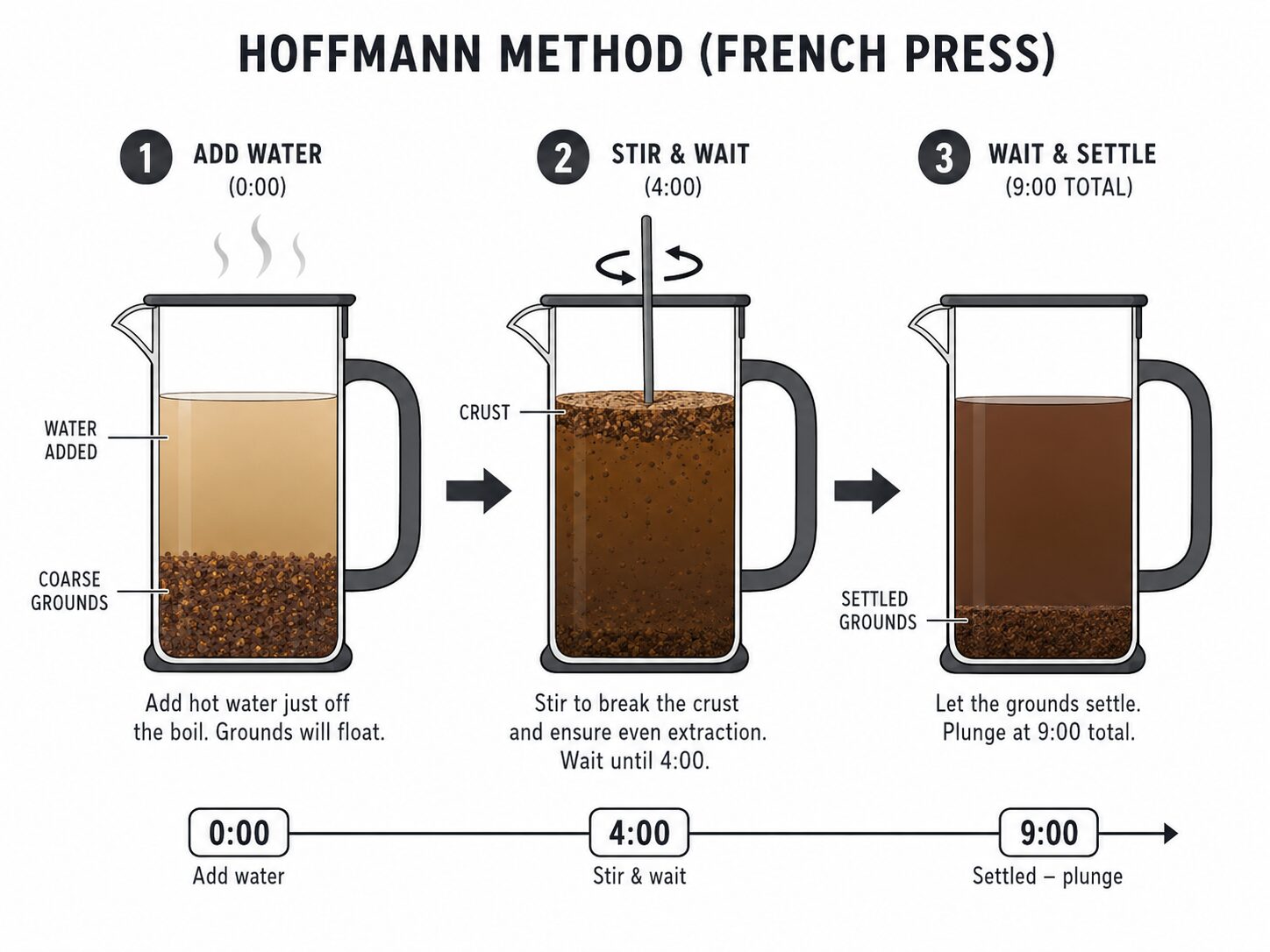
The traditional French press instruction is simple: add coffee, add water, wait four minutes, plunge, and pour. That method guarantees sediment. James Hoffmann’s 2020 video guide flipped the script by introducing a waiting period that lets physics do the filtering.
The Hoffmann method adds a 5-minute rest after the standard 4-minute steep. Here’s why it works: when you plunge immediately, you force the water and all suspended particles through the mesh. The pressure pushes microscopic fine grounds (fines) through the filter and into your cup. By waiting, you let the grounds settle naturally to the bottom. A gentle plunge then compacts this bed without agitating the fines back into suspension.
The process in detail:
1. Add your measured coarse grounds to the dry carafe.
2. Pour all your hot water (200°F/93°C) onto the grounds, ensuring they’re fully saturated. Start a timer.
3. At 4 minutes, use a spoon to break the crust of grounds that has formed on the surface. Give it a gentle stir.
4. Let it sit, completely undisturbed, for another 5 minutes. You’ll watch the grounds form a thick, flat bed at the bottom.
5. At 9 minutes total, place the lid on and press the plunger down with slow, minimal pressure until it just rests on the bed. Do not force it.
6. Pour immediately into your cup, leaving the last bit of coffee and the sludge behind.
The first time I tried this, I was skeptical. Nine minutes for coffee? But the difference was undeniable. The cup was cleaner, brighter, and completely free of the silt that usually coated the bottom of my mug. The flavor clarity, especially with a complex blend vs single origin bean, was a revelation.
What If You Don’t Have a Scale? (And Why You Should Get One)
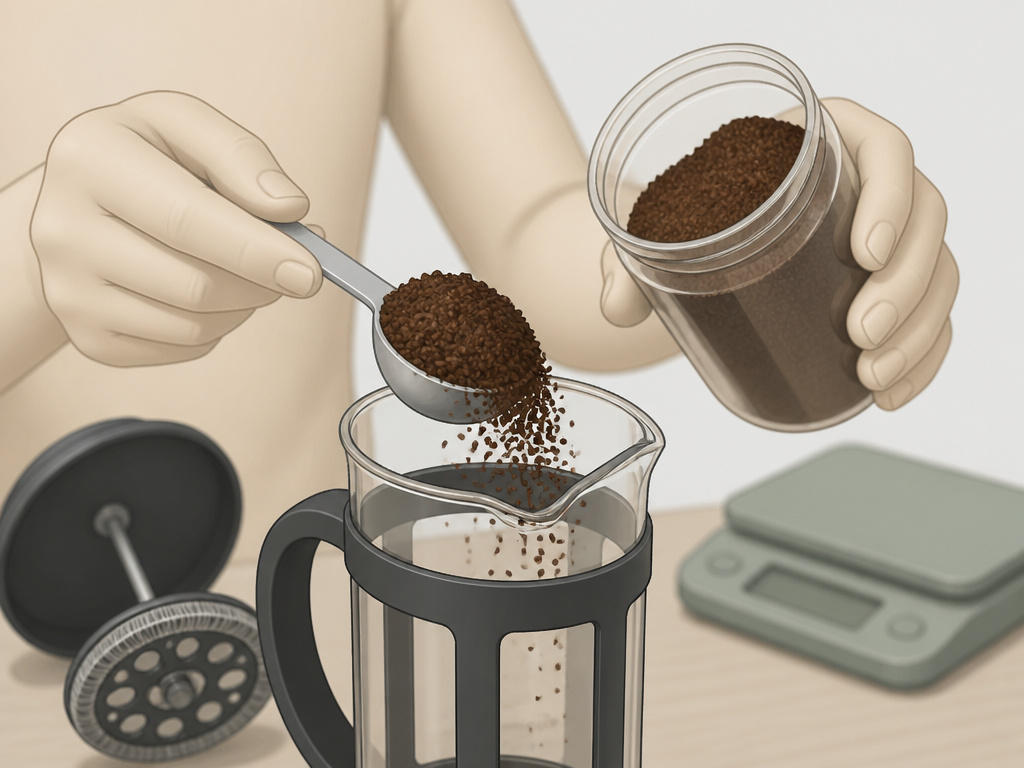
I get it. Not everyone has a digital scale in their kitchen. The fallback is the tablespoon, but you have to know its severe limitations.
A standard coffee scoop or tablespoon holds roughly 5-7 grams of ground coffee, depending on the bean density and grind. A light roast is less dense, so a scoop might be only 5 grams. A dark roast might be 7 grams. That’s a 40% margin of error before you even add water.
If you must use volume, use this as a desperate guide for a 1:16 ratio:
– 1 Liter Press: ~10 tablespoons of grounds
– 500ml Press: ~5 tablespoons
– 250ml Press: ~2.5 tablespoons
It’s a guess. The result will be inconsistent. Investing in a $20 kitchen scale removes all guesswork and is the fastest way to improve your coffee. It’s more important than a fancy kettle or an expensive press.
While we’re on kitchen tools, a common question is whether you can use a Ninja blender for coffee grinding in a pinch. You can, but pulse in very short bursts and shake the carafe constantly to try and achieve some consistency. You will still get a huge amount of fines, making the Hoffmann rest period absolutely critical to avoid silt.
Troubleshooting Your French Press Ratio
Your scale and timer are set, but the coffee still tastes off. Use this table to diagnose and fix the issue.
| Symptom | Likely Cause | The Fix |
|---|---|---|
| Bitter, harsh, ashy | Over-extraction | Coarsen your grind size. Use cooler water (195°F/90°C). Shorten steep time. |
| Sour, weak, grassy | Under-extraction | Finer grind. Ensure water is hot enough (200°F/93°C). Increase steep time. |
| Muddy, gritty sediment | Grind too fine or violent plunge | Coarsen grind significantly. Adopt the Hoffmann 5-minute rest method. |
| Thin, watery body | Ratio too weak (too much water) | Increase coffee dose by 2-3 grams per 250ml of water. |
| Too strong, overpowering | Ratio too strong (too little water) | Decrease coffee dose by 2-3 grams per 250ml. |
If you’ve dialed in the grind and ratio and a persistent bitterness remains, there’s one old barista trick: adding salt to coffee. A tiny pinch of salt (literally two or three grains) added to the grounds before brewing can neutralize perceived bitterness by blocking certain bitter receptors on the tongue. It’s a last resort, not a standard practice.
Frequently Asked Questions
Can I use pre-ground coffee for French press?
You can, but you lose control. Pre-ground is typically ground for drip machines, which is finer than ideal for French press. This leads to over-extraction and more sediment. If you must use it, shorten your steep time to 3 minutes and be prepared for a sludgier cup.
Does the type of coffee bean change the ratio?
Yes, but start with the standard ratio and adjust from there. Dense, light Arabica vs Colombian beans often benefit from a slightly finer grind or a 1:15 ratio to extract their complex sugars. Darker, oilier roasts can taste better with a slightly coarser grind or a 1:17 ratio to avoid ashy tones.
Why does my French press coffee get bitter as it sits in the carafe?
Because extraction doesn’t magically stop when you plunge. The grounds sitting at the bottom continue to steep in the hot liquid. To prevent this, pour all the coffee into a separate thermal carafe or your mugs immediately after pressing. Never let it sit on the spent grounds.
How do I clean my French press to prevent old coffee oils from ruining the taste?
Disassemble the plunger completely after each use. Wash the mesh filter, spring, and plate with soap and hot water. Every few weeks, soak the entire filter assembly in a solution of hot water and a denture cleaning tablet or a dedicated espresso machine cleaner to dissolve baked-on coffee oils.
Is French press coffee stronger than drip coffee?
It’s different. A French press has a higher extraction of oils and suspended solids, giving it a heavier body and more intense flavor that some people call “stronger.” In terms of caffeine content, if you use the same coffee-to-water ratio, they are very similar. For a comparison of brew styles, see our guide on brewed coffee vs Americano.
The Bottom Line
Forget the scoops. Weigh 60 grams of coffee for every liter of water in your press. Grind those beans coarsely, like sea salt. Then, steep for four minutes and walk away for five more before you even touch the plunger.
That last part—the wait—is what turns a good cup into a great one. It’s the difference between coffee and clean, flavorful coffee. The numbers give you control, but the patience gives you clarity. Start with the 1:16.7 ratio, lock in your coarse grind, and let the clock do the hard work. Your next cup will have no sludge, no guesswork, and no going back.
{
“@context”: “https://schema.org”,
“@type”: “HowTo”,
“name”: “How to Measure Coffee Grounds for a French Press”,
“totalTime”: “PT10M”,
“tool”: [
{
“@type”: “HowToTool”,
“name”: “French press”
},
{
“@type”: “HowToTool”,
“name”: “Digital kitchen scale”
},
{
“@type”: “HowToTool”,
“name”: “Burr coffee grinder”
}
],
“supply”: [
{
“@type”: “HowToSupply”,
“name”: “Whole bean coffee”
},
{
“@type”: “HowToSupply”,
“name”: “Filtered water”
}
],
“step”: [
{
“@type”: “HowToStep”,
“name”: “Weigh your coffee beans”,
“text”: “Use a scale to measure whole beans based on your press size and desired ratio. For a 1:16 ratio in a 1-liter press, use 60 grams.”
},
{
“@type”: “HowToStep”,
“name”: “Grind to a coarse consistency”,
“text”: “Grind the beans to a coarse texture resembling sea salt or breadcrumbs. A fine grind will over-extract and slip through the filter.”
},
{
“@type”: “HowToStep”,
“name”: “Heat water to 200°F (93°C)”,
“text”: “Bring filtered water just off the boil to the ideal brewing temperature.”
},
{
“@type”: “HowToStep”,
“name”: “Add grounds and start the timer”,
“text”: “Place the grounds in the empty carafe, then pour in the hot water, starting your timer immediately.”
},
{
“@type”: “HowToStep”,
“name”: “Steep for 4 minutes, then rest”,
“text”: “Let the coffee steep undisturbed for 4 minutes. Then, break the crust on top, let it settle for 5 more minutes, and gently press the plunger.”
}
]
}
{
“@context”: “https://schema.org”,
“@type”: “FAQPage”,
“mainEntity”: [
{
“@type”: “Question”,
“name”: “Can I use pre-ground coffee for French press?”,
“acceptedAnswer”: {
“@type”: “Answer”,
“text”: “You can, but you lose control. Pre-ground is typically ground for drip machines, which is finer than ideal for French press. This leads to over-extraction and more sediment. If you must use it, shorten your steep time to 3 minutes and be prepared for a sludgier cup.”
}
},
{
“@type”: “Question”,
“name”: “Does the type of coffee bean change the ratio?”,
“acceptedAnswer”: {
“@type”: “Answer”,
“text”: “Yes, but start with the standard ratio and adjust from there. Dense, light Arabica vs Colombian beans often benefit from a slightly finer grind or a 1:15 ratio to extract their complex sugars. Darker, oilier roasts can taste better with a slightly coarser grind or a 1:17 ratio to avoid ashy tones.”
}
},
{
“@type”: “Question”,
“name”: “Why does my French press coffee get bitter as it sits in the carafe?”,
“acceptedAnswer”: {
“@type”: “Answer”,
“text”: “Because extraction doesn’t magically stop when you plunge. The grounds sitting at the bottom continue to steep in the hot liquid. To prevent this, pour all the coffee into a separate thermal carafe or your mugs immediately after pressing. Never let it sit on the spent grounds.”
}
},
{
“@type”: “Question”,
“name”: “How do I clean my French press to prevent old coffee oils from ruining the taste?”,
“acceptedAnswer”: {
“@type”: “Answer”,
“text”: “Disassemble the plunger completely after each use. Wash the mesh filter, spring, and plate with soap and hot water. Every few weeks, soak the entire filter assembly in a solution of hot water and a denture cleaning tablet or a dedicated espresso machine cleaner to dissolve baked-on coffee oils.”
}
},
{
“@type”: “Question”,
“name”: “Is French press coffee stronger than drip coffee?”,
“acceptedAnswer”: {
“@type”: “Answer”,
“text”: “It’s different. A French press has a higher extraction of oils and suspended solids, giving it a heavier body and more intense flavor that some people call \”stronger.\” In terms of caffeine content, if you use the same coffee-to-water ratio, they are very similar. For a comparison of brew styles, see our guide on brewed coffee vs Americano.”
}
}
]
}
