
The Right Amount: How Much Coffee Grounds for a Pot of Coffee
Measure coffee grounds for a pot of coffee using a digital scale and the Specialty Coffee Association’s 1:18 coffee-to-water ratio. For a standard 8-cup (1.25L) pot, this means 69 grams of coffee. Manufacturer manuals provide a second check, a Bonavita Connoisseur recommends 55 grams, an OXO Brew suggests 48 grams, and a Technivorm Moccamaster calls for 50-60 grams.
The mistake most people make is using a scoop without weighing. A tablespoon of one dark roast can weigh 5 grams, while a tablespoon of a light roast might be 7 grams. That’s a 40% swing in coffee mass before the water even hits it. Your pot will taste weak one day and bitter the next, and you’ll blame the beans instead of the scoop.
This guide walks through the three numbers that decide your pot’s strength: the universal ratio, your specific machine’s specs, and your beans’ roast level. We’ll cover how to measure without a scale in a pinch, why your brewer’s basket size is the final boss, and how to adjust for water quality.
Key Takeaways
- The Specialty Coffee Association’s 1:18 ratio (55 grams coffee per liter of water) is your baseline, not a rigid rule.
- Your coffee maker’s manual often specifies a different, optimized weight, like 55g for a Bonavita Connoisseur or 48g for an OXO Brew.
- Dark roasts extract faster; reduce coffee by 10% or grind coarser. Light roasts are denser; add 10% coffee or grind finer.
- A standard “scoop” is wildly inconsistent. A digital kitchen scale costing less than a bag of beans fixes this forever.
- The physical limit is your brew basket. Overfilling chokes the water flow, creating a weak, under-extracted pot.
The Universal Coffee-to-Water Ratio
Start with the Specialty Coffee Association’s standard. They define the ideal brew ratio as 55 grams of coffee per liter of water, or a 1:18 coffee-to-water ratio. This is the industry benchmark for a balanced extraction.
For a standard 8-cup coffee maker, which typically holds 1.25 liters of water, the SCA ratio calls for 69 grams of coffee. This calculation is water volume in milliliters multiplied by 0.055.
The 1:18 ratio works because it balances strength and extraction. Use less coffee, and the water over-extracts, pulling harsh, bitter compounds from the grounds. Use more coffee, and the water under-extracts, leaving sour, acidic notes behind. The ratio is your foundation, but your machine and your beans will demand adjustments.
TL;DR: The SCA’s 1:18 ratio (55g coffee per liter) is your starting point. For a 1.25L pot, that’s 69 grams.
Why Your Coffee Maker’s Manual Is Your First Stop
Your brewer’s engineering team spent months testing. Their recommended coffee weight is not a suggestion; it’s the spec that makes their machine perform as advertised. Ignoring it is like putting regular gas in a high-compression engine.
The Bonavita Connoisseur BV1901TS manual states 55 grams for a full 8-cup pot. The OXO Brew 8-Cup manual says 48 grams. The Technivorm Moccamaster KBGV Select manual recommends 50-60 grams for a 1-liter brew. These numbers differ from the SCA ratio because each machine’s showerhead, water temperature, and flow rate are unique.
Common mistake: Assuming all 8-cup machines use the same amount of coffee, following the SCA’s 69g in an OXO Brewer designed for 48g will produce a thick, over-extracted sludge. The motor strains, the basket overflows, and the pot tastes like burnt charcoal.
Treat the manufacturer’s number as your upper bound. It’s the maximum coffee mass the brew basket and water dispersion system were designed to handle efficiently. Your next step is to adjust for your beans.
The Roast Level Adjustment You Can’t Skip
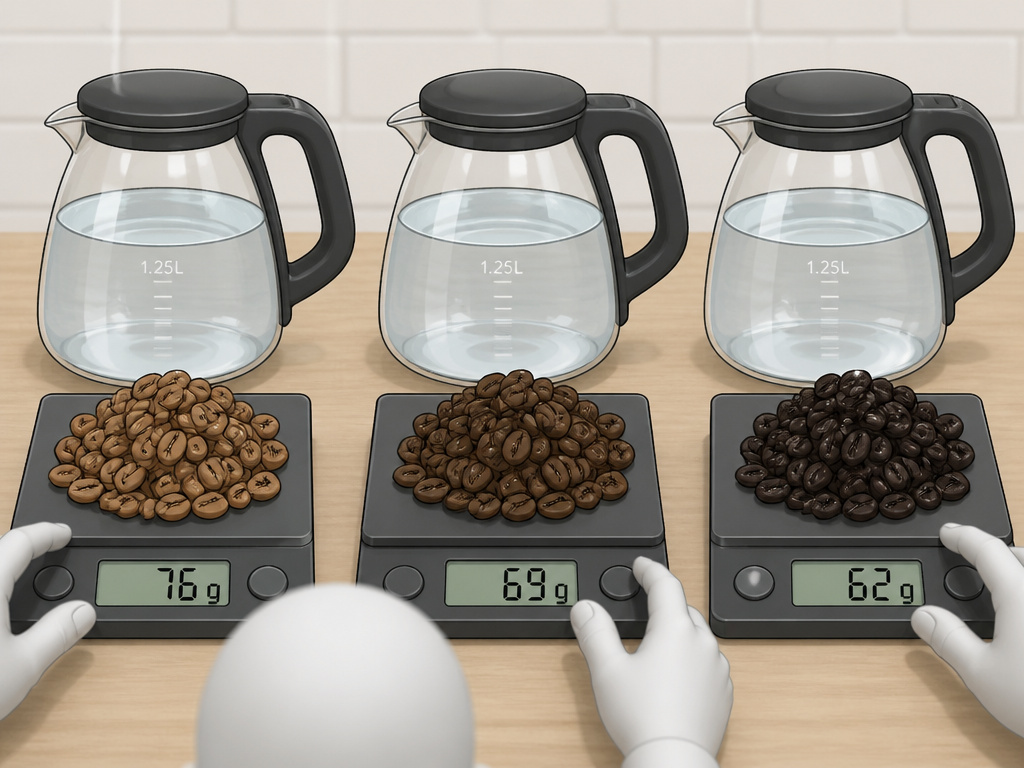
Coffee density changes with roast. Dark roasts lose moisture and mass, becoming more porous. Light roasts retain density. This physical difference changes extraction speed dramatically.
A dark roast exposes more surface area to water. It extracts faster. If you use the SCA’s 1:18 ratio with a dark French roast, the water will over-extract bitter flavors before the cycle finishes. The fix is to use 10% less coffee or a slightly coarser grind. For that 69-gram pot, drop to about 62 grams.
A light or blonde roast is dense. Water penetrates slower. Using the standard ratio often leads to a sour, weak cup because the water under-extracts. The fix is to use 10% more coffee or a finer grind. Bump that 69-gram pot up to around 76 grams. This adjustment is why a pre-ground “breakfast blend” never tastes right in your single-origin light roast recipe.
| Roast Level | Coffee Mass Adjustment (from SCA 1:18) | Why It Works |
|---|---|---|
| Light / Blonde | +10% (e.g., 76g for 1.25L) | Compensates for denser bean, slower extraction. |
| Medium | No change (e.g., 69g for 1.25L) | Matches SCA standard for balanced extraction. |
| Dark | -10% (e.g., 62g for 1.25L) | Prevents over-extraction from porous beans. |
This table is your cheat sheet. It turns a generic ratio into a personalized recipe. The impact of using the wrong coffee grind consistency compounds this effect, a blade-ground dark roast will be a muddy, bitter disaster.
Scoops, Scales, and the Truth About Volume Measuring
A tablespoon is a volume measure. Coffee grounds have air between them. A scoop of fluffy light roast weighs more than a scoop of oily, settled dark roast. The variance can be 2-3 grams per tablespoon. For a pot needing 8 tablespoons, that’s a 16-24 gram swing, enough to turn your brew from balanced to undrinkable.
The only reliable method is a digital scale. A $20 scale lasts for years and eliminates the guesswork. Place your empty carafe on the scale, tare it, add water to the 1.25L mark, then calculate your coffee weight (water ml x 0.055). Tare again, and add grounds until you hit that target gram count.
If you must use a scoop in a pinch, know its true weight. Scoop your usual coffee, then weigh it. My “heaping tablespoon” of a specific blend vs single origin coffee weighs 6.5 grams. Now I know that my 69-gram pot requires about 10.5 of those scoops. It’s still less accurate, but it’s calibrated.
I stopped using scoops after a month of inconsistent pots. My light roast Ethiopian needed 11 scoops to hit 76 grams, while my dark Sumatra needed only 9 scoops for 62 grams. The scoop count changed every time I opened a new bag. The scale reads the same number regardless of bean.
Water Quality and Basket Capacity: The Final Constraints
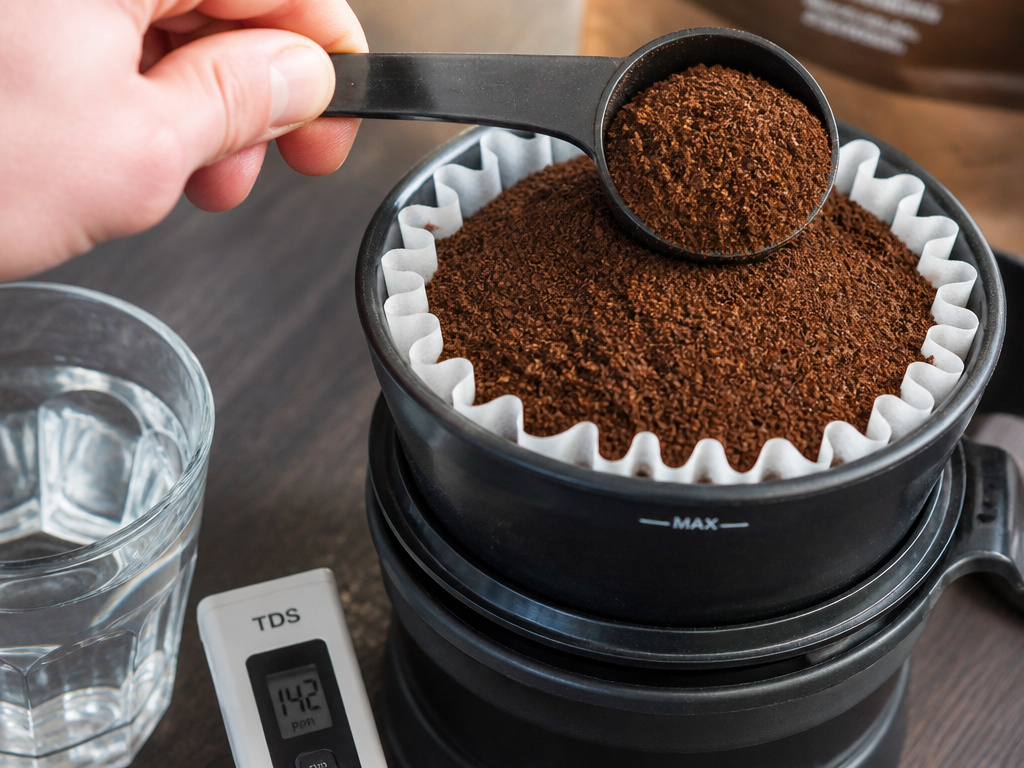
Two hidden variables can break your perfect ratio: your water’s mineral content and your brewer’s basket size. The Specialty Coffee Association recommends water with 150 mg/L of Total Dissolved Solids (TDS). Very soft water lacks minerals to facilitate extraction, potentially requiring a slightly finer grind or less coffee. Very hard water can over-extract, needing a coarser grind or more coffee.
Your brew basket has a physical limit. Overfilling it, piling grounds above the max line, chokes water flow. The water channels around the coffee, leading to a weak, under-extracted pot. Always check your basket’s capacity. If your calculated coffee volume looks like a mountain, you need to reduce the dose or use a larger basket if your machine allows it. This is a common issue when switching to a lighter roast, which is bulkier.
Choosing the right bleached vs unbleached coffee filters also affects flow. Unbleached filters are thicker and can slow water passage slightly, a factor if you’re already near the basket’s capacity.
A Step-by-Step Guide for Any Pot
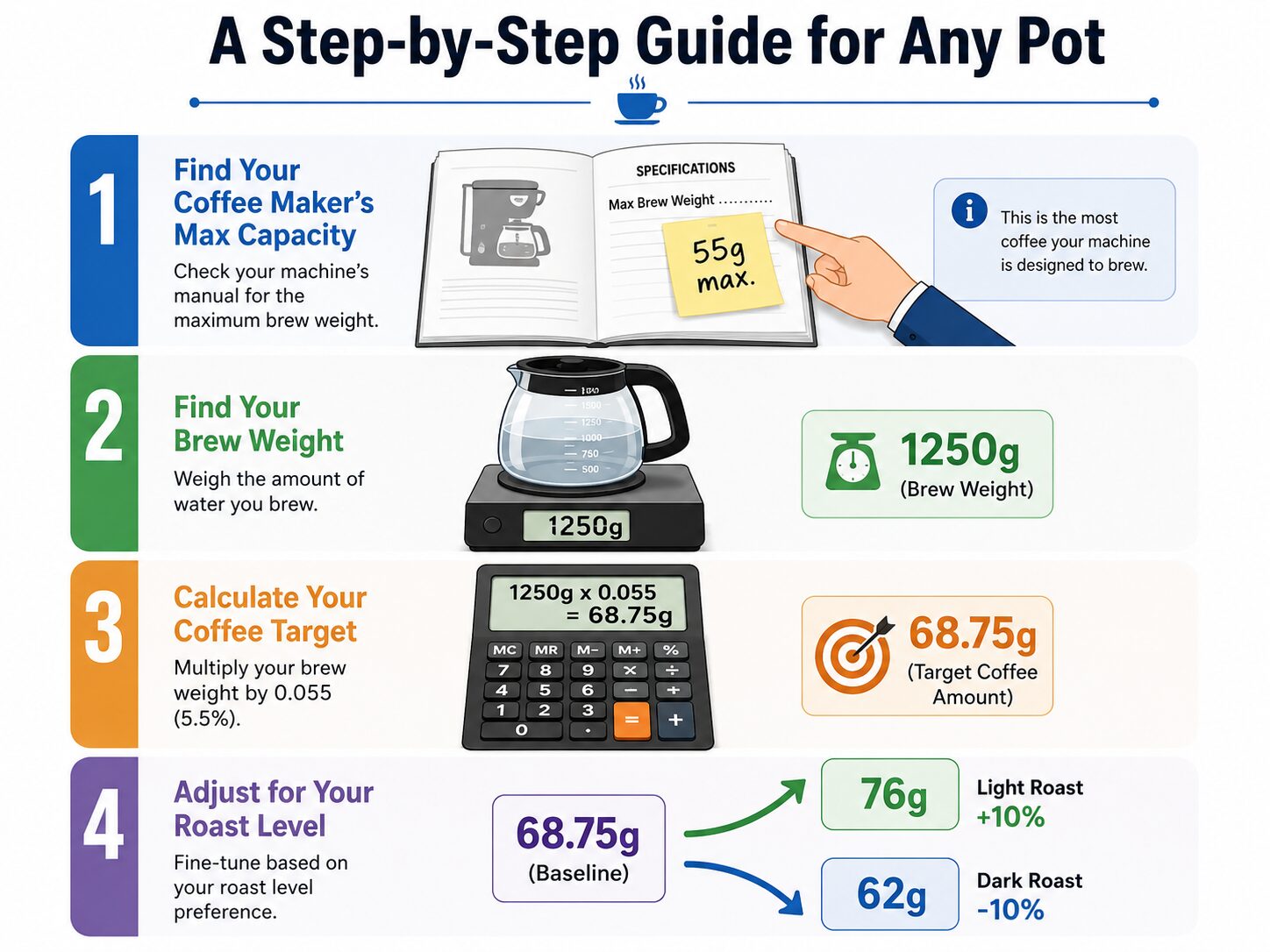
Follow this sequence every time you brew a full pot. It incorporates the ratio, the machine spec, and the roast adjustment.
- Check your brewer’s manual. Find the manufacturer’s recommended coffee weight for a full pot. Write it on a piece of tape and stick it to the machine’s side. This is your anchor.
- Weigh your water. Use a scale for the carafe. For an 8-cup pot, you’re aiming for 1.25 liters (1250 grams of water).
- Calculate the SCA baseline. Multiply your water weight in grams by 0.055. For 1250g water, that’s 68.75g coffee.
- Adjust for roast. Refer to the table above. For a light roast, add 10% (76g). For a dark roast, subtract 10% (62g).
- Reconcile with your machine’s spec. If your adjusted weight (e.g., 76g) is higher than your manual’s maximum (e.g., Bonavita’s 55g), use the manual’s number and compensate by grinding finer. The manual’s limit is about basket capacity, not taste.
- Grind fresh. Set your grinder to a medium consistency, similar to coarse sand. This is ideal for most drip machines.
- Weigh your coffee. Tare your scale with the empty basket and filter on it. Add grounds until you hit your target weight.
- Brew and taste. If the pot is sour, grind finer or increase coffee by 2-3 grams next time. If it’s bitter, grind coarser or decrease coffee by 2-3 grams.
Skipping step one means you might be fighting your machine’s design. Skipping step four means your light roast blonde roast coffee beans will always taste weak. Skipping step seven brings back the scoop inconsistency problem.
How This Applies to Other Brewing Methods
The core principle, weight over volume, adjust for roast, applies everywhere, but the ratios change. A French press uses a stronger 1:15 ratio (67g coffee per liter). A pour-over might use 1:16 (63g per liter). An Americano vs drip coffee comparison highlights how espresso dilution creates a different drink entirely, starting with a 1:2 ratio.
The method changes the math, but the workflow doesn’t. Weigh water, calculate coffee, adjust for roast, weigh grounds. This discipline is what separates a random cup from a repeatable, excellent one. Understanding these foundational ratios also clarifies the differences in brewed coffee vs cafe Americano, one is a direct infusion, the other a dilution of a concentrate.
Frequently Asked Questions
How many tablespoons of coffee for a 12-cup pot?
12-cup pot typically holds about 1.8 liters of water. Using the SCA’s 1:18 ratio, you need 99 grams of coffee. Since a tablespoon of ground coffee averages 5-7 grams, you’d need between 14 and 20 tablespoons. This massive range shows why weighing is critical. Always check your machine’s manual first.
Is 8 cups of coffee 8 measuring cups?
No. The “cup” on a coffee maker is not a standard 8-ounce measuring cup. It’s usually a 5-ounce serving. So an “8-cup” brewer uses about 40 ounces of water, which is 1.18 liters. This is why using a liquid measuring cup to fill your brewer is more accurate than counting the lines on the reservoir.
Why does my coffee taste bitter even when I follow the ratio?
Bitterness is a sign of over-extraction. The most common culprits are using too fine a grind for your machine, using a dark roast without reducing the coffee amount, or water that’s too hot. Try a coarser grind, reduce your coffee dose by 5%, or ensure your brewer’s temperature is between 195°F and 205°F.
Can I use the same amount of coffee for decaf?
Yes. Decaffeination doesn’t significantly alter bean density or extraction rate. Use the same weight you would for a regular medium roast. The flavor difference comes from the chemical process, not a need to change the ratio.
How does water hardness affect the coffee amount?
Very hard water can make coffee taste dull and over-extracted. You might get better results by using a slightly coarser grind or reducing your coffee dose by 2-3 grams. Conversely, very soft water can under-extract; a finer grind or a 2-3 gram increase in coffee can help. Using a Breville coffee machine filter or other built-in water filter can mitigate this.
The Bottom Line
Forget scoops. Buy a scale. Start with 69 grams of coffee for a standard 1.25-liter pot, then immediately check your brewer’s manual, it might tell you to use 55 or 48 grams instead. Adjust that number up for light roasts, down for dark roasts. Your brew basket’s max-fill line is the absolute limit; respect it.
The goal isn’t memorization. It’s building a process: weigh water, calculate coffee, adjust for roast, weigh grounds. Do that three times and the numbers become instinct. Your coffee maker and your Arabica vs Colombian coffee beans will stop fighting each other. The pot you brew on Tuesday will taste exactly like the pot you brew on Friday. That’s the real measure.
