
How Fine to Grind Coffee: A Guide to the Essential Factors
To determine how fine to grind coffee, match the particle size to your brewing method’s water contact time: fine like table salt for espresso (25-30 second contact), medium like sand for drip (3-4 minute contact), and coarse like breadcrumbs for French press (4+ minute contact). The correct grind creates the resistance needed for balanced extraction, where water dissolves the desirable flavors without pulling out harsh bitterness.
Most people grab a bag of beans, twist their grinder dial, and hope for the best. They chase sour shots or bitter cups without realizing the grind size itself is the primary control knob. It’s not about finding a magic number on your grinder. It’s about understanding the relationship between particle size, water flow, and time.
This guide walks through the physics of a coffee particle, provides a clear decision matrix for every major brew method, and explains how to dial in your grind for flavor, not just time.
Key Takeaways
- Grind size dictates extraction speed. Fine grinds slow water down, increasing contact time; coarse grinds let water rush through, decreasing contact time.
- Your target brew time is the best initial guide. Aim for 25-30 seconds for espresso, 3-4 minutes for pour-over, and 4+ minutes for immersion brews like French press.
- Particle distribution matters more than a single “perfect” size. High-quality burr grinders create more uniform particles, leading to even extraction.
- Taste overrules the clock. A sour cup means grind finer; a bitter cup means grind coarser, even if the brew time was “correct.”
- Different beans demand different grinds. A dense, light roast Ethiopian often needs a finer grind than a softer, dark roast Sumatran for the same method.
The Atomic Answer: Grind Size Defined by Brew Method
You need three pieces of information: your brewing method, your target brew time, and the observable texture of the grounds. Start with these benchmarks.
For espresso, target a particle size of 200-400 microns, yielding a 25-30 second extraction for a double shot. For filter coffee, target 500-800 microns, yielding a 3-4 minute brew. These ranges are drawn from commercial grinder specifications like the Mahlkönig EK43 and represent the industry standard for balanced extraction.
If your coffee tastes sour (under-extracted), your grind is too coarse. The water passed through too quickly, grabbing only the bright acids. If it tastes bitter and hollow (over-extracted), your grind is too fine. The water got stuck, over-dissolving the bitter compounds. The timer is a useful diagnostic, but your palate is the final judge.
TL;DR: Match grind size to brew time: fine for fast espresso, coarse for slow French press. Let taste guide your final adjustments.
The Physics of a Coffee Particle
Grinding coffee is about maximizing surface area. A whole bean exposes very little of its interior to water. Smash it into thousands of pieces, and you create a massive landscape for water to explore.
But there’s a catch. Smaller particles pack together more tightly. Think of filling a jar with gravel versus fine sand. Water flows easily through the gravel but struggles to penetrate the dense sand. This is the fundamental tension: more surface area for extraction versus more resistance to water flow. Your brewing method’s mechanics are designed to manage this resistance. An espresso machine uses 9 bars of pressure to force water through a fine, compacted puck. A French press relies on gravity and full immersion, needing a coarse grind so the water can freely circulate and the grounds can later be filtered out.
Common mistake: Grinding one batch for both espresso and drip coffee, the espresso will choke the machine and taste bitter, while the drip will brew in under two minutes and taste sour and weak.
The uniformity of those particles is critical. A blade grinder or a worn burr grinder produces a wide range of particle sizes, from boulders to dust. The fines (dust) will over-extract and turn bitter quickly, while the boulders will under-extract and leave sour notes. This is why investing in a consistent burr vs blade grinders is the single most important upgrade for grind quality. A 2023 study in Scientific Reports found that the proportion of fines in a grind significantly alters extraction dynamics, often leading to channeling in espresso. This is why the Scientific Reports study on espresso fines is a key reference for serious baristas.
Your Grind Size Decision Matrix
Use this table to find your starting point. Remember, “medium” on one grinder might be “fine” on another. Focus on the description and target outcome.
| Brew Method | Grind Texture | Target Time | If Too Fine | If Too Coarse |
|---|---|---|---|---|
| Turkish | Powder, like flour | 3-5 min boil | Will not foam properly; tastes astringent | Gritty, weak, and insipid |
| Espresso | Fine, like table salt | 25-30 sec (2oz shot) | Bitter, slow drip, potential channeling | Sour, gushes, thin body |
| Moka Pot | Fine-Medium, between espresso & drip | ~30 sec from first sound | Bitter, metallic, may clog | Sour, weak, insufficient pressure |
| AeroPress | Medium-Fine, like fine sand | 2-3 min total immersion+press | Difficult plunge, bitter cup | Fast, watery, sour plunge |
| Pour-Over / Drip | Medium, like beach sand | 3-4 min total drawdown | Bitter, clogged filter, long drawdown | Sour, fast drawdown (<2:30) |
| French Press / Cold Brew | Coarse, like breadcrumbs | 4+ min (FP) / 12-24 hrs (CB) | Silty, over-extracted, bitter | Thin, weak, under-extracted |
TL;DR: Start with the texture and time in this table. Your first brew is a diagnostic, note the time and taste, then adjust your grinder one small notch accordingly.
How to Dial In Espresso (The Finest Point)
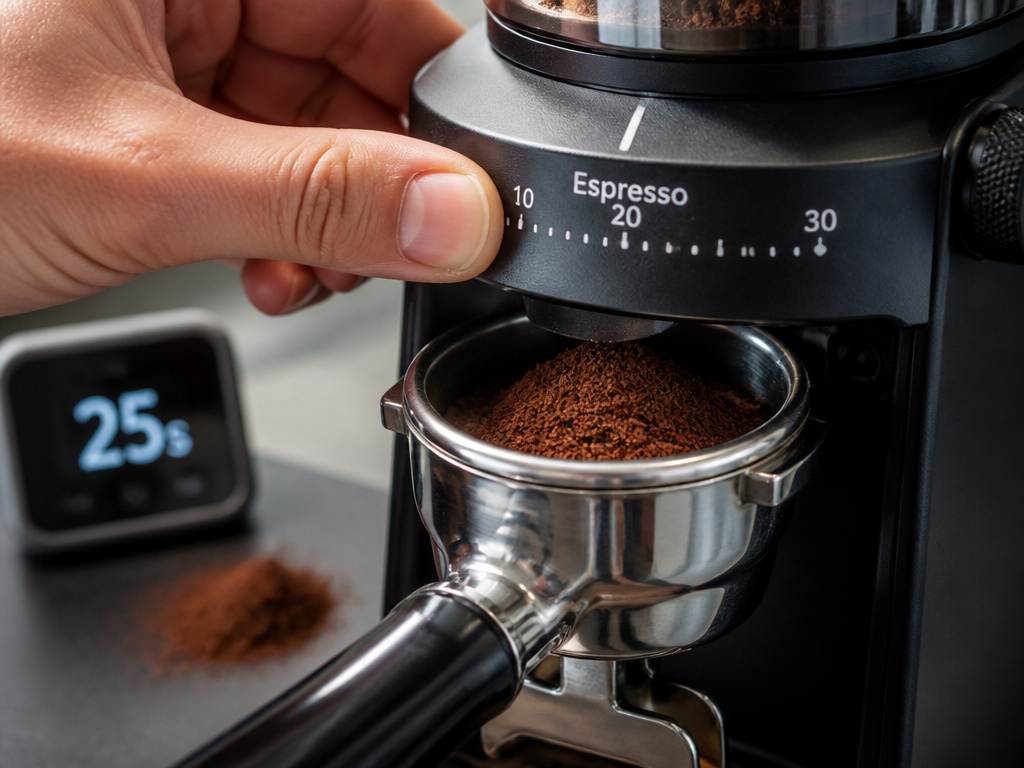 Espresso is the most demanding application for grind size. A difference of one-tenth of a turn on a premium grinder can shift your shot time by five seconds. The standard rule is 18 grams of coffee yielding 36 grams of liquid in 25 to 30 seconds.
But that’s just the consensus starting point. Some machines and beans break the rule. On a Slayer Espresso machine or any device with pre-infusion, baristas often grind significantly finer. They might use a 40-second shot with a long, low-pressure pre-infusion to achieve higher, sweeter extraction. This directly contradicts the La Marzocco Linea PB training guideline of 25-30 seconds. It works because the gentle pre-infusion evenly saturates the ultra-fine puck before pressure ramps up, preventing the channeling that would doom the same grind on a standard machine.
Here is your dial-in sequence: 1. Weigh 18g of beans. Grind at your machine’s suggested “espresso” setting. 2. Pull a shot and time it. Start the timer when you hit the brew switch. 3. Weigh the output. Stop the shot at 36g. 4. Analyze. Was the time 20 seconds? Grind finer. Was it 40 seconds? Grind coarser. 5. Taste. Hit 28 seconds but it’s sour? Grind a touch finer or increase your yield to 40g. Hit 28 seconds but it’s bitter? Grind a touch coarser or decrease your yield to 32g.
I dialed in a new bag of a light-roast Ethiopian this morning. At my grinder’s standard setting, the shot gushed out in 18 seconds and tasted like lemon juice. I made two full steps finer. The next shot took 33 seconds and tasted of jasmine and peach. The timer was “wrong,” but the taste was right.
Every time you change the grind, purge a few grams of coffee. Old grounds stuck in the grinder chamber will contaminate your new setting. This waste is frustrating but non-negotiable for consistency. The European Food Research and Technology journal article on puck preparation underscores how inconsistent grinds lead to unreliable extraction, validating the purge.
Navigating Filter Coffee: Pour-Over and Drip
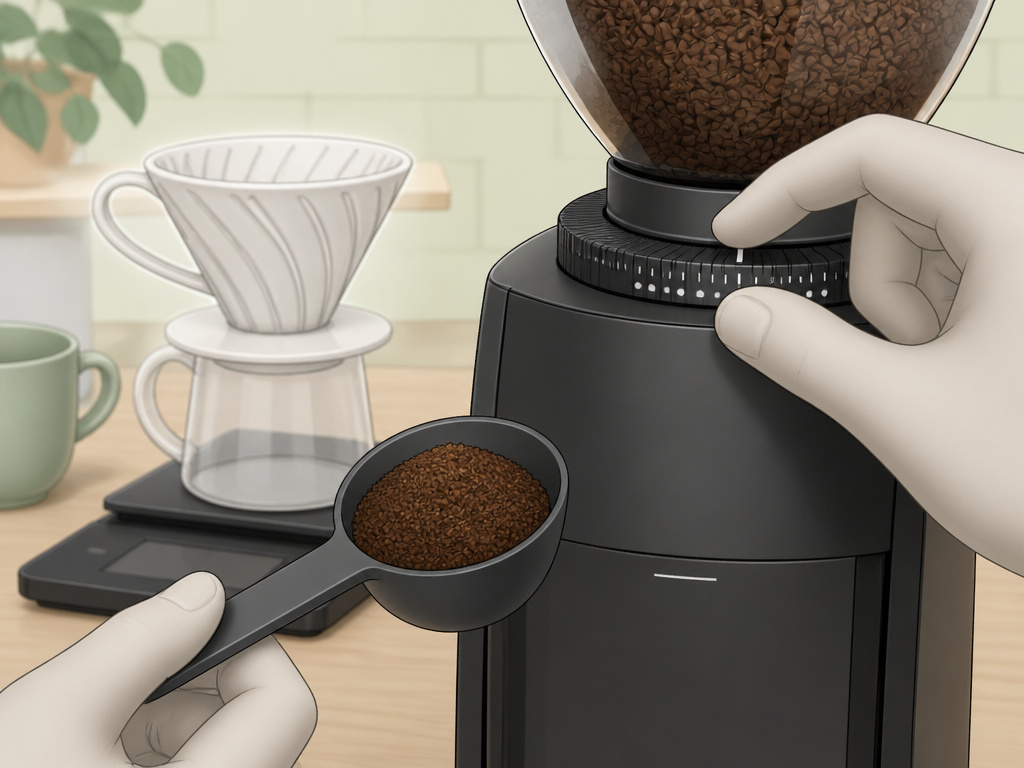 For methods like V60, Chemex, or automatic drip, your target is a total brew time, from first water contact to the last drop, of 3 to 4 minutes. The grind should resemble clean, fine sand.
Your variables are more forgiving than espresso, but the principles are the same. A grind that’s too fine will clog the paper filter, creating a long, bitter drawdown. A grind that’s too coarse will let water sprint through, resulting in a sour, under-developed cup. The type of paper coffee filters you use also plays a role; thicker filters like Chemex brand papers require a slightly coarser grind than the thinner V60 papers to maintain flow.
The pour-over adjustment ritual:
- Brew your recipe.
- Note the final time.
- If it finished in 2:30 and tastes sour, grind finer.
- If it finished in 4:30 and tastes bitter, grind coarser.
- Adjust in small increments. One notch on a Baratza Encore can change your drawdown by 15-20 seconds.
This is where bean density really shows up. A hard-bean, high-altitude single-origin coffees like a Kenyan might need a slightly finer grind than a softer Brazilian bean to hit the same brew time, all else being equal.
The Coarse End: French Press and Cold Brew
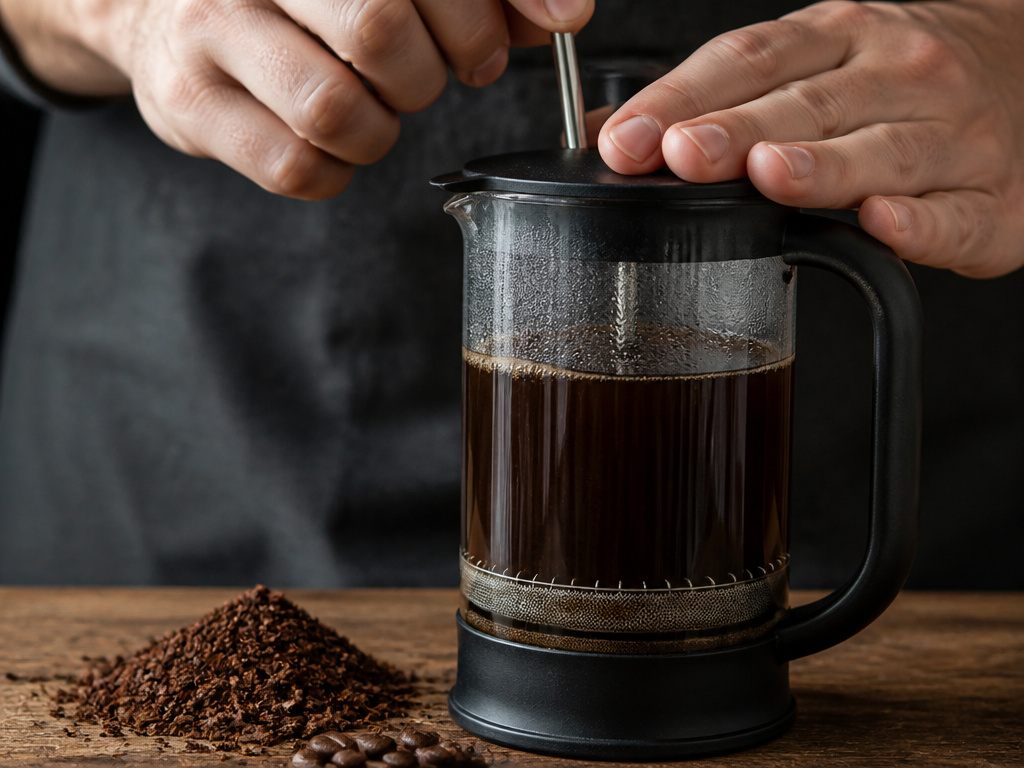 Immersion brewing is the most forgiving, but you can still screw it up. For French press, a coarse grind is non-negotiable. You need particles big enough to be trapped by the metal mesh filter. A medium or fine grind will pass through, leaving a thick, silty sludge at the bottom of your cup, and an over-extracted, bitter taste throughout.
The visual test is reliable. Your grounds should look like coarse breadcrumbs or cracked pepper. If they look like sand, it’s too fine. Steep for 4 minutes, plunge slowly, and pour. Cold brew takes this to the extreme. Because it steeps for 12-24 hours in cold water, extraction is slow. A coarse grind is essential to avoid a powerfully bitter concentrate. If you only have a blade grinder, pulse it very briefly for a chunkier result, or explore coarse grind alternatives if necessary.
Common mistake: Using espresso-ground coffee in a French press, the result is an unfilterable, bitter mud that coats your tongue. You’ll waste coffee and need to scrub the press.
When the Standard Rules Don’t Apply
Some methods flip the rulebook. Turkish coffee demands a grind finer than espresso, a powder so fine it feels like flour between your fingers. This allows it to stay suspended in the tiny ibrik and create the signature foam. There is no “too fine” here, only “not fine enough,” which yields a gritty, weak drink.
On the opposite end, some modern espresso techniques, as mentioned, use coarser grinds. The “turbo shot” trend involves grinding almost at a drip coffee coarseness, then pulling a very fast, high-yield shot to achieve a different, often tea-like, flavor profile. It works by reducing puck resistance and minimizing channeling risk. This highlights a key insight: the “correct” grind is the one that delivers the flavor you want with your specific equipment. The brewing method differences between an Americano and a drip coffee start with this fundamental grind divergence.
Your equipment’s specific needs also matter. A Bunn commercial brewer is engineered for a specific flow rate, often requiring a precise grind to match its spray head and timer. Using the wrong Bunn coffee maker filters or a wildly off grind can throw the whole system out of balance. Similarly, machines with built-in grinders, like many Breville models, have their own calibration. The grind setting “5” on a Breville Barista Touch is specific to its internal burr set and must be dialed in relative to that machine’s pump pressure, not a standalone grinder’s numbers.
Frequently Asked Questions
Can I use pre-ground coffee?
You can, but you surrender control. Pre-ground is typically a medium grind optimized for automatic drip machines. It will be too coarse for good espresso and too fine for a clean French press. The coffee also begins staling immediately after grinding. For any method where taste matters, grinding fresh is the first step.
My coffee is always bitter. Is my grind too fine?
Likely yes, especially if the brew time is slow. Try grinding one full step coarser. If you’re making espresso and the shot drips slowly, this is almost certainly the issue. For drip, a bitter cup coupled with a drawdown over 4:30 minutes points to a too-fine grind clogging the filter.
Why does my grinder have numbers if they’re not universal?
The numbers are relative markers for repeatability on that specific grinder. The “12” on a Baratza Virtuoso is not the same as “12” on a Fellow Ode. Manufacturers use different threading, burr sizes, and calibration points. Use the numbers to remember your settings for different beans or methods, not to compare across brands.
How does roast level affect grind size?
Darker roasts are more brittle and porous, so they break apart more easily. You often need a slightly coarser grind for a dark roast than for a dense light roast to achieve the same brew time. A blonde roast beans might need a finer setting to slow the water down enough for proper extraction.
Is there an ideal grind size for all methods?
No. This is the core concept. The ideal grind size is a moving target defined by brew time, pressure, and filtration method. Searching for one universal setting is why so many people get frustrated. Embrace the need to adjust.
Before You Go
Grind size isn’t a mystery. It’s a direct lever controlling extraction time. Start with the texture and timing guidelines for your method, fine and fast for espresso, coarse and slow for French press. Use your first brew as a diagnostic. Then, let taste guide your adjustments: sour means grind finer, bitter means grind coarser.
Remember that your equipment, from your grinder’s consistency to your machine’s pressure, sets the playing field. A great espresso-based drinks starts with a grind dialed in for your specific portafilter and pump, not a generic recipe. Don’t fear the waste of purging your grinder when you make a change. That small sacrifice is the price of a balanced, delicious cup. Now, go tweak that dial.
