
How Do You Decaffeinate Coffee? Comparing Major Techniques
To decaffeinate coffee, manufacturers use a solvent, water, or pressurized carbon dioxide to extract caffeine molecules from hydrated green coffee beans before roasting. The three dominant methods are the direct solvent method (using methylene chloride or ethyl acetate), the Swiss Water Process, and the supercritical CO₂ method.
Most people assume decaf means zero caffeine and zero chemicals. They’re wrong on both counts. Decaffeination is a trade-off between efficiency, cost, and flavor preservation, and the method used directly shapes what’s in your cup.
This guide breaks down how each decaffeination process works, the specific safety regulations governing chemical residues, and what “99.9% caffeine-free” actually means for your morning brew.
Key Takeaways
- No decaf is 100% caffeine-free; the Swiss Water Process removes 99.9%, while other methods may leave 2–4%.
- Chemical solvents like methylene chloride are regulated to ultra-low residue limits (10 ppm in the US, 2 mg/kg in the EU) deemed safe by food authorities.
- The Swiss Water Process uses only water and carbon filters, making it the only certified organic and chemical-free method.
- Decaffeination always happens on green, unroasted beans because roasting would destroy the delicate extraction machinery.
- Your choice of method impacts flavor: solvents can strip some nuance, while water-based methods aim to preserve origin characteristics.
The Three Main Decaffeination Methods Explained
All decaffeination starts with green coffee beans. Roasting expands the bean’s internal structure and locks in flavors, but it also makes extracting a specific molecule like caffeine nearly impossible. So processors soak the raw beans to open their pores. What happens next defines the method, and the final cup.
The goal isn’t just to remove caffeine. It’s to remove only the caffeine. Every other compound contributing to flavor and aroma should ideally stay put. That’s the engineering challenge.
Green coffee beans are steamed or soaked to expand their cellular structure, then subjected to a caffeine-selective extraction medium, a chemical solvent, water, or supercritical carbon dioxide. The caffeine-laden medium is then removed, and the beans are rinsed, dried, and shipped for roasting.
The Direct Solvent Method: Methylene Chloride and Ethyl Acetate
This is the workhorse of the decaf industry because it’s fast, cheap, and effective. Beans are steamed, then repeatedly rinsed with a chemical solvent that bonds with caffeine molecules. The solvent, now saturated with caffeine, is drained away. The beans get a final steam bath to evaporate any residual solvent before drying.
Two solvents dominate: methylene chloride (dichloromethane) and ethyl acetate. Their safety profiles and effects on flavor differ.
Methylene Chloride (DCM) is the more common industrial solvent. It’s excellent at targeting caffeine with minimal impact on other flavor compounds. The fear factor comes from its classification as a potential carcinogen in high, prolonged inhalation exposures (like in paint-stripping factories). However, food-safety agencies strictly control its residue in coffee.
The US Food and Drug Administration limits residual methylene chloride in roasted decaf beans to 10 parts per million (0.001%). The European Food Safety Authority sets a maximum of 2 milligrams per kilogram. Both agencies state that exposure from decaf coffee consumption is not a health concern.
Ethyl Acetate is often marketed as a “natural” solvent because it occurs in fruits. In practice, the industrial-grade version used in decaffeination is synthetically produced. It is less selective than methylene chloride, meaning it can extract some flavor compounds alongside caffeine. Some roasters claim this gives decaf a faintly fruity note; others say it flattens the profile.
TL;DR: Chemical solvents are efficient and dominate the market. Methylene chloride is tightly regulated and leaves flavor largely intact; ethyl acetate is less selective and can alter taste.
The Swiss Water Process: Chemistry Without Chemicals
This method uses only water, temperature, time, and carbon filters. It’s the only process certified organic and kosher because it introduces no foreign chemicals.
Here’s the clever part: it uses a batch of already decaffeinated beans to protect the flavor of new beans.
First, a batch of green beans is soaked in hot water. This creates a solution saturated with both caffeine and all the soluble flavor compounds, called Green Coffee Extract (GCE). This GCE is passed through activated carbon filters sized to trap only the large caffeine molecules, leaving the flavor-saturated water behind.
Now you have caffeine-free GCE. A new batch of green beans is immersed in this GCE. Since the water is already saturated with flavor compounds, only the caffeine migrates out of the beans and into the solution. The beans’ original flavor profile remains largely undisturbed.
The process is slow and expensive, but it yields beans that are 99.9% caffeine-free without chemical residues. It’s a favorite among specialty roasters focused on origin character.
Common mistake: Assuming “Swiss Water” means the beans are washed with Swiss alpine water. It’s a patented process name, not a geography claim. The water is purified, but it’s the Green Coffee Extract and carbon filtration that do the work.
The Supercritical CO₂ Method
This is the high-tech option. Carbon dioxide is heated and pressurized until it reaches a “supercritical” state, a fluid that can diffuse through solids like a gas but dissolve materials like a liquid.
In this state, CO₂ is pumped into a vessel with pre-soaked green beans. It acts as a selective solvent, bonding with and removing caffeine. The caffeine-rich CO₂ is then passed through a water wash or carbon filter to strip out the caffeine, allowing the CO₂ to be recycled back into the system.
It’s highly efficient and leaves no chemical residue. However, the equipment is extremely costly, making it less common than solvent or water methods. It’s prized for preserving flavor well, often sitting between methylene chloride and Swiss Water in quality perception.
| Method | Agent Used | Caffeine Removal | Flavor Impact | Primary Use Case |
|---|---|---|---|---|
| Direct Solvent (DCM) | Methylene Chloride | ~97% | Minimal; best flavor preservation among chemicals | Large-scale commercial decaf |
| Direct Solvent (EA) | Ethyl Acetate | ~97% | Can impart faint fruitiness; less selective | Marketed as “naturally decaffeinated” |
| Swiss Water Process | Water & Carbon Filters | 99.9% | High preservation of origin character | Organic, specialty, and kosher decaf |
| Supercritical CO₂ | Pressurized Carbon Dioxide | ~99% | Very good preservation; clean finish | High-end specialty decaf |
Is Decaf Coffee Safe? Understanding Chemical Residues
The word “chemical” triggers alarm. When that chemical is methylene chloride, banned in paint strippers, the fear feels justified. But the regulatory science is clear and specific.
The FDA’s 10 ppm limit for methylene chloride residue isn’t an arbitrary number. It’s a level set orders of magnitude below any observed effect in animal studies, with a massive safety buffer for human consumption. To exceed it, you’d need to consume an implausible amount of decaf daily.
The EFSA’s 2020 scientific opinion concluded that “exposure to DCM from the consumption of decaffeinated coffee is not a health concern.” This assessment is based on the 2 mg/kg maximum residue level enforced in the EU.
Think of it this way: the solvent is a tool that’s almost entirely removed after its job is done. The trace amounts that remain are so small they pose no measurable risk under current toxicological models. This is a settled issue among food safety authorities.
The real choice isn’t about safety, as both chemical and non-chemical methods meet strict standards. It’s about personal preference and priorities, whether you prioritize absolute chemical avoidance (choosing Swiss Water or CO₂) or you trust the regulatory science and perhaps prefer the flavor profile of solvent-decaffeinated beans.
TL;DR: Chemical residues in decaf are regulated to negligible levels confirmed as safe by US and EU food agencies. The safety debate is more about personal philosophy than toxicological risk.
Does Decaf Have Any Caffeine?
Yes. “Decaffeinated” is a regulated term, not an absolute claim. In the US, coffee must have at least 97% of its caffeine removed to earn the label. The Swiss Water Process achieves 99.9% removal. But 97% removal of a high-caffeine bean still leaves a small amount behind.
A typical 8-ounce cup of brewed decaf might contain 2 to 5 milligrams of caffeine. A regular cup of the same size holds 80 to 100 milligrams. So decaf isn’t a caffeine-free alternative for those with extreme sensitivity or certain medical conditions. For most people swapping for sleep reasons, the reduction is massive and effective.
A 2006 study from the University of Florida tested ten decaf coffees and found caffeine in nine of them, with amounts ranging up to 13.9 mg per 16-ounce serving. That’s about what you’d find in a can of Coke. If you’re drinking multiple large decafs, you could be getting a mild stimulant dose.
This matters if you’re strictly monitoring intake. If you need zero caffeine, you’re better off with a caffeine-free herbal tea or a roasted grain beverage.
How Decaffeination Impacts Flavor and Your Choice
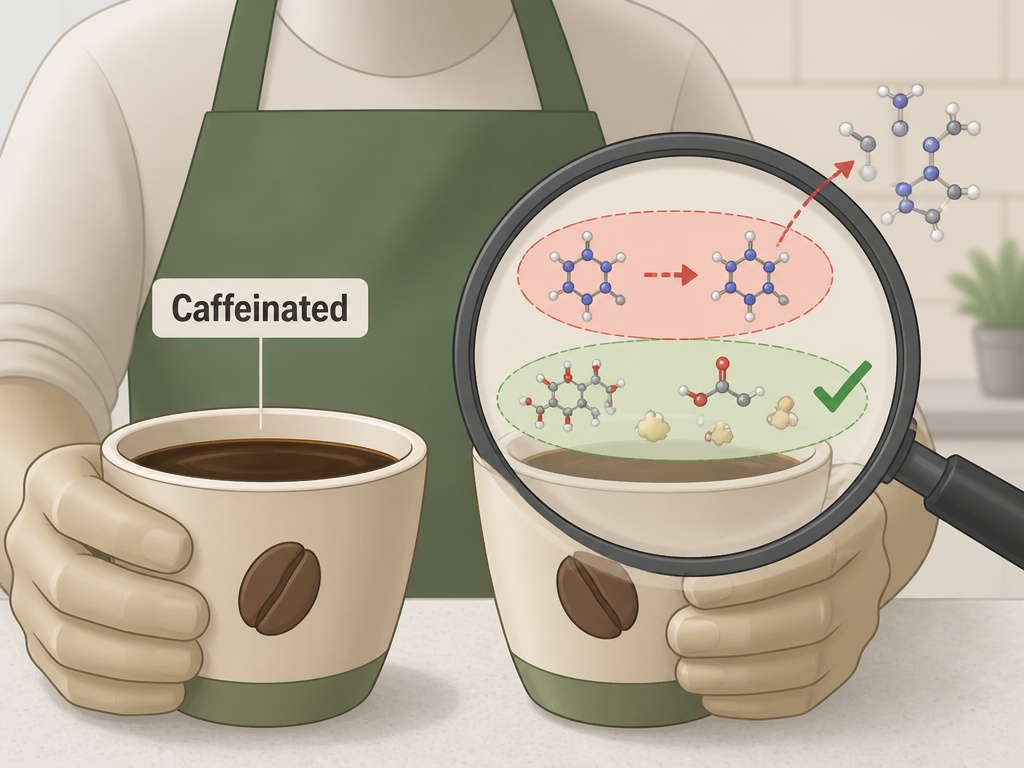
The method changes the cup. It’s not just marketing.
Chemical solvents, especially methylene chloride, are remarkably good at targeting only caffeine. Many professional cuppers struggle to distinguish a high-quality bean decaffeinated with DCM from its caffeinated counterpart in blind tastings. The BBC Future decaffeination explainer notes that solvent methods were developed precisely to improve upon early water processes that destroyed flavor.
The Swiss Water Process, while chemical-free, isn’t perfect. The prolonged hot water bathing can sometimes leach out some sugars and acids, potentially muting the very high notes and complexity that define a stellar single-origin bean. Proponents argue any flavor loss is minor and preferable to chemical contact.
Your choice should follow your priorities:
1. Absolute chemical avoidance: Choose Swiss Water Process or Supercritical CO₂. Look for these terms on the bag.
2. Best possible flavor preservation: A high-quality bean decaffeinated with methylene chloride often wins in blind tastings.
3. Ethical/organic sourcing: Swiss Water is the only method allowed for organic certification in many markets.
4. Cost-consciousness: Solvent-decaf is usually cheaper due to higher throughput and lower capital costs.
Don’t let anyone tell you decaf can’t be delicious. The worst decaf is bad because it started with bad beans, not because it lost its caffeine. Start with a high-quality bean from a roaster who is transparent about their decaffeination process. The University of Queensland public health article emphasizes that consumer choice is now wider than ever, with clarity on methods driving better products.
Before You Start: Selecting and Brewing Decaf

Decaf beans are more fragile. The decaffeination process, especially the initial steaming and prolonged soaking, makes the beans slightly more porous and brittle. This changes how you should store and brew them.
- Grind fresh, brew quickly. The increased surface area means decaf grounds stale faster. Grind immediately before brewing.
- Use slightly cooler water. Aim for 195°F to 200°F instead of a rolling 205°F. The more delicate structure extracts faster, and cooler water can prevent over-extraction and bitterness.
- Store airtight, in the dark. Oxygen is the enemy. Use a sealed container in a cupboard, not the freezer.
- Expect a faster flow. If you’re an espresso drinker, you may need to grind a touch finer for decaf to achieve the same shot time. The porous puck offers less resistance.
Following these tweaks can bridge the gap between a good decaf and a great one. It acknowledges the bean’s physical change instead of pretending it doesn’t exist.
Frequently Asked Questions
Is decaf coffee bad for you?
No. Based on current regulations and scientific assessments, decaf coffee is safe for general consumption. The trace chemical residues from solvent methods are well below safety thresholds. Decaf retains most of the antioxidants found in regular coffee, offering similar health benefits without the stimulant.
Which decaf method is best?
There’s no single “best” method. Methylene chloride (DCM) is best for flavor preservation on a commercial scale. The Swiss Water Process is best for a chemical-free, organic option. Your “best” depends on whether you prioritize taste, purity, or cost.
Why is decaf more expensive?
The decaffeination process adds an extra, resource-intensive step between harvesting and roasting. The Swiss Water and CO₂ methods are particularly slow and equipment-heavy, increasing cost. You’re paying for the additional processing, not just the beans.
Can I decaffeinate coffee at home?
No. The processes require industrial-scale equipment, precise control of solvents or supercritical gases, and the ability to handle green coffee beans. Home methods like soaking roasted beans in water just make weak, flavorless coffee, as they remove everything, not just caffeine.
Does decaf taste different?
It can, but not necessarily worse. Decaffeination may mute some of the most volatile high notes in very complex coffees. However, a well-processed decaf from high-quality beans can be rich, sweet, and satisfying. The difference is often subtle and overshadowed by bean quality and roast.
The Bottom Line
Decaffeination is a feat of food science, balancing chemistry, engineering, and gastronomy. The method etched on your bag of beans tells a story about trade-offs, between efficiency and purity, cost and flavor, scale and craft.
Your choice ultimately hinges on what you value in the cup. If unwavering chemical avoidance matters most, seek out Swiss Water or CO₂. If you’re chasing the purest expression of a stellar single-origin and trust the science, a methylene chloride decaf might surprise you. And remember, no decaf is truly caffeine-free, but the reduction is profound.
The next time you pick up a bag, look past the “decaf” label. Find the method. That’s where the real conversation about your coffee begins.
