
How Do They Make Decaf Coffee? Swiss Water & CO2 Processes
Decaf coffee is made by removing caffeine from unroasted, green coffee beans using water, chemical solvents, or pressurized carbon dioxide. The three primary methods are the Swiss Water Process (water and carbon filters), solvent-based decaffeination (using methylene chloride or ethyl acetate), and the CO2 Process (supercritical carbon dioxide). Each method targets caffeine while attempting to preserve the bean’s inherent flavor compounds.
Most people think decaf is just regular coffee with the caffeine stripped out, leaving a bland, hollow version of the real thing. That assumption is why so many are disappointed by their first cup of supermarket decaf. The truth is more interesting. The method used to strip the caffeine directly shapes what ends up in your mug, its flavor, its aroma, and even how much of a stimulant kick it still packs.
This guide walks through the chemistry and mechanics of the three main decaffeination processes. You’ll learn why a “natural” label can be misleading, how much caffeine actually remains, and which method a seasoned coffee drinker picks when they need a late-afternoon cup that won’t keep them up.
Key Takeaways
- The Swiss Water Process is the only major method that uses zero chemical solvents, relying on water and carbon filtration to achieve 99.9% caffeine-free certification.
- “Natural” ethyl acetate decaf is often made with synthetic solvent because harvesting it from sugarcane is prohibitively expensive.
- Legal definitions matter: In the EU, roasted decaf coffee must have ≤0.1% caffeine by dry weight; instant decaf can have up to 0.3%.
- Roasting temperatures (200+ °C) evaporate almost all residual chemical solvents like methylene chloride, which boils at just 39.6 °C.
- No process removes 100% of caffeine. A typical cup of decaf still contains 2-5 mg of caffeine, versus 95 mg in a regular cup.
The 3 Main Decaffeination Methods Explained
Head-to-head, the differences between decaffeination methods aren’t just about chemicals versus water. They’re about what gets taken out alongside the caffeine. Flavor compounds are soluble, too. A rough process strips them clean, leaving a bean that tastes like wet cardboard no matter how you roast it.
The Swiss Water Process uses a proprietary Green Coffee Extract (GCE) solution, saturated with the soluble flavor components of coffee but not caffeine. When green beans steep in this GCE, caffeine migrates out until equilibrium is reached, leaving flavor molecules behind. The caffeine-laden GCE is then filtered through activated carbon, which traps the caffeine, and the clean GCE is reused.
The goal is selectivity. You want a process that grabs caffeine molecules and ignores everything else. That’s the theory. In practice, each method has a different fingerprint on the final bean.
Swiss Water Process: The Chemical-Free Contender
This method is the favorite for organic certifications and anyone wary of industrial solvents. It’s also slow. The beans undergo an 8 to 10-hour steaming and soaking cycle, moving through various baths. The magic is in the Green Coffee Extract. Because it’s already saturated with coffee’s good stuff, it acts like a flavor anchor, preventing those compounds from leaving the bean during the caffeine exchange.
You pay for that purity. Swiss Water decaf beans often cost 15-20% more than solvent-decaffeinated equivalents. The flavor profile tends to be milder, sometimes described as more “tea-like,” because some aromatic oils are inevitably lost in any water-based process. For single-origin beans where you’re paying for specific terroir notes, this is the method most specialty roasters choose. It’s the closest you get to tasting the bean, not the process.
TL;DR: Swiss Water uses flavor-charged water and carbon filters, costs more, and is the go-to for organic or specialty single-origin decaf.
Solvent-Based Methods: Methylene Chloride and Ethyl Acetate
Here’s where public perception gets messy. These methods use chemical solvents to dissolve and wash away caffeine. The beans are first steamed for about 30 minutes to swell and open their pores. Then they’re soaked in the solvent, often for up to 10 hours, before being steamed again to drive off the chemical, then dried and roasted.
Methylene Chloride (MC) is the workhorse. It’s highly efficient and used for the vast majority of global decaf production, especially for instant coffee. Its safety record is the sticking point. The FDA permits its use with a residual limit of 10 parts per million (ppm) in roasted coffee because it evaporates at a very low 39.6 °C. Roasting temperatures exceed 200 °C, so any trace amounts are vaporized long before grinding. The EU and Canada also allow it within strict limits. The fear is more about the name than the chemistry left in your cup.
Ethyl Acetate (EA) is often marketed as “natural” or “sugar cane decaf.” Ethyl acetate does occur naturally in ripening fruits and sugarcane. The reality, as highlighted in industry sources like Coffee Confidential, is that sourcing sufficient natural EA is expensive. Most decaffeination uses synthetically produced ethyl acetate. The process is the same as MC, but some claim EA can impart a faintly fruity or solvent-like note to the beans. It’s a trade-off: a “greener” marketing story for a potentially less neutral process.
| Method | Solvent Used | Common Labeling | Primary Trade-Off |
|---|---|---|---|
| Direct Solvent | Methylene Chloride | Rarely labeled; often just “decaffeinated” | Efficiency vs. consumer perception of chemical use |
| Direct Solvent | Ethyl Acetate | “Naturally Decaffeinated,” “Sugar Cane Decaf” | “Natural” marketing vs. frequent use of synthetic solvent |
| Swiss Water | None (Water) | “Swiss Water Process,” “99.9% Caffeine Free” | Higher cost, potentially milder flavor profile |
| CO2 Process | Carbon Dioxide | “CO2 Process,” “Sparkling Water Decaf” | High equipment cost, excellent flavor retention |
Common mistake: Assuming “natural” on an ethyl acetate decaf label means the solvent was sourced from plants. Due to cost, it’s often synthetic. The decaffeination process is identical either way.
CO2 Process: The High-Tech Middle Ground
Also called Supercritical CO2 extraction, this is the most technically sophisticated method. Green beans go into a stainless steel chamber. Liquid carbon dioxide is pumped in under immense pressure (70-300 atmospheres). Under these conditions, CO2 enters a “supercritical” state, it has the density of a liquid but the diffusivity of a gas. It acts as a super-efficient, selective solvent, penetrating the beans and dissolving the caffeine.
The caffeine-rich CO2 is then transferred to a separate chamber. When the pressure drops, the CO2 reverts to a gas, leaving the caffeine behind as a residue. The CO2 is captured and reused in a closed-loop system, making it environmentally tidy. The process is excellent at targeting caffeine molecules while leaving most flavor compounds intact. The downside is the multi-million-dollar equipment cost, which keeps this method in the domain of large-scale commercial decaffeinators. You’ll find it on higher-end decaf bags, but it’s less common than Swiss Water or solvent methods.
How Much Caffeine is Actually Left?
The term “decaffeinated” is a legal definition, not a promise of zero. Think of it as “significantly reduced.” According to the EU Directive 2009/32/EC, roasted decaf coffee cannot exceed 0.1% caffeine by dry matter weight. For instant decaf, the limit is 0.3%. The FDA doesn’t set a specific percentage but regulates solvent residues instead.
What does 0.1% translate to in your cup? A typical 8-ounce (236ml) cup of brewed decaf contains between 2 and 5 milligrams of caffeine. Compare that to 95 mg in a regular cup of coffee. That old Florida study cited in YouTube transcripts isn’t wrong, a double-shot decaf latte could indeed harbor as much caffeine as a can of Coke (around 30-40 mg). This residual caffeine is why some people who are extremely sensitive might still feel an effect.
If you’re managing your caffeine intake for health reasons, this is the number to watch. Switching to decaf dramatically reduces your load, but it doesn’t zero it out. This is particularly relevant for those following strict breastfeeding safety guidelines where every milligram counts.
A 2006 study conducted in Florida found that 9 out of 10 decafs they tested had at least some caffeine in them. So the two-shot decaf latte that you’re drinking might contain as much caffeine as a can of coke.
Does the Decaf Method Change the Taste?
Absolutely. It’s the biggest point of contention among coffee roasters. The process isn’t just removing caffeine; it’s a massive chemical intervention on a raw agricultural product. Each method leaves a signature.
Swiss Water beans can taste cleaner but sometimes muted. The water immersion inevitably leaches some sugars and acids, which can lead to a flatter, less complex cup. Great roasters compensate by selecting bean varieties with bold inherent flavors that can survive the bath.
Methylene Chloride is so selective and efficient that many roasters argue it preserves the original flavor profile better than any other method. The chemical itself leaves no taste because it’s completely removed. The fear is purely psychological, not gustatory.
Ethyl Acetate has more debate. Some tasters detect a residual fruity or nail-polish-remover note (ethyl acetate is used in many cosmetics). Others find it indistinguishable. The synthetic version is chemically identical to the natural one, so any flavor difference likely comes from variations in process control, not the solvent’s origin.
CO2 Process is praised for excellent retention of origin characteristics. Because the supercritical CO2 is so targeted, it’s like a precise surgical removal of caffeine with minimal collateral damage to flavor cells. You get the closest thing to a fully-caffeinated coffee’s taste profile.
Your best bet is to buy from a roaster that states the decaffeination method on the bag. If they’re proud of their process, they’ll tell you. A generic “decaffeinated” label almost always means methylene chloride.
What About Health and Safety?
The solvents are the obvious concern. Let’s follow the physics. Methylene chloride boils at 39.6 °C. The coffee beans are steamed after treatment to evaporate it. Then they are roasted at temperatures between 200-240 °C for 10-15 minutes. Any remaining trace amounts are physically incapable of surviving that thermal onslaught. The FDA’s 10 ppm limit is a conservative backstop; actual residues are typically far lower. A scientific explanation of decaf coffee from Phys.org details how modern methods aim to retain flavor while eliminating health risks.
Ethyl acetate is even less of a concern from a toxicity standpoint. It’s widely used as a flavoring agent in foods (it gives pears their distinctive smell). The FDA classifies it as GRAS (Generally Recognized As Safe). The issue, again, is transparency versus marketing.
For the truly risk-averse, the Swiss Water and CO2 methods provide a solvent-free path. They are the only options for coffee that is both certified organic and decaffeinated, as organic standards prohibit the use of synthetic chemical solvents. If you’re exploring lower-caffeine alternatives for health reasons, these methods offer the cleanest story.
Before you start: If you have severe chemical sensitivities or are pregnant, consult your physician. While solvent residues are minuscule, a zero-tolerance approach means choosing Swiss Water or CO2 decaf. Also, remember decaf still contains caffeine, manage your total daily intake accordingly.
Choosing Your Decaf: A Practical Guide
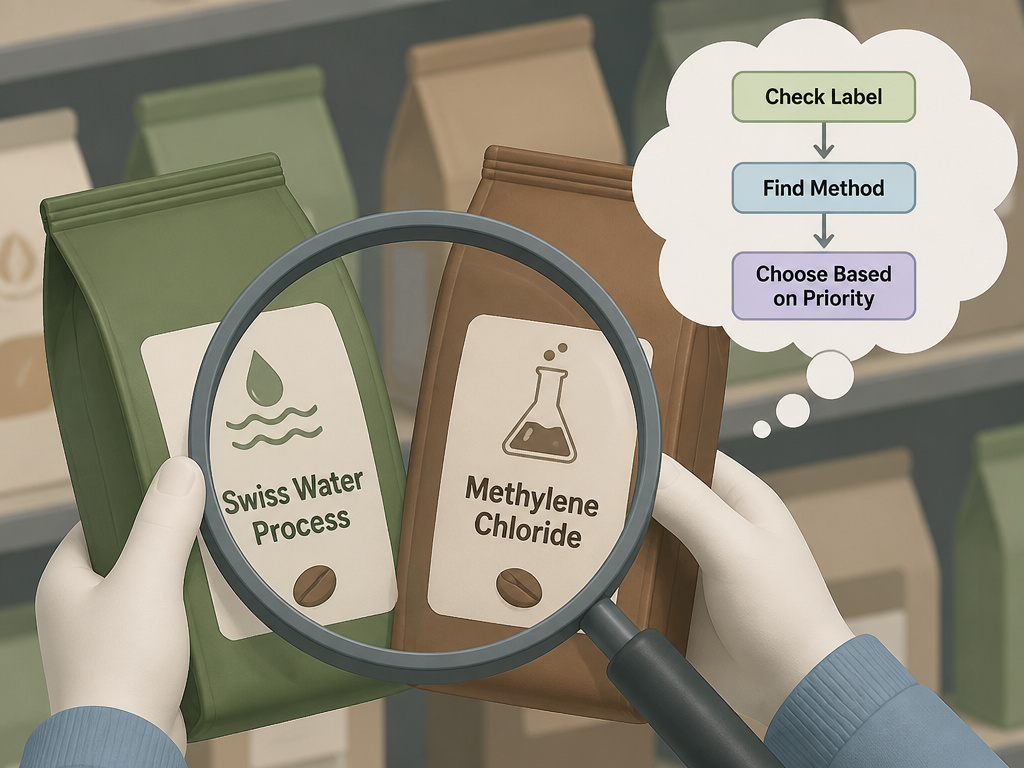
You’re standing in the coffee aisle. Here’s how to decode the bag and pick a winner.
First, look for the method on the label. If it doesn’t say, assume it’s methylene chloride. That’s not a bad thing, it’s likely the best tasting and most affordable. If you see “Swiss Water Process” or “CO2 Process,” you’re paying a premium for a specific production choice.
Second, consider the roast date, not the method, as the primary driver of freshness and flavor. Decaf beans stale at the same rate as regular beans. A freshly roasted methylene chloride decaf will beat a stale Swiss Water decaf every time.
Third, match the method to your priorities:
* Flavor Purist: Try a CO2 or high-quality methylene chloride decaf from a specialty roaster.
* Organic / Clean-Label Seeker: Swiss Water is your only reliable choice.
* Budget-Conscious: A generic methylene chloride decaf from a reputable brand is fine.
* Experimentation: Buy small bags of the same coffee bean decaffeinated by different methods and taste them side-by-side.
The brewing method matters too. Decaf beans can be slightly more porous and brittle after processing, which can affect grind consistency. If your decaf pour-over runs too fast, grind a touch finer. The principles of good brewing still apply, just as they do when comparing espresso caffeine content to filter coffee.
Frequently Asked Questions
Is decaf coffee 100% caffeine free?
No. No decaffeination process removes 100% of the caffeine. EU regulations allow up to 0.1% caffeine by dry weight in roasted decaf. A typical cup contains 2-5 mg of caffeine.
Which decaf method is the healthiest?
From a chemical residue perspective, the Swiss Water and CO2 processes use no chemical solvents and are considered the cleanest. However, regulatory bodies like the FDA and EFSA deem all approved methods (including methylene chloride) safe for consumption, as residues are negligible.
Why does some decaf coffee taste bad?
Poor taste usually stems from low-quality beans chosen for decaf (since the process can mask defects), over-processing that strips too many flavor compounds, or simply stale beans. Decaf goes rancid just as fast as regular coffee.
Can I drink decaf coffee if I’m pregnant?
Most health authorities advise limiting caffeine intake during pregnancy. Decaf is a good option to reduce caffeine, but it is not caffeine-free. Always consult your healthcare provider for personalized advice, especially regarding maternal caffeine limits.
Is ethyl acetate decaf really “natural”?
While ethyl acetate occurs in nature, the solvent used in decaffeination is often synthetically produced for cost and scale reasons. The “natural” label refers to the compound’s existence in nature, not necessarily its sourcing for industrial use.
Does decaf coffee have any benefits?
It provides many of the antioxidants found in regular coffee without the stimulant effects. This can be beneficial for people who enjoy coffee but are sensitive to caffeine, have anxiety disorders, or need to limit their intake late in the day.
Before You Go
Decaf coffee isn’t a fraud or a failure. It’s a feat of food science, a balancing act between removing one specific molecule and leaving hundreds of others untouched. The method stamped on the bag tells you what that balance was, speed and efficiency with solvents, purity and cost with water, or precision and technology with CO2.
Your takeaway shouldn’t be fear of chemicals, but appreciation for choice. Want the classic taste? Don’t shy from methylene chloride. Demand organic purity? Seek out Swiss Water. Chase the perfect flavor replica? Hunt for CO2-processed beans. And always remember that a cup of decaf, like its fully caffeinated cousin, is a complex beverage with a story in every sip. That story begins not at the roastery, but in a decaffeination plant where green beans are washed, soaked, or pressurized long before they ever see heat.
