
Drip Coffee vs French Press Compared | Which Brew is Best?
Drip coffee vs French Press comes down to three things: the filter, the brew time, and who’s in control. Drip coffee uses a paper filter for a clean, bright cup in about 6 minutes, controlled by a machine. French press uses a metal mesh filter for a full-bodied, oily cup in about 4 minutes, controlled entirely by you.
Most people pick a side based on a single bad experience, a bitter French press sludge or a weak, lukewarm pot from a cheap drip machine. That first impression sticks. But the real difference isn’t good versus bad. It’s about which set of trade-offs you actually want to live with every morning.
This guide breaks down the mechanics, the flavors, the costs, and the hidden headaches. We’ll use specific models, recall data, and owner gripes you won’t find in a marketing brochure.
Key Takeaways
- Flavor is dictated by the filter: A paper filter (drip) removes oils and fines for clarity. A metal filter (French press) lets everything through for body and sediment.
- Control is a trade-off: A French press gives you total command over time and temperature. A good drip machine automates consistency but locks you into its program.
- “Set-and-forget” has a cost: Programmable drip machines like the Bonavita Connoisseur offer convenience but can have components fail, as seen in a 2019 recall for fire risk.
- Durability isn’t always what it seems: The Bodum CHAMBORD‘s glass beaker is dishwasher-safe but breaks easily; a Frieling stainless steel press survives drops but costs three times as much.
- Your coffee beans choose the method: A dense, floral Ethiopian Yirgacheffe often tastes better clarified through a drip. A chocolatey Sumatran dark roast can shine with the textured body of a French press.
What’s the Real Flavor Difference?
The flavor difference between drip coffee and French press isn’t subtle. It’s a direct result of the physics of filtration. Drip coffee is an infusion brew, water flows through grounds once. French press is an immersion brew, water and grounds steep together. That fundamental process, combined with the filter, creates two distinct drinks.
Drip coffee brewed with a paper filter produces a clarified, bright cup by trapping oils and microscopic sediment (fines). French press coffee, brewed with a metal mesh filter, produces a full-bodied, viscous cup by allowing those oils and a measurable amount of sediment to pass into the carafe.
Paper filters are the great clarifiers. They trap nearly all the coffee oils and the tiny particles called “fines.” This results in what many describe as a “clean” or “juicy” cup. The flavors you taste are the solubles that easily dissolve in water, fruit acids, sugars, and certain aromatic compounds. This is why the drip coffee flavor profile is often recommended for lighter, more complex single-origin coffees where you want to highlight delicate floral or tea-like notes.
Metal filters are the great conductors. The mesh in a French press plunger allows coffee oils and a significant amount of sediment to pass through. These oils carry flavor compounds that are insoluble in water alone. They coat your tongue, creating a heavier, creamier mouthfeel often described as “syrupy” or “rich.” The sediment adds a tangible grit. This method can mellow high acidity and amplify chocolate or nutty base notes, making it a classic partner for blonde roast coffee or darker blends.
| Aspect | Drip Coffee (Paper Filter) | French Press (Metal Filter) |
|---|---|---|
| Mouthfeel | Clean, light, tea-like | Heavy, creamy, syrupy |
| Clarity | High; individual flavors distinct | Lower; flavors blend into a unified “body” |
| Sediment | Virtually none | Noticeable grit at bottom of cup |
| Best for these flavors | Bright acidity, floral, fruity notes | Chocolate, nutty, spicy, earthy notes |
TL;DR: Choose drip for a clean, articulated cup. Choose French press for a rich, textured one. The filter decides.
The Control and Convenience Trade-Off
This is where lifestyles collide. Convenience isn’t just about time, it’s about mental load and consistency.
French press is a manual commitment. You boil water, grind coffee, start a timer, stir, wait, and press. You control every variable: water temperature (off-boil is usually too hot), brew time (4 minutes is standard, but you can experiment), and the agitation. This control is the appeal. It’s a four-minute ritual. The downside is that it demands your attention. Walk away and you over-extract, fast. The cleanup is also manual: you must discard the wet grounds and wash the beaker and plunger assembly.
Drip coffee is automated consistency. A machine like the Technivorm Moccamaster KBGV Select handles heating, timing, and water distribution. You add grounds and water, press a button, and get a predictable brew. This is the “set-and-forget” method for a reason. It’s scalable, easily making 8-12 cups for a group. The convenience is real, but the control is ceded. You’re trusting the machine’s thermostat, its showerhead pattern, and its brew cycle.
Common mistake: Using a blade grinder for French press, the uneven particle size guarantees a mix of bitter over-extraction and sour under-extraction in the same cup, muddying all the rich body you bought the press for.
The middle ground is cost and repair. A high-quality SCA-certified drip machine is an investment. The Bonavita Connoisseur (BV1901TS) offers that performance for less than a Technivorm, but it carries history. A 2019 CPSC recall noted wiring could overheat, posing a fire hazard. Machines from that era are still in kitchens. A French press has no wiring to fail. A Bodum CHAMBORD‘s glass can break, but a Frieling stainless steel model might outlive your kitchen. However, as some owners note, replacing a Moccamaster glass carafe or brew basket feels expensive relative to the machine’s premium price.
TL;DR: French press gives you control but demands your time. Drip coffee offers hands-free consistency but relies on a machine’s health. Your morning routine picks the winner.
Cost and Maintenance: The Long Game
The upfront price tag is just the entry fee. The real cost unfolds in filters, cleaning, and potential replacements.
Let’s compare two common paths: a Bonavita Connoisseur drip machine and a Bodum CHAMBORD French press. The Bonavita might cost roughly twice as much upfront. But then you need a steady supply of paper coffee filters, which adds a recurring cost and environmental consideration. The machine itself needs occasional descaling and wiping. If its thermal carafe fails, as some owners complain about heat retention, that’s a costly replacement.
The Bodum is cheaper to buy. It needs no filters. But its borosilicate glass beaker is fragile. The manufacturer says it’s dishwasher safe, but many owners report thermal shock cracks or breakage from bumps within a year. Replacing just the beaker often costs half the price of a new unit. This is where the calculus shifts: spending more upfront on a double-wall stainless steel French press like the Espro P7 or Frieling model eliminates breakage risk. It’s a higher initial cost for lower long-term cost.
| Cost Factor | Drip Coffee Maker | French Press |
|---|---|---|
| Initial Investment | Moderate to High ($100-$300+) | Low to Moderate ($30-$150+) |
| Recurring Cost | Paper filters, descaling solution | None |
| Failure Point | Heating element, electronics, carafe | Glass beaker (if applicable), plunger mechanism |
| Cleanup | Easy (discard filter), machine washing | Manual (grounds disposal, thorough washing) |
| Lifespan | 5+ years (with maintenance) | Decades (if stainless steel); 1-3 years (if glass) |
Cleaning is the other daily tax. A drip machine: toss the paper filter and grounds, rinse the basket. Maybe wash the carafe. A French press: you must scoop out or tap out the wet grounds, then wash the beaker and the multi-part plunger (screen, frame, rod). It’s messier. Some oils stick to the metal filter, requiring a more thorough scrub to avoid rancid flavors. Using eco-friendly filters in a drip machine simplifies waste; using a French press requires embracing the mess.
TL;DR: Drip coffee has a higher recurring cost (filters). French press has a higher manual maintenance cost (cleaning). Durability favors stainless steel, not glass.
Which Method Wins for Your Coffee Beans?
Your bag of beans isn’t a neutral player. Its roast level, processing method, and origin characteristics will sing in one brewer and mumble in another. This is where matching matters.
Use a French press for coffees where body is the star. This includes: * Dark Roasts: The method’s heavy body complements chocolate, caramel, and nutty notes, rounding out any smoky bitterness. * Natural or Funky Processed Beans: The immersion brew and metal filter can tame wild, fermented fruit notes into a juicy, wine-like cup. The sediment somehow feels appropriate. * Blends Designed for Milk: If you’re adding a splash of cream or brown sugar sweetener, the French press’s robust base won’t get washed out.
Use a drip machine for coffees where clarity is king. This includes: * Light Roasts & Single-Origin Arabica: To taste the distinct floral, tea, or citrus notes of a Kenyan or Ethiopian coffee, you need the paper filter to strip away the distracting oils. * Complex, High-Acidity Beans: A washed Guatemalan or Panamanian Geisha’s sparkling acidity and layered sweetness are best appreciated in a clean format. * Any Bean You’re Trying to “Read”: When evaluating a new coffee, a drip brew gives you the most transparent snapshot of its flavor profile, free of textural interference.
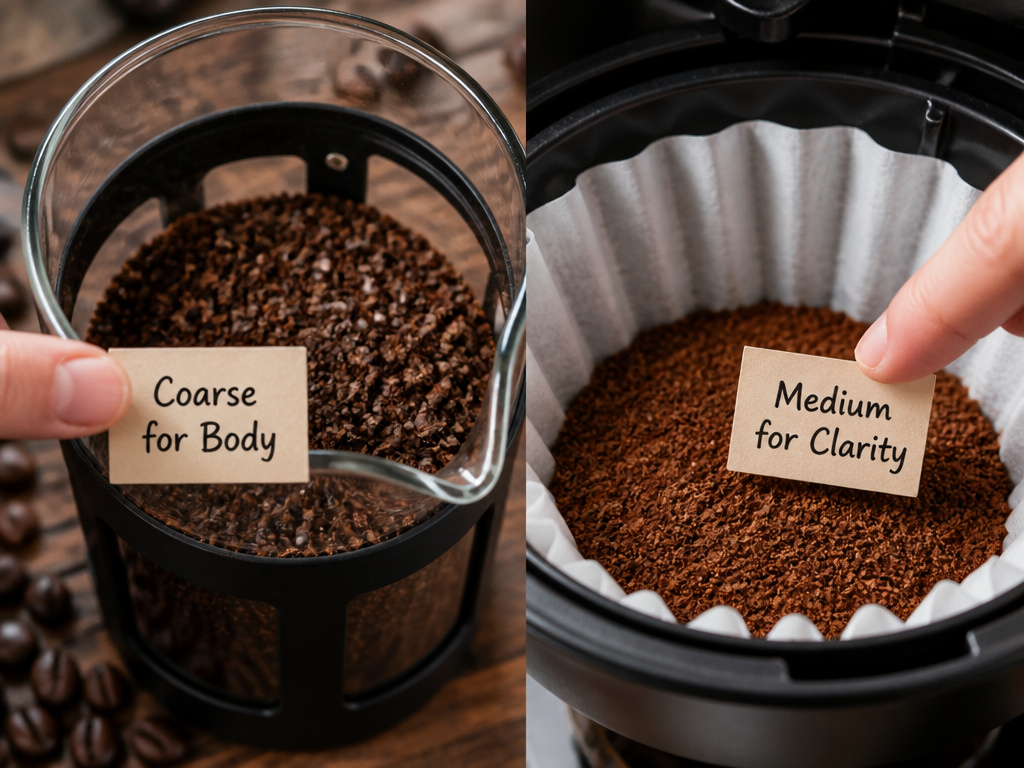
The grind is your final adjustment. French press needs a consistently coarse grind. Any fine particles will slip through the mesh, making the cup unpleasantly muddy. This is why a burr grinder benefits this method immensely. Drip coffee needs a medium grind. Too fine, and water can’t pass through, leading to over-extraction and bitterness. Too coarse, and the water runs through too fast, making a weak, sour cup.
TL;DR: Match dark, bold, or funky beans to French press. Match light, complex, or acidic beans to drip. Your grinder’s consistency is non-negotiable for both.
Frequently Asked Questions
Does French press coffee have more caffeine than drip coffee?
Not inherently. Caffeine extraction is primarily a function of coffee-to-water ratio and brew time, not the method. If you use the same ratio (e.g., 1:16) and similar contact times, the caffeine content will be nearly identical. The perception of strength comes from the French press’s heavier body and oils.
Can you use pre-ground coffee for French press?
You can, but you’ll sacrifice quality. Pre-ground coffee is typically ground for drip machines (a medium grind). In a French press, this finer grind will over-extract, becoming bitter, and will also create excessive sediment. For the best results, grind coarse just before brewing.
Is drip coffee weaker than French press?
It’s not weaker in terms of caffeine per serving, but it is “lighter” in body and texture. The paper filter removes the oils and solids that give French press coffee its characteristic weight and viscosity. Drip coffee can have intense flavor, but it feels cleaner and brighter on the palate.
Which is easier to clean, drip or French press?
drip coffee maker is generally easier for daily cleanup. You simply throw away the paper filter and grounds. Rinsing the basket and carafe takes seconds. Cleaning a French press involves disposing of wet grounds (which can clog sinks) and disassembling and washing the plunger assembly, which has more nooks for old oils to hide.
What about the environmental impact?
French press generates no waste besides coffee grounds, which are compostable. A drip machine using paper coffee filters creates ongoing paper waste, though biodegradable coffee filters are an option. The environmental cost of manufacturing and eventually disposing of the electric drip machine is also a factor versus the simple materials of a press.
The Bottom Line
Stop looking for a universal winner. The drip coffee vs French press debate is about choosing the right tool for the job, and the job is defined by your taste, your time, and your beans.
If your perfect morning is a quiet, hands-on ritual that ends with a rich, textured cup, and you don’t mind washing up, the French press is your brewer. Get a stainless steel one. If your perfect morning involves hitting a button and knowing a consistently clean, bright pot will be ready for you and your family, invest in a reliable drip machine. Pay attention to its thermal carafe.
The best test is direct. Brew the same coffee both ways. The side-by-side taste of clarity versus body will tell you more than any guide. Your preference is the only metric that matters.
