
Does Instant Coffee Go Bad? Avoid Spoilage & Keep It Fresh
Instant coffee doesn’t spoil in a way that makes you sick, but it degrades hard. Exposure to air and moisture causes flavor loss within months and turns the powder into a solid, bitter-tasting brick. The primary risk is mold growth from persistent dampness, which you must discard.
Most people think the expiration date is the only rule. They open a jar, use it for a year on the counter by the kettle, and wonder why their coffee starts tasting flat and bitter by month six. The date is a suggestion for peak quality, but the real clock starts ticking the moment you break the seal.
This guide explains what actually happens to instant coffee over time, how to spot the warning signs of mold and severe degradation, and the storage method that keeps it usable for years, not months.
Key Takeaways
- Instant coffee’s main enemy is humidity, not time. A single damp spoon can start a clumping chain reaction that ruins the entire jar’s texture and taste.
- Mold appears as fuzzy white or green patches. If you see it, throw the whole container away, scraping the top layer won’t remove the invisible spores.
- Freeze-dried instant coffee retains its flavor and resists clumping far longer than spray-dried varieties, making it worth the extra cost for occasional users.
- Storing instant coffee in the fridge or freezer is a mistake unless it’s in an absolutely airtight container. The condensation from moving it in and out introduces moisture.
- The “best by” date is about flavor, not safety. Coffee years past its date is often safe but will taste woody and weak, lacking the bright notes it had when fresh.
What Instant Coffee Actually Is
People treat the jar like it’s ground coffee. It’s not.
Instant coffee is brewed coffee that’s been dehydrated. Manufacturers run hot water through ground beans to make a super-concentrated extract. They then remove the water through one of two methods: spray-drying (blasting the liquid into a hot tower) or freeze-drying (freezing the extract and removing the ice via sublimation in a vacuum). What’s left is a soluble powder or granule.
This process strips out many of the volatile oils and aromatic compounds that give fresh coffee its complexity. That’s why even premium instant coffee has a simpler, flatter taste profile compared to a freshly brewed coffee. But it also removes most of the natural oils that go rancid. Without those oils, the primary drivers of “going bad” shift from rancidity to two other forces: oxidation and hygroscopy.
Instant coffee powder is intensely hygroscopic, meaning it pulls water molecules directly from the air. Studies in food science journals note that absorption of just 4-7% moisture by weight is enough to initiate irreversible clumping and a steep drop in perceived quality.
The lack of oils is also why instant coffee has some unique health trade-offs. It contains almost no diterpenes, the compounds in natural coffee oils that can raise LDL cholesterol. Filtered drip coffee method also removes them, but instant gets a free pass. Conversely, the high-heat dehydration can concentrate acrylamide, a potential carcinogen formed when carbohydrates are heated. The levels in instant are about double that of regular coffee but remain below safety thresholds, you’d need to drink liters daily to approach concern.
The Real Enemies: Air and Moisture
Forget the calendar. The countdown to a ruined jar starts with the first time you open it.
Oxygen in the air slowly oxidizes the remaining flavor compounds. This process, called staling, makes coffee taste increasingly flat, papery, and dull. It happens to all coffee, but it’s more noticeable in instant because the flavor profile was already simplified. The more headspace in the jar, the faster this occurs.
Moisture is the bigger, faster destroyer. That powdery texture is a lie, it’s a sponge. The moment humidity hits it, the granules start to stick.
Common mistake: Storing the open jar next to the kettle or sink, steam and ambient humidity form microscopic clumps in the top layer within a week. Those clumps seed further moisture absorption, and the entire jar can cement itself into a single block within a month during a humid summer.
The physical consequence is a sludge that won’t dissolve properly, leaving gritty particles in your cup. The taste consequence is intensified bitterness, as locked-in moisture also accelerates the oxidation of certain acids.
Before you start: Always use a perfectly dry spoon. A single drop of water left on a teaspoon will dissolve a small patch of coffee into a paste. That paste then acts as a humidity trap, spreading the dampness to the surrounding powder. The jar is compromised from that moment.
This hygroscopic nature is why the international coffee sampling procedure for bulk instant coffee, ISO 6670:2025, mandates specific, moisture-controlled conditions for testing. It’s not just about safety; it’s about preserving the very properties that define the product.
How to Spot Bad Instant Coffee

Your senses are better tools than the date stamp. Here’s what to look for, in order of severity.
The Color and Feel Test. Fresh freeze-dried coffee is typically light brown with distinct, hard granules. Spray-dried is darker and more powdery. If the color has faded to a greyish beige or darkened to a muddy brown, oxidation is advanced. Run a pinch between your fingers. It should feel dry and granular. If it feels at all damp, greasy, or forms a light cake, moisture has already won.
The Sniff Test. The aroma should be recognizably of coffee, albeit simpler. If it smells musty, dusty, or like cardboard, the volatile compounds have departed. A sour or fermented note is a red flag, it signals moisture has been present long enough for chemical changes.
The Clump Test. Gentle tapping should produce a free-flowing powder. If you have to dig out chunks, or if the entire contents move as one solid mass, humidity has thoroughly penetrated. You can sometimes break apart mild clumps, but the dissolved-and-re-solidified coffee will never taste right.
The Mold Test. This is the only absolute discard signal. Mold in instant coffee usually appears as fuzzy white, blue, or green patches. It can also be a thin, cottony layer on the surface or hidden within a large clump. Do not scrape it off. Mold roots with microscopic filaments called hyphae that extend deep into the product. Ingesting it can cause respiratory irritation or allergic reactions.
| Sign | Likely Cause | Is It Safe? | What to Do |
|---|---|---|---|
| Faded color, cardboard smell | Oxidation over months | Safe, but tastes flat | Use quickly or replace |
| Slight clumping, damp feel | Recent humidity exposure | Safe, but texture poor | Break up clumps, store perfectly dry |
| Hard, brick-like block | Chronic high humidity | Safe, but likely very bitter | Discard; quality is gone |
| Fuzzy white/green patches | Mold growth | Not safe | Discard entire container |
TL;DR: If it’s moldy, bin it. If it’s clumped or smells off, it’s drinkable but will taste bad. Your nose and fingers don’t lie.
How to Store Instant Coffee Correctly
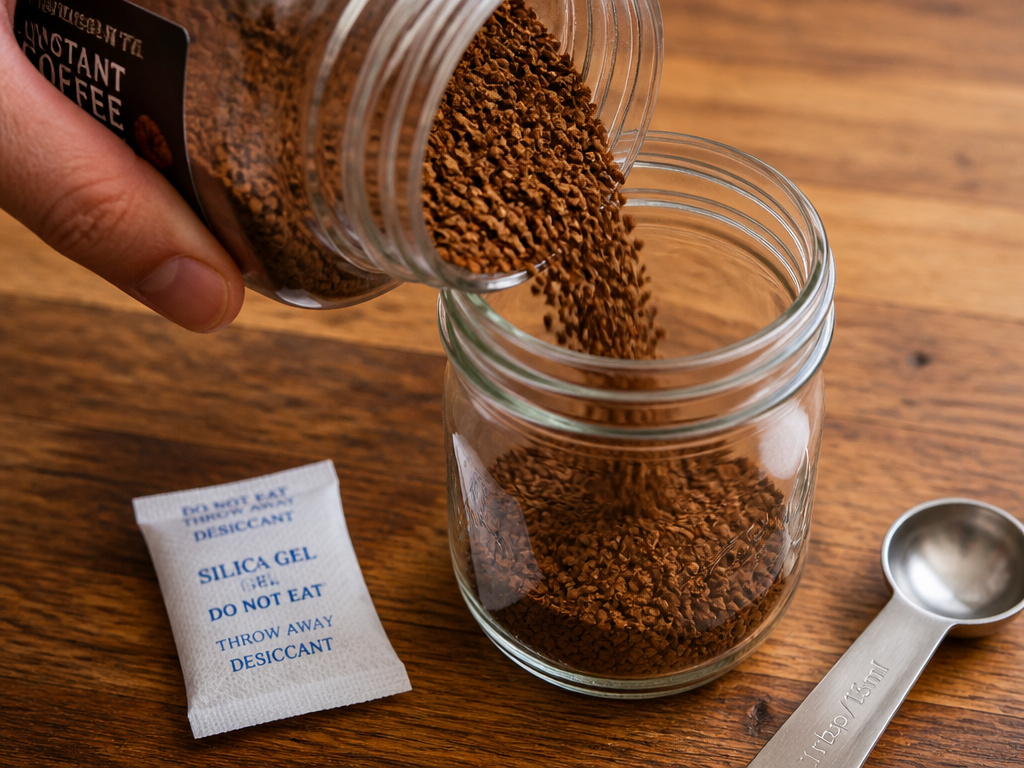
Good storage isn’t complicated. It’s about consistent defense against the two enemies we already named.
- Decant Immediately. The foil seal inside the lid is a one-time barrier. Once broken, the plastic jar itself is slightly permeable to air and moisture. Transfer the contents to a truly airtight container. A glass mason jar with a rubber-sealed lid is ideal. It’s impermeable and you can see the contents.
- Choose the Right Spot. A cool, dark, dry cupboard is perfect. Not on the counter near the stove. Not above the dishwasher. Definitely not next to the sink or kettle. Heat accelerates chemical reactions, and light degrades compounds.
- Armor It Against Humidity. Toss a small, food-safe silica gel desiccant packet into the jar after you fill it. This will scavenge any residual moisture from the air trapped during transfer and any that seeps in over time. Replace the packet every six months.
- Practice Dry Spoon Discipline. This is the most violated rule. Keep a dedicated, bone-dry measuring spoon inside the jar or in a separate sealed container. Never use the spoon you just stirred your wet mug with.
- Resist the Fridge/Freezer Myth. Cold storage seems logical but backfires. Unless the container is laboratory-sealed, every time you move it from a cold fridge to warm room air, condensation forms on the inside walls. That water rolls right into your coffee powder.
I learned the dry-spoon lesson the hard way with a prized jar of specialty freeze-dried Colombian. A seemingly dry teaspoon had been resting in a damp dish rack. Two weeks later, a quarter of the jar had fused into a single, bitter-tasting puck. I salvaged the rest by immediate decanting with a desiccant, but the damage was done.
Why does this method work? It creates a micro-environment. The glass blocks new air, the desiccant scavenges existing moisture, and the cool dark cupboard slows molecular activity. Your coffee exists in a kind of stasis.
For long-term storage (over a year), the best practice is to split a large container. Keep a small mason jar in the cupboard for daily use, and vacuum-seal the remainder in a food-safe bag with a desiccant, stored in a cool, dark place. This minimizes air exposure for the bulk of your supply.
Freeze-Dried vs. Spray-Dried: A Shelf Life Showdown

All instant coffee is not created equal, especially over time.
The manufacturing method dictates the physical structure of the granules. Freeze-dried coffee undergoes a gentle process where frozen coffee extract has its water removed under a vacuum. This preserves more of the original aroma compounds and creates a porous, hard granule that resists moisture absorption. The granules look like little irregular rocks.
Spray-dried coffee is made by spraying liquid coffee concentrate into a blast of hot air. The water flashes off, leaving tiny, hollow spheres. This method is faster and cheaper, but the high heat drives off more volatile aromatics. The resulting powder is finer and more porous, giving it a much larger surface area.
This surface area is the critical factor. More surface area means more exposure to air and a greater capacity to grab onto water molecules from the atmosphere.
| Characteristic | Freeze-Dried Instant | Spray-Dried Instant |
|---|---|---|
| Granule Appearance | Irregular, hard, crystalline | Fine, round, hollow spheres |
| Aroma Retention | Better; gentler process | Poorer; high heat drives off volatiles |
| Hygroscopicity (Moisture Grab) | Lower; dense structure | Higher; massive surface area |
| Shelf Life After Opening | Longer; resists clumping | Shorter; clumps readily |
| Typical Use Case | Premium, specialty products | Standard, economy-grade jars |
A spray-dried jar in a humid climate might become unusably clumped in three months. A freeze-dried jar in the same conditions could last a year before showing similar symptoms. That’s why the extra cost for freeze-dried isn’t just about a marginally better starting taste, it’s an investment in longevity, especially if you’re not a daily instant coffee drinker.
TL;DR: For your backup or occasional-use coffee, buy freeze-dried. It stays shelf-stable far longer, protecting your investment from turning into a paperweight.
Does the “Best By” Date Mean Anything?
Yes, but not for the reason you think.
That date stamped on the bottom is the manufacturer’s estimate of how long the product will retain its peak flavor and quality under ideal storage conditions, unopened, in a cool, dry warehouse. It’s a guarantee of freshness, not safety.
An unopened container of instant coffee stored perfectly can remain safe to consume for years past that date. The flavor, however, will have diminished. The complex top notes vanish first, leaving a bland, woody base. It becomes coffee-flavored water.
Once opened, the “best by” date is void. Your storage practices become the sole dictator of quality. A jar opened yesterday and left on a humid counter will degrade faster than one opened two years ago and kept in an airtight jar with a desiccant.
This is a key difference from many other pantry staples. With canned goods, the date often correlates with safety (botulism risk). With instant coffee, the date correlates almost entirely with sensory pleasure. You won’t get sick from old instant coffee unless mold is present. You will just get a disappointing, lackluster cup that might make you question your life choices.
Frequently Asked Questions
Can you get sick from expired instant coffee?
You cannot get sick from instant coffee that is merely old or oxidized. The only health risk comes from visible mold growth, which you should never consume. If your coffee has a fuzzy white, green, or blue substance, discard the entire container.
Why did my instant coffee turn into a hard block?
This is clumping caused by absorbed moisture. Instant coffee is hygroscopic and pulls water from the air. In a humid environment, or if introduced to a damp spoon, the granules dissolve slightly and re-solidify into a cement-like mass. It is still safe if no mold is present, but the texture and taste are ruined.
Is it better to store instant coffee in the fridge?
No, this is generally not advised. The constant temperature change from cold fridge to warm room air causes condensation inside the container. This liquid water then soaks into the coffee powder, accelerating clumping and mold risk. A cool, dark pantry is superior.
Does freeze-dried instant coffee last longer than regular instant?
Yes, significantly. The freeze-drying process creates a denser, less porous granule that is more resistant to moisture absorption and oxidation. An opened jar of freeze-dried coffee will maintain its quality much longer than an equivalent spray-dried product under the same storage conditions.
How can I tell if my instant coffee has gone bad?
Trust your senses. Look for visible mold (fuzzy patches). Smell it, it should smell like coffee, not dust, cardboard, or fermentation. Feel it, it should be dry and granular, not damp or cemented. If it passes these tests, it is safe. If it tastes unpleasantly bitter or flat, it has degraded but is not harmful.
The Bottom Line
Instant coffee is a durability champion, but it’s not invincible. Time is less of a threat than your own kitchen’s humidity. The difference between a jar that lasts a year and one that bricks itself in a month comes down to a tight seal, a dry spoon, and a cupboard away from heat.
Stop worrying about the date on the bottom. Start worrying about the environment inside the jar. Transfer it to glass, guard it with a desiccant, and treat it like the hygroscopic powder it is. Do that, and your backup coffee will actually be there for you in a crisis, not as a solidified monument to neglect.
That morning cup deserves better than clumps and cardboard notes. Your storage habits decide which you get.
