
Do Coffee Beans Expire? The Real Shelf Life of Coffee Beans
Coffee beans do not expire in a food-safety sense but undergo a predictable quality decline called staling, where they lose aroma and flavor compounds to oxidation and degassing. Peak flavor occurs 7–14 days post-roast; noticeable dulling happens around 30 days for whole beans and within minutes for ground coffee.
The confusion starts at the grocery store. You see a “Best By” date stamped on a bag and assume it’s a hard deadline. That date is a liability shield for the retailer, not a guide for your palate. The real clock started ticking weeks earlier at the roaster.
This guide breaks down the chemistry of staling, the timelines that matter, and the storage methods that actually work. You’ll learn how to read a coffee bag, why your freezer is a tool not a savior, and when to accept that a bag is just past its prime.
Key Takeaways
- Safety expiration does not exist for dry, roasted coffee beans; the “Best By” date is a quality guess for retailers, not a safety warning.
- Flavor peaks 7–14 days after roasting as beans finish degassing, then declines steadily; most single-origin coffees lose their distinct brightness after 30 days.
- Grinding accelerates staling by a factor of 100, exposing the entire interior to air, which is why burr grinders with single-dose capabilities are recommended.
- Freezing roasted beans works only for long-term storage (1+ months) if done correctly: vacuum-seal in single-use portions and never refreeze.
- The first sign of staling is the loss of that fragrant “bloom” when you open the bag; the last sign is a flat, papery cup with no acidity.
The Short Answer: Staleness vs. Expiration
You can drink 40-year-old coffee. It won’t make you sick. It will taste like wet cardboard and regret.
The USDA Food Safety and Inspection Service frames coffee storage around quality, not safety. Their guidance suggests roasted beans last 3-5 months unopened in the pantry and 1-2 years in the freezer. That’s a shelf-life guideline for a stable dry good, not a flavor guarantee. The agency is concerned with mold and pathogens, which are non-issues for properly dried roasted coffee.
Technical Snippet: Staling is primarily an oxidative process. Roasted coffee beans contain hundreds of volatile aromatic compounds and oils. Upon exposure to oxygen, these compounds break down, a process accelerated by heat, light, and moisture. The result is a loss of complexity, sweetness, and acidity, replaced by flat, woody, or rancid notes.
The “Best By” or “Use By” date on supermarket bags exists for stock rotation. It’s a conservative estimate, often set 6-12 months out from roasting. A bag of blended coffees with a “Best By” date next Christmas could have been roasted last spring. That’s why you must hunt for the roast date.
TL;DR: Ignore “Best By” dates. Find the roast date. Your beans aren’t expired, but they might be stale.
The 7-14 Day Peak and the 30-Day Cliff
Freshly roasted coffee is too fresh. It’s packed with carbon dioxide, a byproduct of the roasting chemical reactions. That gas needs to escape, a process called degassing, before brewing. Brew too soon, and the gas interferes with water contact, leading to uneven, sour extraction.
The sweet spot is about a week to two weeks post-roast. The violent degassing has slowed, but the delicate volatile compounds responsible for aroma and flavor are still largely intact. This is when blonde roast coffee beans reveal their tea-like clarity and when a natural-processed Arabica bean sings with berry notes.
After this peak, the decline is gradual, then steep.
Around the 30-day mark for whole beans, you cross a sensory cliff. The change isn’t subtle. As highlighted in a YouTube transcript from a specialty roaster, the first red flag is olfactory. You open the bag and get nothing. No fragrant wave of cocoa, citrus, or caramel. The aroma has literally evaporated.
The second sign is in the cup. Acidity and sweetness fade first. What’s left is the base structure: bitterness and body. Your bright Ethiopian tastes like a generic dark roast. A Scientific Reports coffee storage study published in Nature quantified this, showing measurable declines in key quality parameters like volatile compound concentration and antioxidant activity after specific storage durations.
Common mistake: Storing beans in their original, non-resealable paper bag, the one-way valve lets CO2 out but isn’t airtight, so oxygen gets in. Within two weeks, the beans on top will taste noticeably flatter than the ones on the bottom.
TL;DR: Your coffee’s best 30 days start a week after its roast date. After that, it’s a salvage operation.
How Storage Kills Flavor (And How to Slow It Down)
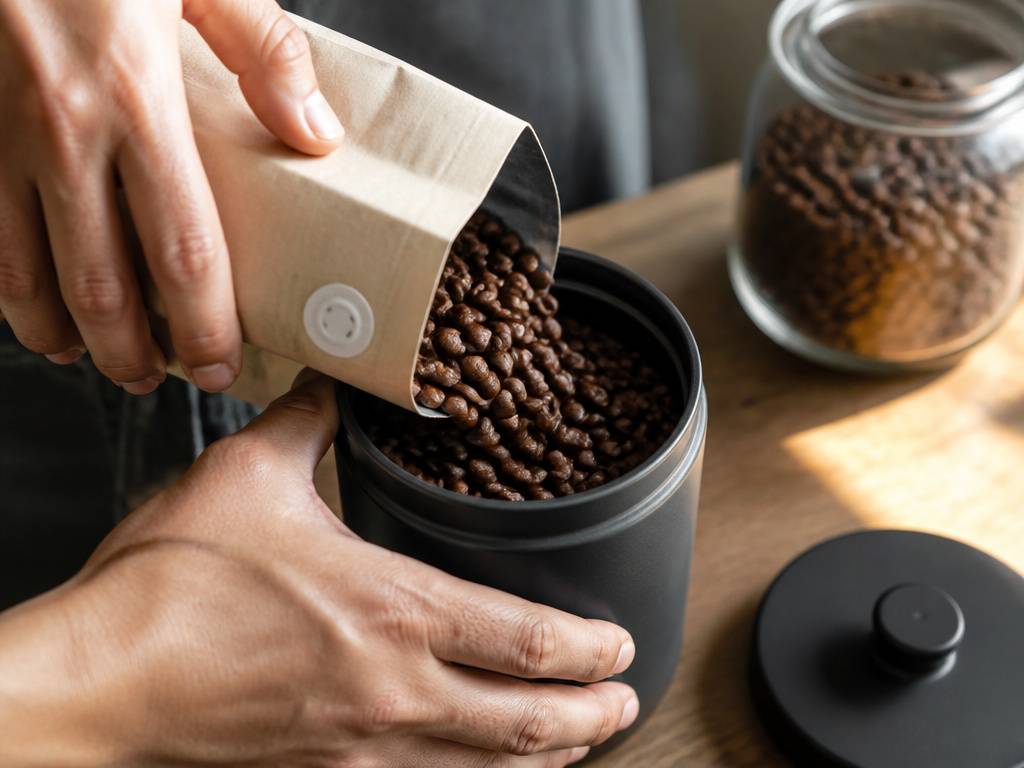
Four enemies work in concert: air, light, heat, and moisture. You can’t stop them, but you can drastically slow their roll.
Air is the main culprit. Oxidation begins the moment beans are exposed to oxygen. This is why pre-ground coffee is a losing proposition. Grinding coffee beans increases their surface area exponentially, inviting oxidation to attack from all sides within minutes. A Baratza grinder manual doesn’t just suggest grinding fresh, it states that pre-ground coffee forfeits the purpose of their equipment.
Light and heat are accelerants. A clear container on a sunny kitchen counter is a staling chamber. Heat increases the kinetic energy of molecules, speeding up chemical reactions like oxidation. This is also why you should never store beans in the fridge. The fridge is humid, and coffee is hygroscopic, it absorbs moisture and nearby odors, leading to muted flavor and a potential for clumping.
| Storage Method | Best For | Primary Risk |
|---|---|---|
| Original Bag (with valve) | First 1-2 weeks | Not airtight; allows oxygen ingress over time. |
| Opaque Airtight Container | Daily use for 2-4 weeks | Frequent opening introduces fresh oxygen. |
| Vacuum-Sealed in Freezer | Long-term storage (1-6 months) | Improper sealing leads to freezer burn and moisture. |
| Nitrogen-Flushed Bag (Unopened) | Maximum shelf life before opening | Once opened, the clock starts; not reusable. |
The winning move for daily drinkers is simple. Buy a two-week supply. Immediately transfer the beans from the bag into a sealed, opaque, ceramic or stainless steel container. Keep it in a cool, dark cupboard away from the stove or oven. This isn’t just a best practice. It’s what the data in an NCBI coffee quality parameters research paper supports as the baseline for preserving sensory characteristics in a home environment.
TL;DR: An opaque, airtight container in a cool, dark place is the minimum viable defense. Everything else is an optimization.
The Freezer Debate: Lifesaver or Flavor Killer?
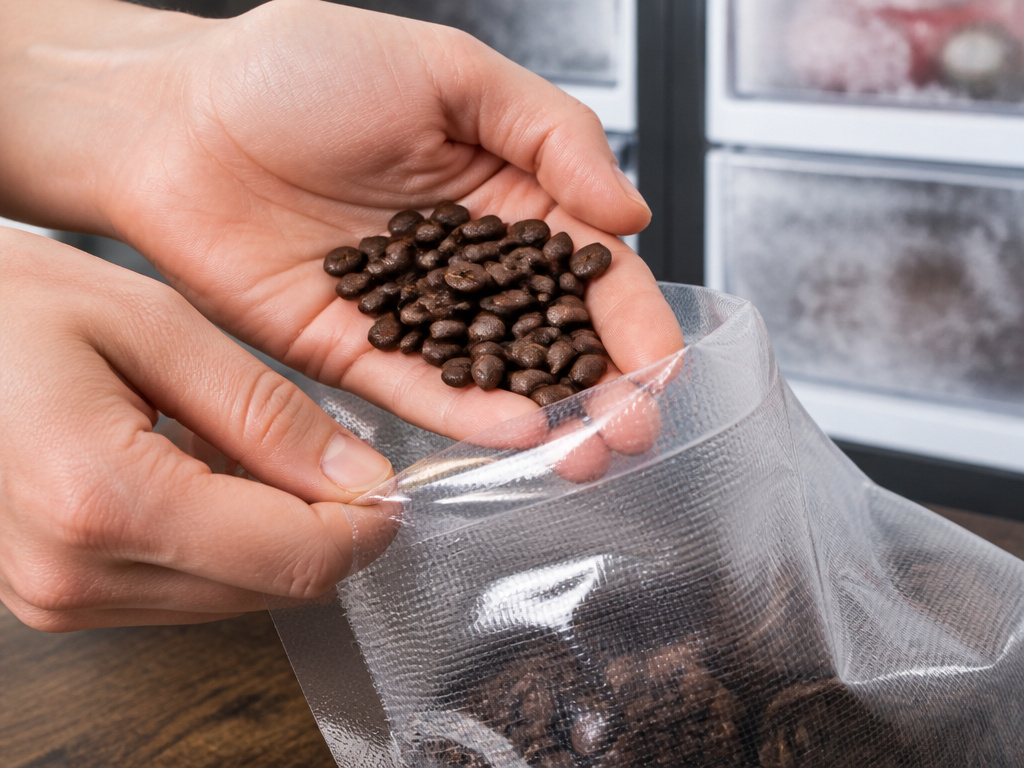
The specialty coffee community is split. Some pros swear by it. Others call it heresy. Both are right, depending on the execution.
Freezing is fantastic for long-term preservation. The cold dramatically slows molecular movement and oxidation. If you buy bulk beans or want to preserve a special single-origin coffee for later, the freezer is your only real option. The key is protocol.
You must freeze once, thaw once, and avoid moisture. This means dividing your beans into weekly portions, vacuum-sealing each portion, and freezing them. When you need coffee, take one sealed bag out, let it come fully to room temperature (this takes an hour), then open it. Condensation forms when cold meets warm, humid air. If you open the bag while the beans are still cold, that moisture coats them and accelerates staling and off-flavors.
I tried freezing beans in their original bag with the valve. After a month, they developed a faint, ghostly aroma of frozen peas. The vacuum sealer I bought the next week paid for itself in three bags of salvaged Gesha.
The fridge is never an option. The temperature fluctuation every time you open the door, combined with high humidity, makes it worse than the counter. Freezing is a binary tool: either do it perfectly with vacuum sealing, or don’t do it at all for beans you’ll finish within a month.
TL;DR: Freeze only vacuum-sealed portions for storage over one month. Never refrigerate. Never refreeze thawed beans.
Green Beans: The Long Game

Unroasted green coffee beans are a different product with a different timeline. They’re stable, living seeds. Under ideal conditions, cool (10-15°C/50-59°F), dark, and at 60% relative humidity, they can maintain viable quality for a year, sometimes two.
But they aren’t inert. The Specialty Coffee Association notes that green coffee is a “living product” that continues to metabolize slowly. It loses moisture, and its acidity gradually diminishes. A “past-crop” bean won’t produce the vibrant, juicy cup it might have when freshly harvested. Home roasters buy green beans for their shelf life, but they still operate on a “first in, first out” mentality.
This long shelf life is why most of the world’s coffee travels as green beans. The roasting date you eventually see is the true birth date for flavor. Everything before that is gestation.
Signs Your Beans Have Gone Stale
Diagnosis is straightforward. Use your senses.
- The Smell Test (Day 1): Open the bag or container. Inhale deeply. If you don’t get a clear, pleasant coffee aroma, whether that’s nutty, fruity, or chocolaty, the volatile compounds are gone. This is the earliest and most reliable sign.
- The Visual Test (Week 2-4): Freshly roasted beans, especially darker roasts, have a slight sheen from migrating oils. Stale beans look dry and matte. They may also feel lighter and more brittle.
- The Brew Test (The Final Verdict): Stale coffee lacks crema in espresso. In pour-over or drip, it brews faster because the degraded cell structure offers less resistance. The taste is hollow. The bright, sparkling acidity is missing. You might add brown sugar coffee or a pinch of salt to compensate for the bitterness, which is now dominant.
If your coffee passes these tests, it’s still good. If it fails, it’s not unsafe. It’s just not worth your time. Use it for cold brew, where the long, cold extraction can pull out some remaining sugars and mask flaws, or as an ingredient in baking.
TL;DR: No aroma, dry beans, fast brew time, flat taste. That’s the staling sequence.
Frequently Asked Questions
Can you use expired coffee beans?
Yes, if “expired” means past a “Best By” date. They are safe to consume. Their flavor will be diminished, making them better suited for cold brew, coffee rubs, or baking where subtlety isn’t required.
How long do whole coffee beans last after opening?
For optimal flavor, plan on 2-4 weeks after opening if stored in an airtight container in a cool, dark place. You’ll notice a decline after 30 days. Pre-ground coffee lasts about 1-2 weeks under the same conditions before tasting flat.
Do coffee beans go bad in the freezer?
Not if properly stored. Vacuum-sealed beans can last 6-12 months in the freezer without significant quality loss. Improperly stored beans (in a permeable bag) will suffer freezer burn and absorb odors, tasting “off” within a month.
What is the best container for storing coffee beans?
An opaque, airtight container made of ceramic, stainless steel, or glass with a rubber-gasket seal. Avoid clear containers. The container should be just large enough for your beans to minimize the air volume inside.
The Bottom Line
Chase the roast date, not the expiration date. Your coffee beans aren’t a gallon of milk. They’re more like a loaf of artisan bread, best enjoyed within a specific, short window of peak quality.
Invest in an airtight container. Consider a vacuum sealer if you buy in bulk. Most importantly, buy only what you’ll drink in a few weeks. The pursuit of the perfect cup isn’t about finding magic beans. It’s about respecting their fragile nature from the roaster to your grinder. Every day you wait is a trade. Make it count.
