
Cone Coffee Filter Sizes | The OEM Specs That Matter
Cone coffee filter sizes are defined by two OEM specs: the cone angle (typically 60° or 45°) and the paper thickness (grams per square meter). Match both to your brewer’s exact geometry to prevent channeling and overflow, which cause hollow or bitter coffee. The wrong size wastes grounds and ruins extraction.
The universal mistake is buying filters by the brewer’s “cup” capacity alone. A “10-cup” label on a box is meaningless if the cone angle is wrong. You get a filter that buckles, the water bypasses the coffee grounds, and you pour $30 of gesha down the drain.
This guide maps the numbered sizes to their real-world dimensions, then dives into the OEM-specific codes for Chemex, Hario, and Kalita. You will learn why a one-inch height difference changes everything and how paper weight dictates your brew time.
Key Takeaways
- A #2 cone filter measures 4 inches tall; a #4 cone filter measures 5 inches tall. That one inch decides whether your filter fits or overflows.
- OEM codes are mandatory for pour-over. Chemex FS-100, Hario VCF-02-100W, and Kalita Wave 185 are not interchangeable, their cone angles and paper densities differ.
- Chemex filters are 20-30% heavier than standard paper. Using a generic #4 filter in a Chemex accelerates flow by up to 30 seconds, leading to severe under-extraction.
- Filter fit precedes grind size. If the paper doesn’t seat flush against the brewer walls, water channels down the sides regardless of your grind setting.
- Flat-bottom filters (Kalita) are not cone filters. They require their own specific size (155 or 185) and create a different extraction profile.
The Core Sizing System: #2, #4, and OEM Codes
Forget “small, medium, large.” The baseline language for cone filters is the numbered system born from automatic drip machines. These numbers correspond to precise dimensions.
A #2 filter stands 4 inches from its sealed bottom tip to the top rim. It fits cone brewers designed for roughly 1 to 6 cups of coffee. The #4 filter is the common large size, measuring 5 inches tall. It targets brewers labeled for 8 to 12 cups. That single inch of extra height isn’t just about capacity, it changes the coffee bed’s geometry. A taller, narrower cone produces a deeper bed, which slows water flow and increases extraction contact time.
Common mistake: Using a #4 filter in a brewer designed for #2, the filter’s rim folds over inside the cone, creating a gap between paper and plastic. Water rushes down this channel, missing most of the coffee grounds. Your brew finishes 45 seconds fast and tastes weak every time.
The numbered system works for basic Melitta-style cones and many older drip machines. But it fails completely for modern specialty brewers. This is where you must switch to the OEM model code.
TL;DR: #2 = 4″ tall, for 1-6 cups. #4 = 5″ tall, for 8-12 cups. The inch matters. For any brewer with a brand name, ignore the number and find the OEM code.
The OEM-Specific Universe: Chemex, Hario V60, and Kalita
When you buy a Chemex, you are buying into a filter ecosystem. The same is true for Hario V60 and Kalita Wave. Their filters are engineered components, not commodities.
Chemex Filters: The Heavyweight
Chemex publishes that their filters, models FS-100 (square) and FC-100 (circle), are 20-30% heavier than other paper filters. This is a critical spec. Thicker paper slows water flow. If you substitute a generic #4 filter, your brew time can drop by 25-30 seconds because the water meets less resistance.
The result is under-extraction. The coffee tastes sour and thin. You might try grinding finer to compensate, but you’re fighting the wrong variable. The filter is the variable.
Chemex also makes the FP-1 half-moon filter for the Funnex and the FP-2 for the 3-cup Classic Series. These are not scaled-down versions of the FS-100; they are different shapes.
Hario V60 Filters: The Precision Cones
Hario uses a clear model-number system: VCF-01-100W (Size 01 for 1-2 cups), VCF-02-100W (Size 02 for 1-4 cups), and VCF-03-100W (Size 03 for 1-6 cups). The “100W” denotes 100 sheets of white, oxygen-bleached paper.
The V60’s spiral ribs and large single hole at the apex are designed for these specific filters. A generic filter might not have the same rigidity to hug those ribs. It sags, water pools, and your draw-down time stalls.
Kalita Wave Filters: The Flat-Bottom Exception
Kalita Wave filters are not cones. They are flat-bottomed papers with a wavy wall and three small extraction holes. They come in two sizes: 155 (1-2 cups) and 185 (2-4 cups). Calling them “cone filters” is technically wrong, they create a different, more uniform coffee bed that extracts more evenly than a cone’s pointed bed. Using a cone filter in a Kalita Wave is impossible; using the wrong Wave size (155 in a 185 brewer) means the paper won’t reach the walls.
| Brewer Brand | Filter Model Code | For Brewer Size | Key Physical Differentiator |
|---|---|---|---|
| Chemex | FS-100 or FC-100 | 6, 8, 10-cup | Paper 20-30% heavier than standard |
| Hario V60 | VCF-02-100W | Size 02 (1-4 cup) | Matches 60° cone angle and spiral ribs |
| Kalita Wave | Wave 185 | 185 brewer (2-4 cup) | Flat bottom with wavy sides, three holes |
| Generic | #4 | “10-12 cup” machines | 5-inch tall, standard paper weight |
TL;DR: Your brewer’s brand dictates its filter model code. Chemex thickness controls flow; Hario codes match the cone angle; Kalita filters are a different shape entirely.
Why Fit and Geometry Trump “Cup Capacity”
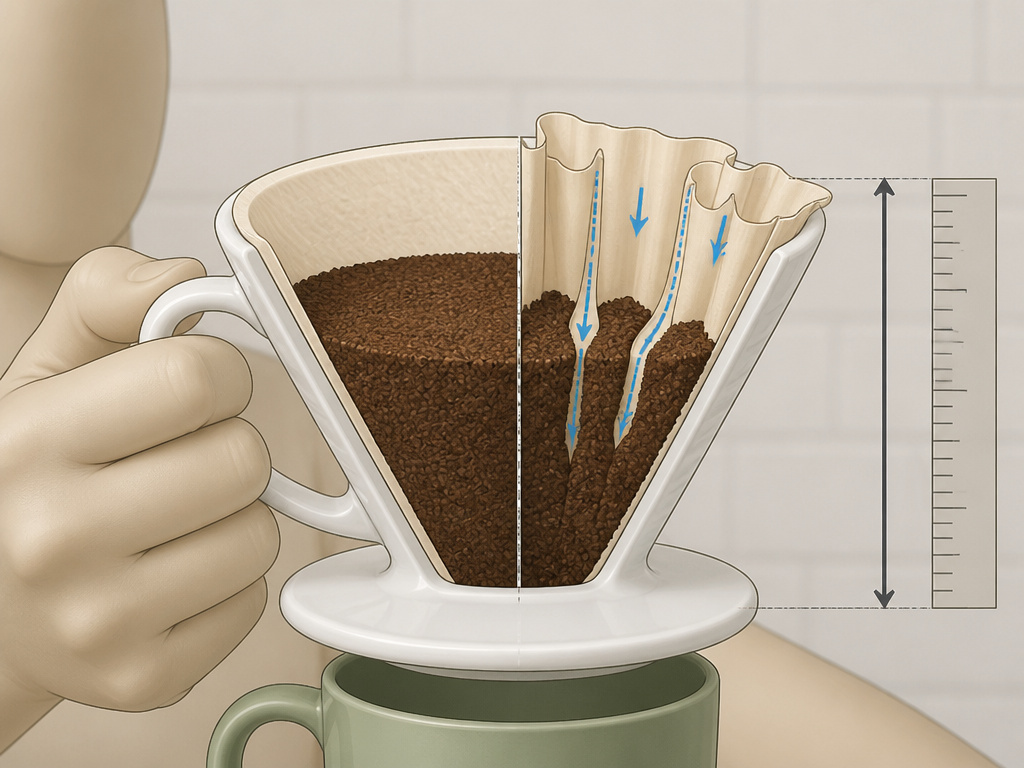 Coffee brewer “cup” capacity is a historical relic, often meaning 5 fluid ounces. A “10-cup” Chemex holds 50 oz, but a “10-cup” automatic drip carafe might hold 60. The label is useless for filter selection.
What matters is the three-dimensional space the filter must occupy. A filter that is too small will not reach the brewer’s rim. Grounds can spill over the top during pouring, and the shallow bed makes for a fast, uneven brew. A filter that is too large will crumple inward at the top. This creates folds that act as water slides, directing flow away from the coffee.
The geometry also dictates extraction. A steep cone (like the V60) produces a deep, narrow bed of coffee. Water wants to channel down the center. A shallow, wide cone (like some batch brewers) produces a wide bed. Water tends to pool. This is why optimizing your coffee grind consistency is step two. Step one is ensuring the filter creates the correct bed shape.
This principle applies to all brewed coffee methods, from manual pour-over to automatic machines. The physical interface between filter and brewer sets the stage.
How to Measure and Match Your Existing Setup
 You have a brewer and no box. Here is the diagnostic sequence.
- Identify the brewer. Look for a brand name and model on the device itself. Is it a Chemex? A Hario V60? A generic glass cone? If it’s a generic cone, proceed to measuring.
- Measure the filter height. Take a ruler. Place a dry filter flat. Measure from the very bottom (the sealed seam) straight up to the top open rim. Is it 4 inches or 5 inches? That tells you #2 or #4.
- Check the cone angle. This is visual. A Hario V60 has a very steep, sharp 60° angle. A Melitta-style cone is broader. A Kalita Wave is flat. The filter must match this.
- Test the fit. Insert one dry filter into your clean, dry brewer. Does it sit snugly against the walls all the way around? Does the top rim sit flush with or just below the brewer’s rim? If it collapses, it’s too big. If it doesn’t open fully, it’s too small.
For automatic drip machines, the process is similar but often simpler. The basket shape is fixed. Most full-size machines use a #4 filter. Compact machines use a #2. The best reference is almost always the machine’s manual or the specific machine filter sizes page for that brand.
I once tried a bargain “for 10-cup brewers” filter in my Technivorm Moccamaster. The paper was flimsy. During the bloom, the entire filter sagged down into the basket, compressing the grounds. The brew choked, overflowed, and made a spectacular mess. The coffee was brutally over-extracted. I now buy the Technivorm-branded filters. They cost more, but they are engineered for the basket’s support ribs.
Cone vs. Flat Filters: A Fundamental Design Split
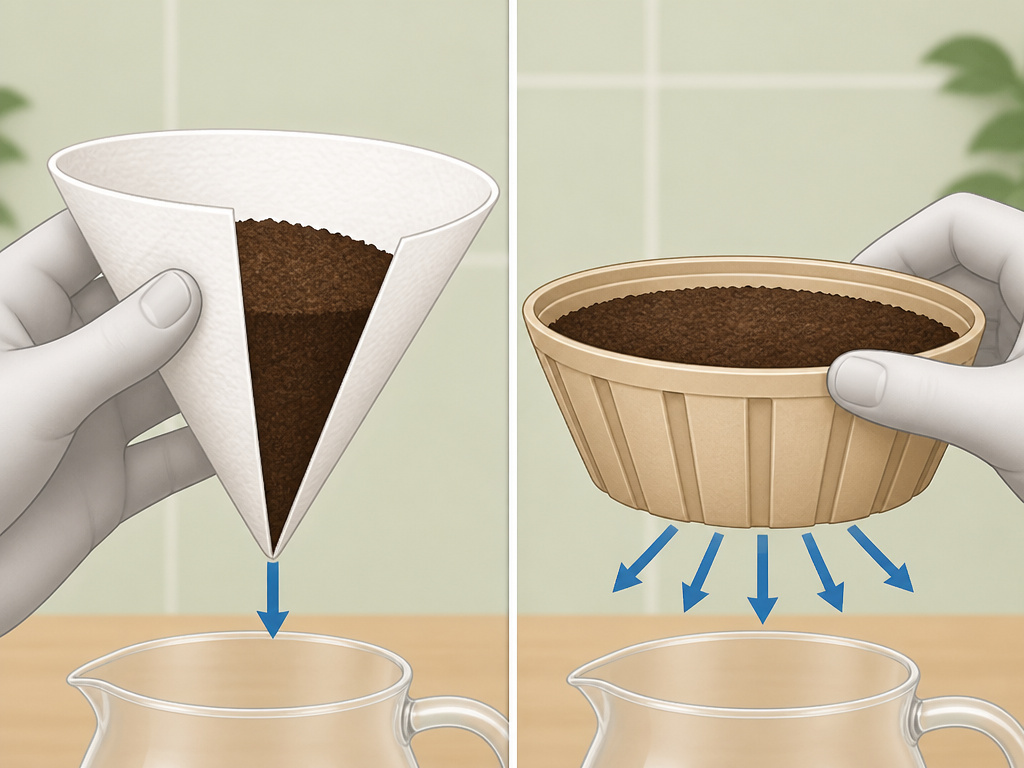 The YouTube research highlights a common point of confusion. Cone and flat filters are different brewing tools.
Cone filters (pointed bottom) create a deep coffee bed. Water flow is faster through the apex, which can encourage a cleaner cup but also risks channeling. They are the standard for manual pour-over and many drip machines.
Flat filters (flat or basket bottom) create a shallow, wide bed. Water drains more evenly across the entire base, which can lead to a more uniform, often fuller-bodied extraction. They are common in some automatic machines and the Kalita Wave.
Your choice here is decided by your brewer. You cannot put a cone filter in a flat-bottom basket. The decision between a cone and flat brewer often comes down to the flavor profile comparisons you prefer. Cones are praised for clarity; flats for balance.
The Impact of Paper Type: Bleached, Unbleached, and Beyond
Filter material changes the game. The debate between bleached and unbleached filters is about more than color.
- Bleached (White) Filters: Use oxygen or chlorine to remove lignin. They impart minimal paper taste. Most specialty OEM filters (Hario, Chemex) are oxygen-bleached.
- Unbleached (Brown) Filters: Retain more natural paper fibers. They can add a slight woody or papery taste to the first few brews until seasoned.
The paper’s density, or weight, is the hidden variable. Chemex’s heavy paper is the extreme example. Thicker paper filters more sediment and slows flow. Thinner paper speeds flow. This is why you cannot blindly swap brands even if the physical size matches.
For those concerned with environmental impact of filters, both paper types are typically compostable. The bleaching process for oxygen-bleached filters is generally considered more eco-friendly.
Troubleshooting Filter Problems
Your coffee tastes off. Before you blame the beans or the grind, rule out the filter.
| Problem | Likely Filter Cause | Immediate Fix |
|---|---|---|
| Brew runs too fast | Filter paper too thin (not OEM), or filter too small. | Switch to OEM-specified filters. Ensure filter fully expands to cone walls. |
| Brew runs too slow | Filter paper too thick, or filter is crumpled. | Check for folds blocking flow. Verify you’re not using a Chemex filter elsewhere. |
| Grounds in finished coffee | Filter is too small, overflowing, or torn. | Use correct size. Pour more gently. Don’t stir aggressively with a spoon. |
| Uneven, weak extraction | Filter is folded, creating a channel between paper and brewer. | Seat filter properly with a pre-wet, which helps it adhere to the brewer walls. |
| Paper taste | New unbleached filter not rinsed enough. | Rinse thoroughly with hot water (200°F+) before adding coffee. |
TL;DR: Fast brew = thin paper or bad fit. Slow brew = thick paper or folds. Sediment = wrong size. Paper taste = rinse more.
Frequently Asked Questions
What is the difference between #2 and #4 cone filters?
2 cone filter is 4 inches tall, designed for brewers making roughly 1 to 6 cups. A #4 cone filter is 5 inches tall, for brewers making 8 to 12 cups. The one-inch difference in height is critical for proper fit and coffee bed depth.
Can I use Chemex filters in a Hario V60?
No. Chemex filters (FS-100/FC-100) are square or circular, much thicker, and designed for a specific brewer shape. They will not fit or perform correctly in a V60’s steep 60-degree cone. You will get severe channeling and incorrect extraction times.
Are Kalita Wave filters considered cone filters?
No. Kalita Wave filters have a flat bottom with pleated sides. They are designed for flat-bottom brewers and create a different extraction profile compared to true cone filters like the V60 or Melitta.
How do I know what size filter my coffee maker needs?
First, check the owner’s manual or the manufacturer’s website for the exact model code (e.g., “use VCF-02-100W”). If that’s not available, measure the height of a filter that currently works. A 4-inch height is a #2; a 5-inch height is a #4. You can also consult resources for Bunn filter selection or other major brands.
Do filter sizes affect the taste of light roast coffee?
Yes, significantly. Light roast beans are denser and harder to extract. Using a filter that causes fast flow (like a thin generic paper) will under-extract them, yielding a sour, grassy cup. The controlled flow of a proper OEM filter is essential for fully extracting their delicate notes.
The Bottom Line
Stop buying cone filters by the “cup” label on the box. The number is a distraction. Find the OEM model code printed on your brewer or its manual. That code. Chemex FS-100, Hario VCF-02-100W, Kalita Wave 185, is the only reliable key.
If you have a generic brewer, the ruler is your guide. Four inches means #2. Five inches means #4. That single inch dictates whether your morning brew is balanced or broken. Remember that the filter is the first variable in the extraction equation, before your grind or your single-origin profiles. Get it wrong, and everything that follows is a compromise.
