
Master Your Brew: Coffee to Water Ratio Calculator & Tips
A coffee to water ratio calculator uses a simple formula: coffee weight (in grams) multiplied by your chosen ratio equals your target water weight (in grams). The industry-standard starting point is a 1:18 ratio, meaning 1 gram of coffee for every 18 grams of water, as defined by the Specialty Coffee Association’s Golden Cup Standard.
Most people skip the math and use a scoop. A tablespoon of light roast whole beans weighs less than a tablespoon of dark roast fine grounds. That single variable throws the entire brew off by 20 percent or more. Your coffee tastes different every morning because you are measuring volume, not mass.
This guide breaks down the calculator’s logic, explains why the standard ratio exists, and shows you when to deliberately ignore it. You will learn how to use a scale once and dial in your personal perfect cup.
Key Takeaways
- The SCA Golden Cup Standard is 55g of coffee per liter of water, a 1:18 ratio. This targets an 18-22% extraction yield for balanced flavor.
- Always calculate by weight, not volume. A “tablespoon” of coffee can vary from 5 to 7 grams based on roast and grind, wrecking your ratio.
- For a stronger, more intense cup, tighten the ratio to 1:15. For a lighter, tea-like cup, stretch it to 1:18.5 or 1:19.
- Cold brew is the major exception, requiring a concentrate ratio between 1:4 and 1:8 before dilution.
- The right coffee grinders matter more than a perfect ratio. Inconsistent grounds extract unevenly, creating both sour and bitter notes at once.
What is the SCA Golden Cup Standard?
The Specialty Coffee Association defines the parameters for an optimally brewed cup. Their Golden Cup Standard is not a suggestion. It is a measurable target for extraction.
The standard calls for 55 grams of coffee per liter of water. This is a 1:18.18 coffee-to-water ratio. The goal is to achieve a Total Dissolved Solids (TDS) measurement between 1.15% and 1.35%, which correlates to an 18% to 22% extraction yield. Within this window, the pleasant sugars and acids are fully dissolved without over-extracting the bitter, woody compounds.
The Specialty Coffee Association’s Golden Cup Standard specifies 55g of coffee per liter of water, targeting a 1.15% to 1.35% strength and an 18% to 22% extraction yield. Brewers like the Bonavita BV1900TS are engineered to meet this standard with correct dose and grind.
SCA-certified brewers, such as the Bonavita BV1900TS, are designed with precise heating and showerhead systems to achieve this extraction window when you use the right amount of coffee. The machine does its job. Your job is to feed it the correct dose.
TL;DR: The SCA standard is a 1:18 ratio aiming for 18-22% extraction. It’s the laboratory definition of balanced flavor, not the final word on taste.
Why the 1:18 Ratio Works (The Why-Layer)
A ratio is a tool to control extraction. Extraction is the process of dissolving flavor compounds from the coffee grounds into hot water.
Soluble compounds leave the grounds in a specific order. Fruity acids and bright sugars extract first. Sweetness and body come next. Finally, bitter alkaloids and astringent compounds dissolve. The 1:18 ratio, with water heated to 92°C–96°C, creates an environment where the water becomes saturated with the good flavors before it can pull out too many of the bad ones.
Use too little water (a 1:15 ratio) and the water saturates too quickly, stalling extraction. You get a strong, intense cup that might lack sweetness and complexity. Use too much water (a 1:20 ratio) and the brew becomes over-extracted and thin as the water continues to pull compounds long after the good flavors are gone. The 1:18 landing zone maximizes sweetness and balance for most coffee beans and most brewing methods.
How to Use a Coffee to Water Ratio Calculator
Forget online tools. The calculator is in your head. The formula is elementary school math.
Target Water Weight = Coffee Weight × Desired Ratio
If you start with 20 grams of coffee and want a 1:17 ratio, you need 340 grams of water (20 × 17 = 340). That is the entire calculation. The work lies in the setup.
You need a digital scale with 0.1-gram precision. The $25 models work fine. Place your empty dripper or French press on the scale. Press tare to zero it out. Add coffee until you hit your target dose—say, 20 grams. Now, either place your serving carafe on the scale, tare it, and pour water until you hit 340 grams, or simply know that 340 grams of water is roughly 340 milliliters.
The common mistake is measuring water by volume first and then trying to back-calculate the coffee. This reverses the control. The coffee dose is your independent variable. You lock that in first, then apply the ratio to determine the water.
| Your Coffee Dose | 1:15 Ratio (Strong) | 1:18 Ratio (Standard) | 1:20 Ratio (Light) |
|---|---|---|---|
| 15g | 225g water | 270g water | 300g water |
| 20g | 300g water | 360g water | 400g water |
| 30g | 450g water | 540g water | 600g water |
TL;DR: Multiply your coffee grams by your ratio number to find water grams. Dose the coffee first, then calculate the water.
When to Ignore the Golden Ratio

The 1:18 standard is a baseline for a reason. It works for most people, most of the time. Your taste buds and your specific beans are not most people.
Common mistake: Blindly following a 1:18 ratio for every bean and brewer — the coffee will taste perfect one day and unbalanced the next, and you’ll blame the roast instead of the ratio.
If your coffee consistently tastes weak, sour, or hollow, you are under-extracting. Tighten the ratio. Move to 1:16 or even 1:15. This gives the water less volume to saturate, forcing it to pull more flavor from the same amount of grounds. Conversely, if your coffee is bitter, ashy, or drying, you are likely over-extracting. Loosen the ratio to 1:19. This provides more water to dilute the later, bitter extracts.
Professionals like Matt Perger of Barista Hustle often advocate for stronger ratios in the 1:15 to 1:16 range for a more intense, flavorful cup, arguing the SCA standard can lean too dilute. This is a matter of preference, not correctness.
The major technical exception is cold brew. Cold water extracts soluble compounds about 30% slower than hot water. A standard ratio would produce a weak, insipid brew after 18 hours. Cold brew requires a concentrate ratio between 1:4 and 1:8. You steep 100 grams of coffee in 400-800 grams of cold water, then dilute the strong concentrate with water or milk to taste.
Common Mistakes and Their Consequences
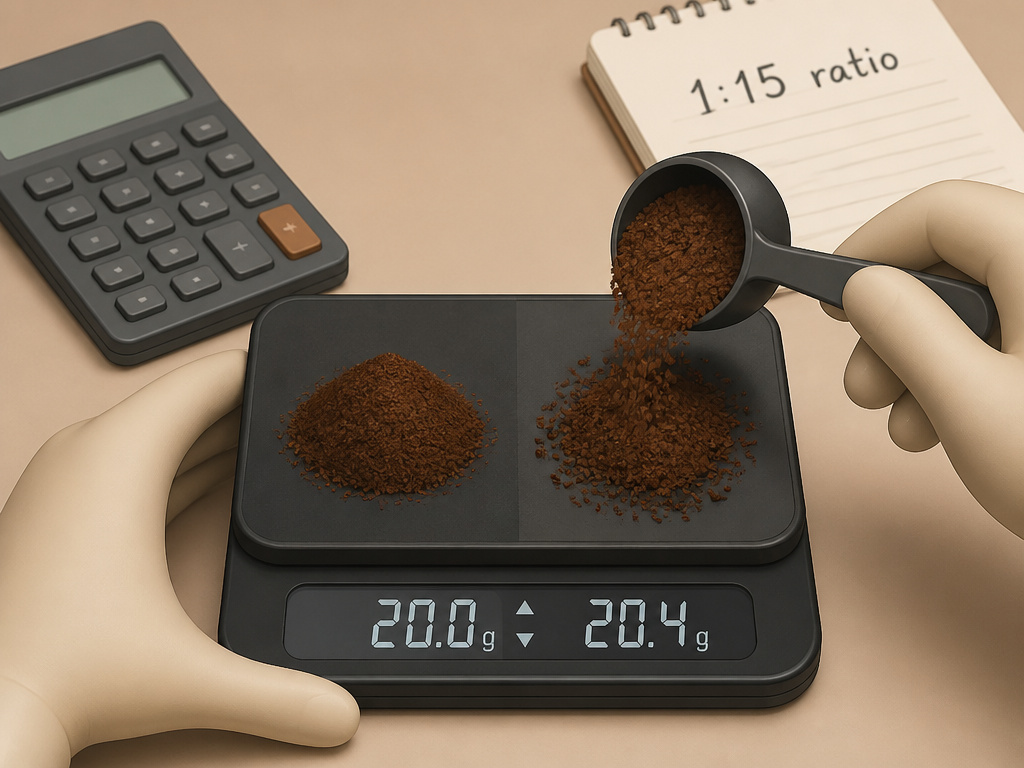
Getting the ratio right but fumbling the execution still ruins the cup. These are the silent failures.
Using volume measures. This is the cardinal error. A tablespoon is a unit of volume, not mass. A tablespoon of a dark roast French press grind might weigh 7 grams. A tablespoon of a light roast espresso grind might weigh 5 grams. For a 20-gram dose, that’s a difference between three scoops and four scoops. Your ratio swings from 1:18 to 1:13.5 without you knowing. The coffee tastes wildly different day to day.
Ignoring grind size. Ratio and grind size work in tandem. A finer grind exposes more surface area, accelerating extraction. If you tighten your ratio to 1:15 and use a fine grind, you will over-extract and create bitterness. The fix is to coarsen the grind as you tighten the ratio. Think of it as a balancing act: stronger ratio needs coarser grind, weaker ratio needs finer grind.
Forgetting the coffee’s mass in the final weight. This matters for immersion brewing like French press. If you add 350 grams of water to 20 grams of coffee, the total brew weight is 370 grams. About 2-3 grams of coffee mass dissolves. When you press and pour, you leave about 17 grams of wet grounds behind. You are not drinking a 1:17.5 ratio (350/20). You are drinking a ratio closer to 1:18.3. The difference is small but real for precision.
| Mistake | Immediate Consequence | Long-Term Result |
|---|---|---|
| Measuring coffee by volume | Uncontrolled dose, ratio varies ±20% | Inconsistent flavor, inability to replicate good cups |
| Using stale beans | Fast, weak extraction; water passes through easily | Necessitates a tighter ratio (e.g., 1:14) to compensate |
| Mismatching grind and ratio | Simultaneous sour and bitter flavors | Frustration, constant adjustment of wrong variable |
| Not accounting for water retention | Weaker final cup than calculated | Consistent under-strength immersion brews |
Choosing Your Tools: Scale, Grinder, and Brewer
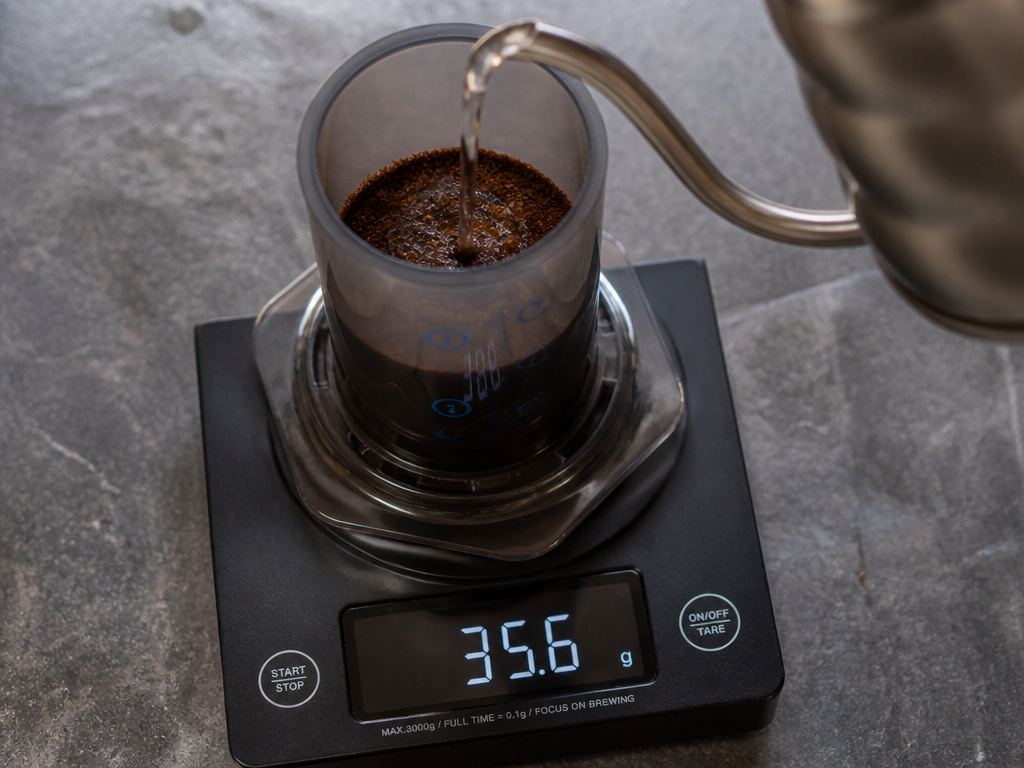
The ratio is the plan. Your tools execute it.
A 0.1g precision scale is non-negotiable. It is the single most important purchase after the grinder. Timing your brew is guesswork without knowing the exact weights going in.
Your burr grinder is more critical than the ratio. A blade grinder produces a mix of dust, fine, and boulders. The dust over-extracts and turns bitter while the boulders under-extract and taste sour. You can have a perfect 1:18 ratio and still get a terrible cup because the extraction is uneven. A consistent grind lets the ratio do its job.
The brewer itself dictates some ratio parameters. An espresso machine filter system uses a very tight ratio, around 1:2. A standard drip coffee brewing machine works in the 1:15 to 1:18 range. Always check if your machine, like a Braun coffee maker or Black & Decker coffee maker, has a recommended dose per carafe line. Those lines are calibrated for a specific ratio using a specific paper filter basket.
TL;DR: Buy a scale first. Then a burr grinder. Your brewer comes third. The best ratio cannot save inconsistent grounds.
Frequently Asked Questions
Can I use a coffee to water ratio calculator without a scale?
You can, but you will not get consistent results. Volume-based calculators rely on the false assumption that a “tablespoon” of coffee has a fixed weight. If you must, use the volume method as a rough starting point: one standard coffee scoop (2 tablespoons) to every 6 fluid ounces of water is approximately a 1:17 ratio. Expect variation.
Is the coffee to water ratio the same for all brew methods?
No. The core principle is the same, but the target ratios differ. Espresso is typically 1:2. Pour-over and drip range from 1:15 to 1:18. French press often sits at 1:15 for a fuller body. Cold brew concentrate is 1:4 to 1:8. The method changes the contact time and extraction efficiency, demanding a ratio adjustment.
Why does my coffee taste bitter even with the correct 1:18 ratio?
Bitterness is a sign of over-extraction. If your ratio is correct, the culprit is almost always grind size. Your grind is too fine for your brewer, causing the water to over-extract the grounds. Coarsen your grind setting. The second culprit could be water temperature that is too high, scorching the grounds.
How does bean type affect the ratio?
Darker roasts are more porous and extract more easily. You might prefer a slightly weaker ratio (like 1:18.5) with a dark roast to avoid bitterness. Dense, light-roast beans are harder to extract. You might need a tighter ratio (1:16) and a finer grind to pull enough sweetness out. This is where personal calibration begins.
The Bottom Line
A coffee to water ratio calculator gives you control. The SCA’s 1:18 Golden Cup Standard is your reliable starting point for balanced brewed coffee. Weigh your coffee, multiply by 18, and weigh your water.
Then start breaking the rule. Tighten the ratio for intensity. Loosen it for clarity. Throw it out for cold brew. Your perfect ratio is the one that makes your taste buds happy, not the one that matches a textbook. The number is a tool for consistency, not a dogma. Find your number, write it down, and use it to make tomorrow’s cup as good as today’s.
