
Coffee Maker Coffee Ratio: The Ultimate Guide for Better Brews
The perfect coffee ratio for a coffee maker is measured in grams of coffee per liter of water, not scoops. Start with 60 grams per liter (a 1:16.7 ratio) and adjust based on your machine’s performance and your taste, using a scale for consistency.
Most people get this wrong because they use a scoop. A scoop of dark roast weighs less than a scoop of light roast. Your morning brew becomes a lottery.
This guide explains why the grams-per-liter method works, shows you the exact numbers from major coffee maker manuals, and teaches you how to adjust for your specific taste. You will need a scale.
Key Takeaways
- Volumetric scoops can vary by over 10% in weight, making consistent coffee impossible. A digital scale is non-negotiable.
- Start with 60 grams of coffee per liter of water. For a standard 8-cup (1.25L) carafe, that’s 75 grams.
- Your coffee maker’s manual often has a specific ratio. The Bonavita Connoisseur recommends 55g/L, while the Technivorm Moccamaster suggests 60g/L for medium strength.
- Only adjust your ratio upward (use more coffee) after you’ve fixed under-extraction by grinding finer. A weak, sour cup is usually a grind problem, not a ratio problem.
- For immersion methods like a French press used in a machine’s hot cycle, increase your ratio by about 10% compared to a standard drip recipe to account for full water retention.
Why Grams-per-Liter Beats Every Other Ratio
Forget tablespoons. Ignore the “1:15” math. The most reliable system for a sleepy brain is grams per liter.
You have a carafe that holds one liter. You want to know how much coffee to put in the filter. If your target is 60 grams per liter, you use 60 grams. Making half a liter? Use 30 grams. The math is instant and immune to human error. This method aligns with the Specialty Coffee Association’s Golden Ratio of 55 grams per liter, a standard used to certify home brewers.
The Specialty Coffee Association (SCA) brewing standard recommends 55 grams of coffee per liter of water. This ratio is the benchmark for certified brewers and provides a balanced extraction when paired with correct grind size and water temperature.
Volumetric measurements fail on two fronts. First, a “scoop” has no standard size. Second, and more critically, coffee density changes. A heaping scoop of a dense, light-roast Ethiopian can weigh 10 grams. That same scoop of an oily, dark-roast Sumatran might only weigh 7 grams. That’s a 30% difference in coffee before water even touches it. Your Monday cup will be wildly different from your Friday cup, and you’ll blame the beans.
The other common format, the “1:15” ratio, is backwards for practical use. You don’t start with coffee and wonder how much water you can make. You start with the amount of coffee you want to drink and work backwards. Dividing 500ml of water by 15 before caffeine is a chore.
TL;DR: Use grams per liter. Weigh your water, multiply by your ratio (start at 60g/L), and weigh your coffee. A scale costs less than two bags of good beans.
The Manufacturer Numbers You Can Trust
Your coffee maker’s manual isn’t just warranty filler. For SCA-certified machines, it contains a tested starting point. These numbers come from engineers who tuned the machine’s shower head, water temperature, and brew time to work best at a specific ratio.
| Coffee Maker Model | Recommended Ratio | For a 1.25L (8-cup) Brew | Source |
|---|---|---|---|
| Bonavita Connoisseur (BV1901TS) | 55 grams per liter | 68.75 grams | Bonavita Manual, page 4 |
| Technivorm Moccamaster KBGV | 60 grams per liter (med. strength) | 75 grams | Moccamaster Manual, page 5 |
| OXO Brew 8-Cup | 8 grams per 5oz cup (~64g/1.25L) | 64 grams | OXO Manual, page 4 |
These specs matter. The Bonavita is designed to extract optimally at 55g/L with its precise 200°F shower. Pushing it to 70g/L with a coarse grind won’t make stronger coffee, it will make bitter, over-extracted coffee. If you own a Braun coffee maker or a Black & Decker coffee maker, the principle is the same. Check your coffee maker manual for a similar starting point; if it’s absent, the 60g/L rule applies.
The community often tweaks these. On forums, Technivorm owners debate pushing to 65g/L for darker roasts or pulling back to 55g/L for delicate blonde roast beans. That’s fine. But treat the manual’s number as your baseline calibration. It’s the factory setting.
Common mistake: Ignoring your machine’s manual and using a generic ratio, you miss the engineered sweet spot and blame the machine for “weak coffee.”
How to Find Your Personal Ratio in 3 Steps
Your perfect ratio lives where good extraction meets your personal strength preference. You must solve for extraction first.
- Lock in your extraction. Start with 60g/L and a medium grind. Brew a pot. If the coffee tastes sour, grassy, or weak, your grind is too coarse. Grind finer on your next attempt. If it tastes bitter, harsh, or dry, your grind is too coarse? Wait, no. Bitter means over-extraction, grind coarser. Do not change the coffee weight yet. Chase the balanced flavor.
- Evaluate strength. Once the cup tastes balanced, some sweetness, clear flavor notes, no glaring sourness or bitterness, then ask if you want it stronger or milder. If you want more intensity, increase your ratio to 65g/L. Want it lighter? Drop to 55g/L.
- Document and repeat. Write down your recipe: “Ethiopian Yirgacheffe, 68g for 1.1L water, grind setting 15 on Baratza Encore.” This is your map for next time.
Changing the ratio before fixing extraction is like turning up the volume on a staticky radio. It just makes the bad sound louder. A sour, under-extracted cup at 60g/L will become a strong, sour cup at 70g/L. You’ll waste more beans.
This process highlights why a burr grinder is critical. A blade grinder creates inconsistent particles, making even extraction impossible. You’ll forever be guessing.
TL;DR: Grind finer until sourness disappears. Only then add more coffee if you want more strength. Write down what works.
The One Adjustment for French Press & Immersion Brewing
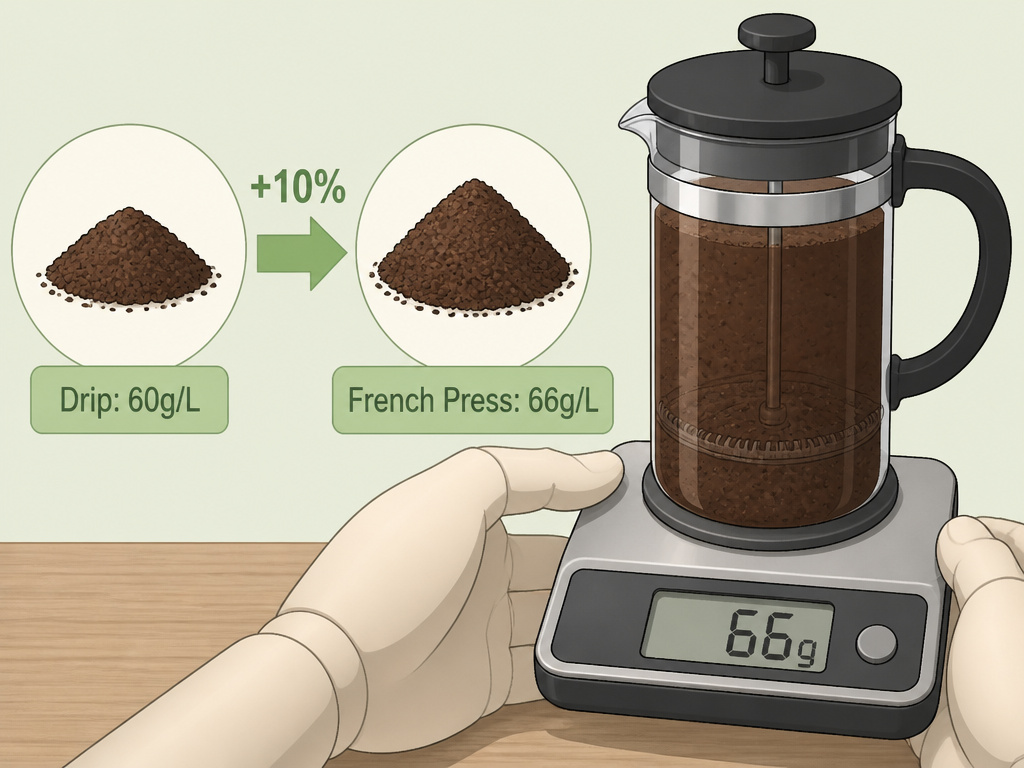
Your standard drip machine is a percolation brewer. Water passes through the coffee grounds once. A French press, or the “steep” function on some machines, is an infusion brewer. All the water and grounds mingle for the entire time. This physical difference demands a ratio adjustment.
In a pour-over or drip machine, about 2 grams of water get trapped and absorbed by each gram of coffee. That water never drips into your carafe. In a French press, all the water you add stays in the vessel. The extracted coffee solubles are diluted into the full volume.
If you use 60 grams per liter in a French press, your brew will be noticeably weaker than a drip machine using the same ratio, even with identical extraction. The trapped water in the drip filter effectively creates a more concentrated beverage.
The fix is simple. Bump your ratio up by about 10% for immersion brewing. If you use 60g/L for drip, use 66g/L for French press. This compensates for the lack of water loss and delivers a comparable strength. It’s a small change that prevents that frustrating “why is this so weak?” moment when you switch methods.
This is part of understanding fundamental brewing methods. The same logic applies when comparing a standard drip coffee method to an Americano, which is espresso diluted with water.
Tools You Actually Need (It’s a Short List)
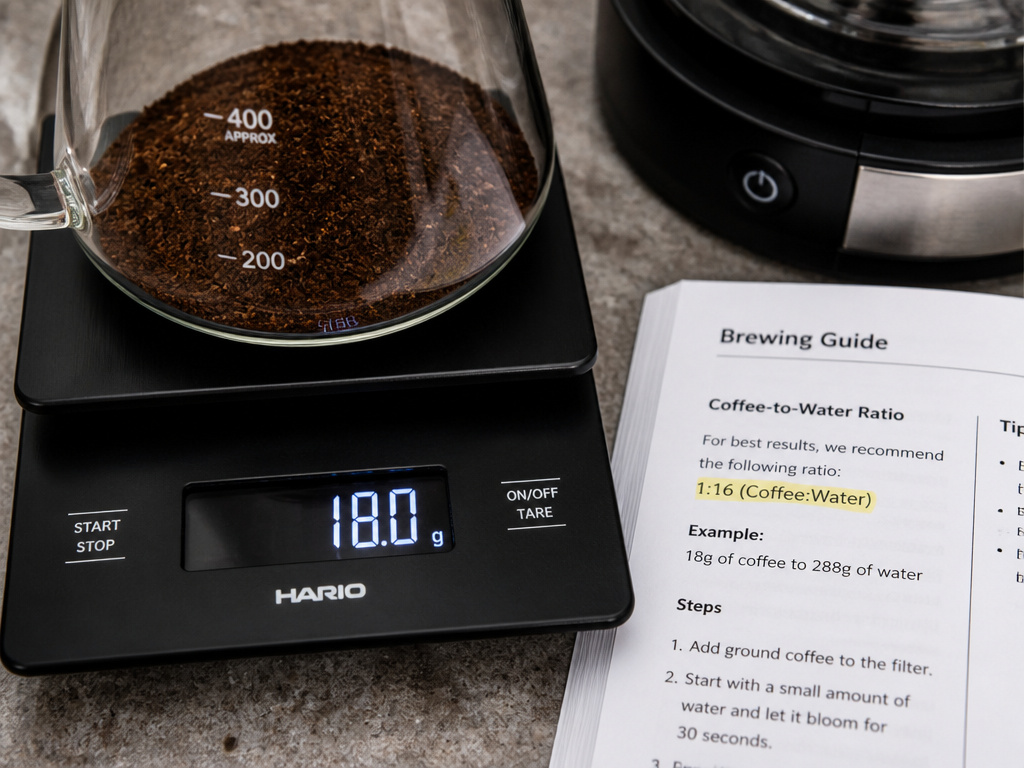
You can spend hundreds on gear. For nailing your ratio, you need two things.
- A 0.1g Precision Scale: This is the cornerstone. Don’t use a postal scale. You need one that can measure 0.1 gram increments to reliably measure 20-80 grams of coffee. It should have a tare function. Without this, you are guessing.
- Your Coffee Maker’s Manual: Find the PDF online if you lost it. Look for the “brewing guide” or “recommended coffee amount.” It often gives both volumetric (scoops) and weight-based guidance. The weight is what you want.
- A Consistent Water Source: Tap water heavy with minerals or chlorine will mask flavors. Use filtered water if you can. It’s a bigger upgrade than you think.
- The Right Filter: Using the wrong Bunn coffee maker filters in a Bunn machine can cause bypass, where water runs around the coffee bed. Whether you prefer bleached coffee filters or unbleached, make sure it fits your basket snugly.
The scale is non-negotiable. Everything else supports the system.
When to Break the Rules: Cold Brew & Espresso
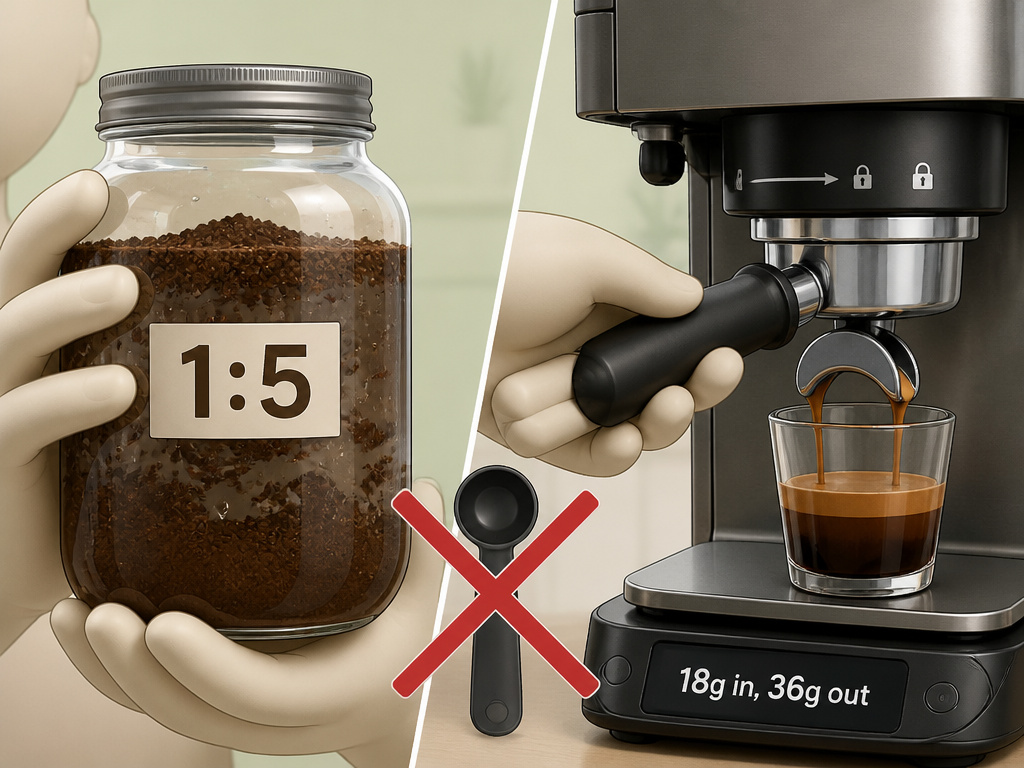
The grams-per-liter rule governs the world of hot, filter-style brewing. Two major exceptions live outside its borders.
Cold brew requires a massive increase in coffee concentration. Ratios range from 1:4 to 1:8 (coffee to water). That’s 125 to 250 grams of coffee per liter. The cold water and long steeping time (12-24 hours) extract more slowly, demanding more coffee to achieve a flavorful concentrate. Using a standard 60g/L will produce a watery, insipid brew.
Espresso is the opposite. It uses high pressure to extract a small, concentrated shot. A standard double shot uses about 18 grams of coffee to yield 36 grams of liquid, a 1:2 ratio. Putting 60 grams of coffee in an espresso portafilter is physically impossible and would choke the machine instantly.
These methods have their own rulebooks. Applying your drip machine ratio to them is the fastest way to waste an entire bag of single-origin coffee.
Frequently Asked Questions
What is the golden ratio for coffee?
The Specialty Coffee Association’s “Golden Ratio” is 55 grams of coffee per liter of water, which is approximately a 1:18 ratio by weight. It’s designed as a balanced starting point for filter coffee brewing.
How many scoops is 60 grams of coffee?
You cannot reliably convert grams to scoops. A scoop’s volume holds different weights depending on the coffee’s roast and grind. One scoop might be 7 grams of a dark roast or 10 grams of a light roast. Always use a scale.
Why does my coffee taste sour even when I use enough coffee?
Sourness almost always signals under-extraction. You are not dissolving enough of the coffee’s soluble compounds. The fix is to grind your coffee finer, which increases the surface area for the water to work on. Do not add more coffee yet.
Is it better to measure coffee by weight or volume?
Always measure by weight. Volume measurements (cups, tablespoons, scoops) are inconsistent due to variations in coffee grind size, roast density, and how tightly you pack. A gram is always a gram.
Do I need to adjust the ratio for different coffee beans?
You adjust for taste, not directly for the bean. However, denser Arabica beans from high altitudes might taste better with a slightly finer grind at the same ratio, while a darker roast might benefit from a slightly coarser grind to avoid bitterness. Dial in the grind first, then the ratio.
Before You Go
Stop using scoops. Dig out your kitchen scale, it’s hiding in a drawer behind the cheese grater. Weigh your water. Weigh your coffee. Start at 60 grams per liter.
Check your machine’s manual for its specific number. It’s there. Trust it for the first pot. If the flavor is balanced but too mild for you, add five more grams of coffee next time. If it’s sour, grind finer.
This isn’t about being fussy. It’s about making the same good coffee tomorrow that you made today. The scale guarantees it. The ratio guides it. Your taste approves it. Now go brew.
