
Drip Coffee Brewing Ratio: SCA Standard vs. Your Machine
The drip coffee brewing ratio is the weight of coffee grounds to the weight of water you use, typically between 1:15 and 1:18. This means for every gram of coffee, you use 15 to 18 grams of water. The Specialty Coffee Association (SCA) standard targets 1:18 for optimal extraction balance.
Most people get this wrong by treating the ratio as a fixed rule. They pour a scoop of pre-ground into a filter, fill the reservoir to a line, and hope. The result is a gamble, sometimes weak and sour, sometimes harsh and bitter. The machine’s markings are a volume guess, not a weight guarantee.
This guide breaks down the standard, shows you why your machine might need a different target, and gives you a method to dial in your perfect cup. You need a scale.
Key Takeaways
- The SCA’s “Golden Ratio” is 1:18, but your taste and machine may demand 1:15 or even 1:14.
- Commercial BUNN brewers often run a 1:12.8 ratio, much stronger than the home standard.
- A weak, sour cup needs more coffee (a tighter ratio). A bitter, astringent cup needs less coffee (a wider ratio).
- Light roast beans often require a tighter ratio (more coffee) than dark roasts to extract fully.
- Never adjust by volume. A “scoop” of dark roast is heavier than a scoop of light roast, throwing the ratio off before water even touches it.
What is the Standard Drip Coffee Brewing Ratio?
The benchmark comes from the Specialty Coffee Association. Their brewing control chart, a foundational document for professional coffee evaluation, identifies the target brew strength and extraction yield zone. For drip brewing, this lands at a 1:18 coffee-to-water ratio by weight.
The SCA Brewing Standard 310-2021 defines the parameters for optimal extraction. A 1:18 ratio, with water between 91°C and 96°C and a total brew time of 4-6 minutes, aims to extract 18-22% of the coffee’s soluble material into the cup.
This is the “Golden Ratio.” It’s not a secret. It’s the consensus starting point for a balanced, clean-tasting cup where sweetness, acidity, and body are in harmony. Machines certified by the SCA, like the Technivorm Moccamaster, are engineered to hit these parameters, temperature, time, and water dispersion, assuming you use the correct ratio.
Your standard home drip machine probably isn’t SCA-certified. Its shower head may not saturate evenly. Its heating element might not hold a steady 94°C. The 4-6 minute brew time is the first thing to check. If your machine dumps water through the grounds in two minutes, a 1:18 ratio will produce a weak, under-extracted cup every time. You’ll need to tighten the ratio to compensate.
TL;DR: The standard is 1:18, but treat it as a laboratory baseline. Your kitchen isn’t a lab.
Why Your Machine’s Manual Might Disagree
Open a BUNN commercial brewer manual. The brewing instructions won’t talk about 1:18. They’ll specify something like 1.25 pounds of coffee per gallon of water.
Do the math. One gallon of water weighs 3785 grams. 1.25 pounds of coffee is about 567 grams. That’s a ratio of roughly 1:12.8. That’s a massively stronger brew than the SCA standard.
| Brewer Type | Typical Ratio | Target User | Why It Differs |
|---|---|---|---|
| SCA-Certified (e.g., Technivorm) | 1:16 to 1:18 | Home enthusiast / café | Engineered for optimal extraction at lower strength. |
| Commercial Batch (e.g., BUNN) | ~1:12.8 | Restaurants, offices | Built for volume and to hold up to milk/sugar; assumes dilution. |
| Standard Home Drip | Varies widely | General consumer | Design prioritizes convenience and cost over precise parameters. |
Commercial machines run a tighter ratio because the coffee often sits on a warmer for hours or is diluted with milk. The strength is a buffer. Your home machine doesn’t need that buffer. Following a commercial spec at home makes a cup that’s overpowering and expensive.
Then there’s your machine’s “cup” marking. It’s a 5-ounce coffee cup, not an 8-ounce measuring cup. A “10-cup” brewer holds about 50 fluid ounces of water. If you use the included scoop, you’re guessing at both coffee weight and water volume. The ratio is a fantasy.
Common mistake: Using the brewer’s “cup” lines and a volumetric scoop, the coffee grinders you choose matter less if your ratio is a random number. Your coffee will taste different every time.
The fix is simple. Ignore the markings. Use a scale.
The Physical Consequences of a Wrong Ratio
This isn’t just about taste. The wrong ratio physically changes what happens in the filter basket.
A ratio that’s too wide (too much water, like 1:20) means each coffee particle is over-saturated and over-extracted. You’re pulling out too many soluble compounds, including the bitter, astringent ones. The stream from the brewer looks dark but thin. The coffee tastes hollow, then leaves a drying bitterness on your tongue. It happens within the first 30 seconds of the brew cycle, the water flushes through too fast because the coffee bed isn’t dense enough to provide resistance.
A ratio that’s too tight (too much coffee, like 1:12) creates a thick, muddy bed. Water struggles to pass through evenly. It finds channels, leaving some grounds under-extracted and others over-extracted. The result is a simultaneous sourness and bitterness. The machine might even stall or overflow. You’ll see grounds creeping up the sides of a paper filter, a sure sign of bypass.
The goal is a coffee bed that looks like damp sand after the brew, not a swamp or a cracked desert. The right ratio creates that.
The 3-Step Ratio Adjustment Method
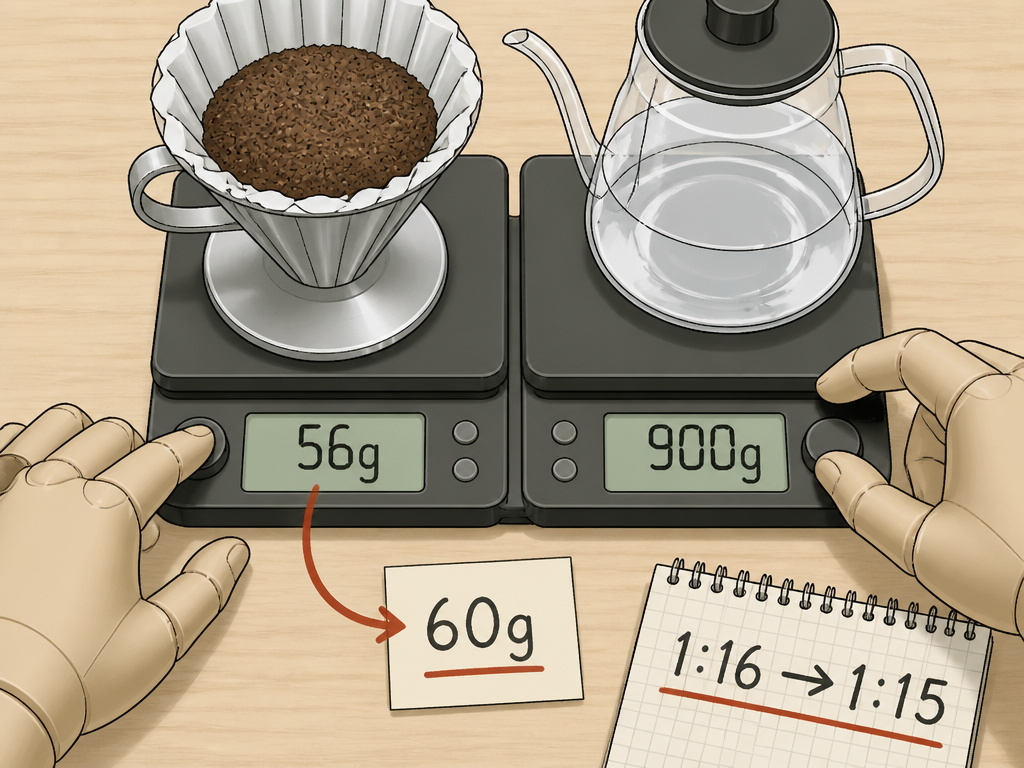
You need a digital scale with 0.1-gram resolution. This method assumes you’re using a burr grinder for consistent particle size. Blade grinders add too much variable.
- Start at the Standard. Weigh your water. Weigh your coffee. For a full pot, try 900 grams of water to 56 grams of coffee (that’s 1:16). Brew it.
- Taste and Diagnose. Take a sip without milk or sugar. Is it weak, tea-like, or sour? That’s under-extraction, tighten the ratio. Use more coffee next time (try 60g for the same 900g water, a 1:15 ratio). Is it strong, bitter, or drying? That’s over-extraction, widen the ratio. Use less coffee (try 52g, a 1:17.3 ratio).
- Lock It In. When you hit a cup that’s balanced, sweet, with clear acidity and a clean finish, write down the weights. That’s your machine’s ratio.
Only change the coffee weight. Keep the water volume and grind size constant. If you change two things at once, you won’t know which fix worked.
I started every new bag of beans at 1:16 for years. Then I got a particularly dense Ethiopian light roast. At 1:16, it was all sour lemon and no body. I inched the ratio down to 1:14.5 over three brews. The fruit notes popped and the mouthfeel turned silky. The bag’s recommended ratio was 1:17. Their brewer wasn’t my brewer.
TL;DR: Start at 1:16, taste, and adjust the coffee weight in 2-gram increments until the sour or bitter edge disappears.
How Bean Type and Roast Level Change the Math
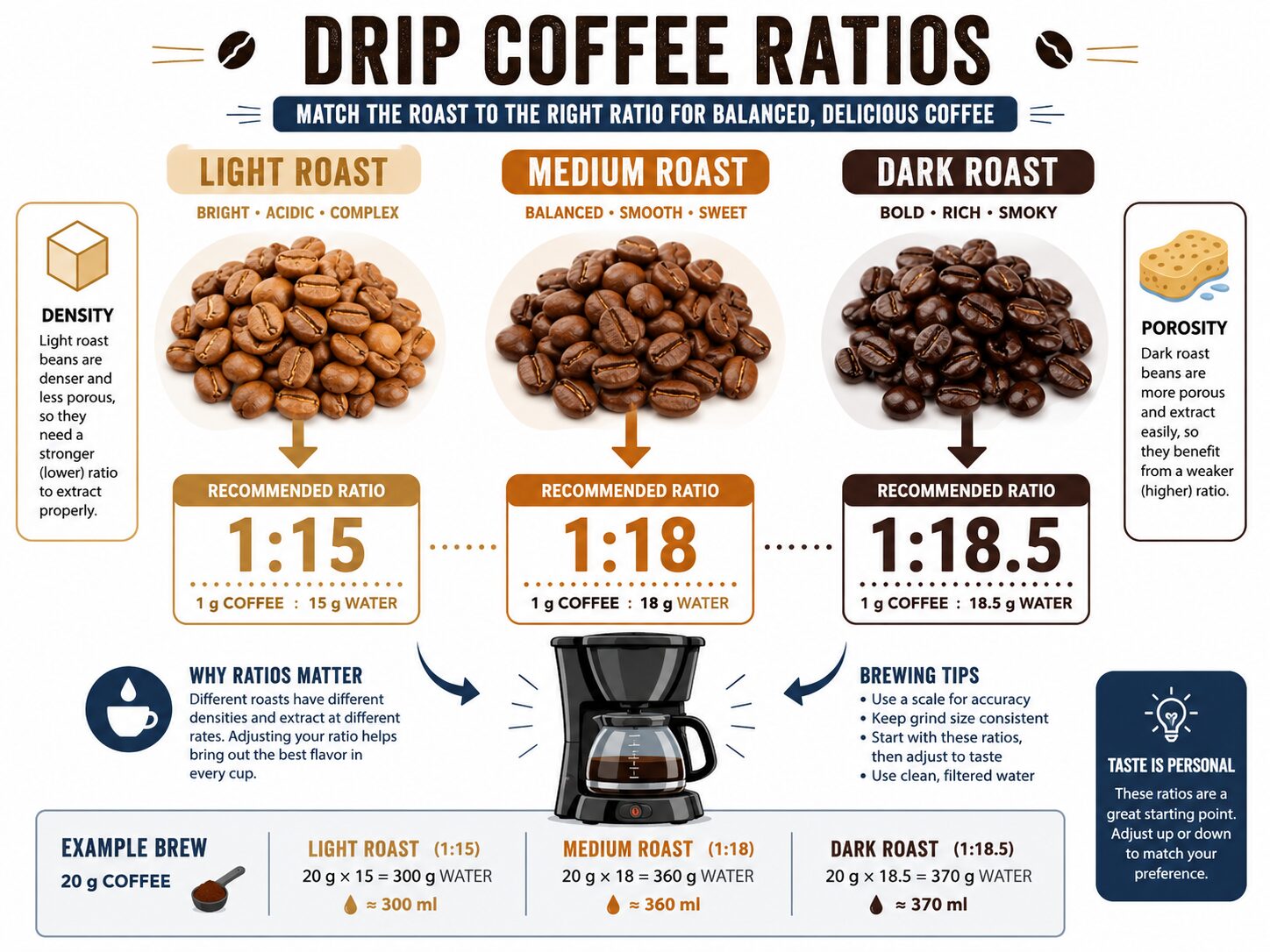
The 1:18 standard assumes a medium roast. Your single-origin coffee or blonde roast beans break that assumption.
Light roasts are denser. They resist water. To get a full extraction without a sour edge, you often need a tighter ratio, more coffee, to increase the resistance in the bed and extend the contact time. Think 1:15 to 1:16.
Dark roasts are more porous and brittle. They give up their solubles easily, including bitter compounds. A slightly wider ratio, less coffee, can prevent over-extraction. Think 1:17 to 1:18. A very dark, oily roast might even taste better at 1:18.5.
This is where the SCA standard meets real-world coffee flavor profiles. A Colombian coffee with chocolate notes can handle a tighter ratio that emphasizes body. A bright Kenyan might sing with a slightly wider ratio that highlights acidity.
| Coffee Characteristic | Ratio Adjustment | Reason |
|---|---|---|
| Light Roast / High Density | Tighter (e.g., 1:15) | Increases contact time and extraction yield to overcome cellular resistance. |
| Dark Roast / Oily Surface | Wider (e.g., 1:18) | Prevents rapid over-extraction of bitter compounds and ashiness. |
| Arabica beans (Typical) | Standard (1:16-1:18) | Balanced solubility and sugar content. |
| Blend with Robusta | Slightly Tighter | Robusta extracts differently; a tighter ratio balances the blend’s strength. |
Edge Cases and Exceptions
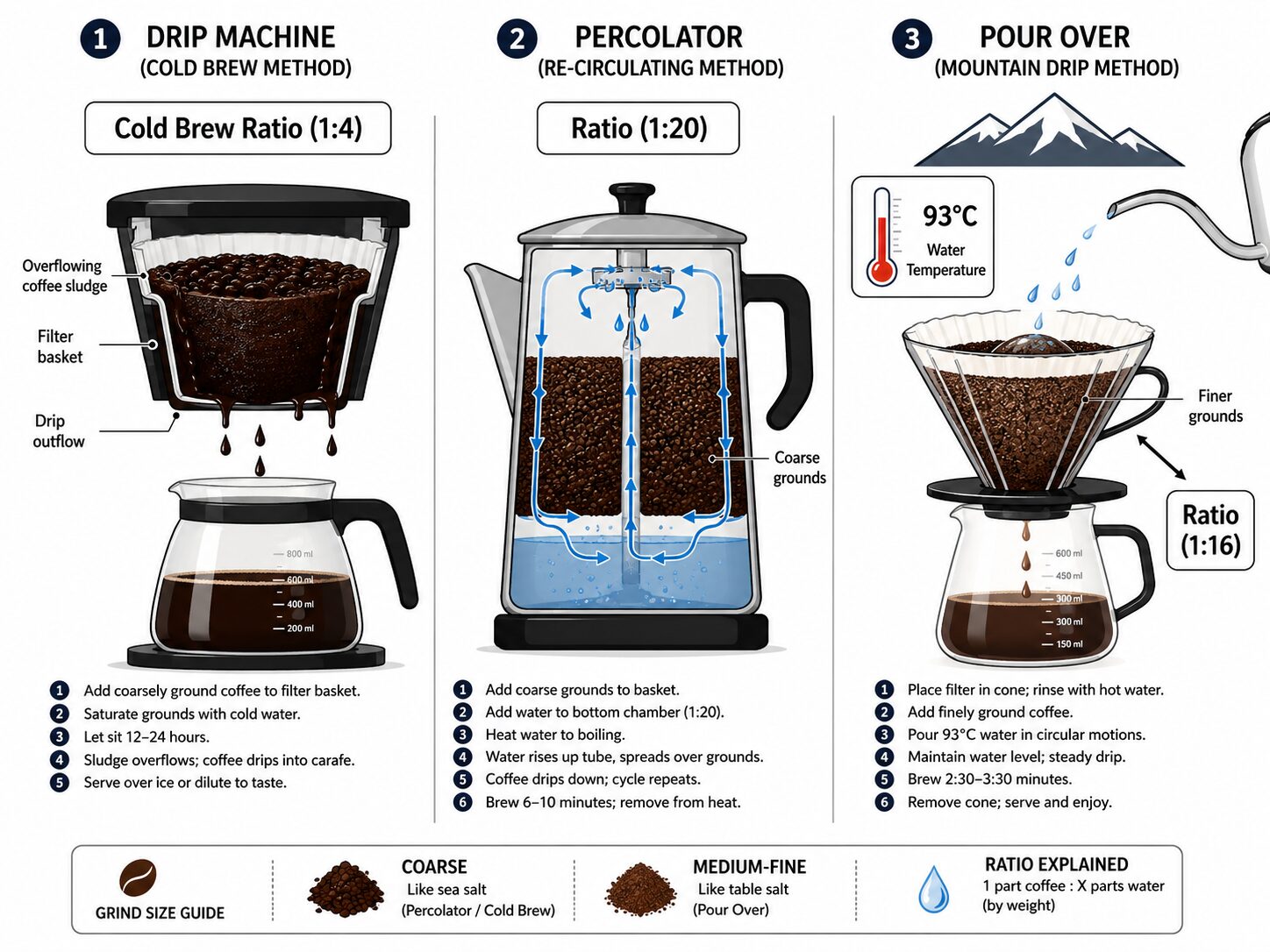
Some brewing methods live outside the drip ratio rules entirely.
Cold brew concentrate uses a radical ratio, between 1:4 and 1:8. You’re creating a syrup-like extract meant to be diluted with water or milk. Trying to run that through a drip machine would jam it solid.
Percolators recirculate boiling water through the grounds. This repeated contact demands a wider ratio, less coffee, to avoid bitter over-extraction. A percolator recipe might call for 1:19 or 1:20.
High-altitude brewing is a sneaky one. Water boils below 96°C. Lower temperature means slower extraction. If you use a standard 1:18 ratio, you’ll under-extract. The fix is to tighten the ratio (more coffee) OR grind finer to increase surface area. The ratio change is simpler.
Common mistake: Applying a cold brew concentrate ratio to a hot drip machine, the grounds swell and choke the filter, leading to overflow and a ruined batch. Keep the extreme ratios for their intended methods.
Tools You Actually Need (It’s a Short List)
Forget special gadgets. You need three things to master ratio.
- A Good Scale. It must measure in grams. The $20 kitchen model is fine. Place your carafe on it, tare to zero, pour water to your target weight. Tare again, add coffee.
- A Consistent Grinder. Blade grinders create dust and boulders. The dust over-extracts, the boulders under-extract. A burr grinder gives even particles, so your ratio adjustments actually mean something. The grind consistency is the foundation.
- A Notepad. Or your phone. Write down the weight of coffee, weight of water, and three tasting notes for the pot. Do this for three days. You’ll see the pattern.
The type of paper coffee filters you use matters for taste, but not for calculating the ratio. Bleached coffee filters have a neutral flavor; unbleached coffee filters can add a papery taste. Choose based on that, not on ratio math.
Frequently Asked Questions
Is a 1:15 or 1:18 coffee ratio stronger?
1:15 ratio is stronger. It uses more coffee for the same amount of water, resulting in a higher concentration of coffee solubles in your cup. Strength is about dissolved solids. A 1:18 ratio produces a lighter, more tea-like cup.
How much coffee for 8 cups of water?
If your machine’s “cup” is 5 ounces, 8 cups is 40 fluid ounces, which weighs about 1180 grams. Using a 1:16 ratio, you’d need 74 grams of coffee. Always weigh. The volume markings are unreliable.
Can I use a tablespoon instead of a scale?
No. A tablespoon of a dense light roast weighs more than a tablespoon of a fluffy dark roast. Volume measuring introduces a 15-20% error in your coffee dose before you start. That error guarantees your ratio is wrong. A scale costs less than two bags of specialty coffee.
Why does my coffee taste bitter even with the “right” ratio?
Bitterness from over-extraction can be caused by a ratio that’s too tight (too much coffee), a grind that’s too fine, water that’s too hot, or a brew time that’s too long. If you’re confident in your 1:18 ratio, try grinding slightly coarser. The bitter edge should fade in the next pot.
Does the type of water affect the ratio?
Water quality affects extraction efficiency and taste, but not the ratio calculation itself. Hard water with lots of minerals can slow extraction, making your coffee taste weaker at a given ratio. If your water is very hard, you might find yourself tightening the ratio (using more coffee) to compensate for the sluggish extraction.
Before You Go
The drip coffee brewing ratio is a dial, not a switch. The SCA’s 1:18 is the center point. Turn it towards 1:15 for more intensity and body, towards 1:18 for clarity and lightness. Your machine, your beans, and your morning mood decide the final position.
Skip the scoops and lines. Use a scale for five consecutive brews. Note the weights and the taste. The pattern that emerges is your personal ratio. It’s the difference between a random cup of brewed coffee and a repeatable one you actually want to finish. That’s the goal.
