
Cocoa Beans vs Coffee Beans: A Flavor and Caffeine Comparison
Cocoa beans and coffee beans are seeds from completely different tropical plants, processed for entirely different purposes. Cocoa beans (Theobroma cacao) are fermented for days to develop chocolate flavor, then roasted and ground into a paste for chocolate. Coffee beans (Coffea) are processed to remove fruit, then roasted to create soluble compounds for brewing a stimulating beverage. Their shared words, ‘bean,’ ‘roast,’ ‘origin’, mask a fundamental divide in biology, chemistry, and culinary destiny.
Most comparisons stop at “one makes chocolate, one makes coffee.” That misses the point. The real difference isn’t the end product; it’s the irreversible fork in the road just after harvest. Get the post-harvest step wrong, and you get vinegar or mold, not luxury.
This guide walks through that fork. We’ll compare their origins, break down the non-negotiable processing steps that define them, and explain why you’d never use a single-origin coffee bean to make a bar of chocolate.
Key Takeaways
- Fermentation is non-negotiable for cocoa, optional for coffee. Cocoa beans must ferment for 2-8 days to develop chocolate flavor precursors; without it, they taste unbearably bitter. Coffee fermentation is a cleaning step lasting 12-72 hours, aimed at removing mucilage, not building flavor.
- The stimulants are chemically distinct. Coffee delivers caffeine, a fast-acting stimulant that blocks adenosine receptors for alertness. Cocoa delivers theobromine, a milder, longer-lasting methylxanthine that gently boosts mood and dilates blood vessels.
- Roasting serves opposite masters. Cocoa roasting develops flavors created during fermentation. Coffee roasting creates flavor through the Maillard reaction and caramelization of raw sugars present in the green bean.
- Genetic diversity dictates use. Fine-flavor cocoa varieties (Criollo, Trinitario) are prized for chocolate, while sturdy Forastero fuels bulk production. In coffee, Arabica beans target quality drinks, while Robusta beans target caffeine strength and crema.
- They are not substitutes. You cannot brew a drink from processed cocoa beans that resembles coffee, and you cannot make chocolate from roasted coffee beans. Their chemical profiles and physical structures after processing are locked for their singular uses.
Botanical Roots: Two Trees, Two Continents
Cocoa and coffee start worlds apart. Cocoa beans grow inside large, rugby-ball-shaped pods that sprout directly from the trunk and branches of the Theobroma cacao tree. The pods are colorful, yellow, red, purple, and contain 30-50 beans surrounded by a sweet, white pulp. The tree is native to the deep tropical Amazon basin.
Coffee beans are the pits inside small, red cherry-like fruits that grow in clusters on the Coffea shrub. You typically get two beans per cherry, facing each other flat side in. The two commercially dominant species are Coffea arabica (Arabica) and Coffea canephora (Robusta), originating from the highlands of Ethiopia and central/western Africa, respectively.
This botanical separation is absolute. A coffee plantation is a field of shrubs. A cocoa plantation is a shaded forest of trees. The geographic coffee origins that matter. Ethiopia, Colombia, Brazil, are different from the prime cocoa lands of Ghana, Ivory Coast, and Ecuador.
Theobroma cacao translates to “food of the gods.” Coffea arabica‘ name points to its historical trade route through Arabia. One is named for divinity, the other for commerce. That tells you something about their historical journeys to our cup and bar.
TL;DR: Cocoa comes from large pods on a tree in the Americas; coffee comes from small cherries on a shrub from Africa. They have never been the same plant.
From Tree to Treat: The Processing Journey
Here is where the paths violently diverge. The sequence of harvest, fermentation, drying, and roasting has one goal for cocoa and a completely different goal for coffee. Getting this wrong ruins the crop.
| Processing Stage | Cocoa Beans | Coffee Beans |
|---|---|---|
| Primary Goal | Develop chocolate flavor precursors via microbial fermentation. | Remove the fruit mucilage to access a stable, green bean for roasting. |
| Fermentation | Mandatory. 2-8 days in piles, boxes, or baskets. Yeast & bacteria break down pulp, generate heat & acids, and trigger biochemical changes inside the bean. | Often used, but for cleaning. 12-72 hours (wet process). Enzymes or water break down mucilage. Can be skipped entirely in the dry/natural process. |
| Drying | Slow sun-drying to reduce moisture from ~60% to ~7%, halting fermentation. | Drying to ~10-12% moisture for stable storage and shipment. |
| Roasting | Develops flavors created during fermentation (brown notes, acidity). Lower temps (250-320°F). | Creates flavor via Maillard reaction & caramelization. Higher temps (370-480°F). |
The Cocoa Fermentation Imperative
For cocoa, fermentation is the soul of chocolate. Fresh cocoa beans are intensely bitter and astringent, with no chocolate flavor. The sweet pulp surrounding them is a fuel source for a controlled microbial riot.
Farmers pile beans and pulp into boxes or heap them on banana leaves. Yeasts kickstart the process, converting sugars to alcohol and raising the temperature. Lactic acid bacteria then take over, followed by acetic acid bacteria. This heat and acid bath kills the bean’s embryo and breaks down cell walls. Inside, enzymes activate, transforming simple compounds into the complex flavor precursors that will become chocolate during roasting.
Skip this step, and you have a bean that will never taste like chocolate. A study on Ecuadorian cocoa processing variations found that fermentation location and method directly correlated with final quality and sensory scores. This is why the international ISO cocoa bean quality standard includes fermentation as a key grading criterion.
The Coffee Processing Pragmatism
For coffee, the fruit is mostly a problem to be solved. The goal is to get to the clean, green seed inside. The “wet” or “washed” process uses fermentation tanks where enzymes loosen the sticky mucilage, which is then washed away. This fermentation is about sanitation and ease of removal, not flavor creation. In fact, over-fermentation here is a defect, leading to sour, vinegary notes.
The “dry” or “natural” process skips fermentation altogether; cherries are simply dried in the sun with the fruit intact. The flavor profile changes, often yielding fruitier, heavier-bodied coffees, but the core chemistry of the bean isn’t being built from scratch like it is with cocoa.
Common mistake: Equating coffee fermentation with cocoa fermentation. Coffee fermentation is a mechanical cleaning step. Cocoa fermentation is a flavor-creating biochemical transformation. Confusing them means you misunderstand the fundamental purpose of processing each bean.
TL;DR: Cocoa processing is a flavor-building biochemical reaction. Coffee processing is a seed-cleaning operation. This is the single most important difference between them.
The Chemical Kick: Caffeine vs Theobromine
Both beans contain stimulants from the methylxanthine family, but their effects on your body are opposites.
Caffeine (Coffee’s Driver):
Caffeine is a central nervous system stimulant. Its primary mechanism is blocking adenosine receptors in your brain. Adenosine builds up throughout the day, making you feel tired. Caffeine parks in those receptors, preventing adenosine from binding. The result: you feel alert, focused, and energetic. The onset is quick, within 15-45 minutes, and the effects are sharp. This is why we use coffee bean caffeine content as a measure of potency. Overdo it, and you get the well-known jitters, anxiety, and crash.
Theobromine (Cocoa’s Gentle Push):
Theobromine is a milder, slower-acting methylxanthine. It doesn’t block adenosine as aggressively. Instead, it has a more diffuse effect: it dilates blood vessels, which can lower blood pressure; it gently stimulates the heart; and it can promote feelings of well-being. Its onset is slower, its peak is lower, and its effects are more sustained and calming. You won’t get a jittery buzz from a bar of dark chocolate. This is also why theobromine is toxic to dogs, they metabolize it far too slowly.
| Stimulant | Primary Source | Onset & Duration | Primary Effect | Feel |
|---|---|---|---|---|
| Caffeine | Coffee beans, tea | Fast (15-45 min), shorter (3-5 hrs) | Blocks adenosine receptors | Sharp alertness, can cause jitters |
| Theobromine | Cocoa beans | Slower (1-2 hrs), longer (6-8 hrs) | Dilates blood vessels, mild diuretic | Gentle mood lift, sense of calm |
This fundamental difference in chemical effect dictates consumption patterns. We drink coffee for a rapid cognitive tool. We consume cocoa for pleasure, comfort, and a sustained sense of satisfaction. The debate over the health benefits of coffee often centers on managing caffeine’s powerful effects.
TL;DR: Coffee’s caffeine is a sharp, blocking stimulant for alertness. Cocoa’s theobromine is a gentle, dilating stimulant for mood. They work on your body in different, complementary ways.
Flavor and Genetics: A Map of Diversity
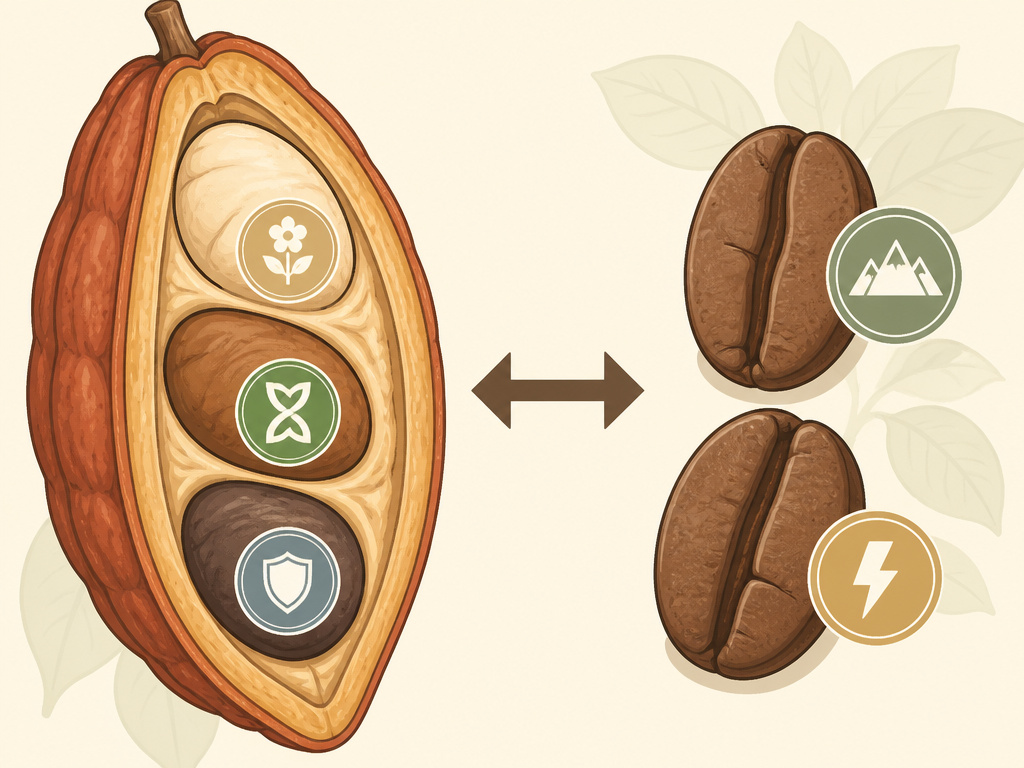
You can’t talk about flavor without talking about genetics. Both crops have wild diversity, but humans have selectively bred them down two distinct paths.
Cocoa’s Flavor Tribes
There are three main genetic groups: * Criollo: The rare, fine-flavor original. Thin-shelled, delicate, complex with nutty, floral, and low-bitterness notes. Prone to disease. Used for ultra-premium single-origin chocolate. * Forastero: The hardy “bulk” cocoa. Thick-shelled, robust, higher bitterness, classic chocolate flavor. Accounts for ~80% of world production. * Trinitario: A hybrid of Criollo and Forastero. Attempts to balance fine flavor with disease resistance. Much of the craft chocolate market uses high-quality Trinitario beans.
The flavor profiles of coffee beans are influenced by origin, but for cocoa, genetics are the first dictator. A Criollo bean from Venezuela will share a delicate family resemblance, distinct from the robust punch of a Forastero from Ghana.
Coffee’s Quality Divide
- Arabica: The quality standard. Smoother, sweeter, more complex acidity and aroma. Grown at higher altitudes, more delicate. Used for specialty espresso, pour-over, and drip.
- Robusta: The strength and efficiency bean. Higher caffeine, more bitterness, grainier flavor. Grows at lower altitudes, disease-resistant. Used in espresso blends for crema and in instant coffee.
The pursuit of single-origin coffee beans in the Arabica world mirrors the craft chocolate movement’s focus on Criollo and Trinitario. Both are about tracing a specific, superior flavor back to a specific piece of land. However, the production of coffee beans for bulk commercial blends often leans on Robusta, just as bulk chocolate relies on Forastero.
I once tasted a bar made from a rare Peruvian Criollo. The notes were like red fruit and roasted nuts, with zero astringency. The next week, I tried a mass-market chocolate. The difference wasn’t just quality, it was like listening to a symphony versus a single note played on a kazoo. The genetic potential of the bean sets the ceiling.
TL;DR: Criollo and Arabica are the delicate, high-flavor aristocrats. Forastero and Robusta are the sturdy, high-yield workhorses. Your end product is only as good as the genetic material you start with.
Practical Uses: Why You Can’t Swap Them
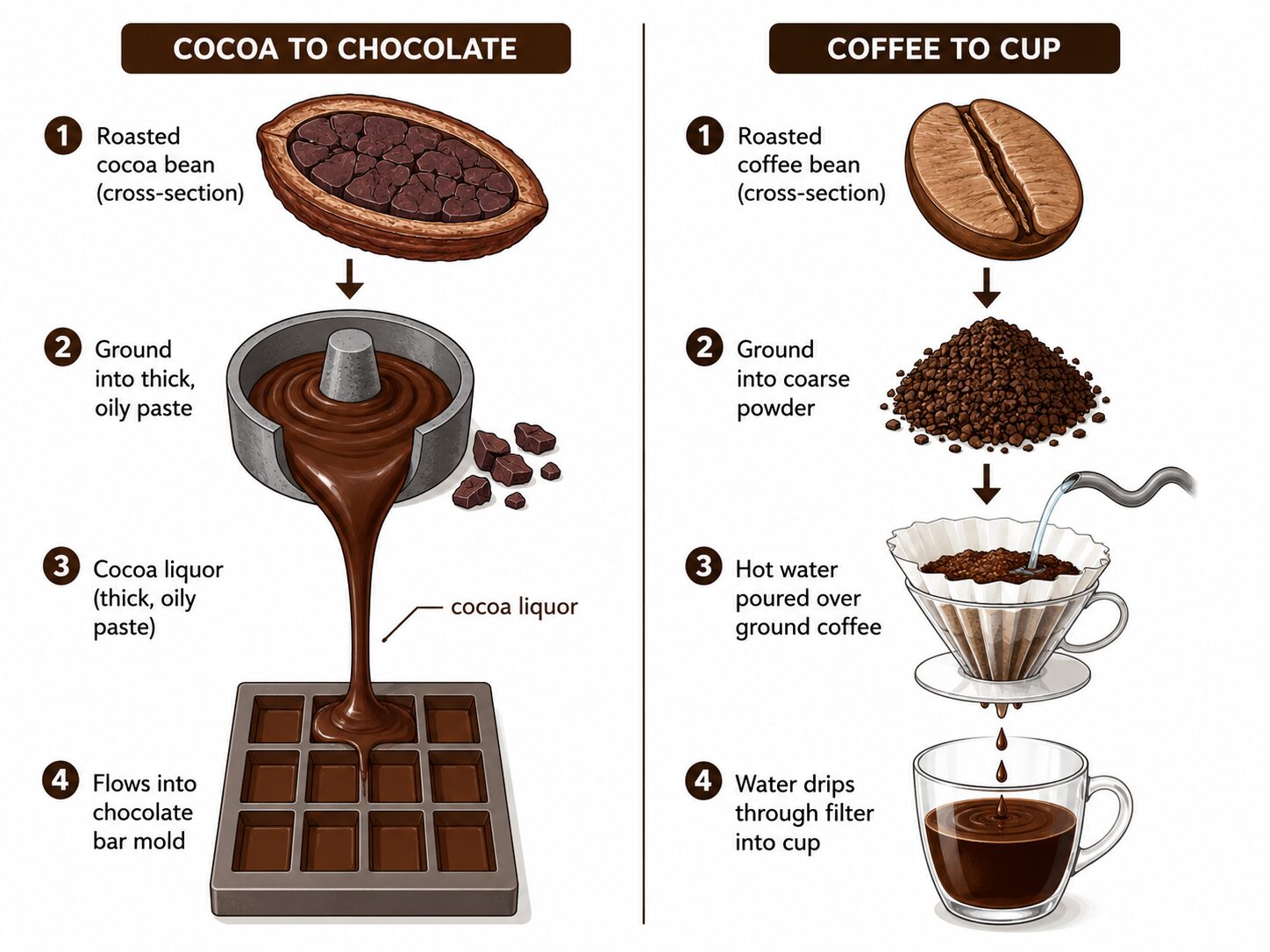
This is the final, practical truth. These beans are tools engineered for specific jobs.
You cannot make coffee from cocoa beans. A processed, roasted cocoa bean (nib) is oily, fatty, and fibrous. Steeping it in hot water would produce a thin, greasy, and bitter broth, not a clear, aromatic, stimulating beverage. The soluble compounds in cocoa are not designed for extraction in that way. Their destiny is to be ground into a paste (cocoa liquor) that can be pressed into cocoa butter and powder or solidified into chocolate.
You cannot make chocolate from coffee beans. A roasted coffee bean is brittle and porous, designed to be ground and have hot water pass through it to extract solubles. It contains almost no cocoa butter (the fat that gives chocolate its melt and snap). If you tried to grind roasted coffee beans into a paste, you’d get a gritty, oily mess that would never temper or set into a solid bar. The coffee bean preparation ritual of grinding coffee beans in a burr coffee grinder is for brewing, not confectionery.
Their equipment chains reflect this. A chocolate maker uses melangers (granite grinders) to refine cocoa paste for days. A coffee shop uses an expensive grinder like a Mahlkönig EK43 to achieve a perfectly uniform particle size for even extraction in 30 seconds. The machinery never crosses over.
| Aspect | Cocoa Bean End-Use | Coffee Bean End-Use |
|---|---|---|
| Final Product | Chocolate, cocoa powder, cocoa butter. | Brewed beverage (espresso, drip, pour-over). |
| Key Process | Fermenting, conching (mechanical smoothing). | Roasting, precise grinding, controlled extraction. |
| Consumption Form | Solid bar (eaten), powder (baked, drunk). | Liquid infusion (drunk). |
| Critical Equipment | Melanger, tempering machine. | Roaster, burr grinder, espresso machine/brewer. |
TL;DR: Cocoa beans are engineered to become a solid fat-based product. Coffee beans are engineered to become a water-based infusion. Their physical and chemical properties make them functionally non-interchangeable.
Frequently Asked Questions
Can you brew cocoa beans like coffee?
No. Roasted cocoa nibs steeped in hot water make a weak, oily, and bitter tea called “cacao tea,” not coffee. It contains theobromine but lacks the body, aroma, and caffeine kick of coffee. It’s a different drink entirely.
Which has more caffeine, cocoa or coffee?
Coffee has significantly more caffeine. A standard 8-oz cup of brewed coffee contains 80-100mg of caffeine. A 1.5-oz serving of dark chocolate (70-85% cocoa) contains about 20-30mg of caffeine, along with 150-250mg of theobromine. For a direct comparison, see our guide on espresso bean caffeine levels.
Why is chocolate a solid and coffee a liquid?
This comes down to fat content. Cocoa beans are about 50% fat (cocoa butter), which allows them to be ground into a fatty paste that solidifies. Coffee beans are only about 15% fat, and their structure is designed to be porous for water extraction, not to hold a solid form.
Are cocoa and coffee ever combined?
Yes, in flavoring. Mocha drinks combine chocolate flavor or syrup with espresso. Some dark roast coffees have natural chocolatey notes, and some craft chocolates are infused with roasted coffee beans. But at the bean-processing level, they remain separate. A true hybrid bean does not exist.
Which is healthier, cocoa or coffee?
They offer different benefits. High-quality dark cocoa is rich in flavonoids and minerals like iron and magnesium. Black coffee is rich in antioxidants and linked to various metabolic benefits. The “healthier” choice depends on your goals, antioxidant intake, stimulant sensitivity, or mineral supplementation. Comparing the effects of coffee consumption to cocoa’s benefits is complex.
The Bottom Line
Cocoa beans and coffee beans are not cousins. They are neighbors from different continents who happen to work in the same building, the kitchen. One is a sculptor who builds flavor through the slow art of fermentation. The other is a chemist who creates flavor through the applied heat of roasting.
You choose cocoa for the deep, comforting, mood-altering experience of chocolate. You choose coffee for the sharp, purposeful, mind-clarifying tool of caffeine. Understanding the caffeine release rates of coffee versus the slow diffusion of theobromine in cocoa explains your daily ritual better than any marketing tagline.
Respect the divide. Use a fine Arabica coffee bean in your grinder for tomorrow’s morning cup. Save a bar of single-origin Criollo chocolate for an evening treat. Each bean has earned its distinct place, and confusing them does a disservice to the centuries of craft that delivered them to your hand.
