
Chemex Coffee to Water Ratio Guide: The 1:15.5 Golden Rule
The Chemex coffee to water ratio is 1 gram of coffee to 15.5 grams of water. For a standard 30-gram dose, that’s 465 grams of water. This 1:15.5 middle ground balances the manufacturer’s 1:15 recommendation and the SCA’s 1:18 standard, accounting for the Chemex filter’s thicker paper.
Most people get this wrong by picking a single ratio and sticking to it for every bean. They blame the coffee when a light roast tastes grassy or a dark roast turns ashy. The ratio isn’t a fixed setting. It’s the first variable you change when the coffee changes.
This guide walks through the official specs, the community-tested sweet spot, and the precise adjustments for roast level, grind size, and even which Chemex model you own. You’ll learn how to match the water to the bean, not the other way around.
Key Takeaways
- The Chemex company recommends a 1:15 ratio. The Specialty Coffee Association standard is 1:18. The practical sweet spot for most brews is 1:15.5.
- Roast level dictates ratio. Use a tighter ratio (1:14 to 1:15) for dark roasts to avoid over-extracting bitter compounds. Use a higher ratio (1:16 to 1:17) for light roasts to fully extract their dense structure.
- Grind size must change with your ratio. A higher ratio (more water) needs a finer grind to slow the flow. A tighter ratio (less water) needs a coarser grind to speed it up. Target a total brew time of 3:30 to 4:30.
- The thick Chemex filter is the reason these ratios differ from other pour-overs. It filters more oils and fines, which can mute flavor if the ratio is too high.
- Your taste is the final judge. A sour, weak cup needs less water or a finer grind. A bitter, harsh cup needs more water or a coarser grind. Adjust one variable at a time.
The Official Manufacturer Ratio (And Why It’s a Starting Point)
Chemex’s own brewing instructions give a volumetric rule: one rounded tablespoon per five-ounce cup. Weigh that out. A “rounded tablespoon” of whole bean coffee is roughly 10 grams. Five ounces of water is 150 grams. That’s a 1:15 coffee to water ratio.
The Chemex Coffeemaker official website specifies a brewing ratio of “one rounded tablespoon of coffee per 5 oz. cup,” which translates to approximately 1 gram of coffee to 15 grams of water (1:15).
It’s a solid, simple starting point. But it has two flaws. First, “rounded tablespoon” is imprecise. Your scoop and my scoop differ. Second, it treats all coffee the same. A dark roast Colombian and a light roast Ethiopian have different densities and solubilities. They need different amounts of water to extract properly. Using 1:15 for everything is like using the same oven temperature for cookies and bread.
TL;DR: Start with the official 1:15 ratio to learn the brewer, but plan to adjust it based on your coffee’s roast date and roast level.
The Science of Strength: Why Roast Level Changes Everything
Coffee isn’t just brown beans. Roast level physically changes the bean’s structure. Light roasts are dense. Dark roasts are porous. This density difference is why your ratio must shift.
Light roast beans are roasted for less time. They retain more cellular structure and organic acids. They’re harder. Water struggles to penetrate them and pull out flavor. If you use too little water (a tight ratio like 1:14), you get underextraction. The cup tastes sour, salty, or grassy. You left flavor inside the bean.
Dark roast beans are roasted longer. Their structure expands and becomes brittle. They’re filled with cracks. Water flows through them easily, pulling out everything—including the bitter, carbonized compounds formed during roasting. If you use too much water (a high ratio like 1:18), you overextract. The cup tastes ashy, bitter, or hollow.
The fix is intentional. Match the water volume to the bean’s porosity.
| Roast Level | Target Ratio Range | Why It Works |
|---|---|---|
| Light Roast | 1:16 to 1:17 | More water volume ensures full extraction of the dense, complex sugars and acids. |
| Medium Roast | 1:15 to 1:16 | A middle ground that extracts balanced sweetness and body. |
| Dark Roast | 1:14 to 1:15 | Less water volume avoids over-extracting bitter, roasted flavors. |
This isn’t a subtle suggestion. I once brewed a beautiful Ethiopian Yirgacheffe light roast at 1:15 because it was my default. The cup was thin and aggressively sour. I upped the ratio to 1:16.5 on the next brew, grinding a touch finer to compensate. The sourness vanished. The tea-like jasmine and bergamot notes appeared. The difference was in the water weight, not the bean.
Common mistake: Using a 1:15 ratio for every coffee — light roasts will taste weak and sour, dark roasts will taste ashy and bitter. Adjust the ratio first, before touching the grind.
Dialing In Your Grind to Match Your Ratio
Changing your coffee to water ratio breaks your grind setting. You have to recalibrate. Think of it as a balance scale. On one side is coffee mass, on the other is water volume and time. Change one side, you must change the other.
A higher ratio means more water flowing through the same mass of coffee. If you keep the grind the same, the water will flow through too fast. The brew time drops. You get underextraction. To compensate, you must grind finer. The finer particles increase surface area and resistance, slowing the water down to hit your target brew time.
A tighter ratio means less water flowing through the coffee bed. With the same grind, the water might stall. The brew time balloons. You get overextraction. The fix is a coarser grind. The larger particles create more channels for the smaller water volume to flow through quickly.
Your target total brew time for a Chemex is 3 minutes 30 seconds to 4 minutes 30 seconds. This includes the 30-45 second bloom. Use that as your guide.
- Pick your ratio based on the roast level table above.
- Use your previous grind setting as a starting point.
- Brew and time it.
- Adjust the grind: If the brew is too fast (<3:30), grind finer. If it’s too slow (>4:30), grind coarser.
- Taste. If the timing is right but the taste is off, adjust the ratio next time, not the grind.
This interplay is why a single-setting grinder fights the Chemex. You need a good burr coffee grinder for consistent particle size. A blade grinder creates dust and boulders. The dust overextracts, the boulders underextract, and no ratio change can fix the muddled cup.
Model Matters: Adjusting for Your Chemex Size
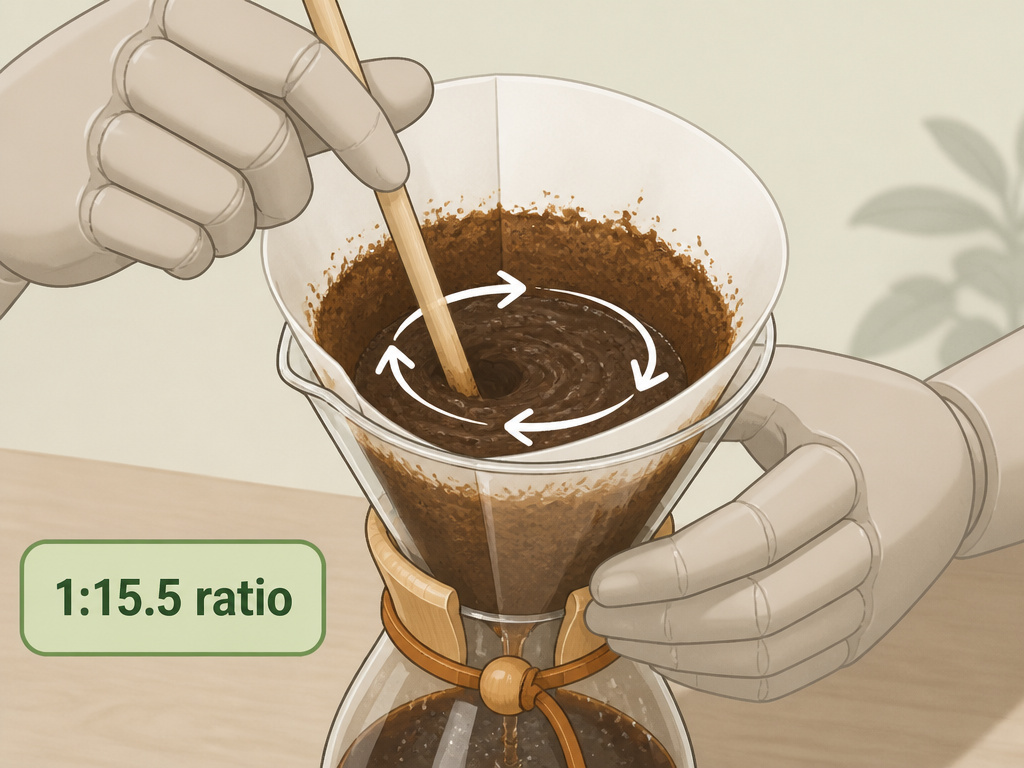
A 3-cup Chemex isn’t just a small 6-cup. The cone is narrower and deeper. The filter forms a long, thin tube of coffee. This geometry changes the hydrodynamics.
The main challenge is even saturation. When you pour, water tends to channel down the center. The grounds plastered against the deep sides of the filter never get fully wet. This leads to uneven extraction—part of the coffee is a soggy overextracted mess, part is a dry, underextracted cliff.
The fix is technique, not ratio. After your bloom, use a spoon or chopstick to gently stir the slurry, ensuring all grounds are submerged. Some brewers, like in the YouTube transcript, use a final long center pour to agitate the deep bed. The ratio itself (1:15.5) stays the same, but your pour must be more deliberate to ensure all the coffee earns its keep.
For the 6-cup and 8-cup models, the wider cone allows for easier, more even pouring. The standard circular pour works fine. The key with these is managing the larger volume of water. Don’t let the water level rise too high above the coffee bed, or you’ll add weight that causes compaction and stalling.
The Bloom and Pour: Executing Your Ratio

You’ve weighed 30 grams of coffee. You’ve calculated 465 grams of water for a 1:15.5 ratio. Now you have to get that water into the coffee effectively.
Start with a rinsed filter. Use hot water to rinse your paper coffee filters and pre-heat the Chemex. Dump the rinse water. This removes the paper taste and warms the glass, keeping your brew temperature stable.
Add your coffee. Give the brewer a shake to level the bed.
The Bloom: Start your timer. Pour 60 grams of water (twice the coffee weight) evenly over the grounds, ensuring all are wet. Let it sit for 30 to 45 seconds. You’ll see the coffee puff up and bubble as CO2 escapes. This degassing is critical. If you skip it, the gas will repel water later in the brew, creating channels and uneven extraction.
The Pour: After the bloom, begin adding the remaining 405 grams of water. Pour in slow, steady circles, starting from the center and moving outward. Keep the water level about half an inch to an inch above the coffee bed. Never let it dry completely, but don’t flood it. Your goal is to finish pouring all your water by around the 1:30 to 2:00 mark on your timer. Then let it drain.
If you’re exploring blonde roast beans, remember their density. You might need a slightly longer bloom (45 seconds) and a more aggressive pour to ensure even saturation of those hard beans.
Troubleshooting Your Chemex Brew

Your brew is done. It took 4 minutes. You taste it. Something’s wrong. Use this table to diagnose and fix the issue on your next cup. Always change only one variable at a time.
| Symptom | Likely Cause | Immediate Fix (Next Brew) |
|---|---|---|
| Sour, sharp, weak | Underextraction | Use a tighter ratio (e.g., 1:15 instead of 1:16) OR grind finer. |
| Bitter, harsh, ashy | Overextraction | Use a higher ratio (e.g., 1:16 instead of 1:15) OR grind coarser. |
| Flat, dull, empty | Stale coffee or wrong ratio | Ensure fresh beans (<3 weeks post-roast). Try adjusting ratio toward 1:15.5. |
| Brew time too fast | Grind too coarse / ratio too high | Grind finer. If ratio is above 1:17, consider tightening it. |
| Brew time too slow | Grind too fine / ratio too tight | Grind coarser. If ratio is below 1:14, consider increasing it. |
If you enjoy a drip coffee method for its simplicity, the Chemex can feel fussy. But that control is the point. Each variable—ratio, grind, pour—is a dial you can turn to highlight exactly what you love in a coffee.
Frequently Asked Questions
What is the best ratio for a 6-cup Chemex?
The best ratio doesn’t change with the brewer size. A 6-cup Chemex just holds more. The ideal ratio range is still 1:14 to 1:17 based on roast. A standard starting point is 30 grams of coffee to 465 grams of water (1:15.5). Scale up or down from there.
Can I use a 1:18 ratio like other pour-overs?
You can, but you likely shouldn’t. The Chemex’s thick filter material differences remove more oils and solubles. A 1:18 ratio often produces a thin, tea-like cup that lacks body. The 1:15 to 1:17 range compensates for the filter’s high retention.
Why does my Chemex coffee taste bitter?
Bitterness means overextraction. First, check your ratio. If you’re using a dark roast at 1:17, that’s too much water. Tighten to 1:15. Second, check your grind. It’s probably too fine, causing a slow brew. Grind coarser to get your total time under 4:30.
How much coffee do I need for 4 cups?
Ignore “cups.” Use weight. A standard serving is about 12-15 grams of coffee per 200 ml of water. For four servings, aim for 48-60 grams of coffee. At a 1:15.5 ratio, that’s 744-930 grams of water. Use your scale.
Does water quality affect the ratio?
Yes, indirectly. Hard water with high mineral content can inhibit extraction. If your coffee consistently tastes weak even at tight ratios, try brewing with filtered or bottled water. The right water can make your ratio behave more predictably.
The Bottom Line
Forget memorizing a single number. The perfect Chemex coffee to water ratio is a range you navigate. Start at 1:15.5 with a medium grind. Taste. If it’s sour, tighten the ratio or grind finer. If it’s bitter, increase the ratio or grind coarser.
The ratio is your primary control for the coffee’s strength and balance. The grind is your control for the extraction time. Master their dance. Your reward is a cup that matches the roaster’s intent, whether that’s a bright, complex light roast coffee or a smooth, chocolaty dark roast. Now go weigh your coffee.
