
TSA Rules: Can You Bring Coffee Grounds on a Plane? Guide
Yes, you can bring coffee grounds on a plane in both your carry-on and checked luggage according to TSA and CATSA rules. Dry, ground coffee is considered a solid food item with no specific quantity limits for security purposes. The main considerations are packing to avoid spills and knowing that carry-on amounts over 12 ounces may trigger extra powder screening.
Most travelers get tripped up not by the security rules, but by the separate, and often forgotten, customs regulations for certain types of beans. You can sail through the TSA checkpoint with a five-pound bag of grounds only to have it held at agriculture inspection when you land.
This guide walks through the official rules from TSA, CATSA, and CBP, explains the powder screening advisory, and shows you how to pack coffee to keep it fresh from takeoff to brewing.
Key Takeaways
- TSA and CATSA explicitly list ground coffee as permitted in carry-on and checked bags with no weight limit for security.
- Carry-on powders (including coffee grounds) in quantities larger than 12 oz / 350 ml are subject to additional screening, which can mean a bag search.
- U.S. Customs (CBP) allows roasted coffee but requires green (unroasted) beans to be free of pulp; this is an agricultural rule, not a security one.
- Always pack coffee in a sealed, airtight container placed inside a plastic bag to contain any mess from cabin pressure changes.
- For international travel, check the destination country’s agricultural import rules, which can be stricter than U.S. departure rules.
The TSA’s Official Stance on Coffee Grounds
The Transportation Security Administration’s “What Can I Bring?” tool is the definitive source for U.S. airport security. Its entry for “Coffee (Beans or Ground)” states the item is allowed in both carry-on and checked bags. This isn’t a suggestion or a common practice, it’s the published regulation.
Ground coffee and whole coffee beans are permitted in carry-on and checked bags. There are no TSA‑imposed quantity limits for these solid food items.
The listing makes a critical distinction: coffee is a solid. This places it outside the restrictive 3-1-1 liquids rule that governs beverages, gels, and aerosols. You do not need to squeeze your bag of grounds into a quart-sized bag or limit it to 3.4 ounces. A one-pound bag, a five-pound bag, from a security standpoint, the TSA does not care about the weight.
But there is a catch for carry-ons. In 2018, the TSA began implementing enhanced screening for powders. The agency advises that “powders over 12 oz. (350 ml)” in carry-on bags may require additional screening. Coffee grounds fall under this powder advisory.
TL;DR: TSA says yes to any amount of coffee grounds. For carry-ons, pack under 12 oz to breeze through; over 12 oz means your bag might get opened for a quick test.
The 12-Ounce Powder Rule and What “Additional Screening” Means
That 12-ounce threshold isn’t a hard limit but a trigger point. If your carry-on contains a container of grounds larger than a standard soda can, be prepared for the possibility of extra scrutiny.
The screening usually involves a security officer opening your bag, swabbing the outside of the coffee container with a test strip, and inserting the strip into a chemical analyzer. The process takes an extra two to three minutes. It’s not a denial, just a delay. The officer is verifying the powder isn’t a security concern.
The rule exists because certain explosive materials can be disguised as innocuous powders. It’s the same reason you might see someone’s bag of flour or protein powder being inspected. To avoid this delay entirely on a domestic flight, place large quantities of coffee in your checked luggage. The powder rule does not apply to checked bags.
| Bag Type | Under 12 oz | Over 12 oz |
|---|---|---|
| Carry-On | No extra screening expected. | Subject to additional screening (bag search, swab test). |
| Checked | No issue. | No issue. Powder rules do not apply. |
Crossing Borders: Customs Rules Are Different Than Security
Clearing the TSA checkpoint with your coffee only gets you onto the plane. When you arrive in another country, you must clear customs and agriculture inspection. This is where a separate set of rules applies, governed by agencies like U.S. Customs and Border Protection (CBP) and the USDA’s Animal and Plant Health Inspection Service (APHIS).
For the United States, the APHIS agricultural product import rules are clear. Roasted coffee beans and grounds are generally admissible because the roasting process neutralizes most pests and plant diseases. They are considered a processed agricultural product.
Common mistake: Assuming security approval means customs approval, the TSA governs what gets on the plane, CBP governs what comes into the country. They have different mandates.
The significant edge case is unroasted, or “green,” coffee beans. CBP guidance states green coffee beans are admissible only if they are “free of pulp.” This targets beans processed using the “natural” or “dry” method, where the coffee cherry fruit is dried around the bean before removal. If any dried fruit pulp remains, it could harbor insects or fungi and may be confiscated.
If you are importing green beans commercially, you need a permit. For personal amounts (a few pounds), declaration on your customs form is required. Be honest. The worst that happens is the officer takes a look and lets you keep them if they’re clean. Trying to sneak them through can lead to fines.
Packing Coffee for the Flight (and Avoiding Stale Cups)
You have permission. Now you need a strategy. The goal is to arrive with fresh, dry, intact coffee. The cabin of an airplane is a terrible environment for coffee: it’s dry, the air pressure fluctuates, and baggage holds get cold.
First, choose your container. The bag from the roaster is not good enough. The seal isn’t meant for pressure changes. Grounds have more surface area and release carbon dioxide faster than whole beans, accelerating staling.
Transfer your grounds to a truly airtight container. A hard-sided plastic or stainless-steel container with a rubber gasket is ideal. Glass is a risk. If you must use the original bag, place the entire bag inside a heavy-duty zipper-lock plastic bag and squeeze out the excess air. This double-bagging contains any mess if the inner bag ruptures.
Second, consider the journey. For short hops, your carry-on is fine. For long international trips where your coffee will be in transit for 24 hours or more, checked luggage might be better. The hold is dark and cool, which slows staling. Just ensure the container is buried among soft clothes to buffer it from rough handling.
Why You Should Consider Whole Beans and a Grinder
This is the veteran move. If you’re traveling for more than a few days and care about quality, pack whole beans and a small manual grinder. Whole beans stay fresh weeks longer than pre-ground coffee. The difference in the cup after a week of travel is stark, grounds taste flat and muted; freshly ground beans still have aroma and clarity.
A compact burr coffee grinder is a travel game-changer. The consistent grind size it produces matters more when you’re using an unfamiliar hotel coffee maker or a portable pour-over. Blade grinders are smaller and cheaper, but they create uneven particles that lead to uneven extraction. You’ll taste both bitter and sour notes in the same cup.
If you go this route, pack the grinder in your carry-on. Its mechanical parts can confuse scanner algorithms, and you don’t want it lost with your checked bag. Be prepared to explain it at security. I’ve never had one confiscated, but I’ve had my bag pulled for a manual inspection three times.
Coffee Makers, Filters, and Other Gear
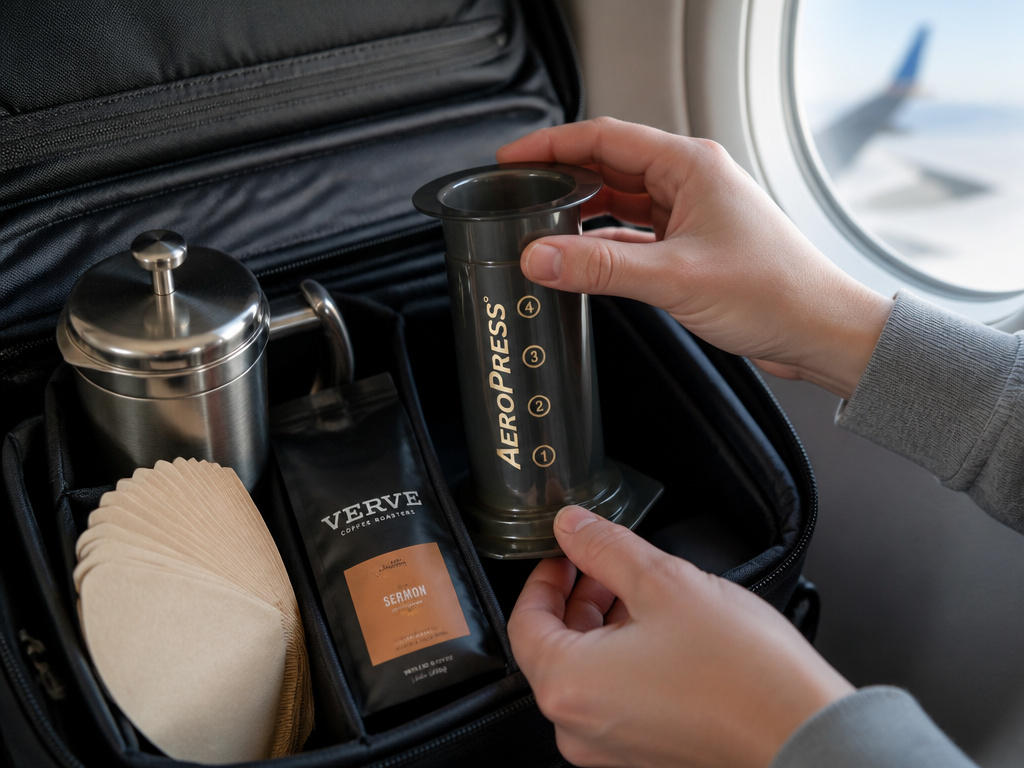
Your coffee grounds are useless without a way to brew them. Bringing your own coffee maker is a separate question with its own rules.
Most standard drip coffee makers are permitted in both carry-on and checked luggage. They contain no hazardous materials. However, if the machine has a water reservoir, it must be completely dry. Any residual moisture can be flagged as a liquid. The FAA PackSafe hazardous materials guide is the authority for what’s forbidden in the cargo hold, but a standard coffee maker isn’t on the list.
Portable brewers like an AeroPress, a V60 dripper, or a stainless-steel French press are excellent travel choices. They are almost always carry-on friendly. The AeroPress is just plastic; the French press is glass or metal. Pack the plunger assembly separately to avoid accidental pressure changes causing it to engage.
Don’t forget the paper coffee filters. A stack of filters takes up no space. If you’re environmentally conscious, biodegradable coffee filters are a good option, though you’ll need to find a composting bin at your destination. For owners of specific machines, like a Bunn coffee maker or a Breville coffee maker, bringing the exact size and type of filter guarantees a proper brew on the road.
Frequently Asked Questions
Can I bring opened packages of coffee grounds on a plane?
Yes. The TSA does not require coffee to be in its original, sealed packaging. An opened bag or container is permitted. Just make sure it’s sealed well to prevent spills that will cause a mess and slow down security as they check the powder residue.
Does the 3-1-1 liquids rule apply to ground coffee?
No. The 3-1-1 rule applies to liquids, gels, aerosols, creams, and pastes. Dry ground coffee is a solid food item. You can pack a large bag in your carry-on without putting it in a quart-sized baggie.
Can I bring instant coffee on a plane?
Yes. Instant coffee granules or powder is treated the same as ground coffee, it’s a solid. You can bring it in any quantity. This makes single-serve packets of instant coffee a incredibly convenient and low-risk option for travel.
What about liquid coffee or cold brew?
Liquid coffee is subject to the 3-1-1 liquids rule. In your carry-on, it must be in a container 3.4 ounces or less, and all such containers must fit inside a single quart-sized, clear, plastic, zip-top bag. You can pack larger amounts in your checked luggage.
Are there countries that ban coffee imports?
Most countries allow roasted coffee for personal use. However, a few nations with strict agricultural biosecurity, like Australia and New Zealand, require you to declare any food products, including coffee, upon arrival. It’s rarely banned, but it must be inspected. Always check the destination country’s official agriculture website before you fly.
The Bottom Line
Bringing coffee grounds on a plane is straightforward. The TSA and CATSA say yes. Pack them securely to avoid a mess, and if you’re carrying more than 12 ounces in your carry-on, budget an extra few minutes for a potential bag check.
The real nuance is for international travelers bringing back green, unroasted beans. That’s a customs question, not a security one. Declare them, ensure they’re clean, and you’ll likely be fine. For the best tasting coffee at your destination, skip pre-ground altogether. Pack whole Arabica coffee beans and a small grinder. The extra minute of morning ritual is worth it when you’re far from home.
