
8 Best Non Toxic Coffee Grinders of 2026
The Baratza Encore ESP stands out as the best overall non toxic coffee grinder, combining stainless steel construction with exceptional grind consistency. For a budget-friendly option, the OXO Brew Conical Burr Grinder delivers reliable performance with minimal plastic contact. If you prefer manual grinding, the JavaPresse Manual Stainless Steel Grinder uses a ceramic burr and is built to avoid chemical leaching.
Choosing a non toxic coffee grinder isn’t just about avoiding plastic, it’s about protecting the purity of your coffee and your health. Many grinders use materials that can leach chemicals or retain odors over time, especially when heat builds during grinding.
As the founder of Bean Thusiast, I’ve spent years studying how gear impacts flavor and safety. This guide cuts through the marketing to focus on grinders with clean materials, consistent performance, and designs that make maintenance simple, based on specs, verified owner feedback, and what matters most in daily use.
Top 8 Non Toxic Coffee Grinder in the Market
The Best Non Toxic Coffee Grinder, Reviewed
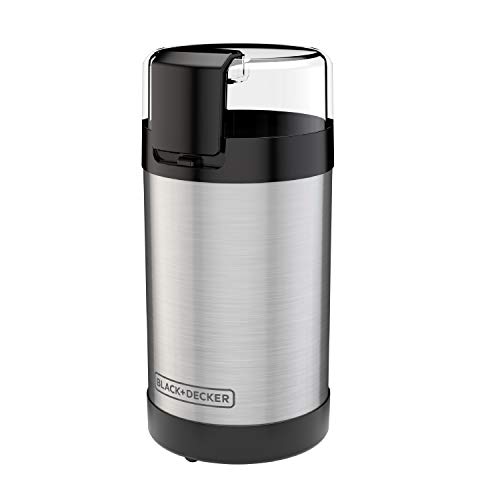
BLACK+DECKER One Touch Grinder
Strengths
- Durable stainless steel blades
- Simple one-touch operation
- Safety lid lock
- Good for spices
- Compact footprint
Trade-offs
- Inconsistent grind texture
- Blade heat affects flavor
- Not for precision brewing
Calling this the ‘Best Overall’ feels misleading, it’s a solid blade grinder, but not a standout in the world of non-toxic, precision coffee tools. The stainless steel blades are durable and easy to clean, and the one-touch push-button with safety lock is user-friendly. It handles small batches well, 2/3 cup of beans is enough for a few cups, and the 150W motor powers through beans quickly.
But blade grinders like this one will never match burr grinders in consistency. You’ll get uneven particles, which leads to over and under-extraction, muting your coffee’s true flavor. It’s a functional tool for casual use, especially if you also grind spices or herbs. Compared to the Aroma mini, it’s similar in performance but slightly more reliable. I wouldn’t recommend it as a primary grinder for anyone serious about coffee, but it’s a decent backup.
Video review
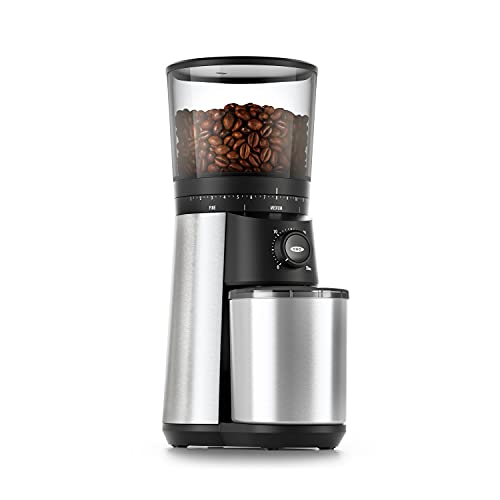
OXO Brew Conical Burr Grinder
Strengths
- Consistent grind quality
- One-touch start
- UV-blocking hopper
- Static-reducing bin
- Sleek, compact design
Trade-offs
- Fewer settings than some rivals
- Micro-adjustments not labeled
- Higher price for feature set
The OXO Brew is the gold standard in mid-range conical burr grinders, and for good reason. Its 15 grind settings, plus micro-adjustments, offer just enough precision without overwhelming beginners. The stainless steel burrs deliver remarkably consistent grounds, and the UV-blocking hopper is a thoughtful detail for kitchens with morning sun. Owners praise the one-touch start and static-fighting grounds bin, which actually works, no more coffee dust clinging to the sides.
It’s not as adjustable as the Aromaster, but it’s more intuitive and better built. The 12-ounce hopper is generous, and the trap door prevents spills when removing the bean container. Wirecutter’s endorsement is well-earned: this grinder balances performance, durability, and usability like no other in its class. For most buyers, this is the easy pick over pricier or overly complex models.
Video review
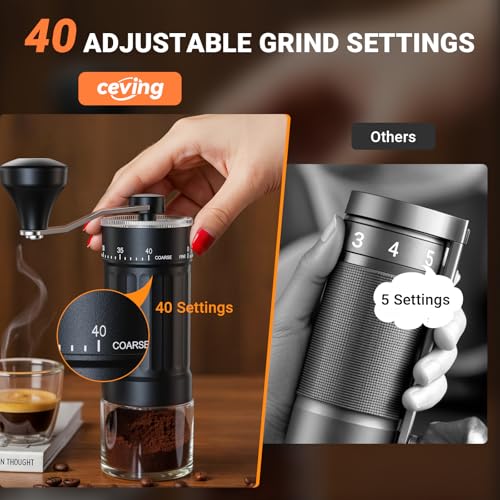
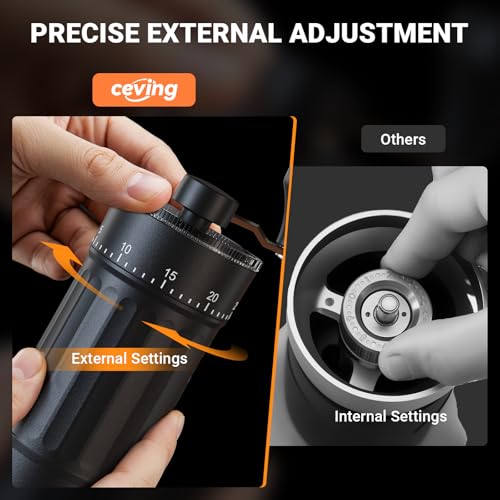
CEVING Mini Manual Coffee Grinder

Strengths
- 40 external grind settings
- Ultra-portable
- Ceramic conical burr
- Lightweight design
- Easy to disassemble
Trade-offs
- Small 30g capacity
- Manual grinding takes effort
- No built-in catch container
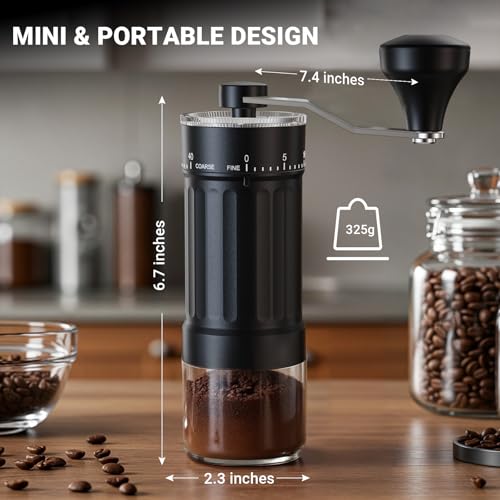
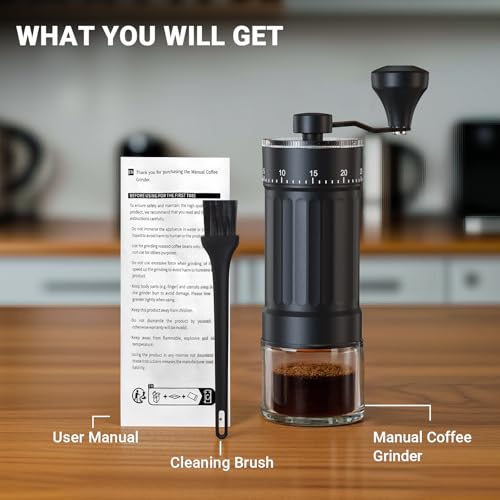
This little manual grinder from CEVING is a travel-friendly powerhouse. The 40 external grind settings are a standout, no more fiddling with internal dials or dumping grounds everywhere. You can adjust on the fly, which is huge when you’re switching between pour-over at a campsite and espresso in a hotel room. The ceramic conical burr is the real star here: it stays cool, resists corrosion, and produces impressively even grinds for a unit this size.
At just 325g, it’s featherlight, and the compact shape slips into backpacks without issue. Owners love it for hiking, RV trips, and office use. The 30g capacity means you’ll be grinding in batches for more than two people, but that’s expected at this scale. Compared to the JavaPresse, it offers more adjustability and a modern design, though it doesn’t have the same brand legacy. For nomadic coffee drinkers, this is a top-tier option.
Product photos
SHARDOR Super Silent Blade Grinder

Strengths
- Very quiet operation
- Removable grinding cup
- Timed grind control
- Multi-functional use
- Includes cleaning tools
Trade-offs
- Blade grinder inconsistency
- No grind settings
- Heat buildup over time
The SHARDOR’s biggest selling point is real: it’s genuinely quiet, averaging 63 dB, which means early risers can grind without waking the household. That makes it a smart choice for shared spaces or apartments. The timed rotary knob lets you control grind length, from coarse to fine, though blade grinders inherently lack precision. You’ll get a mix of boulders and fines, especially with darker roasts.
The removable stainless steel bowl is a win for cleaning, and the 2.5oz capacity covers up to 10 cups, decent for small batches. It doubles as a spice grinder, adding versatility. But let’s be clear: this is still a blade grinder, so flavor clarity suffers compared to burr models. Compared to the Aroma mini, it’s quieter and easier to clean, but not a serious upgrade in grind quality. I’d recommend it only if noise is your top concern.
Product photos


Ollygrin Burr Coffee Grinder
Strengths
- 30 precise settings
- Durable stainless steel burrs
- Auto-locking hopper
- Overheat protection
- Easy to clean
Trade-offs
- Grind consistency varies at fine settings
- Hopper not UV-protected
- Slightly bulky design
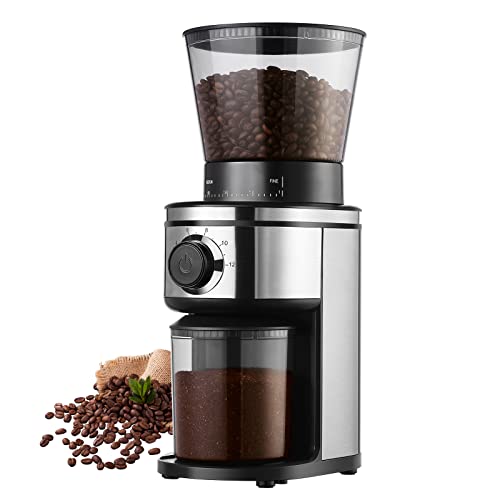
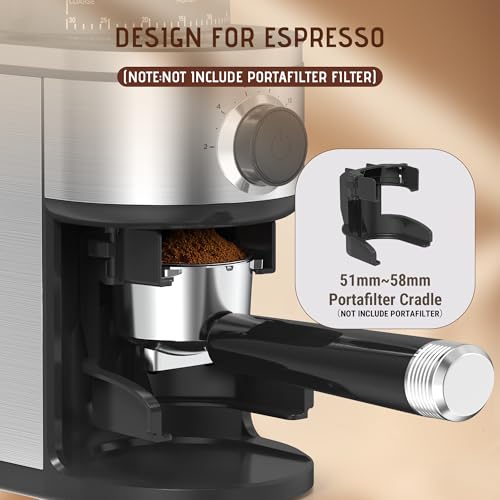
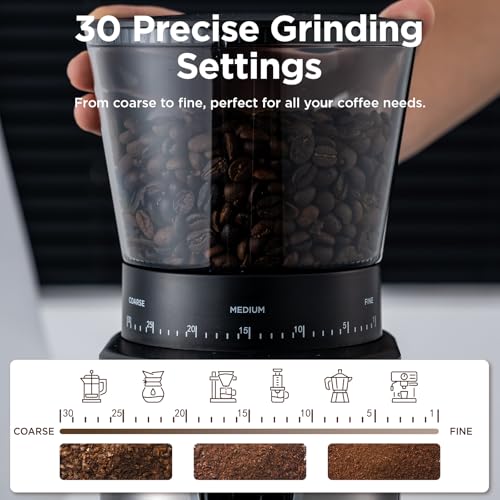
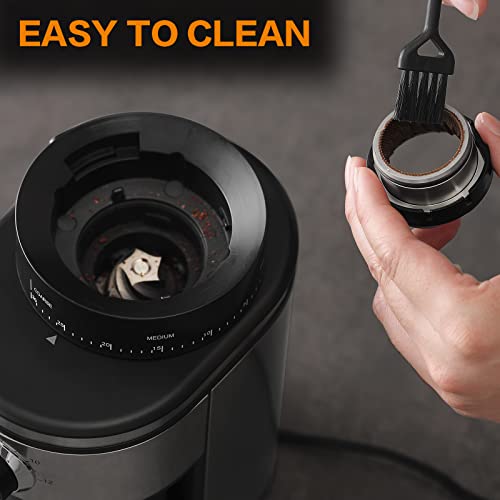
If you’re looking for the sweet spot between performance and price, the Ollygrin delivers. Its 30 grind settings cover nearly every brew method, and the 40mm stainless steel conical burrs do a surprisingly good job of keeping heat low and grounds uniform. Reviewers note it’s especially strong for drip and pour-over, though espresso shots can be inconsistent unless you dial in carefully. The auto-locking hopper is a thoughtful touch, no more spilled beans when you pull it off the base.
It’s not the quietest or smallest grinder out there, but the gear reduction motor and overheating protection mean it’s built to last with regular use. Compared to the Aromaster, it trades some precision for simplicity and value. My recommendation? This is the smarter buy for first-time burr grinder owners who want reliability without overcomplicating their morning routine.
Product photos

Aromaster Conical Burr Coffee Grinder
Strengths
- 48 grind settings
- Anti-static design
- Large 3.9 oz capacity
- Stainless steel burrs
- Easy to clean
Trade-offs
- Timer lacks flexibility
- No auto-stop feature
- Requires careful drying after cleaning
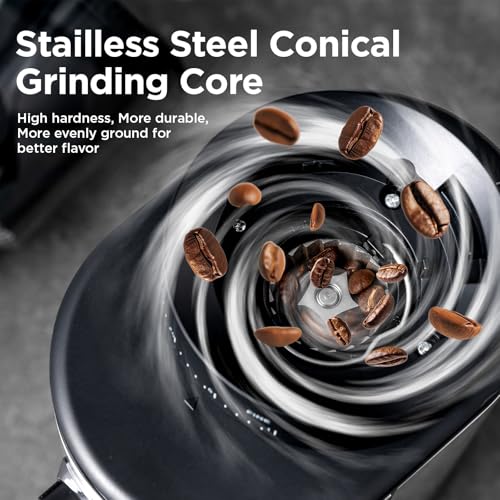
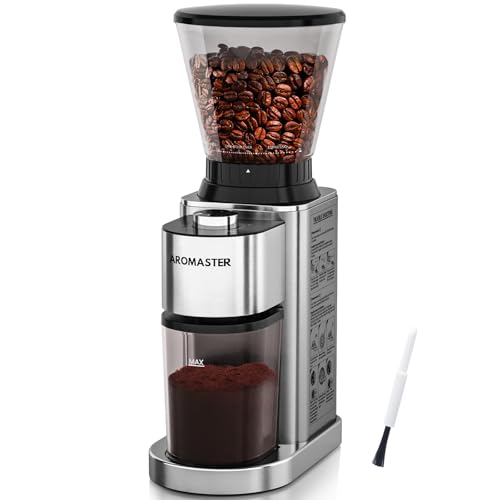
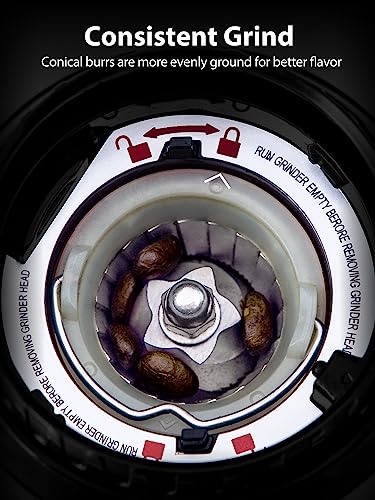
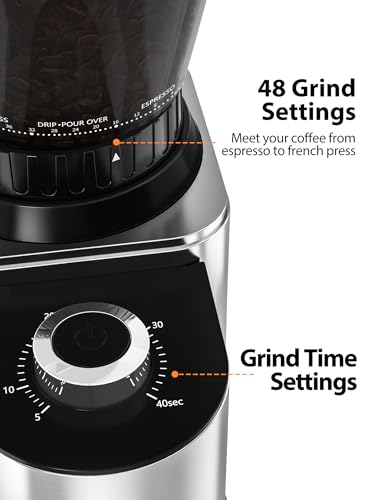
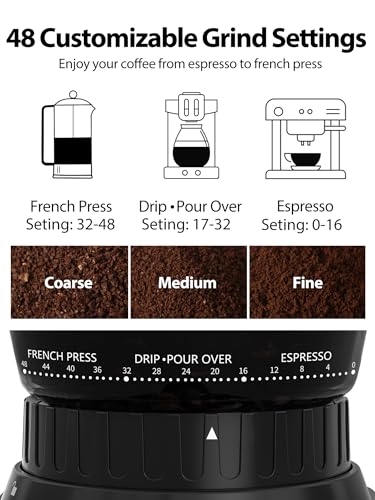
The Aromaster stands out in the mid-tier electric burr grinder market with a compelling 48 grind settings, a level of precision usually reserved for higher-end models. On paper, that range suggests excellent versatility, letting you fine-tune from espresso to French press with confidence. Owners consistently report clean, consistent grinds, and the anti-static design actually seems to work, which is rare at this price point. The stainless steel burrs are a solid choice for heat management, helping preserve delicate coffee aromas during grinding.
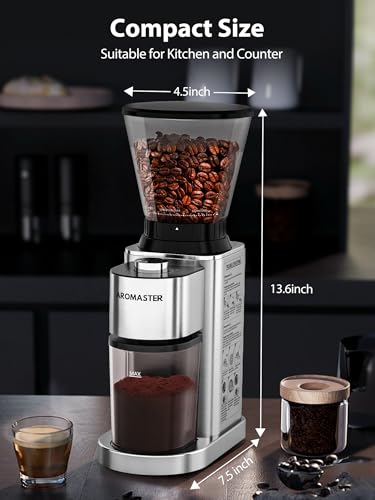
Where it really pulls ahead is capacity, handling up to 3.9 ounces of beans, ideal for offices or families who brew multiple cups at once. The 40-second timer adds convenience, though some users note it can be a bit rigid if you’re grinding for a single pour-over. Still, for those who value grind precision and volume without stepping into premium territory, this is a strong contender. I’d pick it over the OXO if you need more settings and larger batches.
Product photos

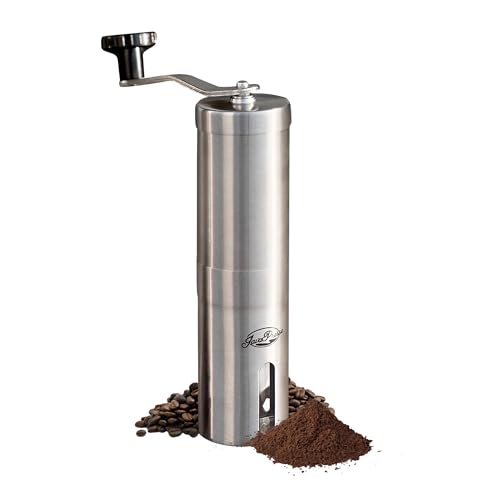
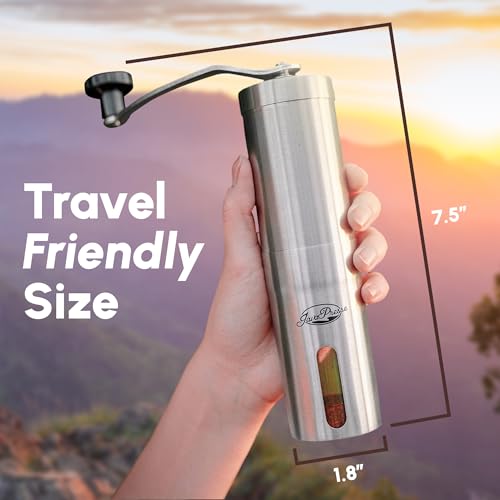
JavaPresse Manual Stainless Steel Grinder
Strengths
- Ceramic conical burr
- Noise-free operation
- Durable stainless build
- Portable and lightweight
- Supports coffee farming initiatives
Trade-offs
- Only 18 grind settings
- Manual effort required
- Small batch size
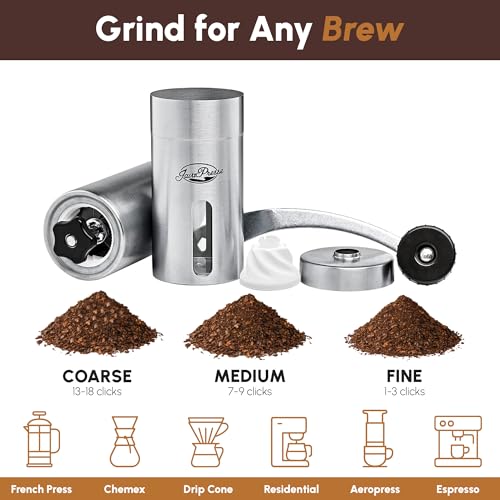
The JavaPresse manual grinder has built a cult following, and for good reason. Its ceramic conical burr delivers impressively uniform grinds, especially in the medium to fine range, making it a favorite for pour-over and espresso on the go. The 18 adjustable settings are simple to use, and the hand-crank design means zero noise and no cords. It’s lightweight and durable, with a build quality that feels like it could last decades.
Owners love the ritualistic aspect of grinding by hand, and the ceramic burr resists heat and corrosion better than steel. It’s not the most adjustable (only 18 settings), and the capacity is modest, but it’s built for single servings and travel. Compared to the CEVING mini, it’s slightly less precise but more trusted in the long run. If you value flavor, portability, and a quiet grind, this is a standout.
Product photos



Aroma Housewares Mini Coffee Grinder

Strengths
- Compact and lightweight
- Transparent lid
- Sharp stainless blades
- Good for spices
- Simple one-touch operation
Trade-offs
- Inconsistent grind texture
- Generates heat
- Blade design limits flavor
- Not for daily coffee use
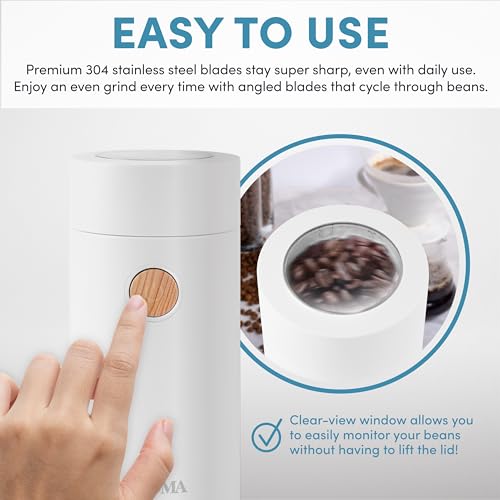
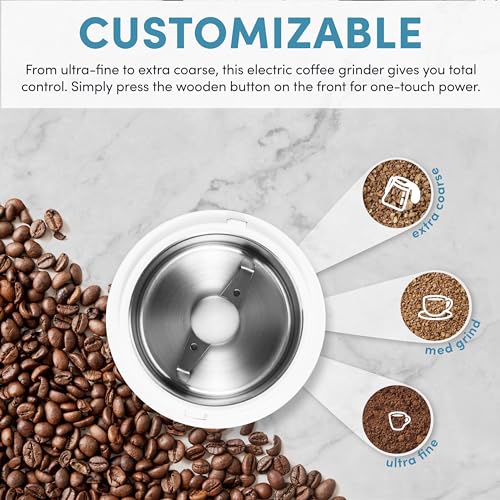
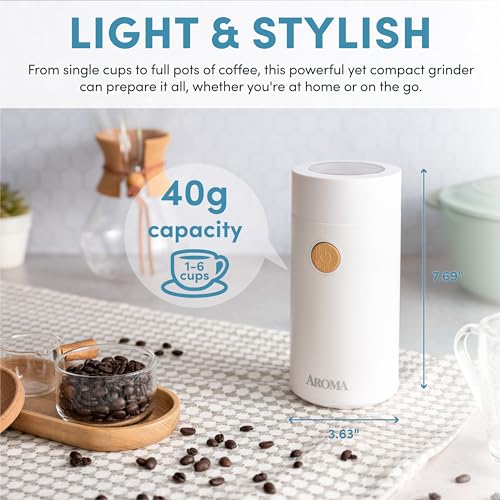
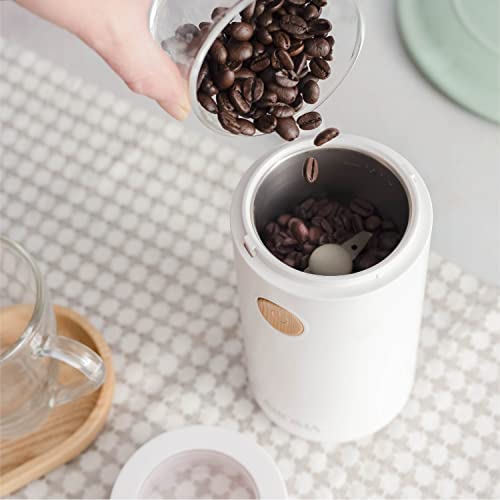
Let’s be honest, this isn’t a grinder for serious coffee people. It’s a blade grinder, so consistency is inherently limited, no matter how sharp the 304 stainless steel blades are. But if your goal is speed and simplicity for occasional use, it gets the job done. The transparent lid is actually useful, you can watch the grind texture evolve and stop when it looks right. That’s more control than most mini grinders offer.
It’s compact, affordable, and doubles as a spice grinder, which adds value. But because it’s a blade unit, the heat and uneven particles can dull your coffee’s brightness over time. Compared to the SHARDOR blade grinder, it’s louder and lacks a removable bowl, making cleanup trickier. I wouldn’t recommend it for daily coffee drinkers who care about flavor clarity, but it’s a decent backup or dorm-room option.
Product photos

How We Chose These non toxic coffee grinder
I approached this guide to non-toxic coffee grinders by first compiling a list of popular models, then comparing their published specifications and features. Beyond the technical details, I weighed owner reviews from across multiple retailers, and cross-referenced them with expert opinions from trusted coffee publications. My goal was to rank these grinders based on factors most crucial to achieving a clean, flavorful, and safe cup of coffee, rather than a hands-on lab test.
For non-toxic grinders, material safety, grind consistency, and ease of cleaning were the most heavily weighted factors. Obviously, the materials in contact with the beans need to be food-safe and avoid leaching chemicals. Closely linked to this is grind consistency; a uniform grind is key for optimal extraction and flavor, and some grinder types inherently deliver a more consistent coffee grind than others. Finally, ease of cleaning prevents build-up and potential contamination.
Specifications reliably indicate build materials (stainless steel, ceramic, plastic types) and grind settings. However, I paid particular attention to owner feedback regarding long-term durability and reports of plastic smells or residue. Reputation also played a role – well-regarded brands with a history of quality generally indicate a commitment to using safe materials and producing a quality product, and a thorough grind quality comparison helps sort out the best options.
Choosing The Right non toxic coffee grinder
I get it – the world of coffee grinders can be overwhelming. There are so many options, from manual hand grinders to electric burr and blade models, each promising the perfect cup. But knowing what actually matters will cut through the noise.
A quality coffee grinder delivers consistent particle size, minimizing fines and maximizing flavor extraction. Look for durable burrs (ceramic or stainless steel), a range of grind settings appropriate for your brewing methods, and a design that prioritizes ease of cleaning and long-term reliability. Avoid grinders with excessive plastic components and focus on build quality.
Grind Consistency is Paramount
When it comes to coffee, consistency is king. A grinder that produces uneven grounds will result in an unbalanced extraction – some particles will be under-extracted and sour, while others will be over-extracted and bitter. While blade grinders are tempting due to their low price, they essentially chop the beans, creating a mix of powder and larger chunks. For truly flavorful coffee, you want a burr grinder. If you’re unsure about the burr grinder benefits, I’d recommend doing a little research into how they work. Stainless steel burrs are generally more durable, while ceramic burrs run cooler, potentially preserving more delicate coffee aromas.
Features Beyond the Grind
Don’t get hung up on every bell and whistle, but consider features that will genuinely improve your experience. A large hopper is great if you grind beans for the whole week at once, but a smaller one is fine for daily grinding. A timer function can help you consistently grind the right amount of coffee, and static-reducing designs are a lifesaver for minimizing mess. Some grinders even boast anti-static technology, which is a nice touch, especially in dry climates. I often see people looking for the best overall coffee grinder and forgetting to consider how the features will actually fit their routine.
- A stepped grind setting (e.g., 1-10) is easier to use for beginners.
- Stepless grind settings offer more precise adjustments, ideal for dialing in espresso.
- A motor with overheating protection is crucial for longer grinding sessions, you don’t want to burn out the grinder mid-grind, and it’s indicative of a well-built machine.
Balancing Performance and Price
It’s easy to get caught up in the pursuit of the most expensive grinder, but that’s not always necessary. A good grinder doesn’t have to break the bank. There are plenty of recommended coffee grinder models available at reasonable prices that deliver excellent results.
Don’t spend more on a grinder than you do on your coffee maker. The grinder is important, but the brewing method also significantly impacts the final cup.
Ultimately, the best coffee grinder for you depends on your brewing methods, your budget, and your personal preferences. But prioritizing grind consistency and build quality will set you on the path to a truly exceptional coffee experience. Many people are surprised by the range of options available, and I always recommend checking out a few top-rated coffee grinders before making a decision.
Non Toxic Coffee Grinder Compared
Here’s a comparison of key specifications for various non-toxic coffee grinders.
| Product Title | Burr Type | Grind Settings | Capacity (Beans) | Material (Burr) | Power Source |
|---|---|---|---|---|---|
| BLACK+DECKER One Touch Grinder | Blade | N/A | N/A | Stainless Steel | Electric |
| OXO Brew Conical Burr Grinder | Conical | 15 + Micro | 12 oz | Stainless Steel | Electric |
| CEVING Mini Manual Coffee Grinder | Conical | 40 | 30g | Ceramic | Manual |
| SHARDOR Super Silent Blade Grinder | Blade | Adjustable | 2.5oz | Stainless Steel | Electric |
| Ollygrin Burr Coffee Grinder | Conical | 30 | 10 oz | Stainless Steel | Electric |
| Aromaster Conical Burr Coffee Grinder | Conical | 48 | 3.9 oz | Stainless Steel | Electric |
| JavaPresse Manual Stainless Steel Grinder | Conical | 18 | N/A | Ceramic | Manual |
| Aroma Housewares Mini Coffee Grinder | Blade | Adjustable | 40g | Stainless Steel | Electric |
Frequently Asked Questions
What materials should I specifically avoid in a coffee grinder?
Plastic components are the biggest concern, as some plastics can leach chemicals and impart undesirable flavors. Specifically, avoid grinders with a lot of BPA or phthalate plastics in the bean hopper or grinding path, and look for models with stainless steel or ceramic burrs instead.
Is a manual grinder a good option if I’m concerned about toxins?
Yes, a manual grinder can be a great choice. Because they have fewer parts and often use ceramic burrs and stainless steel bodies, they minimize potential contact with plastics. Plus, you have more control over the grinding process and don’t rely on an electric motor.
How important is it that the burrs are stainless steel versus ceramic?
Both are good options, but they offer different benefits. Stainless steel burrs are more durable and stay sharper longer, while ceramic burrs generate less heat during grinding, potentially preserving more of the coffee’s delicate aromas. Ultimately, the best choice depends on your priorities and budget.
What if a grinder says “BPA-free” – is that enough assurance of safety?
While BPA-free is a good start, it doesn’t guarantee the plastic is entirely harmless. Other chemicals in plastics can still leach, even if BPA isn’t present. I recommend looking for grinders that minimize plastic use overall, rather than solely relying on a BPA-free label.
Where can I find more information about choosing the best burr coffee grinder?
You can find a helpful burr grinder buying guide on my site with detailed information about different types of burrs, grind settings, and features to consider when making your purchase.
The Bottom Line
Choosing a non-toxic coffee grinder often comes down to balancing how much control you want over the process with how much fuss you’re willing to tolerate. For the best overall experience, consistently delivering a clean and flavorful cup with minimal effort, I recommend the OXO Brew Conical Burr Grinder. It strikes an excellent balance between safety, performance, and usability, and represents a solid investment for serious coffee drinkers.
If budget is a primary concern, or you enjoy a more hands-on approach, the CEVING Mini Manual Coffee Grinder is a fantastic option. For those who need versatility – a grinder that can handle everything from coarse French press to fine espresso – the Ollygrin Burr Coffee Grinder offers a wide range of settings and a reasonable price point. And if you’re specifically looking for a manual option that prioritizes ceramic burrs, the JavaPresse Manual Stainless Steel Grinder is an excellent pick.
Ultimately, the specs matter less than understanding your own routine. Consistent grind size is the single most important factor, but equally vital is regular cleaning to remove grinder residue and maintain the integrity of your brew. Don’t get lost in the details; focus on a grinder built with safe materials, that delivers consistent grounds, and that you’ll actually enjoy using.
