
Can a Food Processor Grind Coffee Beans? Here’s the Answer
Yes, you can grind coffee beans in a food processor, but it produces a wildly inconsistent, coarse grind full of powdery fines. This uneven particle size causes over- and under-extraction, resulting in a bitter, muddy cup. It’s only suitable for coarse brews like French press and is a last-resort method.
Most people assume any spinning blade can pulverize beans. The real problem is the blade design and the physics of chopping versus grinding. A food processor’s S-blade hacks at beans from random angles, creating a wild mix of large chunks and dust. That uneven extraction ruins the cup before the water even hits it.
This guide walks through the gritty reality of using a food processor as a pinch-hitter grinder. We’ll cover the specific models that struggle with this task, the exact technique to minimize damage, and why your resulting brew will never taste like it came from a cafe.
Key Takeaways
- Food processors like the Breville Sous Chef 12 or Cuisinart models are not designed for coffee; their manuals omit it as a recommended use.
- You will get a wildly inconsistent particle size, leading to simultaneous under-extraction (sour notes from big chunks) and over-extraction (bitterness from fines).
- The process is extremely loud, community reports describe it as “kind of crazy loud”, and creates a mess of static-charged grounds.
- It only works acceptably for very small batches (under 1/2 cup) and coarse grinds for methods like a French press.
- Treat this as a one-time emergency fix, not a brewing solution. The sensory and taste trade-offs are significant.
The Pinch-Hitter Reality Check
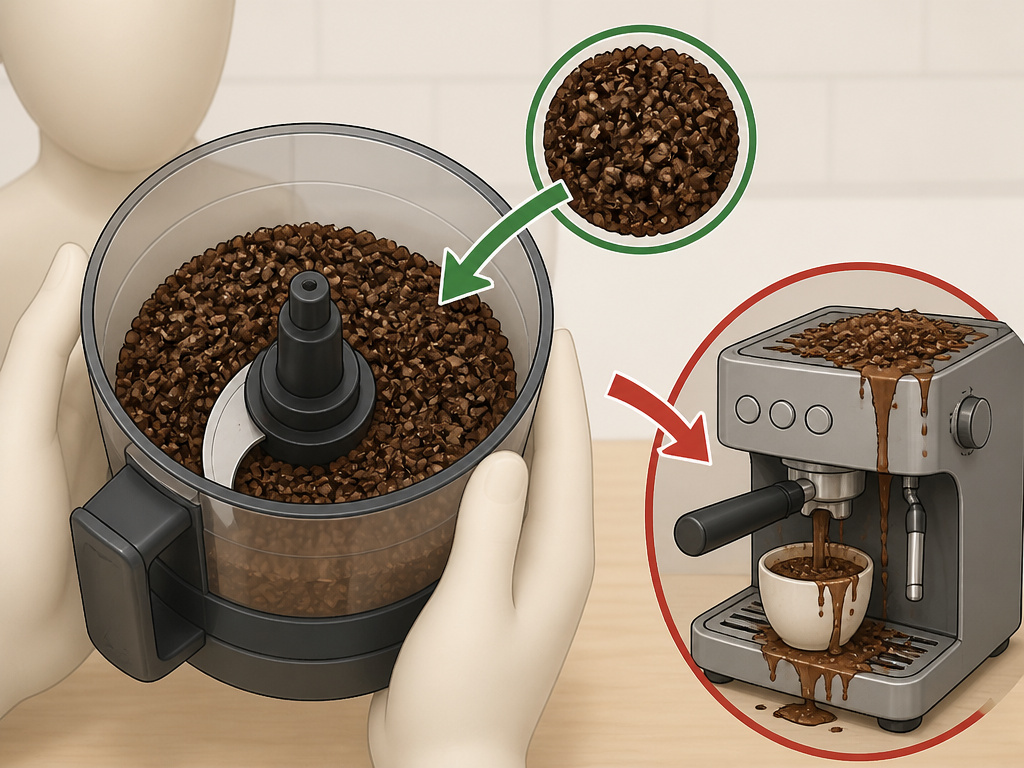
A food processor is a chopping and pureeing appliance. Its flat, S-shaped blade is engineered to slice through soft vegetables and nuts, not fracture hard, brittle coffee beans into uniform particles. When you pulse beans, the blade strikes them at oblique angles, shearing off random-sized pieces. This creates a grind spectrum from boulders to dust, known in coffee circles as a high “fines” content.
Common mistake: Running the processor continuously for 30 seconds, this overheats the beans through friction, baking off volatile aromatics and oils before they ever reach your cup. The result is a flat, baked flavor regardless of bean quality.
The noise is the first sensory clue you’re abusing the tool. YouTube tests of a standard Cuisinart note the operation is “super loud… kind of crazy loud” with beans in the bowl. That racket is the sound of the motor and blade assembly straining against a task it wasn’t engineered for. Prolonged use risks wearing the motor brushes or dulling the blade’s edge against the harder beans.
TL;DR: A food processor chops, it doesn’t grind. Expect noise, mess, and a grind consistency that guarantees a muddy, unbalanced cup of coffee.
Why Your Breville or Cuisinart Manual Says Nothing About Coffee
Look up the official use and care guide for a Breville Sous Chef 12 (BFP660SIL) or a Cuisinart model like the DFP-14BCNY. You’ll find recommendations for chopping onions, kneading dough, and shredding cheese. Coffee bean grinding is conspicuously absent. This omission is a manufacturer’s quiet way of stating the tool isn’t fit for that purpose.
The motor RPM and torque in a food processor are tuned for high-inertia, wet tasks. Coffee grinding requires high-speed, low-inertia cutting with specialized burrs. Using the processor for coffee doesn’t typically void a warranty, but it falls under “misuse” that could accelerate wear. Community forums like Home-Barista.com have users who’ve done it “in a pinch” since 2007, acknowledging the sub-optimal results as a necessary evil when a real grinder dies before the morning brew.
The physical limitation is the blade clearance. There’s a significant gap between the S-blade’s edge and the bowl’s walls. Small bean fragments and dust escape into this dead zone, avoiding further cutting. You have to stop and stir constantly to get even a coarse consistency, which is why the process is so inefficient.
How to Grind Coffee in a Food Processor (Step-by-Step)
If you’re in a vacation rental or your grinder just sparked its last spark, here’s the least-worst way to do it. This method prioritizes minimizing heat and achieving a passable coarse grind.
Before you start: Unplug the appliance before inserting or removing the blade. Coffee grounds create a fine, static-charged dust that will fly everywhere when you open the lid, work over a sink or large baking sheet.
- Use a dry, clean bowl and blade. Any residual moisture or oil from previous use will contaminate the coffee’s flavor. Wipe everything down thoroughly.
Skip this, and your coffee will taste like yesterday’s pesto. - Measure a small batch. Pour no more than 1/2 cup of whole beans into the bowl. Overfilling leads to uneven grinding as beans cushion each other from the blade.
- Secure the lid and pulse. Lock the lid. Use the pulse function in 2-3 second bursts. Wait 5 seconds between pulses to let the motor and beans cool.
- Check and stir after 5 pulses. Remove the lid (unplugged!). Use a spatula to stir the grounds, pulling the large pieces from the edges into the center.
- Repeat the pulse-stir cycle. Aim for a coarse, pebble-like texture. It will never be uniform. Stop when most particles are roughly the size of coarse sea salt.
- Decant immediately. Pour the grounds into your brewer. Leaving them in the warm plastic bowl continues to degrade the fragile aromatics.
The entire process should take under two minutes of total motor run time. If you’re going longer, your target grind is too fine for this tool.
| Step | Key Action | What Happens If You Skip It |
|---|---|---|
| Small Batch | Use ≤ 1/2 cup beans | Beans cushion the blade, resulting in whole beans mixed with powder. |
| Pulse, Don’t Run | 2-3 second bursts | Continuous running overheats beans in 20 seconds, baking off flavor. |
| Stir Mid-Process | Redistribute grounds | Large chunks hide at the bowl’s edge, creating wildly inconsistent size. |
| Target Coarse Grind | Stop at “sea salt” size | Attempting a fine grind produces more powder and overheats the motor. |
The Inevitable Result: A Side-by-Side Brew Comparison
So what does this “pinch-hitter” grind actually do to your coffee? The uneven particle size sabotages extraction, the foundation of good brewing. Water extracts flavors at different rates from different particle sizes.
Water flows through the path of least resistance, through the channels of fine powder. The large chunks get bypassed. You get a cup that’s simultaneously bitter from over-extracted fines and sour from under-extracted boulders.
I tried this once with a single-origin Ethiopian Yirgacheffe in a Breville precision brewer. The food processor batch (following the pulse method) brewed a cup that was thin, lacked the distinctive floral and citrus notes, and finished with a sharp, ashy bitterness. The same beans ground in a basic burr grinder vs blade grinder produced a vibrant, sweet, and complex cup. The difference wasn’t subtle; it was the difference between tasting the coffee and tasting the process.
This is especially punishing for delicate blonde roast beans, where nuanced acidity and fragrance are the main attractions. The brutal chopping action and heat from a food processor blunt those subtleties first.
When It’s Almost Okay (And When It’s Not)
There is one scenario where the food processor’s shortcomings are slightly less catastrophic: when you need a large-quantity, very coarse grind for cold brew or a French press. The extraction method is more forgiving of inconsistent particle size.
- Almost Okay: Making cold brew. The long, room-temperature steep (12-24 hours) is slow and gentle, allowing water to eventually penetrate larger chunks. The resulting concentrate will still have more sediment, requiring careful filtering through a fine mesh or a paper coffee filter.
- Not Okay: Espresso, pour-over, or AeroPress. These methods rely on precise, uniform grind size to control water flow and extraction time. An inconsistent grind will channel, clog, or brew too fast, producing undrinkable coffee.
The community-sourced edge case is the “single-serving emergency.” A Reddit discussion from 2015 noted that grinding a tablespoon of beans for one cup was marginally more effective because the tiny volume forced more direct blade contact. It’s a testament to the desperation of the situation, not a recommendation.
Your Actual Alternatives for Fresh Grounds

If you’re considering the food processor route, you likely want fresh-ground coffee but lack a dedicated grinder. Here are better paths, listed in order of preference.
- Buy a dedicated grinder. Even an entry-level blade grinder, while imperfect, is designed for the task and will outperform a food processor. It’s smaller, easier to clean, and creates less heat.
- Use a blender. Some high-powered blenders, particularly those with a “dry grains” container, can manage a coarse grind. We have a full guide on the nuances of grinding coffee in a blender versus a food processor.
- Ask your local grocery store or cafe. Many stores with bulk coffee sections have a grinder for customer use. Most cafes will gladly grind a bag of beans for you if you ask politely. Specify your brew method.
- Use pre-ground coffee. This is a better option than butchering good beans in a food processor. Buy in small quantities and store it in an airtight container away from light and heat.
Investing in a proper grinder is the single biggest upgrade you can make to your home coffee, far outweighing a more expensive machine. It protects the value of the beans you buy, whether they’re cost-effective Arabica coffee beans or rare single-origins.
Frequently Asked Questions
Will grinding coffee damage my food processor?
It won’t typically break it in one use, but it accelerates wear. The hard beans are tougher on the blade’s edge and motor bearings than vegetables. The fine, abrasive dust can also work its way into seals. It’s hard on the appliance.
Can I make espresso grind in a food processor?
No. Achieving a fine, powdery-espresso consistency is impossible with a food processor blade. You will only succeed in creating a hot, dusty mess that will choke an espresso machine instantly. The required uniformity is only possible with a burr grinder.
Why is the grind so inconsistent?
The S-blade doesn’t cut beans against a fixed surface like a burr grinder does. It throws them around the bowl, chopping them haphazardly. Small pieces escape the blade’s path, while others are hit repeatedly, creating powder. This is the core mechanical reason it fails.
My food processor has a “grind” setting. Does that work?
Some high-end models have a specific blade or setting for grinding dry spices or grains. This may work slightly better than the standard S-blade for a coarse coffee grind, but it’s still not comparable to a dedicated coffee grinder. Check your manual, like for a Braun coffee maker or Black & Decker coffee maker, the manufacturer’s instructions are the final word.
How do I clean coffee oils out of the processor afterward?
Wash the bowl and blade immediately with warm, soapy water. Coffee oils are persistent and can go rancid, affecting future foods. For stuck-on grounds, a paste of baking soda and water can help scrub the plastic. Ensure everything is bone-dry before storing.
The Bottom Line
A food processor can crack coffee beans into brewable pieces in a true emergency. The cup it produces, however, will be a stark reminder of the compromise. It’s a loud, messy process that yields a jagged, inconsistent grind capable of turning premium beans into a dull, bitter shadow of themselves.
Save the processor for salsa and pie dough. For coffee, even a simple blade grinder or the grinder comparison guide we’ve written is a wiser path. Your beans, and your morning, deserve the right tool for the job.
