
Where Can Coffee Be Grown? Mapping the Global Bean Belt Regions
This post contains affiliate links. As an Amazon Associate, we earn from qualifying purchases.
Where coffee can be grown is defined by the “Bean Belt,” a geographic band between 25° North and 25° South of the Equator, where tropical conditions of stable warmth, ample rainfall, and distinct seasons exist. However, merely being inside this belt doesn’t guarantee great coffee. True quality requires specific altitudes (often above 1,000 meters), particular shade tree canopies, and often a unique local processing method that becomes part of the land’s signature.
Coffee grows within a specific band around the Earth’s middle, but the best beans come from a precise combination of elevation, temperature, and human touch that most maps don’t show.
Most guides stop at the map. They tell you coffee likes it tropical and leave it there. The real answer lives in the details between the lines of latitude, in the way a bean from 1,800 meters tastes nothing like one from 800, and how a farmer’s choice of a specific shade tree can change everything in your cup. It’s about the places that work now, and the ones that won’t in thirty years.
Let’s walk past the simple map. We’ll look at the hard geographic limits, the altitude trade-offs that define flavor, the hidden players like soil and shade, and the surprising edge cases where coffee’s story gets truly wild.
Key Takeaways
- The “Bean Belt” (25°N–25°S) is the baseline, but altitude above 1,000 meters is the real marker for high-quality, complex Arabica.
- Climate change isn’t uniform: a 2023 study projects an 8% average decline in Brazilian Arabica yields by 2051-2100, but some regions may see gains.
- Specific shade tree species like Vachellia abyssinica in Ethiopia directly improve bean quality by slowing cherry ripening and enriching soil.
- Post-harvest processing can be terroir. Sumatra’s Giling Basah (wet-hulling) method creates a flavor profile impossible to replicate elsewhere.
- Low altitude (<850m) + high rainfall (>2110mm/year) reliably produces less appreciated coffee, marked by grassy, astringent notes.
The Hard Lines of the Coffee Belt
Forget vague notions of “tropical regions.” Commercial coffee cultivation operates within firm geographic boundaries. The plant is a shade-adapted tropical shrub, biologically intolerant of frost or prolonged drought.
Coffee (Coffea spp.) is a perennial evergreen shrub or small tree in the Rubiaceae family, comprising approximately 130 species. It is widely cultivated in tropical and subtropical regions, ranking among the world’s three most important beverage crops. As a shade-adapted tropical plant, coffee is mainly grown within the “Bean Belt,” which extends between 25° N and 25° S.
This belt provides the non-negotiable foundation: consistent temperatures between 18°C and 24°C (64°F–75°F), annual rainfall of 1,500 to 2,500 mm, and a defined dry season for flowering and a wet season for fruit development. Outside this zone, the plant struggles or fails.
But this is just the real estate flyer. It tells you where you could plant coffee, not where you should for quality. Every country within this belt grows coffee, but the cup profiles from Colombia’s Nariño region at 2,300 meters are galaxies apart from lowland Brazilian Cerrado at 900 meters. The belt is the canvas. Altitude, soil, and microclimate are the paint.
TL;DR: The Bean Belt between 25°N and 25°S is the only place coffee grows commercially, but your cup’s quality is decided by factors far beyond latitude.
Altitude is Everything, But Not Everywhere
Altitude is the single greatest predictor of coffee quality and flavor profile. It’s a brutal filter. Higher elevation means cooler temperatures, which slows the cherry’s maturation process.
This extended ripening window allows more complex sugars and aromatic compounds to develop within the seed. A peer-reviewed study in PMC crystallizes this: “High altitude (>1000 m) and low rainfall (<1600 mm/year) are associated with more appreciated coffee (aromatic, slightly bitter, acidic, with body). Low altitude (<850 m) and high rainfall (>2110 mm/year) result in less appreciated coffee (more bitterness, grassy flavor, lower aroma, increased astringency).”
The numbers aren’t gentle suggestions. They are diagnostic.
| Altitude Range | Typical Quality | Common Flavor Notes | Prime Example |
|---|---|---|---|
| 1,700–2,300 masl | Exceptional | Intense citrus, floral, tea-like, syrupy | Nariño, Colombia; Yirgacheffe, Ethiopia |
| 1,200–1,700 masl | High | Bright acidity, honey, clean, spiced | Tarrazú, Costa Rica; Antigua, Guatemala |
| 800–1,300 masl | Good / Commercial | Chocolate, nuts, low acidity, full body | Cerrado Mineiro, Brazil |
| Below 800 masl | Lower / Robusta | Earthy, woody, bitter, harsh | Many Robusta-growing regions |
Common mistake: Assuming all coffee from a famous country is high-altitude. Much of Brazil’s vast output comes from the Cerrado plateau around 1,000 meters, producing those classic chocolate-nut cups, not the intense citrus bombs of Colombian mountains.
This altitude-flavor link directly shapes the global market and the single-origin coffee choices available to you. It also dictates farming economics. Higher altitude often means steeper, harder-to-harvest slopes, which is part of why those beans command a premium.
But altitude isn’t a standalone variable. It works in a system. That same Springer Nature climate change study shows temperature and rainfall during specific growth phases matter more than annual averages. Warmth during blooming helps, but extreme heat during ripening kills yield. This nuance is why climate projections show a patchwork future.
Soil, Shade, and a Side of Elephants
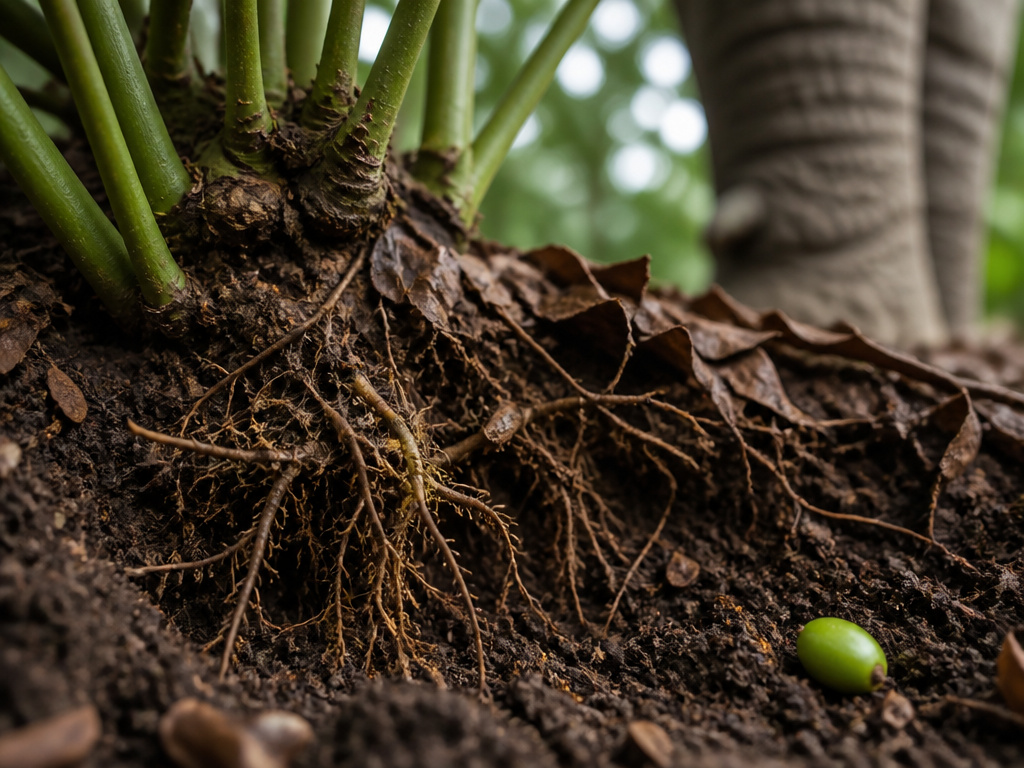
The land itself speaks through the bean. Terroir, the complete natural environment, includes the dirt, the canopy above, and even the animals that wander through.
Soil needs to be well-drained, deep, and rich in organic matter. Volcanic regions like parts of Guatemala and Costa Rica are famous for this. But soil can be managed. The more fascinating, non-commodity factor is the specific shade tree species a farmer plants.
Research from Ethiopia’s Jimma Zone, published in Agroforestry Systems, proved this decisively. Scientists evaluated Arabica varieties (7440, 744, F59, and 75,227) under different shade trees. They found that Vachellia abyssinica and Albizia gummifera “improve coffee quality by enriching soil organic matter and slowing cherry ripening through canopy shade.” This isn’t generic “shade-grown” marketing. These specific trees change the bean’s biochemistry, leading to objectively better flavor, aroma, and chemical profiles in the final cup.
Shade does three concrete things: it modulates temperature, slows ripening, and adds leaf litter that fertilizes the soil. Skipping it for full sun might boost short-term yield, but it burns out the plants and flattens the flavor within a few seasons.
Then there are the edge cases that break all standard models of “where coffee grows.”
Kopi Luwak and Black Ivory Coffee don’t come from a place on the map as much as from a bizarre biological process. In Sumatra and other parts of Southeast Asia, the Asian palm civet eats ripe coffee cherries. Its digestive enzymes ferment the beans as they pass through, producing Kopi Luwak. Similarly, in Thailand, elephants consume coffee cherries, and their digestive tract produces Black Ivory Coffee. The scientific assessment of coffee geography would classify these as part of terroir, where local fauna and processing are environmentally locked. You cannot replicate an elephant’s digestive system in a lab and get the same result. These coffees are literal products of their place in the most extreme sense.
Climate Change is Redrawing the Map
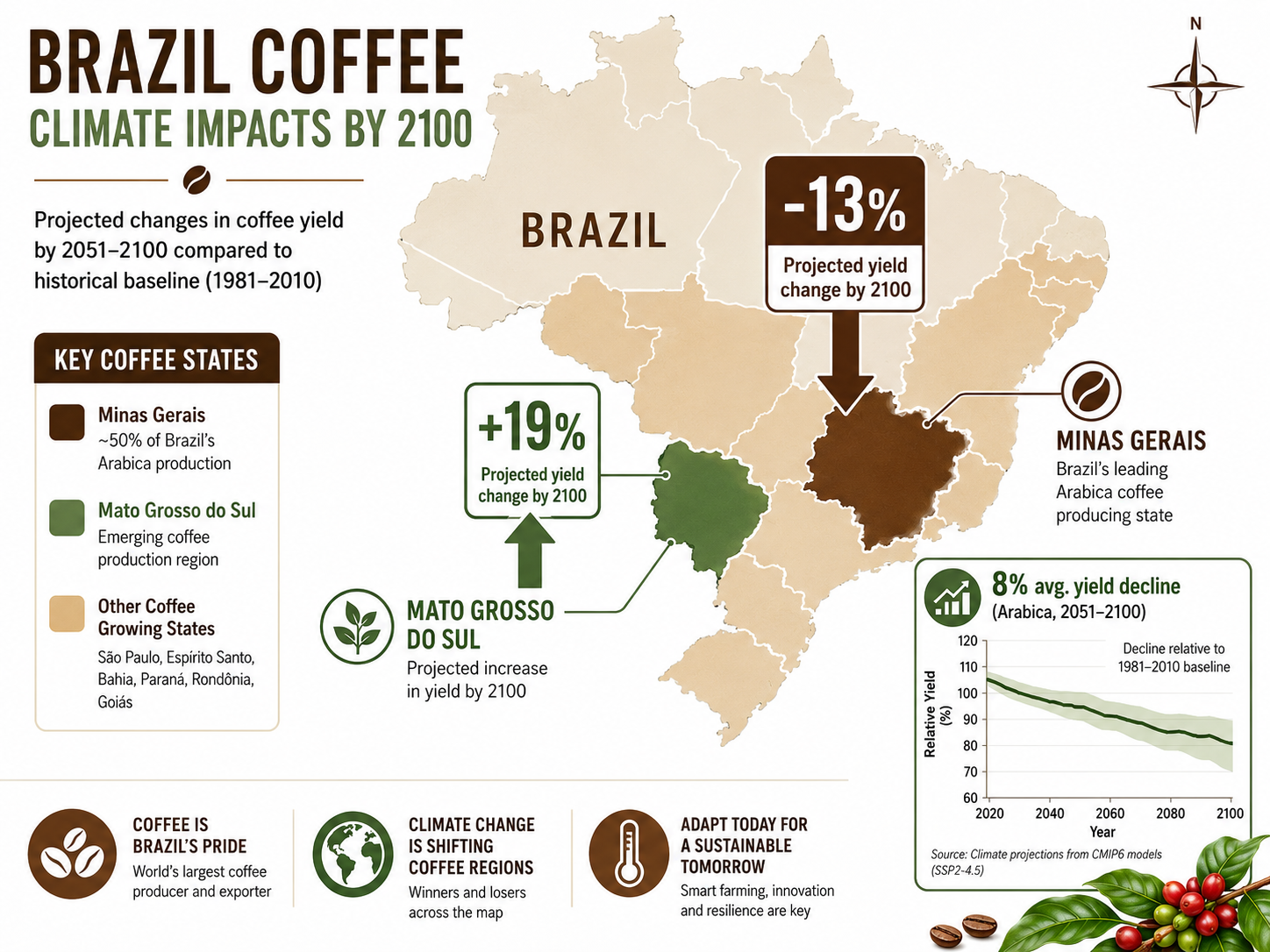
The Bean Belt is static on a page, but the climate within it is shifting. This isn’t future speculation; models are already projecting tangible yield changes that will alter the global coffee production methods landscape.
The most granular data comes from a 2023 study analyzing climate impacts across 2,048 Brazilian municipalities from 1980 to 2018. Using the IPCC SSP2-4.5 scenario, the model forecasts an 8% average decline in Arabica yields for Brazil between 2051-2100 compared to the 2009-2018 baseline.
Common mistake: Thinking climate change impacts all growing regions equally. The same Brazilian study shows profound heterogeneity. Minas Gerais, a powerhouse, is projected to decline by 13%. Meanwhile, Mato Grosso do Sul, currently a minor player, could see yields increase by 19% under the same model.
Why? Because coffee’s climate sensitivity is phase-specific. Warmth during flowering (measured in Growing Degree Days) boosts yields. Extreme heat (Harmful Degree Days) during ripening crushes them. Rainfall helps during flowering and ripening but can ruin the harvest. The future suitability of a parcel of land depends on how these variables dance together throughout the year.
This means the answer to “where can coffee be grown” has a time stamp. Regions ideal today may struggle in 30 years. Some marginal areas may become viable. Adaptation isn’t just about irrigation; it may mean shifting to different coffee bean types or even different species. It makes understanding the underlying science more critical than ever for anyone serious about their coffee flavor profiles.
TL;DR: Climate models forecast an 8% average Arabica yield drop in Brazil by century’s end, but impacts will be hyper-local, making some current regions obsolete and others newly important.
The Role of Processing in Defining “Place”
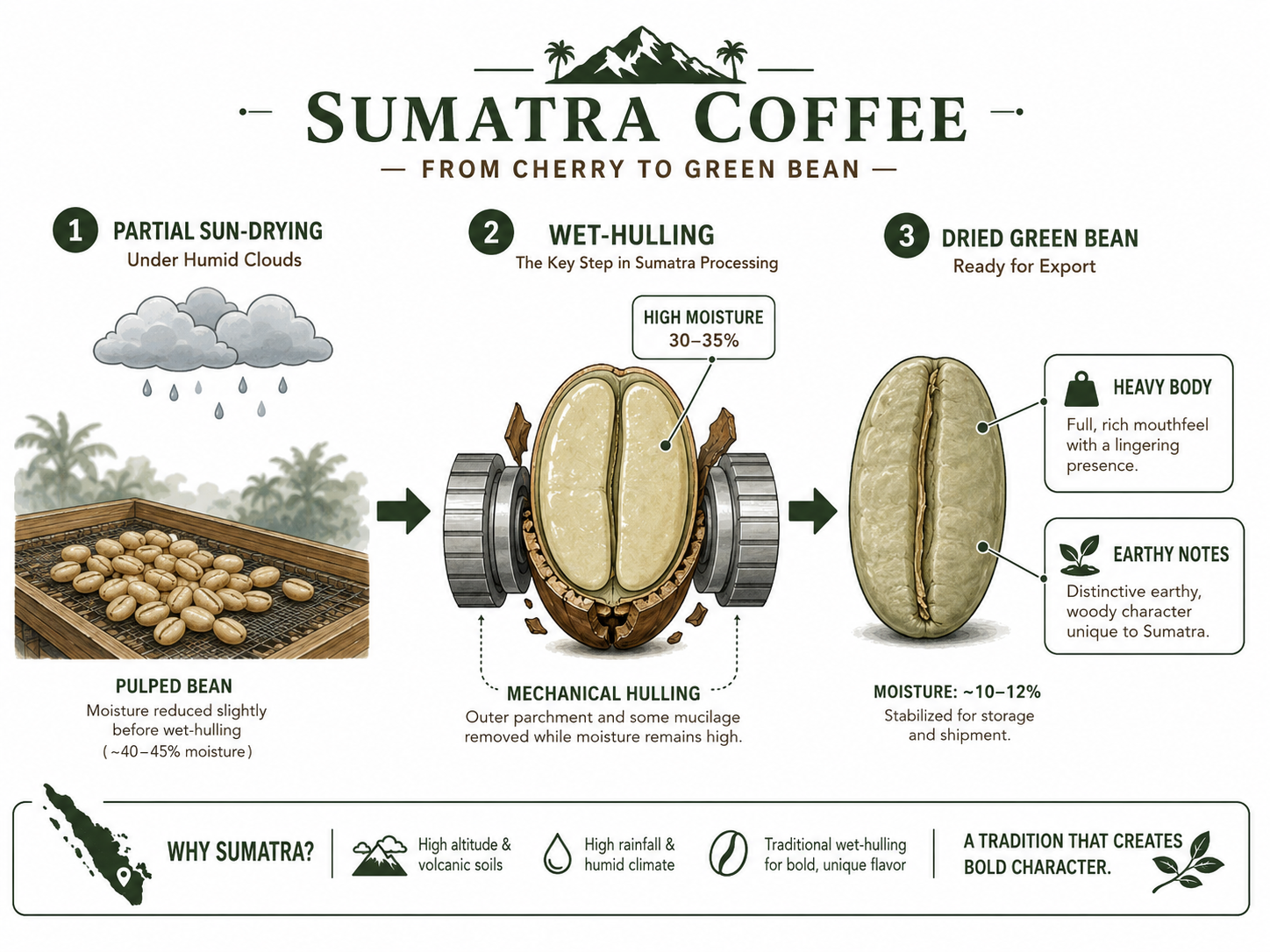
Terroir usually stops at the farm gate. For coffee, that’s a mistake. Unlike wine, where processing is largely controlled and standardized off-site, coffee’s post-harvest treatment is often deeply tied to its origin and environment. This makes processing a legitimate part of its geographic identity.
Consider Sumatra. The island’s humid climate doesn’t permit the slow, sun-drying used in Africa or Central America. Instead, farmers developed Giling Basah, or wet-hulling. Beans are pulped, partially dried, then hulled while still soft and high in moisture (around 30-35%), before final drying. This method, born of necessity, creates the signature profile of Sumatran coffees: heavy body, low acidity, and earthy, cedar-like notes. You cannot take a Colombian bean and wet-hull it to get Sumatra Mandheling. The process is inextricable from the local climate.
This environmental dependency means that the regional coffee characteristics in your cup are a blend of natural endowment and human ingenuity. It’s why a coffee bean roasts differently depending on its origin’s processing method. A wet-hulled bean behaves differently under heat than a fully-washed one.
The takeaway is that “where” coffee grows includes the culture and climate of how it’s transformed from cherry to green bean. This layer adds another dimension to the geographic coffee origins puzzle.
Can You Grow Coffee at Home?
After reading about the Bean Belt and altitude, you might wonder if that pot on your windowsill has a chance. The short answer is yes, but with managed expectations.
You won’t produce viable beans for roasting without a near-perfect replication of tropical conditions, think a heated greenhouse with high humidity. However, you can grow a coffee plant as a fascinating ornamental. The process, as shown in a YouTube gardener’s attempt, is fiddly. It involves soaking seeds for 24 hours, scraping off the mucilage, removing the parchment layer to speed germination, and planting them flat-side down in soil kept at 75–85°F (24–29°C) with high humidity. Germination can take 3 to 5 weeks.
It’s a lesson in patience and a direct, hands-on way to understand the plant’s specific needs. You’ll learn why frost kills it, why drainage is critical, and why that first sprout feels like a minor miracle. It connects you to the coffee consumption ritual in a deeper way, even if your harvest is a single, sad cherry.
Frequently Asked Questions
What are the best countries for growing coffee?
The “best” depends on the flavor profile you prize. For bright, complex acidity: Ethiopia, Colombia (Nariño, Huila), and Kenya. For balanced, chocolatey cups: Brazil (Cerrado Mineiro) and Guatemala. For unique, heavy-bodied profiles: Sumatra, Indonesia. Each excels within the Bean Belt due to its unique combination of altitude, soil, and climate.
Can coffee grow in the United States?
Yes, but only in very specific microclimates. The only commercial coffee farm in the U.S. is in Hawaii (the Kona region), which sits comfortably within the Bean Belt. A few experimental farms exist in Southern California, but they require significant environmental manipulation and are not commercially significant.
What’s the difference between Arabica and Robusta growing regions?
Arabica requires higher altitudes (usually above 800-1000m), cooler temperatures, and more careful cultivation. It’s grown across the Bean Belt in mountainous regions. Robusta (Coffea canephora) is hardier, tolerates lower altitudes (0-800m), higher temperatures, and is more disease-resistant. It dominates lower-elevation regions in Vietnam, Brazil, and parts of Africa.
How does altitude affect caffeine content?
Generally, the higher the altitude, the slower the coffee cherry matures. This slower growth can lead to a denser bean, but it doesn’t inherently increase caffeine. Robusta beans, grown at lower altitudes, actually contain nearly twice the caffeine of Arabica. The primary effect of altitude is on flavor compounds, not stimulant content, a nuance often missed in discussions of caffeine content.
Why is some coffee so expensive?
Price is a function of scarcity, labor intensity, and unique terroir. High-altitude Arabica requires hand-picking on steep slopes. Specific processes like natural or honey processing are riskier. And then there are the ultra-rare, labor-intensive animal-processed coffees like Kopi Luwak or Black Ivory, whose bizarre production methods and tiny outputs command prices of hundreds of dollars per pound.
The Bottom Line
Where coffee grows is a story of hard lines and soft variables. The Bean Belt is the stage. Altitude writes the first draft of the flavor script. Specifics like a Vachellia abyssinica shade tree or Sumatra’s perpetual humidity for wet-hulling become the final edits. Now, climate change is in the editing room, cutting some scenes and elevating others.
This means your morning cup is a geographic snapshot. It’s a product of a specific hillside at a specific moment in the planet’s climatic history. Understanding that context, the 8% decline projected for Brazil, the 19% potential gain for an obscure state, turns a simple drink into a living document. You’re not just tasting notes of citrus or chocolate. You’re tasting a place, its traditions, and its uncertain future. That knowledge is the real richness in the bean.
