
Why Is Coffee So Expensive? 5 Key Factors Driving Up Costs
This post contains affiliate links. As an Amazon Associate, we earn from qualifying purchases.
Coffee is expensive because five converging pressures, extreme weather, soaring fertilizer costs, political tariffs, low global stocks, and rising production labor, have doubled farmgate prices since 2020 while retail and cafe markups compound the final cost.
Most people blame general inflation or greedy cafes. They miss the specific chain: a drought in Vietnam cuts yield by 20%, a shipping lane closure raises fertilizer costs 30% in Nicaragua, and a new tariff slashes Brazilian exports to the US by half. Your bag of beans is a receipt for global instability.
This guide walks through each pressure point with sourced numbers, explains why your latte costs £4.50, and shows what parts of the price might actually come down.
Key Takeaways
- A 50-kg bag of fertilizer in Uganda now costs 21% more than a year ago, and fertilizer accounts for 24% of a Peruvian coffee farm’s total production costs.
- The 50% U.S. tariff on Brazilian coffee in 2025 caused exports to plummet by 53% in a single month, forcing roasters to pay more for beans from other origins.
- Arabica coffee plants suffer “extremely harmful” effects when temperatures exceed 30°C, a threshold being crossed more often across the coffee belt.
- The green beans inside a bag of ground coffee represent only about 40% of the retail price you pay at the supermarket.
- World coffee stocks hit a 25-year low in November 2025, meaning there’s no buffer left to absorb another bad harvest.
The 5 Main Reasons Coffee Prices Are Rising
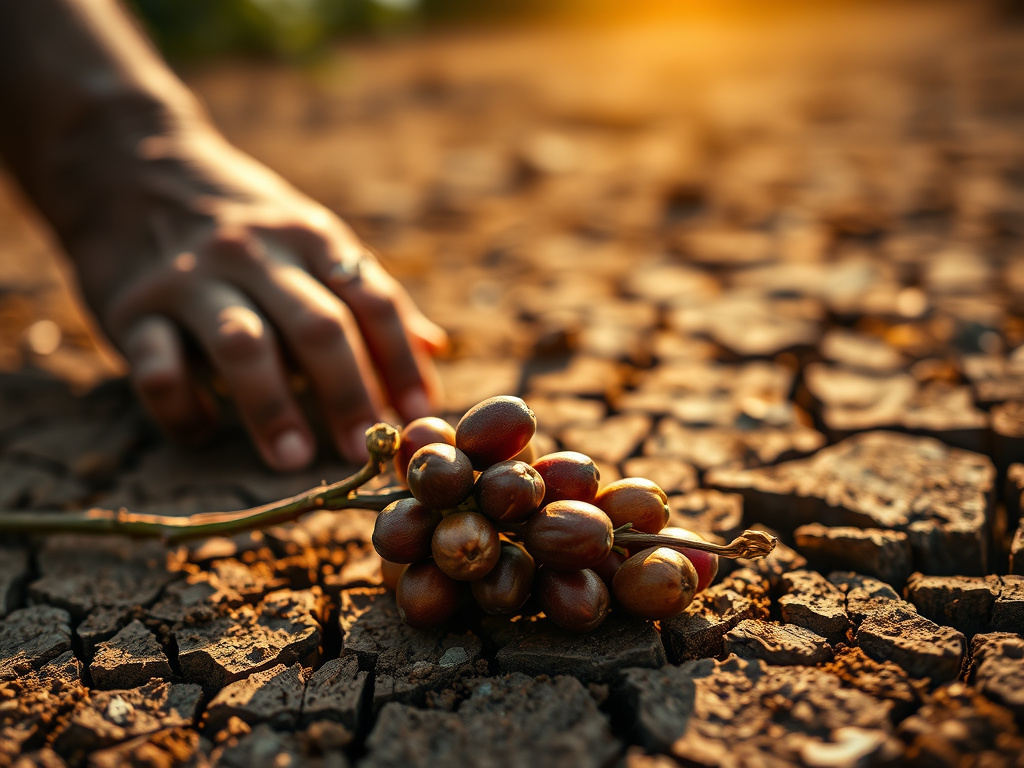
The price on a bag of beans or a cafe menu isn’t a single number. It’s the sum of a fragile supply chain breaking in five places at once. You can’t fix a drought in Brazil or a tariff in Washington. But you can see exactly where your money goes.
According to a Climate Central analysis, temperatures beyond 30°C are “extremely harmful for growing arabica coffee plants and suboptimal for growing robusta.” This thermal ceiling is now routinely breached across the traditional “bean belt,” directly reducing yield and quality.
The first and largest pressure is the environment. The 2021 frost in Brazil’s arabica regions was a historic shock. The drought in Vietnam in early 2024 cut rainfall by 30%. These aren’t isolated bad years. They’re the new pattern. Arabica is a fussy plant. It needs specific altitudes, stable rainfall, and mild temperatures. Robusta is tougher but still has limits. When the weather misses, the harvest shrinks. The 2025 Specialty Coffee Transaction Guide reported a median price for green specialty coffee at US$4.39/lb. That’s the starting point before anything else is added.
TL;DR: Extreme weather is the primary driver, but fertilizer costs, tariffs, low stocks, and labor form a perfect storm that doubled farmgate prices.
1. Climate Shocks Are Shrinking Harvests
Coffee grows in a thin band around the equator. That band is getting hotter and less predictable. The physical mechanism is straightforward. Prolonged heat above 30°C stresses arabica plants, causing premature cherry ripening and reducing bean density. Drought during flowering leads to “floaters”, empty, unusable beans. The 2024 drought in Brazil was the worst in 70 years. Vietnam’s 2023-24 drought cut production by 20%. Smaller harvests mean less coffee to go around. Basic economics kicks in. Less supply with steady demand equals higher prices. This isn’t a future worry. It’s the reason the arabica futures price hit $4.38 per pound in February 2025, a level not seen since 1977.
| Climate Event | Origin | Impact on Harvest | Price Consequence |
|---|---|---|---|
| Frost (2021) | Brazil | Severe arabica damage | Global price spike |
| Drought (2024) | Brazil | 70-year record low yield | Futures hit 48-year high |
| Drought (2023-24) | Vietnam | 20% production drop | Robusta prices surged |
| Typhoon (Late 2023) | Vietnam | Harvest disruption | Exports fell 17% |
The specialty coffee origins that command premium prices are often the most vulnerable to these shifts. A farm’s unique terroir can be erased by one season of abnormal heat.
2. Fertilizer and Fuel Costs Are Crushing Farmers
This is the hidden cost most drinkers never see. Coffee is an agricultural product. It needs fertilizer to grow. According to USDA Foreign Agricultural Service reports, input affordability is the dominant production risk right now. In Peru, fertilizers account for 24% of total coffee production costs. In Colombia, it’s about 25%. Now look at the price jumps. In Nicaragua, fertilizer rose 25% in the first half of 2026. In Uganda, a 50-kg bag of nitrogen- and phosphorus-based fertilizer costs about 21% more. In Vietnam, fertilizer and fuel climbed approximately 30% over the prior year.
A farmer facing a 30% cost increase for essential inputs has two choices. Absorb the cost and make less money, or reduce fertilizer use and risk a smaller, lower-quality harvest next year. Many choose the latter, creating a negative feedback loop that depresses future supply. This BBC News coffee price analysis details how these localized cost spikes ripple out to global markets.
Common mistake: Thinking a price hike is pure retailer markup, often, the farmgate price paid to growers has already doubled due to inputs they can’t control.
3. Tariffs and Trade Policy Disrupt Supply
Politics directly flavors your cup. The most stark example is the 50% tariff imposed on Brazilian coffee imports to the U.S. in 2025. Brazilian coffee flows to the U.S. fell by nearly 53% year-over-year that September. Roasters who relied on consistent, affordable Brazilian beans had to scramble. They turned to other origins, bidding up prices in Colombia, Honduras, and Ethiopia. Even when the additional 40% tariff was removed later in 2025, a base 10% duty remained, keeping costs elevated. This kind of policy shock doesn’t just add a tax. It fractures established supply routes and increases risk, which traders price in immediately.
The tools for making that coffee, like Breville coffee machines for home or commercial equipment for roasters, are a separate capital cost. But trade policy affects the raw material they all depend on.
4. Global Stocks Are at a 25-Year Low
Inventory is a buffer. For decades, large stockpiles of green coffee in warehouses could smooth over a bad harvest in one country. That buffer is gone. By November 2025, world coffee stocks reached their lowest point in 25 years. Why does this matter? With no inventory cushion, any new shock, another frost, a shipping strike, causes an immediate price spike. There’s no slack in the system. Traders get nervous, and futures prices become volatile. This low-stock environment is a direct result of consecutive years of underproduction meeting steady global demand. It makes the entire market brittle.
5. Labor Costs Are Rising at Every Stage
From the farm to the cafe, coffee is handcrafted. In Colombia, labor represents 69% of the production cost structure. Picking coffee cherries is skilled, intensive work. Wages are rising in producing countries, rightly so. Then the beans move. Shipping costs fluctuate with fuel prices and geopolitics, like disruptions in the Strait of Hormuz. Finally, at your local shop, the labor of a trained barista using a £10,000 La Marzocco machine is the largest component of your £4.50 latte. The coffee itself might be less than £1 of that cost. The specialty coffee gear and skilled labor needed to brew it are premium services.
How a $5.50 Green Bean Becomes a £4.50 Latte
Let’s follow the money. A roaster buys a pound of high-grade green arabica for $5.50 (around the 75th percentile in the 2025 Specialty Coffee Transaction Guide). They roast it, losing about 18% of the weight to moisture loss. Packaging, logistics, and their margin might add another $3. They sell that 12-ounce bag to a cafe for $10. The cafe uses about 20 grams of those ground beans for your drink. The bean cost to them is about $0.35. Now add 200ml of organic milk (£0.60), a skilled barista’s time (£1.50), rent for the space (£1.00), and the cost of running that La Marzocco machine (£0.50). The math hits £4.50 fast. The premium coffee beans are a small fraction of the final experience.
I switched my home subscription to a single-origin coffee from Honduras last year. The price per bag jumped 30% in six months. The roaster’s note cited “unprecedented fertilizer costs at origin and alternative shipping fees.” It wasn’t a vague inflation claim. It was a receipt.
Cafes like Greggs can offer a regular coffee for £2.40 because of automation and volume. They use standardized Swiss machines and buy massive quantities of commercial blends. The experience, and the cost structure, is entirely different from a third-wave shop pulling single-origin shots.
Will Coffee Prices Ever Go Down?
Some pressures might ease. Fertilizer costs could stabilize if shipping lanes open. Tariffs can be repealed. But the climate trend is not reversible on a timeframe that helps next year’s harvest. The NOAA forecast puts the probability of El Niño conditions emerging in mid-2026 at 62%. El Niño typically brings drought to Southeast Asia, threatening Vietnam’s robusta crop again. The long-term solution involves funding climate-resilient farming, developing heat-tolerant hybrid plants, and building more direct trade relationships that pay farmers a sustainable price. As a consumer, your best hedge is to understand the cost breakdown. A premium light roast might be expensive because it’s from a high-altitude farm now battling erratic rains. The price tells that story.
Your daily ritual depends on a network of people from hillside farms to port drivers to baristas. Each link in that chain has gotten more expensive. The coffee filter costs and specialty ingredients are minor details. The core story is written by weather maps, fertilizer invoices, and trade policy documents. That’s why your coffee is so expensive.
Frequently Asked Questions
Is expensive coffee actually better quality?
Not always, but often. A higher price can reflect better farming practices, more careful processing, and fairer wages for pickers, all of which improve flavor. However, a steep price can also just reflect scarcity from a climate-damaged harvest, not superior taste.
Which is more expensive, arabica or robusta?
Arabica is typically more expensive. It’s more delicate to grow, has a smoother, more complex flavor, and is often grown at higher altitudes. Robusta, used in many instant coffees and espresso blends, is hardier and cheaper, but its price has also surged due to droughts in Vietnam, a major producer.
Why is instant coffee also getting more expensive?
Instant coffee is primarily made from robusta beans. The 2023-24 drought in Vietnam, the world’s largest robusta producer, cut harvests by 20% and caused prices to spike. In the US, instant coffee prices rose a near-record 25% in the year to March 2026.
Does buying “direct trade” or “fair trade” coffee cost more?
Usually, yes. These certifications or purchasing models aim to pay farmers a higher, more stable price to cover sustainable production costs and community investment. You’re paying for that ethical premium upfront, which can insulate farmers from the worst commodity price swings.
The Bottom Line
Coffee prices are high because the world’s coffee belt is under physical and economic stress. The next time you see a bag of specialty coffee blends for $18 or a flat white for £4, you’re not just paying for a caffeine fix. You’re covering the cost of a farmer’s fertilizer in Nicaragua, a missed rainfall in Vietnam, a tariff on a Brazilian shipment, and the skill of a barista in your neighborhood. Some of these costs might recede. The trend, however, is toward a more precious, less predictable cup. Choose your beans knowing what’s in the price.
