
What Is the pH of Coffee? The Science of Coffee Acidity
This post contains affiliate links. As an Amazon Associate, we earn from qualifying purchases.
The pH of coffee typically ranges from 4.85 to 5.10, making it less acidic than orange juice but more so than milk. This exact acidity depends on three locked variables: the roast level, the bean’s origin and processing, and the brewing method used.
The pH of brewed coffee typically sits between 4.85 and 5.10. That’s less acidic than orange juice but more acidic than milk. The exact number in your cup depends on three locked variables: the roast level, the bean’s origin and processing, and your brewing method.
Most people think darker roasts are more acidic because they taste bitter. The bitterness comes from roasted compounds, not acid. The actual acidity peaks during the roasting process’s first crack, then drops sharply by second crack. A light roast brewed hot can hit a pH of 4.7. A dark roast pulled as espresso might land at 5.3.
This guide maps how roasting transforms acids, why your Brazilian cup reads lower than a Kenyan one, and which brew method pulls the least acid into your mug. You’ll also get a straightforward method to test your own coffee’s pH with a meter.
Key Takeaways
- Coffee’s pH isn’t fixed; it swings between 4.7 and 5.3 based on roast, origin, and brew.
- Titratable acidity peaks at first crack during roasting, averaging 4.9 mL NaOH/40 mL, then decays to its original level by second crack.
- Citric acid is the only acid consistently above its sensory detection threshold in brewed coffee, directly influencing perceived brightness.
- Washed processed coffees are measurably more acidic than natural processed ones, but a heavier body in naturals can mask that acidity.
- Cold brew extraction yields the lowest acidity, up to 70% less than hot methods like French press.
The pH Scale and Where Coffee Lands
A pH of 5.0 means coffee is mildly acidic. Pure water is neutral at 7.0. Beer often sits at 4.0. Orange juice can be as low as 3.5.
The pH of green coffee bean extract ranges from 6.3 to 6.7, depending on the water used. Roasting drives that number down into the acidic range we taste.
The drop happens because heat breaks down the bean’s complex organic acids into simpler, more perceptible ones. This isn’t a straight line from light to dark. The process has a distinct peak.
TL;DR: Coffee’s pH starts near neutral in the green bean and becomes acidic through roasting, with the level of acidity fluctuating during the roast cycle.
How Roasting Changes Coffee’s pH
Roasting doesn’t just make coffee darker. It chemically reorganizes its acids. The key metric here is titratable acidity (TA), a lab measure of how much acid is present.
A 2024 study in Scientific Reports tracked TA across roast profiles. It found titratable acidity invariably peaks during first crack and then decays to its original value by second crack, regardless of the roast profile. The peak TA exhibited almost no statistically significant differences among roast profiles, with an average of 4.9 ± 0.2 mL NaOH/40 mL.
Think of first crack as the moment the beans expand and pop. That’s when acidity is highest. As you roast further toward second crack, those acids break down further or combine with other compounds. The result is that a medium roast, stopped right after first crack, will often be more acidic than a dark roast taken well into second crack.
| Roast Stage | Typical pH Range | Primary Acids Present | Perceived Flavor |
|---|---|---|---|
| Light (Before First Crack) | 4.7–4.9 | Chlorogenic, Citric, Malic | Bright, Tart, Fruity |
| Medium (At/After First Crack) | 4.9–5.1 | Citric, Acetic, Quinic | Balanced, Sweet, Complex |
| Dark (Second Crack+) | 5.1–5.3 | Quinic, Acetic | Bold, Bitter, Smoky |
The common belief that dark roasts are “more acidic” is a taste confusion. Dark roasts are more bitter due to roasted compounds like pyrazines. The actual acid content has already fallen from its peak.
Common mistake: Choosing a dark roast to avoid stomach acid — the darker roast lowers pH, but the higher concentration of roasted compounds can still irritate some stomachs independently.
TL;DR: Acidity peaks at first crack during roasting, then falls. A dark roast is chemically less acidic than a light roast stopped at first crack.
The Acids in Your Cup and What You Actually Taste
Coffee contains over a thousand compounds, but a handful of organic acids dictate its sourness. A PMC study on coffee acids mapped their concentrations and sensory thresholds.
Six to ten percent of the dry weight of green coffee beans is made up of chlorogenic acid (CGA). Roasting breaks CGA down into quinic and caffeic acids. The study found the concentration of all individual acids except formic acid either significantly decreased (citric, malic, and chlorogenic acid) or increased (acetic, lactic, phosphoric, quinic, and glycolic acid) systematically with an increasing roast degree.
The sensory detection threshold for malic, acetic, and lactic acid was above their actual concentration in coffee, and just below for phosphoric acid. Only citric acid was clearly detectable above its measured concentration (detection threshold <0.16 g/L, found concentration 0.23–0.60 g/L).
That means citric acid is the primary driver of what you perceive as “brightness” or “sourness” in a cup. If your coffee tastes lemony or sharp, citric acid is likely above its threshold. Other acids like acetic (vinegar) or malic (apple) are usually below their taste threshold, contributing to the overall acid profile without being individually noticeable.
This chemical reality explains why a coffee science pH resource notes the perceived acidity of washed coffees is significantly higher than that found in naturally (dry) processed coffee. Washed processing preserves more of these bright acids. Natural processing often leads to a heavier body that masks the acidity, even if the pH measurement is similar.
TL;DR: Citric acid is the main acid you taste. Its concentration stays above the sensory threshold in most brews, directly creating that bright, fruity note.
Bean Origin and Processing: The Hidden Variables
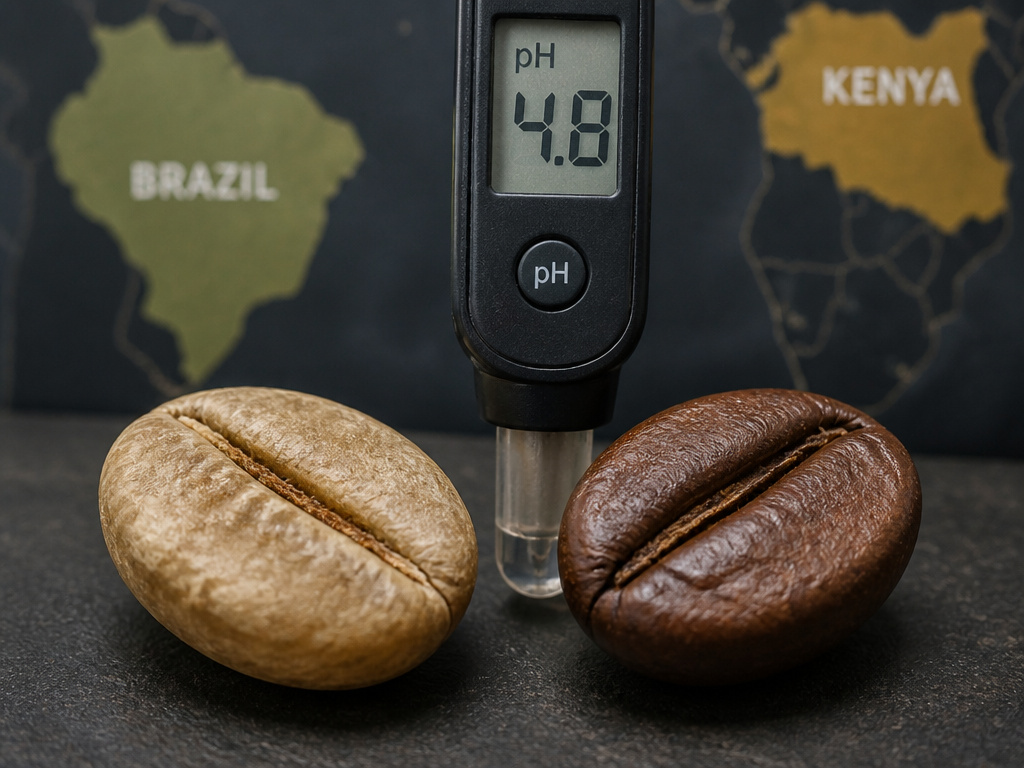
Where your beans grew and how they were processed after harvest changes their acid makeup before roasting even begins.
The same PMC study found that Brazilian and Bolivian coffees, on average, contain a higher organic acid concentration than Kenyan coffees, mainly due to higher amounts of citric and quinic acid. The pH was also lower in Brazilian brews. This contradicts the popular belief that Kenyan coffees are more acidic.
Altitude and soil play a role, but the most dominant factor is post-harvest processing. Washed coffees, where the fruit pulp is removed before drying, tend to retain more citric and malic acids. Natural or dry-processed coffees, dried with the fruit intact, undergo fermentation that changes the acid profile and often adds body.
That heavier body can mask acidity. You might measure two coffees with the same pH, but the natural processed one will taste smoother, less sharp. This is why many people seeking low-acid coffee for stomach comfort gravitate toward natural processed beans from Brazil or Sumatra, not because they are chemically lower in acid, but because the taste perception is milder.
If you’re exploring low-acid beverage options for health reasons, understanding this distinction between measured pH and perceived acidity is critical.
Brewing Method Acidity Ranking
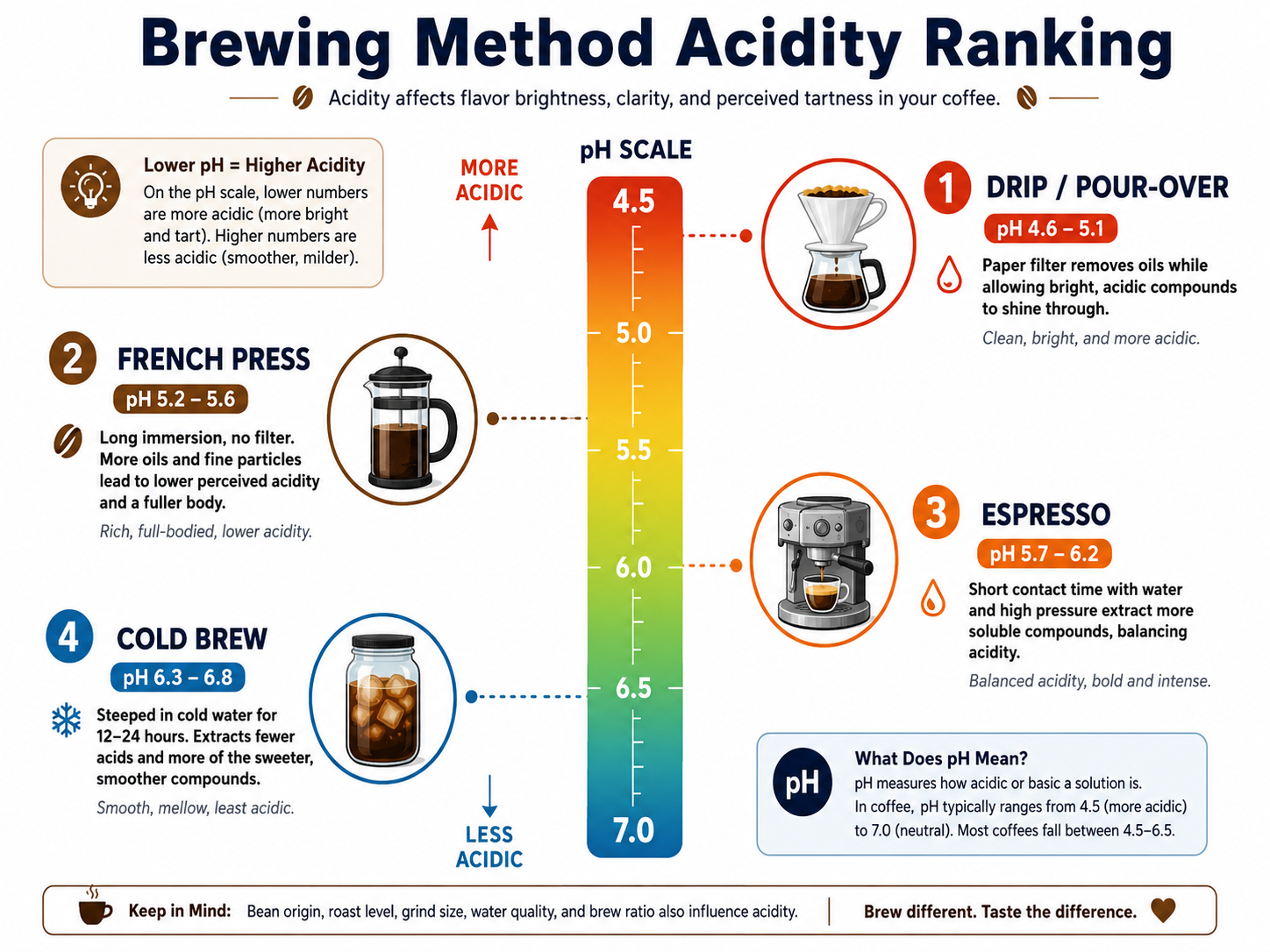
Your brewing method is the final variable. It determines which acids actually dissolve into your cup.
Espresso, with its high pressure and short contact time (25–30 seconds), extracts fewer acids. It typically ranges slightly above pH 5 to about 5.5. Drip or pour-over coffee, with longer contact time and full immersion, extracts more. The French press, with its long immersion and no paper filter to trap acids, often yields the most acidic brew.
Cold brew steeps grounds in cold water for hours, which dramatically reduces acid extraction. Some methods claim it can cut acidity by up to 70% compared to hot brews.
| Brewing Method | Relative Acidity (High to Low) | Key Reason | Best For |
|---|---|---|---|
| French Press | Highest | Long, full immersion without a filter trapping acids | Bold, full-bodied flavor lovers |
| Drip / Pour-Over | Moderate | Balanced extraction time; paper filter traps some acids | Daily drinkers wanting clarity |
| Espresso | Lower | High pressure, short contact time extracts fewer acids | Those seeking intensity without sharpness |
| Cold Brew | Lowest | Cold water drastically reduces acid solubility | Sensitivity to acidity or stomach discomfort |
The paper filter in a drip machine or pour-over setup traps some acids and oils. Using bleached vs unbleached filters doesn’t change this fundamental trapping, but the filter material itself can slightly influence the final taste.
I brewed the same Ethiopian light roast as a French press and as a pour-over with a paper filter. The French press cup tasted vibrant and sharp. The pour-over was muted, almost tea-like. The pH meter confirmed it: the French press read 4.8, the pour-over 5.0.
TL;DR: Brew method is your final control knob. Cold brew and espresso pull less acid into the cup than full-immersion hot methods like French press.
How to Measure Your Coffee’s pH (and Why You Might)
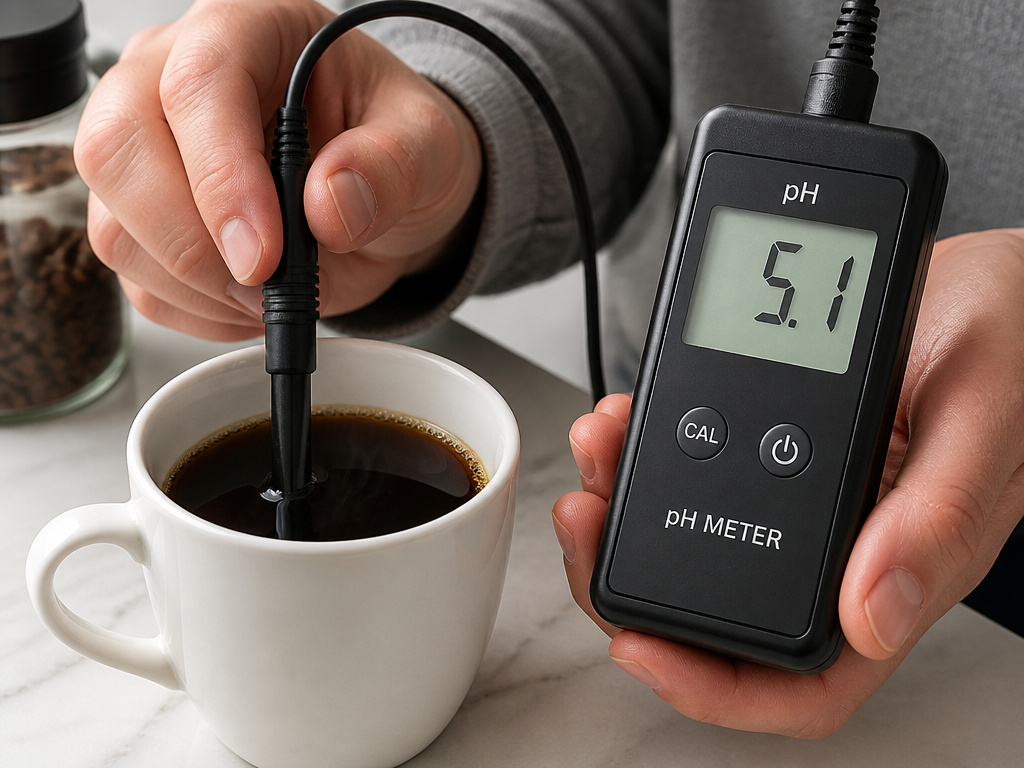
You can buy a basic digital pH meter for under fifty dollars. Calibrate it with the included solution, then dip the probe into your brewed coffee.
Wait for the reading to stabilize. It’ll give you a number, usually between 4.8 and 5.2. This is fun for curiosity, but it’s also practical if you’re managing stomach sensitivity or trying to replicate a specific taste profile.
A number below 5.0 means higher acidity. If that correlates with stomach discomfort for you, your next move could be switching to a natural processed bean, a darker roast, or a cold brew method. If you love brightness, a number above 5.0 might mean your brew is under-extracting or your beans are too dark.
Remember, pH measures free hydrogen ions, not the concentration of individual acids like citric or malic. Your taste buds are sensing those specific acids. The meter tells you the overall environment, not the flavor blueprint.
Frequently Asked Questions
Does adding milk change the pH of coffee?
Yes. Milk is slightly alkaline, with a pH around 6.7. Adding it to coffee raises the overall pH of the mixture, making it less acidic. This can also buffer the acid, reducing its sharp taste and potential impact on stomach acid for some people.
Is cold brew really less acidic?
Yes, measurably. Cold water extraction solubilizes fewer acidic compounds. Studies and simple pH tests show cold brew can be up to 70% less acidic than hot brewed coffee. This makes it a common recommendation for those with acid sensitivity.
Why does my dark roast sometimes taste sour?
This is usually a sign of under-extraction, not high acidity. If your grind is too coarse or your water temperature too low for a dark roast, you’ll extract the bright acids first without pulling the balancing roasted compounds. The result is a sour, thin cup despite the dark beans. Fix your grind or temperature.
Can I change the pH of my coffee by adding something?
You can alter the perceived acidity by adding a pinch of salt, which masks sourness, or a splash of milk, which buffers it. You cannot significantly change the actual pH without diluting the coffee substantially or adding a strong alkaline agent, which would ruin the flavor.
Does the type of coffee bean matter for acidity?
Absolutely. Arabica beans generally have lower acidity than Robusta beans. Within Arabica, origin and processing are the biggest factors. Washed process coffees from high altitudes often taste brighter (more acidic) than natural process coffees from lower altitudes like Brazil.
The Bottom Line
Coffee’s pH isn’t a single number. It’s a range from about 4.85 to 5.13, controlled by a roast level that peaks at first crack, a bean origin that determines its acid starting point, and a brew method that selects which acids make it to your cup.
If you’re chasing brightness, aim for a light roast, a washed process bean, and a hot brew method like pour-over. If you want less sharpness, go for a dark roast, a natural process bean, and cold brew or espresso. Your stomach and your taste buds will tell you which side of pH 5.0 you prefer.
