
Defining Burr Coffee Grinders: How They Work and Key Benefits
A burr coffee grinder is a device that crushes whole beans between two abrasive surfaces, called burrs, to produce ground coffee of a specific, adjustable size. The distance between the burrs determines the fineness, from coarse French press to fine espresso, enabling precise control over extraction and flavor that blade grinders cannot match.
Most people think all burr grinders are the same. They buy the one with the biggest burrs or the shiniest hopper, expecting it to magically produce better coffee. The real difference isn’t in the size printed on the box. It’s in the shape of the blades, the speed of the motor, and a dozen small design choices that separate a $100 grinder from a $1000 one.
This guide breaks down the mechanics, the flat vs. conical debate with real numbers, and the specific failures that kill grinders within a year. You’ll learn how to pick one and, more importantly, how not to break it.
Key Takeaways
- Burr geometry, the shape and pattern of the cutting teeth, affects flavor more than burr size. Larger burrs grind faster, not necessarily better.
- Never wash steel burrs with water. They rust. The Baratza Encore ESP manual states this voids the warranty.
- Most home grinders use 40mm or 50mm conical burrs spinning between 400–1400 RPM. The Baratza Preciso‘s 40mm burrs grind at 1.5 to 2.4 grams per second.
- Grinders like the OXO Barista Brain have safety locks. They won’t run without the hopper or grounds container correctly seated.
- A stone in your beans can shatter a burr. Manufacturer warranties, like Baratza‘s one-year coverage, explicitly exclude damage from foreign objects.
How a Burr Coffee Grinder Works
Forget spinning blades. A burr grinder is a precision crusher. Two hard surfaces, typically made of hardened steel or ceramic, are aligned with a microscopic gap between them. One burr rotates while the other remains stationary. Whole beans fall into this gap and are sheared apart into smaller and smaller particles until they exit at the perimeter.
The exact size of those particles is controlled by adjusting the distance between the burrs. Turn the dial to widen the gap for a chunky grind, or tighten it for a powder-fine espresso grind. This consistency is everything. Uniform particles extract evenly in hot water. Inconsistent grounds, a mix of dust and boulders, extract at different rates, leading to a cup that’s simultaneously bitter and sour.
A burr coffee grinder utilizes two abrasive surfaces, or burrs, to crush coffee beans into uniform particles. The grind size is determined by the adjustable distance between the burrs, enabling precise control for brewing methods ranging from French press to espresso.
The motor matters as much as the burrs. A high-torque, low-speed motor is the goal. The OXO Barista Brain uses a 400 RPM DC motor. Slow rotation minimizes heat transfer, which protects fragile coffee oils and aromatics. A fast, cheap motor generates friction heat. That heat cooks the grounds as they’re made, stripping flavor before water even touches them.
You’ll feel the difference in sound and resistance. A proper burr grinder has a deep, steady hum. A struggling one whines and bogs down. That bogging means the burrs are chewing, not cutting.
TL;DR: Two burrs crush beans at a set gap for uniform size. A slow motor preserves flavor. The hum tells you it’s working right.
Flat Burrs vs. Conical Burrs
This is the great divide. Both types crush beans, but their geometry changes the coffee’s journey and the final cup’s profile.
Flat burrs are two parallel discs, like miniature millstones. Beans feed into the center and are pushed outward by centrifugal force as they’re ground. The path from center to edge is long, with progressively finer teeth. This design can produce an extremely even particle distribution, which is why most high-end commercial espresso grinders use large flat burrs. The trade-off is they typically run at higher RPMs, generate more heat, and are louder.
Conical burrs look like a ring with a cone inside it. Beans travel a shorter, vertical path from top to bottom. Gravity assists the feed, which allows the motor to spin slower, often under 500 RPM. The design is inherently more forgiving and produces fewer ultra-fine particles (fines). This often results in a cup that tasters describe as having more body and sweetness, with less perceived acidity.
| Burr Type | Best For | Typical Use Case | Heat Generation |
|---|---|---|---|
| Flat Burrs | Maximum uniformity, clarity | Commercial espresso, light roasts | Higher (faster RPM, longer path) |
| Conical Burrs | Body, sweetness, forgiveness | Home use, drip, French press | Lower (slower RPM, gravity-assisted) |
My first serious grinder was a Baratza with conical burrs. I used it for everything from cold brew to espresso for three years. When I finally upgraded to a grinder with large flat burrs for espresso, the difference wasn’t just “better.” The flat burrs gave me laser-like clarity. I could pinpoint a blueberry note in an Ethiopian bean that the conical burr had blended into a general fruitiness. But for my daily morning pot of drip? I switched back to the conical. The flat burr’s clarity came with a brightness that felt abrasive at 6 a.m.
The choice isn’t about good versus bad. It’s about flavor priority. Want to highlight delicate, tea-like notes in a light roast? Lean flat. Prefer a balanced, chocolatey cup from a medium roast? Go conical.
Burr Size and Geometry: What Actually Matters
Bigger burrs grind faster. That’s the primary, and often only, benefit. A cafe needs a 80mm burr set to grind a pound of coffee in 30 seconds. You don’t. For a home user grinding 20 grams at a time, the difference between 40mm and 50mm burrs might be two seconds.
The real engine of flavor is burr geometry. This refers to the shape, angle, and pattern of the cutting teeth on the burr’s surface.
Common mistake: Chasing the largest burr size listed in the specs, the burr’s geometric design and motor speed have a far greater impact on grind consistency and final cup taste.
Cheap “masticating” burrs, as described in a Sun Goose Coffee video, have blunt, pegged teeth that smash and tear the bean. They create a wide range of particle sizes and generate noticeable heat. High-quality burrs, whether flat or conical, have sharp, precisely machined cutting edges that slice the bean. This produces a tighter particle distribution and less heat damage.
Think of it like slicing bread. A sharp knife gives you clean, even slices. A dull knife mashes and rips, creating a mess of crumbs and intact chunks. Your coffee water extracts flavor from each “slice” of bean. Consistency is the goal.
| Burr Quality Signal | What It Means | Result in the Cup |
|---|---|---|
| Sharp, machined cutting edges | Precision slicing of the bean | Even extraction, clear flavors |
| Blunt, pegged “masticating” teeth | Crushing and tearing the bean | Muddy, uneven flavors, potential bitterness |
| High-torque, low-RPM motor (<500 RPM) | Slow, cool grinding | Preserved aromatics, no baked flavors |
| High-RPM, low-torque motor | Fast, hot grinding | Risk of scorched, flat-tasting coffee |
The Wikipedia entry on the burr mill details this fundamental crushing principle. Geometry is the implementation of that principle. It’s why two grinders with identical 40mm conical burrs can produce wildly different coffee. One might use a cheap, cast burr with crude geometry; the other uses a precision-machined, hardened steel burr.
You can’t see geometry in an online listing. You find it in professional reviews, tear-down videos, and by trusting brands with a reputation for quality machining like Baratza, Fellow, or Eureka.
The Main Components and What They Do
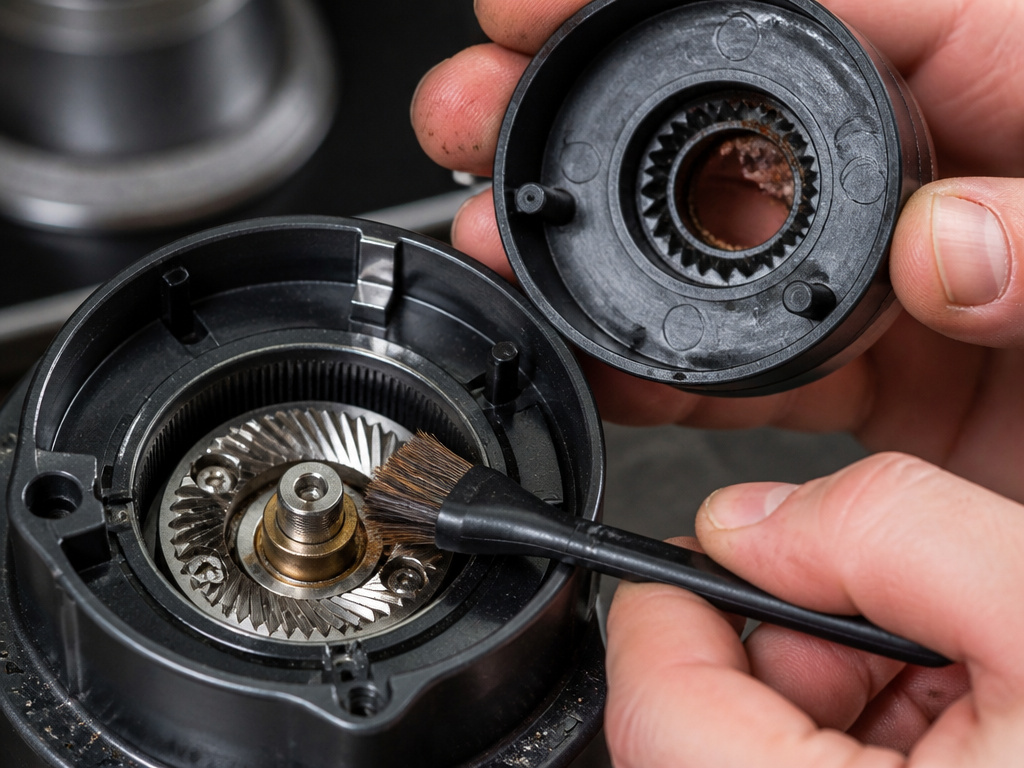
A burr grinder isn’t just a motor and some blades. It’s a small system. When one part fails, the whole machine stops.
- Hopper: The bean reservoir. It’s more than a bucket. On grinders like the Baratza Encore ESP, a micro-switch underneath it acts as a safety lock. No hopper, no grind, a simple fix that prevents you from running the motor empty and spraying beans everywhere.
- Burr Set: The heart. The upper burr (or outer ring) is usually removable for cleaning. The lower burr (or inner cone) is fixed to the motor shaft. They must be perfectly aligned. Forcing a misaligned burr back in can crack the mounting lugs.
- Adjustment Mechanism: This moves one burr closer or farther from the other. It can be a stepped click-dial (like on a Baratza Encore) or a stepless micrometric ring (like on a Eureka Mignon). Stepless gives you infinite adjustment between settings, crucial for dialing in espresso.
- Grounds Chute & Container: The exit path. Static electricity is the enemy here, causing grounds to cling to the plastic chute. Some grinders have anti-static coatings or metal grounds bins to mitigate this. The OXO Barista Brain uses its stainless steel container as part of the electrical circuit, no container, the grinder won’t start.
- Motor & Gearbox: The muscle. Look for a DC motor designed for high torque at low speeds. The gearbox reduces the motor’s RPM to the optimal speed for the burrs. Grinding overly dark, oily beans or trying to pulverize a pebble will strain this system to its breaking point.
Cleaning is where most people break the rules. The manuals are unanimous: never wash the steel burrs. Wiping them with a dry brush is fine. Running a handful of Grindz cleaning pellets through every few months is better. But water leads to rust, and rust destroys the precise cutting edges. Once pitted, those burrs will never produce a consistent grind again.
Why Choose a Burr Grinder Over a Blade Grinder?
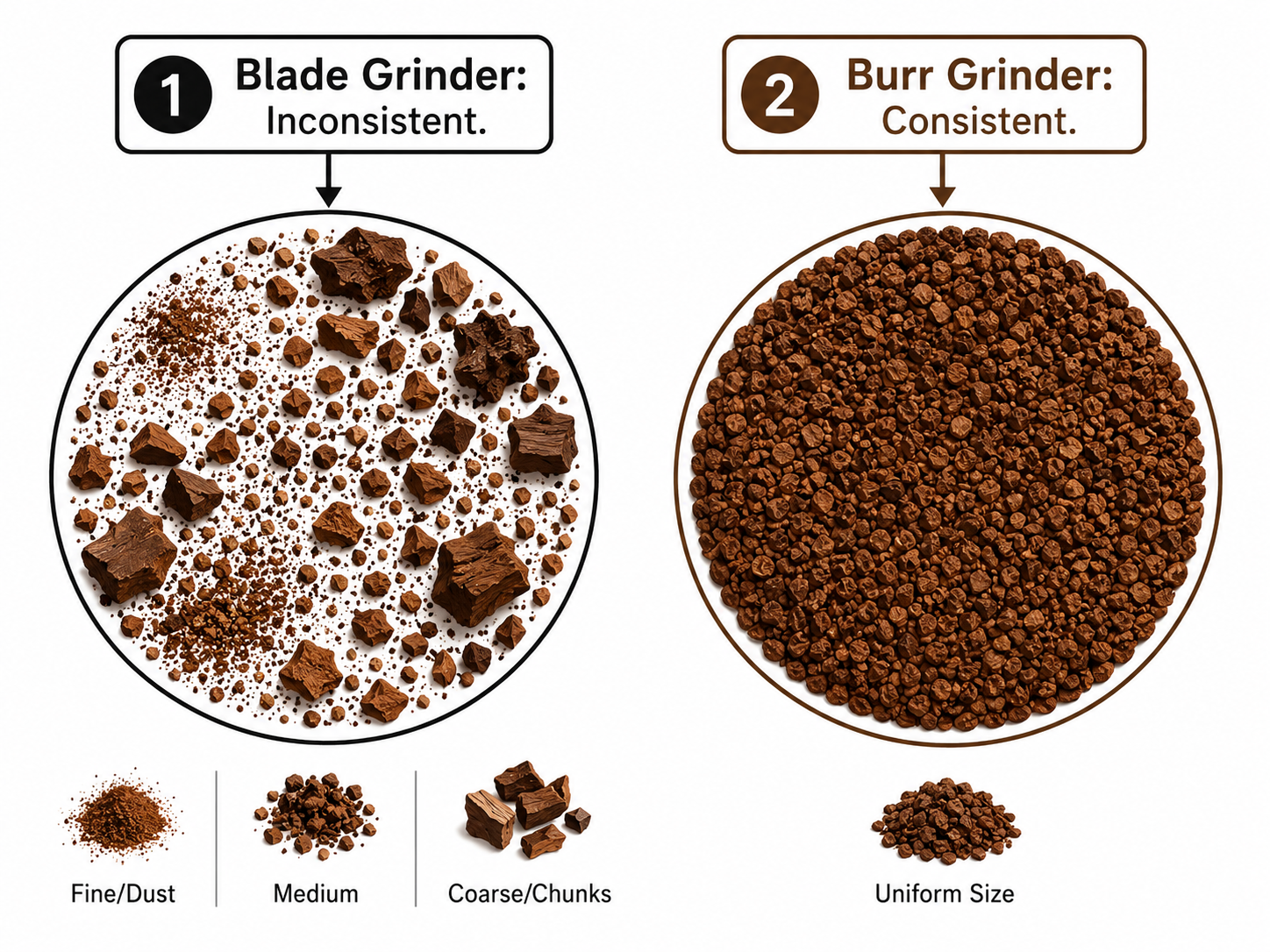
A blade grinder is a food processor for coffee. A spinning propeller chops the beans randomly until you stop it. You get a mixture of dust, chunks, and everything in between. This inconsistency guarantees uneven extraction. The fine dust over-extracts, turning bitter. The large chunks under-extract, tasting sour and weak. You brew both into the same cup.
A burr grinder solves this by design. It produces a controlled particle size. Every ground is roughly the same size, so they all extract at roughly the same rate. The result is a balanced, clean cup where you can actually taste the coffee’s intended flavors, the chocolate, the citrus, the floral notes.
The second major advantage is adjustability. You cannot adjust a blade grinder. You can only run it for a shorter or longer time, which still produces an inconsistent mix, just of different average sizes. A burr grinder has a dedicated control. Switching from a French press grind to an espresso grind takes a five-second turn of a dial.
Heat is the silent killer of flavor. Blade grinders generate immense heat through friction because they spin so fast. This heat is transferred directly into the coffee grounds, volatilizing the delicate aromatic compounds. You lose the fragrance before brewing. Burr grinders, with their slower motors and crushing action, run significantly cooler.
For a detailed breakdown of this fundamental choice, our guide on burr vs blade grinders covers the practical impacts on your morning routine. If you’re considering grinding with a blender as an alternative, understand it suffers from the same fundamental flaws as a blade grinder, just on a larger scale.
Types of Burr Coffee Grinders for Home Use
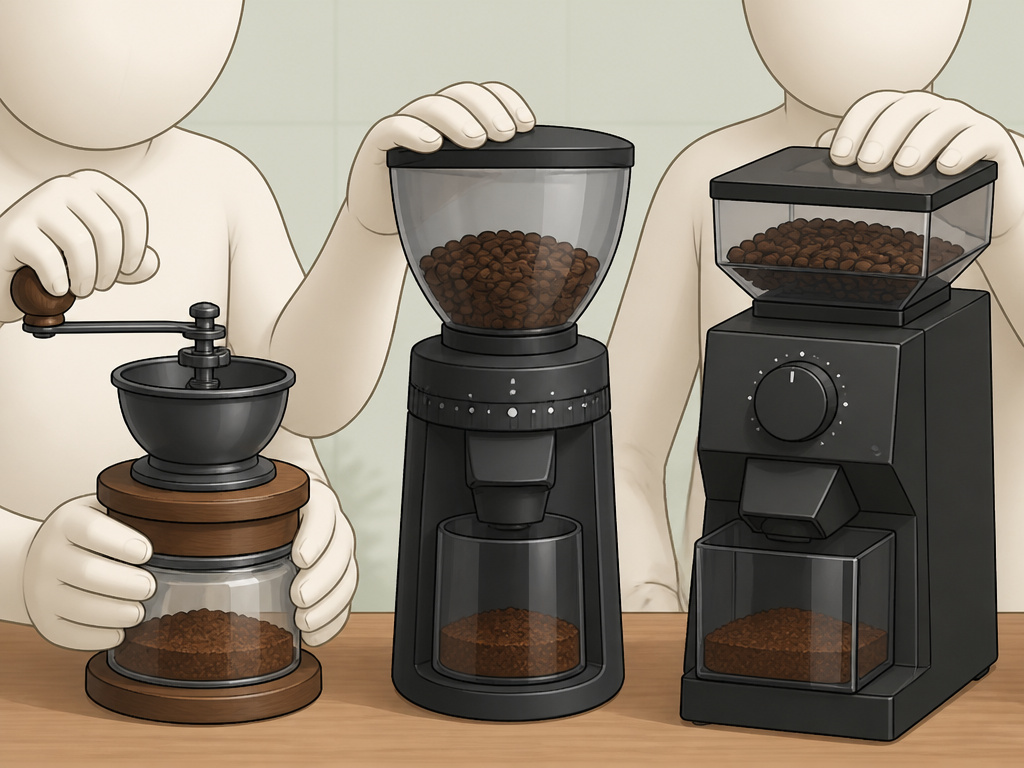
You have three main paths, each with a different cost and commitment level.
Manual Burr Grinders are your direct-drive option. You turn a crank, which rotates the burrs. Brands like Hario and 1Zpresso make excellent models. The pros: they’re quiet, portable, generate zero heat, and are surprisingly consistent for their price. The con: it’s work. Grinding 20 grams for espresso can feel like a forearm workout. They’re perfect for travel, camping, or if you truly want to feel connected to the process.
Electric Conical Burr Grinders are the standard recommendation for most homes. Think Baratza Encore, OXO Barista Brain, or Capresso Infinity. They offer the best balance of consistency, speed, and price. They’re workhorses built for daily drip and occasional espresso. Their 40mm to 50mm conical burrs are forgiving and durable. This category is where you’ll apply most of the maintenance advice in this article.
Electric Flat Burr Grinders are the enthusiast and espresso-specialist tier. Brands like Eureka, DF64, and Baratza’s Vario line live here. They prioritize ultimate uniformity for espresso, but many handle all brew methods well. They are larger, often louder, and more expensive. You buy one when you’ve decided that grind quality is your primary bottleneck to better coffee.
Your choice should follow your brewing method. If you mainly use a drip coffee method or a French press, a capable electric conical burr grinder is your finish line. If you’re deep into espresso-based drinks, you’ll eventually want to invest in a dedicated flat burr grinder. Starting with a good conical grinder is still a massive leap from a blade.
Frequently Asked Questions
What’s the difference between a burr grinder and a mill?
Nothing. The terms are interchangeable in the coffee world. “Burr mill” is the more general engineering term, while “burr coffee grinder” specifies the use. Both refer to the same two-surface crushing mechanism.
Can you grind spices in a coffee burr grinder?
You can, but you shouldn’t. Oils from spices like cloves or cinnamon will coat the burrs and interior plastics. That flavor will then transfer to your coffee, no matter how well you brush it out. Coffee beans are dry and brittle; spices are often oily or moist. Buy a separate, cheap blade grinder for spices.
Why won’t my burr grinder start?
Check three things in this order. First, is the hopper fully seated? Many have a safety switch. Second, is the grounds container properly attached? Grinders like the OXO need it to complete a circuit. Third, is the upper burr locked into place correctly? If it’s misaligned, the machine may not engage.
How fine should I grind for espresso?
The grind should feel like fine table salt or powdered sugar. In practice, you dial it in by time and taste. Start with a setting that yields a 1:2 ratio (e.g., 18g in, 36g out) in about 25-30 seconds. If it runs too fast, grind finer. Too slow, grind coarser. The needed fineness can also depend on your roast types, as denser light roasts often require a finer setting than dark roasts.
Do ceramic burrs last longer than steel burrs?
Not necessarily. High-quality hardened steel burrs are extremely durable. Ceramic burrs are harder and won’t rust, but they are more brittle. A rogue rock is more likely to chip a ceramic burr than dent a steel one. For most home users, the material is less important than the quality of the machining.
Before You Go
A burr coffee grinder is the single most impactful upgrade you can make to your coffee setup. It turns a variable you can’t control into one you can master. Remember that consistency comes from burr geometry and a steady motor, not from the largest diameter you can find.
Treat it right. Keep it dry, brush it out, and feed it only whole coffee beans. That one-year warranty on most models doesn’t cover rocks or rust. Pair it with fresh, well-chosen beans, whether that’s a complex single-origin coffee or a reliable blend, and you’re 90% of the way to a great cup.
The last 10% is your water, your filter selection, and your technique. But without a good grind, you’re building on a shaky foundation. Start there.
{
“@context”: “https://schema.org”,
“@type”: “HowTo”,
“name”: “How to Choose and Use a Burr Coffee Grinder”,
“totalTime”: “PT10M”,
“tool”: [
{
“@type”: “HowToTool”,
“name”: “Burr coffee grinder (conical or flat)”
},
{
“@type”: “HowToTool”,
“name”: “Whole bean coffee”
},
{
“@type”: “HowToTool”,
“name”: “Small brush for cleaning”
}
],
“step”: [
{
“@type”: “HowToStep”,
“name”: “Identify your grinder type”,
“text”: “Locate the burr set inside your grinder. Conical burrs are shaped like a cone; flat burrs are two parallel discs. This determines your cleaning and adjustment process.”
},
{
“@type”: “HowToStep”,
“name”: “Set the grind size”,
“text”: “Turn the adjustment dial or ring to match your brew method. Start coarse for French press, medium for drip, and fine for espresso. Run a few beans through to purge old grounds.”
},
{
“@type”: “HowToStep”,
“name”: “Grind your dose”,
“text”: “Add your weighed whole beans to the hopper. Secure the grounds container. Start the grinder. Most motors are low-RPM and will hum steadily.”
},
{
“@type”: “HowToStep”,
“name”: “Clean immediately after use”,
“text”: “Unplug the grinder. Use a dry brush to sweep out loose grounds from the burr chamber and chute. Never wash the steel burrs in water.”
}
]
}
{
“@context”: “https://schema.org”,
“@type”: “FAQPage”,
“mainEntity”: [
{
“@type”: “Question”,
“name”: “What’s the difference between a burr grinder and a mill?”,
“acceptedAnswer”: {
“@type”: “Answer”,
“text”: “Nothing. The terms are interchangeable in the coffee world. \”Burr mill\” is the more general engineering term, while \”burr coffee grinder\” specifies the use. Both refer to the same two-surface crushing mechanism.”
}
},
{
“@type”: “Question”,
“name”: “Can you grind spices in a coffee burr grinder?”,
“acceptedAnswer”: {
“@type”: “Answer”,
“text”: “You can, but you shouldn’t. Oils from spices like cloves or cinnamon will coat the burrs and interior plastics. That flavor will then transfer to your coffee, no matter how well you brush it out. Coffee beans are dry and brittle; spices are often oily or moist. Buy a separate, cheap blade grinder for spices.”
}
},
{
“@type”: “Question”,
“name”: “Why won’t my burr grinder start?”,
“acceptedAnswer”: {
“@type”: “Answer”,
“text”: “Check three things in this order. First, is the hopper fully seated? Many have a safety switch. Second, is the grounds container properly attached? Grinders like the OXO need it to complete a circuit. Third, is the upper burr locked into place correctly? If it’s misaligned, the machine may not engage.”
}
},
{
“@type”: “Question”,
“name”: “How fine should I grind for espresso?”,
“acceptedAnswer”: {
“@type”: “Answer”,
“text”: “The grind should feel like fine table salt or powdered sugar. In practice, you dial it in by time and taste. Start with a setting that yields a 1:2 ratio (e.g., 18g in, 36g out) in about 25-30 seconds. If it runs too fast, grind finer. Too slow, grind coarser. The needed fineness can also depend on your roast types, as denser light roasts often require a finer setting than dark roasts.”
}
},
{
“@type”: “Question”,
“name”: “Do ceramic burrs last longer than steel burrs?”,
“acceptedAnswer”: {
“@type”: “Answer”,
“text”: “Not necessarily. High-quality hardened steel burrs are extremely durable. Ceramic burrs are harder and won’t rust, but they are more brittle. A rogue rock is more likely to chip a ceramic burr than dent a steel one. For most home users, the material is less important than the quality of the machining.”
}
}
]
}
