
What Grind for Drip Coffee | The SCA Standard Most Miss
The right grind for drip coffee is a medium consistency, comparable to beach sand, which for most burr grinders falls between steps 15–24 on a Baratza Encore or 32–42 clicks on a KINGrinder K6. This size allows water to flow through the grounds in 4–6 minutes, extracting balanced flavor without clogging the filter.
Most people get this wrong because they chase a texture description, “like sand”, without accounting for their specific machine’s temperature, their filter’s material, or their beans’ roast date. A grind perfect for a paper filter in a $20 Mr. Coffee will choke a commercial Bunn brewer with a metal filter.
This guide walks through the exact particle size standard, translates it to your grinder’s dial, and shows you how to adjust for the three variables that break the generic advice.
Key Takeaways
- The SCA’s official standard for a drip-appropriate grind is 70–75% of particles passing through an 850-micron (20-mesh) sieve.
- Your grinder’s “middle” is your starting point, but the correct final setting depends on your machine’s brew temperature and your filter type.
- Dark roast beans require a grind 2–4 clicks coarser than medium roast to prevent over-extraction and bitterness within a standard brew cycle.
- A reusable metal filter demands a noticeably coarser grind than paper to avoid a muddy, over-extracted cup full of sediment.
- The total brew time, from first water contact to last drip, should land between 4 and 6 minutes for a balanced extraction.
The Exact Grind Size (and Why You Can’t Just Use “Medium”)
A medium grind is useless advice without a physical reference. The Specialty Coffee Association (SCA) provides one. Their Standard 102-2024 defines the grind for cupping, a controlled immersion brew, as one where 70–75% of the particles pass through a 20 US standard mesh sieve. That sieve has an 850-micron aperture.
For batch brewing assessment, the SCA specifies a brew ratio of 55–60 grams of coffee per liter of water (a 17:1 to 18:1 water-to-coffee ratio), with the grind “specific to the chosen brewing method.”
Drip brewing is a percolation method, not immersion. Water flows through a stationary bed of grounds. The ideal grind for drip is slightly finer than the SCA’s cupping standard to increase surface area and compensate for the shorter water contact time. That target falls squarely in the texture range of fine beach sand or coarse table salt.
The problem with the “sand” analogy is sensory memory. Your memory of sand from a Florida beach is different from mine of a Oregon dune. Without a fixed reference, you’re guessing.
TL;DR: Target a grind where 70–75% of particles would pass through an 850-micron sieve, which visually matches coarse sand. Start there, then let your machine and your taste buds dictate the final tweak.
How Your Machine and Filter Change the Grind
Your brewer’s heat and your filter’s holes are the two wild cards. Ignore them and your “perfect” grind makes terrible coffee.
SCA-certified machines brew at a consistent 205°F (96°C). That higher, stable temperature extracts more efficiently. You can use a slightly finer grind, think a 4 on a 1–10 scale, without stalling the flow. A standard drip machine that brews between 185°F and 200°F needs a coarser grind, around a 5 or 6, to avoid a bitter, over-extracted sludge.
The filter is the other half of the equation. Paper filters are tight. They trap fine particles and oils, producing a clean cup. A reusable metal filter has a mesh that allows those fines and oils to pass through. If you use the same grind you would for paper, you’ll get a cup full of sediment and a heavy, over-extracted flavor.
Common mistake: Using a paper-filter grind with a metal filter, the cup turns muddy and bitter within 3 minutes because the fines over-extract instantly.
Metal filters need a grind two to three notches coarser on your dial. The goal is to reduce the number of tiny particles that can slip through the mesh and stew in your carafe.
Paper vs. Metal: A Quick Decision Guide
| Filter Type | Ideal Grind Setting | Why It Works | Risk If Wrong |
|---|---|---|---|
| Paper (Bleached/Unbleached) | Medium (e.g., 5 on 1-10) | Tight weave traps fines; allows for finer grind and higher extraction. | Too fine = bitter, clogged filter. Too coarse = weak, sour coffee. |
| Reusable Metal Mesh | Medium-Coarse (e.g., 6-7 on 1-10) | Larger holes require coarser grind to reduce sediment. | Using a paper-filter grind = muddy cup, over-extracted bitterness. |
| Cloth | Medium-Fine (e.g., 4-5 on 1-10) | Retains some oils but less than metal; can handle a slightly finer grind. | Hard to clean; retains old oils if not maintained, causing rancid flavors. |
Choosing the right paper coffee filters or metal alternative is the first step. The grind follows.
Translating “Medium” to Your Grinder’s Dial
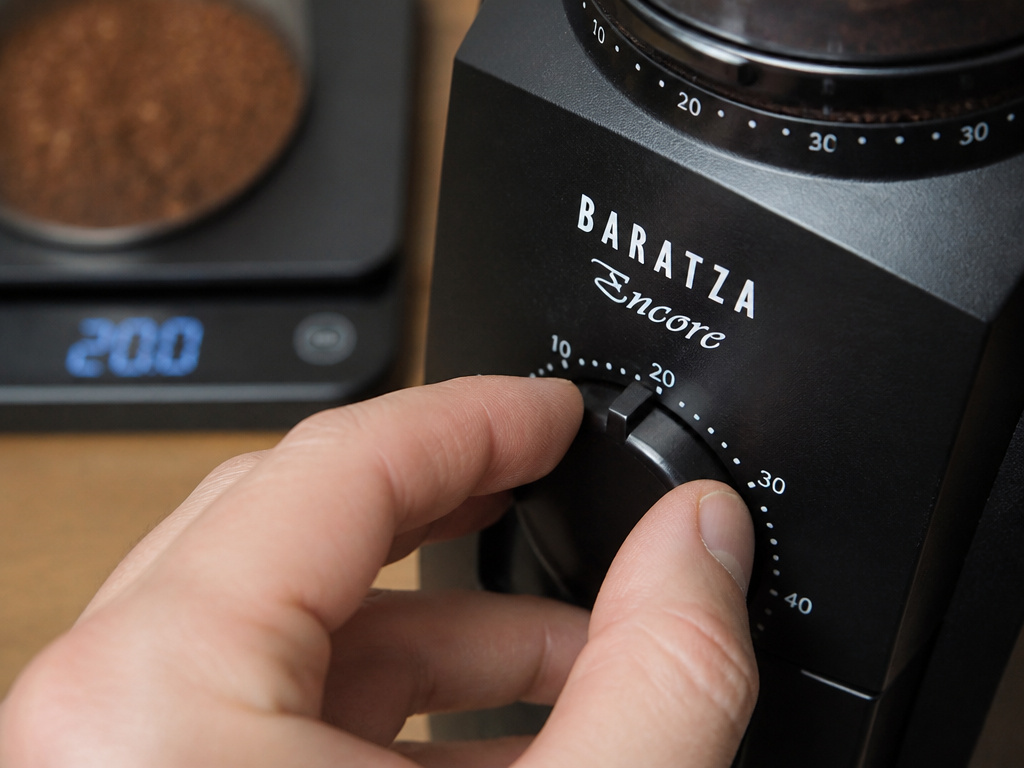
Manufacturer numbers are not universal. A “20” on one grinder is a “40” on another. Your manual is the only truth.
The KINGrinder K6 hand grinder’s drip range is 32–42 clicks from zero. Each single click at this range changes the brew time noticeably. Grinding 20 grams takes under 60 seconds.
For the Baratza Encore, the drip range is steps 15–24. The Baratza Virtuoso+ uses steps 17–26. The LIDO E manual grinder lists its drip range as “about 8-1 +8 marks from zero.”
If you’re ever using an unfamiliar grinder, at a rental, a friend’s house, start dead in the middle of its numbered range. That setting will get you in the ballpark for a standard paper-filter drip machine every time.
This isn’t a guess. Commercial grinders and even multi-setting home models are calibrated so the middle of the dial is the factory-default drip setting. It’s the safest assumption you can make.
TL;DR: Find your grinder’s manual. If you can’t, set the dial to its exact midpoint. Brew. Then adjust based on time and taste, not the number.
The Dark Roast Rule (And Other Bean Variables)
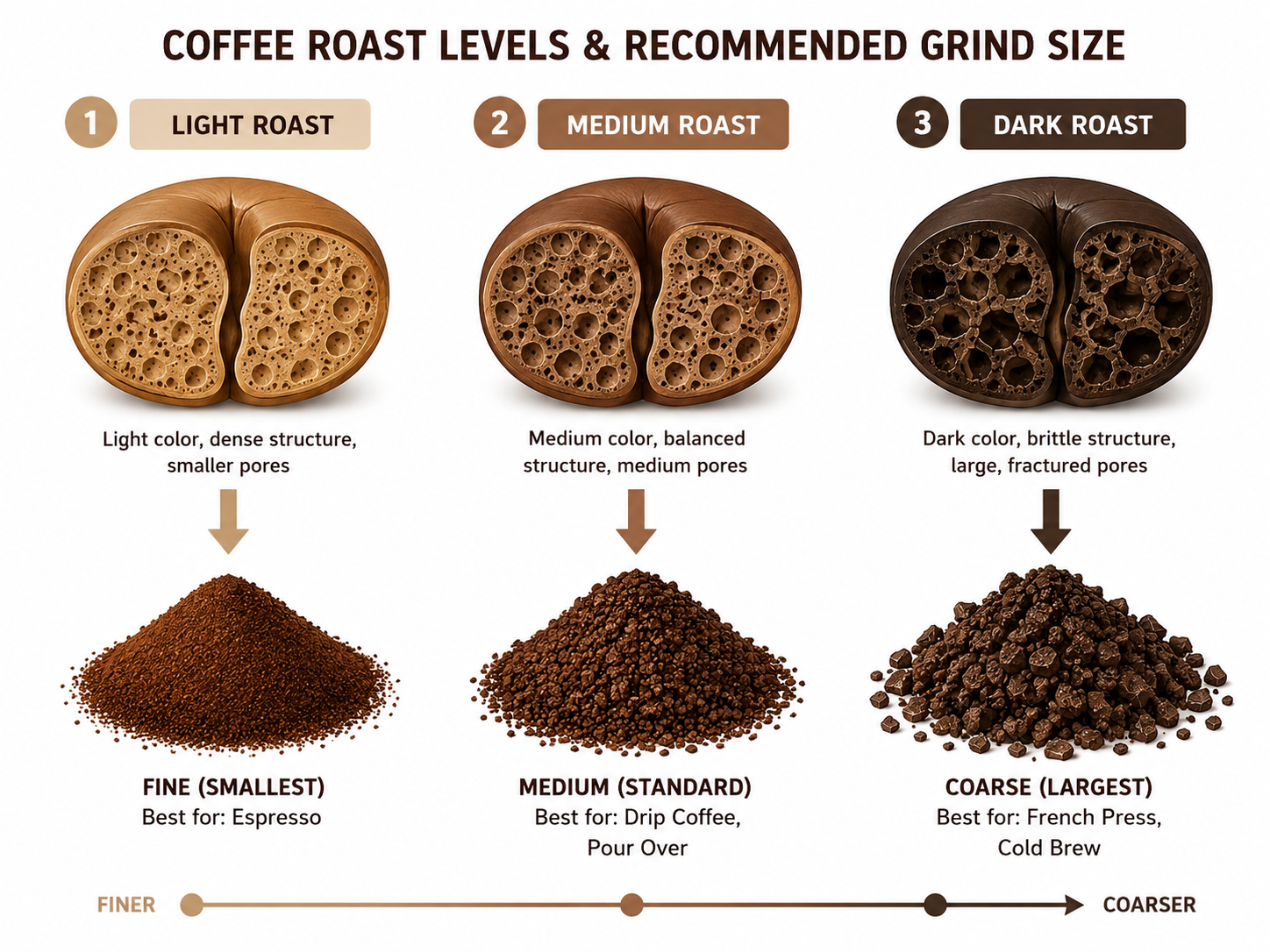
Bean density changes everything. A dark roast bean has been roasted longer. Its cellular structure is more fractured and porous. Hot water extracts flavor from it much faster.
If you use the same grind setting for a dark roast that you use for a medium roast, you will over-extract it. The result is a harsh, ashy bitterness that no amount of cream will fix.
The fix is simple: go coarser. When switching to a dark roast, move your grinder 2 to 4 clicks coarser from your established medium-roast setting. This reduces the surface area and slows extraction just enough to keep the brew time in the 4–6 minute window.
Light roasts and single-origin coffee beans are denser. They often need a slightly finer grind to pull enough sweetness out during the same brew cycle. Arabica beans, the standard for specialty coffee, vary widely in density depending on origin and process, another reason to trust your palate over a fixed number.
Freshness matters too. Coffee releases CO2 for about two weeks post-roast. Very fresh beans (less than 5 days old) will bloom aggressively, creating channels if the grind is too fine. A slightly coarser grind can help the water saturate the bed evenly.
How to Dial In Your Grinder by Taste
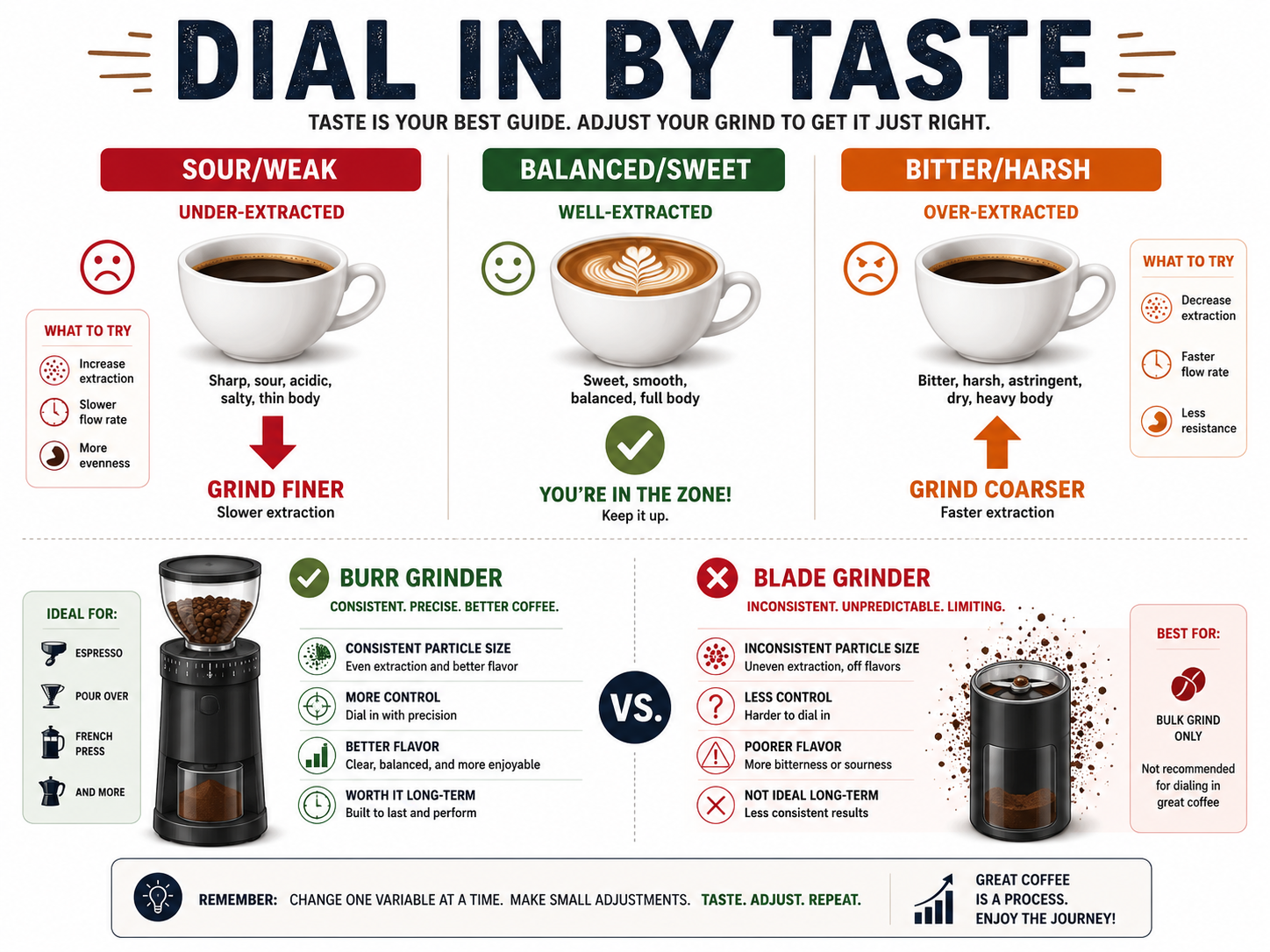
The numbers get you close. Your mouth gets you exact.
- Start at the midpoint. Use your grinder’s documented drip range or the literal middle of its dial.
- Brew a small batch. Use a 1:16 coffee-to-water ratio (e.g., 20g coffee to 320g water). Time the entire process from first water contact to the last drop hitting the carafe.
- Listen and watch. The water should drip steadily, not gush or trickle. A complete brew should take 4 to 6 minutes.
- Taste. Slurp it loud to aerate. What do you notice first?
- Adjust one variable at a time. Only change the grind setting between batches.
Here’s what your taste is telling you:
- Sour, sharp, weak: The coffee is under-extracted. Water flowed through too fast. Grind finer.
- Bitter, harsh, drying: The coffee is over-extracted. Water lingered too long. Grind coarser.
- Balanced, sweet, clear: You’ve hit the sweet spot. Mark this setting on your grinder.
This process is why a burr grinder vs blade grinder matters. Blade grinders produce a random mix of powder and boulders. You can’t adjust them predictably. A burr grinder moves in precise, repeatable increments. One click changes the result predictably.
When the Standard Drip Grind Doesn’t Apply
Two common scenarios throw the “medium grind” rulebook out the window.
Cold brew in a drip basket seems like a hack. You use your standard drip machine but with cold water and a long steep. The grind for this is not medium. It’s extra coarse, a 9 or 10 on a 1–10 scale. The contact time is 12 to 24 hours. A medium grind would over-extract horribly, yielding a bitter, unpleasant concentrate. You want chunks the size of coarse sea salt.
Decaf beans are often processed with water or solvents that make them more brittle and porous. They extract faster than regular beans. Start with a slightly coarser grind than your standard setting, similar to the dark roast rule. Taste and adjust from there.
Using a Bunn coffee maker filters designed for commercial throughput? These machines run hotter and faster. You might need to go a touch finer than for a home brewer to achieve full extraction in the shorter contact time. The same logic applies to maintaining a Breville machine filter, scale buildup changes flow rate, which in turn changes the ideal grind.
Frequently Asked Questions
What is the best grind size for a regular drip coffee maker?
For a standard home drip machine with a paper filter, start with a medium grind, visually similar to beach sand. This typically corresponds to steps 15–24 on a Baratza Encore or 32–42 clicks on a KINGrinder K6. The total brew should finish in 4–6 minutes.
Can I use pre-ground coffee for drip?
You can, but you’re locked into the manufacturer’s one-size-fits-all grind. It’s often slightly too coarse to compensate for stale coffee and older machines. For the best flavor, grind fresh beans right before brewing and adjust the size to your specific setup.
How does grind size affect coffee strength?
Grind size primarily affects extraction, not strength. A finer grind increases extraction, which can lead to bitterness if overdone. Strength, the concentration of coffee in your cup, is controlled by your coffee-to-water ratio. Use a scale: a good starting point is 1 gram of coffee for every 16 grams of water.
Why does my coffee taste bitter even with a medium grind?
Bitterness from over-extraction can be caused by a grind that’s too fine for your setup, but also by using dark roast beans with a medium-grind setting, or by a machine that brews too hot. Try moving 2 clicks coarser. If it’s still bitter, check if you’re using a metal filter with a paper-filter grind.
Is there a difference between drip coffee and pour-over grind?
Yes. Pour-over methods (like V60 or Chemex) generally use a slightly finer grind than automatic drip machines. The pour-over brewer has more manual control over water flow and agitation, allowing for a more efficient extraction with finer grounds. Don’t use your drip setting for pour-over; it will run too fast and taste weak.
Before You Go
Chasing the perfect drip grind isn’t about finding a magic number. It’s about matching three things: your machine’s heat, your filter’s flow, and your bean’s density. Start with the middle of your grinder’s range, that’s the universal baseline. Then let a 4–6 minute brew time and the absence of sour or bitter notes guide your final clicks. Remember that dark roast means coarser, metal filters mean coarser, and cold brew means drastically coarser. Your palate, not a chart, has the last word. Now go mark that winning setting on your grinder with a piece of tape.
{
“@context”: “https://schema.org”,
“@type”: “HowTo”,
“name”: “How to Find the Right Grind for Drip Coffee”,
“totalTime”: “PT10M”,
“tool”: [
{
“@type”: “HowToTool”,
“name”: “Burr coffee grinder”
},
{
“@type”: “HowToTool”,
“name”: “Kitchen scale with 0.1g accuracy”
},
{
“@type”: “HowToTool”,
“name”: “Drip coffee machine or brewer”
}
],
“step”: [
{
“@type”: “HowToStep”,
“name”: “Identify your filter type”,
“text”: “Paper filters require a medium grind, while reusable metal filters need a coarser setting to prevent sediment.”
},
{
“@type”: “HowToStep”,
“name”: “Set your grinder to the middle of its range”,
“text”: “For an unknown grinder, start at the exact middle of its numbered dial or click range as a baseline.”
},
{
“@type”: “HowToStep”,
“name”: “Brew a test batch and time the flow”,
“text”: “Aim for a total brew time, including bloom, of 4 to 6 minutes. If it’s faster, grind finer; slower, grind coarser.”
},
{
“@type”: “HowToStep”,
“name”: “Adjust for roast level”,
“text”: “If using dark roast beans, move 2 to 4 clicks coarser from your medium-roast setting to avoid bitterness.”
},
{
“@type”: “HowToStep”,
“name”: “Taste and refine”,
“text”: “If the coffee tastes sour or weak, grind finer. If it tastes bitter or astringent, grind coarser.”
}
]
}
{
“@context”: “https://schema.org”,
“@type”: “FAQPage”,
“mainEntity”: [
{
“@type”: “Question”,
“name”: “What is the best grind size for a regular drip coffee maker?”,
“acceptedAnswer”: {
“@type”: “Answer”,
“text”: “For a standard home drip machine with a paper filter, start with a medium grind, visually similar to beach sand. This typically corresponds to steps 15–24 on a Baratza Encore or 32–42 clicks on a KINGrinder K6. The total brew should finish in 4–6 minutes.”
}
},
{
“@type”: “Question”,
“name”: “Can I use pre-ground coffee for drip?”,
“acceptedAnswer”: {
“@type”: “Answer”,
“text”: “You can, but you’re locked into the manufacturer’s one-size-fits-all grind. It’s often slightly too coarse to compensate for stale coffee and older machines. For the best flavor, grind fresh beans right before brewing and adjust the size to your specific setup.”
}
},
{
“@type”: “Question”,
“name”: “How does grind size affect coffee strength?”,
“acceptedAnswer”: {
“@type”: “Answer”,
“text”: “Grind size primarily affects extraction, not strength. A finer grind increases extraction, which can lead to bitterness if overdone. Strength, the concentration of coffee in your cup, is controlled by your coffee-to-water ratio. Use a scale: a good starting point is 1 gram of coffee for every 16 grams of water.”
}
},
{
“@type”: “Question”,
“name”: “Why does my coffee taste bitter even with a medium grind?”,
“acceptedAnswer”: {
“@type”: “Answer”,
“text”: “Bitterness from over-extraction can be caused by a grind that’s too fine for your setup, but also by using dark roast beans with a medium-grind setting, or by a machine that brews too hot. Try moving 2 clicks coarser. If it’s still bitter, check if you’re using a metal filter with a paper-filter grind.”
}
},
{
“@type”: “Question”,
“name”: “Is there a difference between drip coffee and pour-over grind?”,
“acceptedAnswer”: {
“@type”: “Answer”,
“text”: “Yes. Pour-over methods (like V60 or Chemex) generally use a slightly finer grind than automatic drip machines. The pour-over brewer has more manual control over water flow and agitation, allowing for a more efficient extraction with finer grounds. Don’t use your drip setting for pour-over; it will run too fast and taste weak.”
}
}
]
}
